Thursday, January 29, 2026
Home Blog Page 221

Kansas’ Water Problem: Changing minds, changing practices

0

All the snow this winter has helped improve the drought conditions across Kansas. But it’s just the proverbial drop in the bucket of what we need to make sure we’ll still have drinking water for our kids and grandkids, especially in parts of Western Kansas.

The governor and leading Republicans have said securing the state’s water future is a top priority this year. But some say there’s one practice holding up the process.

Drought Conditions

Miller Drilling has stayed busy this last year. One could almost say, too busy. KAKE News caught up with them one day as they were drilling a new well in Hutchinson.

“Basically, they don’t have any water,” said Adam Miller.

It’s a refrain this Central Kansas company has been hearing for years.

“We had a major drought back in 2011 and ’12, and the groundwater never really recovered from that,” he said.

It’s only gotten louder and more persistent recently.

“I think probably since about August, probably a third of our wells have been emergency jobs here. People are flat running out of water,” said Ez Miller. “Forty-nine years since I started drilling, it’s probably about as bad as I’ve ever seen it.”

Retired farmer and current state lawmaker, Joe Seiwert of Pretty Prairie knows exactly what the Millers are talking about. He’s had to re-drill the well for his home multiple times, deeper every time.

“If you can’t get water, what’s your house going to be worth? Who’s going to buy it?” Seiwert asked.

It’s just one of many concerns he has about the falling water levels in Reno County, where his home is.

“Some places, we might have been able to get by with a 30 or 40-foot well, and some of those now we’re going down close to 200 feet,” Adam Miller said.

A recent survey in Wichita showed the top priority Wichitans want the City Council to work on this next year is drinking water.

“We’re still in drought, and obviously worried about going into Phase 3 of drought which could have a huge impact on our economy and our community,” Councilwoman Becky Tuttle said during a recent council workshop.

So it might surprise you to learn, that drinking water isn’t the biggest use of water in Kansas, a state where agriculture runs so much.

Agriculture and Irrigation

“About 83-84% of the water use in the state of Kansas is for irrigation,” said Earl Lewis, director of the Department of Agriculture’s Division of Water Resources. “It is by far our biggest user, and it is primarily the reason that we’re seeing water levels decline in some of those areas.”

It’s an effect Seiwert says he’s seen on his land.

“That river was a huge river,” he said, pointing to what’s now a nearly dry river bed that leads through his land to Cheney Reservoir. “When I was a kid. Grew up in our backyard. You could hardly walk across it, because it was 16-18 inches deep. Now it’s three or four inches deep.”

When asked what he thinks has changed, he said, “The 1200 and some irrigation circles in Reno County along the rivers, you know, pulling out a million gallons a day.”

The State’s Fault

He says it’s not the irrigators who are at fault, though, but the State of Kansas.

“It’s not the farmer’s fault. He cannot pump that water without that permit. I can’t put in a well without a permit,” Seiwert said.

Then he repeated himself, “It’s not the farmer’s fault. He is doing what he has to do to keep his water permit. You know? He’s kind of between a rock and a hard spot, too.”

Use it or Lose it

It’s a policy Seiwert refers to as “Use it or Lose it.” If an irrigator doesn’t use all the water their permit allows in a given year, they lose their permit.

It’s a policy Lewis says doesn’t really exist anymore.

“That’s always out there, but it’s really more most, for the most part, myth, in fact,” Lewis said.

That’s because of a 2012 change in the law that allows irrigators to get what’s called a Multi-Year Flex Account, where they get a five-year allocation of water with no limits on what they can use in any one particular year, as long as they don’t exceed the five year total.

“People tend to save about 15% just by having that flexibility,” said Rep. Jim Minnix, R Scott City.

Minnix is the Chair of the Kansas House Committee on Water and a farmer who uses irrigation wells.

“From an economic standpoint, it makes all kinds of sense. If we’re in an extreme drought and someone has already planted corn and invested thousands of dollars an acre in their crop out there…and you want to save your crop, it’d be nice to be able to water it. And then given the next year, if you have more rainfall, higher than average, be able to save some.”

Minnix says his committee is working on adding more flexibility to those accounts. He adds there are also fines in place for people who over-irrigate or wastewater.

“Those have been on the books for many, many years. There’s a mentality of irrigators out there, a small percentage of them, want to pump as much as possible in a given year, whether they need to or not, just to have a high historical pumping usage rate in case they get a 25% cut…from the State of Kansas. That mentality is antiquated,” he said.

Seiwert, who also serves on the Water Committee, says the accounts are a step in the right direction, but not enough. Not yet.

“(When irrigators turn the water on,) we’re pumping a third of the Mississippi every day,” he said. “When they’re using it.”

The Governor’s Take

So while KAKE News was at the Statehouse in January, Senior Political Reporter Pilar Pedraza asked the governor if there was any talk of dropping the water allocations entirely from the permitting process.

“There is talk particularly, use it and lose it. That’s such a dumb thing, so dumb, wherever it is,” Gov. Laura Kelly, D Kansas, said. “That whole use it or lose it has always been bad policy, so we are having conversations with that.”

Lewis pointed out a lot of the issues surrounding water use today came from decisions made generations ago.

“These decisions that led us to this point where we have a declining water situation really were public policy decisions going clear back to the 1950s,” he said.

The question is, will a Republican supermajority get along well enough with a Democratic governor to make changes that could upset some Kansans?

“You have a lot of people who have a lot of skin in that game,” Kelly said. “So it’s sensitive.”

Politics at the Door

But it’s something lawmakers say they’re making progress on.

Minnix said the state has made great advances since 2021, adding that last year the Water Committee got lawmakers to increase funding to water programs in Kansas, programs like loans to small cities that need financial help to upgrade their water systems.

“You heard earlier, $350 million in requests for a… $19 million fund,” said Minnix. “There’s that much demand, even in our small municipals out there to upgrade their water systems, drinking water or wastewater.”

As he spoke to committee members during their first meeting of the 2025 Legislative Session, he asked them to leave their political differences at the committee room door.

“‘I’m asking you, as committee members, to come in this door, leave the Republican/Democrat stuff outside, leave the…rural and urban, everything,” Minnix said. “When we come in here, we’re…working on policy to improve the water situation here in the State of Kansas.”

After the meeting, Minnix said part of the challenge in the committee is educating people with antiquated ideas about water usage.

“The people that are still practicing (use it or lose it) don’t realize what has happened in the last 20 years,” he said. “It’s an antiquated thought pattern and we need to educate them that they’re not helping themselves as much as they think they are.”

“It’s a cultural shift as much as anything,” Lewis agreed, “Getting people to understand they can use less water and still be productive in their farm.”

As reported on KAKE News

Lettuce Eat Local: an Xtra special recipe

0

Amanda Miller
Columnist
Lettuce Eat Local

Let’s pretend it was on purpose. I could have specifically bypassed it for multiple reasons: I thought maybe procrastinating would make it easier; or I wanted to skip it to see if anyone was paying attention; or I liked the idea of adding an extra, bonus recipe at the end.

Or should I say, an eXtra recipe…did you notice that I completely skipped writing about the letter X? And definitely not purposefully, even though the logic would be there if I had. I didn’t even notice my mistake until a friend mentioned it. I had gotten so distracted by the what-I-thought was such a timely focus on yogurt after teaching a class on it that I had gone straight to Y and was already brainstorming Z, without ever considering X.

There are, however, 26 letters in the alphabet, and ignoring one doesn’t mean it disappears. I was afraid I might forget a letter at some point in my journey through them, but I was so close to the end that I let down my guard. Kind of like the photo album I made last year, wherein I apparently got so distracted by November and the appearance and subsequent glut of pictures of our precious Kiah, that I completely missed making pages for September and October. Oops. 

Fortunately, I can fix this alphabetical mistake a little less awkwardly — although finding an X to write a recipe on isn’t the easiest; the classic X is for Xylophone doesn’t work so well here. But we can go eXtracurricular, with a not-for-eating recipe featuring Xylitol: homemade toothpaste. 

Like most words that begin this way, the x sounds like a z; don’t say “ks” or “ex” at the beginning of xylitol. It is a derivative of birch bark, and is often used as an alternative to sugar. While it tastes sweet, xylitol doesn’t cause blood sugar spikes and is less caloric, and instead of contributing to tooth issues, it may actually help protect against dental cavities. It’s quite commonly used in chewing gum, and can also be found in things like medications and oral hygiene products. 

I haven’t used xylitol much in baking or as a sugar substitute, but my son goes through so much gum, I’m very glad if it can help his teeth instead of hurt them. Trust me, he needs all the help he can get; I would rather not discuss how many cavities he has. Kiah is an overachiever and is working on getting her last tooth or two; while she seems way too young to go to the dentist, I hear the earlier kids get teeth the worse they are likely to be, and Benson’s track record isn’t making me feel optimistic. I know bad teeth can be somewhat genetically predisposed, and while he skipped my brown eyes, he apparently inherited my teeth.

Fortunately, both kids also inherited my seemingly paradoxical love for good dental hygiene. I brush and floss multiple times a day, but even I can’t hold a candle to Benson’s and Kiah’s love for toothbrushes. They each have several brushes of their own, and you never know where you’ll find one or more lying about the house. (Toothbrushes, not kids.) Round-handled ones, suction-cup-base ones, battery-powered ones, you name it. It’s a battle every bedtime not to get them to brush their teeth but rather for Kiah not to freak out about needing to use everyone else’s toothbrushes. 

I made homemade toothpaste before kids anyway, but especially since they don’t spit well, I didn’t want them ingesting commercial toothpaste. 

Making toothpaste might seem really “eXtra,” but trust me, it’s so easy. Definitely easier than trying to safely get my kids out of the dental aisle without them grabbing handfuls of new toothbrushes. 


Homemade Xylitol Toothpaste

I’m not a dentist, so of course I should include the disclaimer that I can’t technically vouch for this product’s effectiveness. But I checked with the hygienist and she said it was good stuff, and we sure like how it tastes and feels. I often add some bentonite clay to my mix, hence the grayish color, but that’s totally optional. I could barely get a picture because my kids kept trying to grab all the toothbrushes! We use this in the mornings and “regular” toothpaste at night. 

Prep tips: the texture of this paste varies with the temperature — the coconut oil is more or less solid as it fluctuates. 

⅓ cup baking soda

⅓ cup unrefined coconut oil

2 tablespoons xylitol, to taste

10 drops peppermint essential oil, to taste

Mix-smash all ingredients together until homogenous (I use a spoon and rubber spatula). Taste a smidge and adjust, remembering it’s not meant to be eaten but you do want it to be pleasantly minty and not off-puttingly bitter. Store in a tight-lidded container and use a small spoon to scoop out what you need to brush. 

Gruesome aggie humor

0

At the Old Geezer Gang’s morning coffee gathering, the conversation topics entail the full gamut of “stuff” — from local history and events, to politics, to jokes, to pointed repartee, to discussions about our inevitable aches and pains, and even to our inevitable impending mortality.

Some of the jokes told are too risqué to repeat in my column. Others are gruesome, but still humorous. The following is one of those gruesomely humorous stories.

***

Back in the 1950s, an old tenant farmer went to his eternal reward. His bereaved widow did the best she could afford to make her deceased hubby presentable for the visitation and funeral — she purchased a new pair of overalls to dress him in and a pine coffin to bury him in.

During the evening visitation, the funeral director overheard the widow lamenting that she wished her hubby could have been buried in a nice suit, rather than overalls. So, with discretion he whispered in her ear “don’t worry about it. He’ll look nice tomorrow.”

So, the next day at the funeral, sure enuf, the old farmer lay resplendent in a fancy blue suit in his pine coffin. All the funeral attendees commented about how nice he looked in repose. And, that’s the way he went into the grave.

After the funeral, the widow sidled up to the funeral director and said, “I can’t thank you enough for all the cost and effort you must have gone to get the blue suit on my husband.”

The funeral director replied, “Oh, it wasn’t all that much trouble. I had a wealthy deceased in the back room dressed in the blue suit, and he has no family, and he is going to be cremated. So, I just switched heads.”

***

Chew on this: I read a story that claimed a dog’s life — even if that means joyfully and endlessly chasing squirrels or retrieving sticks — is more meaningful than a dog owner’s life. That claim comes from Mark Rowlands, a professor at the University of Miami.

He claims that, “A dog loves his life with everything he has because it is all he has.” It’s a philosophical message on how we humans can live a more fulfilling life inspired by the unselfish joy dogs experience — even in repetitive tasks such as chasing a ball. The lesson to be learned from dogs in the professor’s deep dive is the love of life and the action a dog experiences in his uncomplicated life.

The author interprets meaning in life as authentic happiness and that the lives of dogs are typically more meaningful and filled with more love than the lives of humans because they are not burdened by personal reflection, self-doubt, and have only one life to live.
I have no idea if the professor is correct that dogs love their lives more than people, but I will say that dogs are almost always happy and that’s not a bad way to be.
***
I never thought I’d see the day when eggs were so scarce and valuable that they’d be the target of thieves, but they are now. Police are scrambling to identify the thieves who poached about 100,000 organic eggs from a Pennsylvania egg producer. The current street value of the eggs wuz estimated at $40,000. Investigators say Pete & Gerry’s Organic Eggs was victimized when one of its distribution trailers was burglarized. Police are looking for the thieves who might be trying to fence 8,333 dozen eggs.
***
Speaking of the high price of eggs. Last week, I gave reasons why governmental “Aggie Executive Orders” won’t work to bring down egg prices. However, common sense inventions could help if they make hens more efficient when squeezing out an egg.
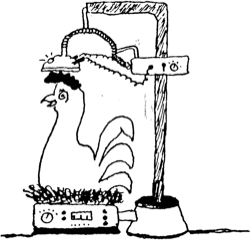
Faithful readers will recall that I long-ago I invented a device that does improve egg-laying efficiency. It’s called the Hi-Volt Egg-O-Matic and here’s how it works.
First off, a hen getting ready to lay an egg really is in no hurry to get her job done. After she selects a nest, she relaxes for a goodly time span, then the takes her own sweet time to gently squeeze her egg out, then she inefficiently wastes several minutes cackling about her achievement. All the while, she is preventing another hen from laying an egg in the same nest.
Well, the Hi-Volt Egg-O-Matic solves that problem once and for all. It’s a nest that is electrified in a manner that when a hen settles down to lay an egg, an electrified “comb-cap” descends upon her head and completes an electrical circuit.
In that brief moment, the electrified nest shocks the shell out of the hen and she leaves the nest, allowing another hen to follow her. I’ve pictured the Egg-O-Matic. I expect sales of it to increase dramatically immediately and help lower egg prices.

Popeye and Testosterone Replacement

0

A few (or more) years ago, Popeye the Sailor Man was an inspirational cartoon character. When needed, the superhero would quickly swallow some spinach and become strong, able to pack a punch that would defeat any evil villain.

Nowadays, TV and internet commercials are encouraging men to consider testosterone replacement as the way to become stronger. While they are quick to tout the benefits, the risks are important and should not be ignored.

Testosterone is the hormone in men that is produced from the testicles. It helps in sexual development in men, libido, erections, sperm production, muscle mass, and bone growth. It counteracts fat mass, stimulates red blood cell production, and plays a role in cognition and mood.

If a man has low testosterone (hypogonadism), determined by at least two early morning fasting blood draws, and they have symptoms of low testosterone, then it is reasonable to consider testosterone replacement therapy. Signs and symptoms of hypogonadism include low libido, decreased erections, loss of body hair, low bone mineral density, gynecomastia (breast development), and small testes.

Symptoms such as fatigue, depression, reduced muscle strength, increased fat mass, and low blood counts can be caused by a wide variety of factors, and should not be reasons alone to consider testosterone replacement.

The best way to increase one’s testosterone is through good old diet and exercise. Studies have shown exercise, strength training, and weight loss all help to increase testosterone levels, oftentimes more than testosterone replacement does. Fat produces a hormone called leptin, which counteracts testosterone. Thus, losing fat and gaining muscle naturally increase one’s testosterone. Meanwhile, a healthy diet and exercise often boost energy, mood, and overall health.

The most effective method for testosterone replacement is by injection. There are also topical gels and patches. Any over the counter supplement that claims to boost testosterone is misleading and unlikely to have any significant effect on testosterone levels.

Risks of testosterone replacement include prostate cancer, heart attacks, strokes, blood clots, acne, breast enlargement, sleep apnea, aggression, and can contribute to an enlarged prostate, which can cause urinary frequency or even urinary obstruction. While natural testosterone stimulates sperm production, testosterone replacement decreases sperm counts, decreases fertility, decreases testicular size, and decreases natural testosterone production.

Testosterone levels naturally decrease as men get older. While some may advertise testosterone as a “fountain of youth,” the benefits are limited in this scenario and the risks increase as men get older. Popeye had the right idea. Putting in the work, and eating some spinach, is likely the better long-term plan.

Andrew Ellsworth, MD. is part of The Prairie Doc® team of physicians and currently practices Family Medicine at Avera Medical Group in Brookings, South Dakota. Follow The Prairie Doc® at www.prairiedoc.org, Facebook, Instagram, YouTube and Threads. Prairie Doc Programming includes On Call with the Prairie Doc®, a medical Q&A show (most Thursdays at 7pm streaming on Facebook), 2 podcasts, and a Radio program (on SDPB), providing health information based on science, built on trust.