Friday, January 30, 2026
Home Blog Page 235

Area young farmers and ranchers attend statewide leadership conference

0
Photo credit: Nicholas A. Tonelli
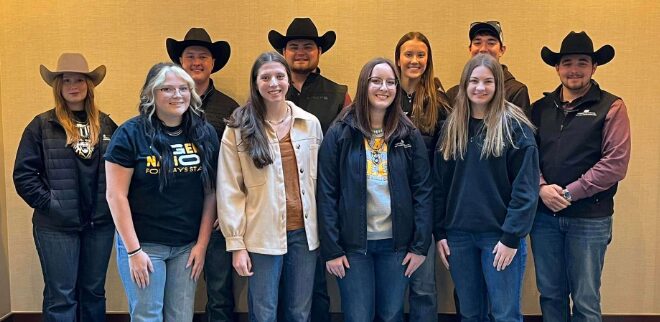
Farmers and ranchers from across Kansas gathered in Manhattan Jan. 10-12 for the annual Young Farmers and Ranchers (YF&R) leaders conference.

Nearly 500 attended the three-day Kansas Farm Bureau conference designed to provide educational and networking opportunities for young growers in Kansas.

The conference provided farmers and ranchers between the ages of 18-35 with agricultural education, motivational speakers and opportunities to connect with industry resources and network with peers.

Attendees heard from Jordy Nelson, a former K-State star receiver and Super Bowl XLV champion with the Green Bay Packers, and Dan Thomson, a feedlot veterinarian and CEO of Production Animal Consultation who founded “Doc Talk” on RFD TV.

State committee members from each of the 10 Kansas Farm Bureau districts planned and hosted the conference, which included workshops, speakers, tours and competitions. The YF&R state committee played an integral part in making this year’s conference a success.
Abby Graham, Fort Hays State University, receives recognition from CEO of Kansas Farm Bureau Terry Holdren. Courtesy photo

Winners of the conference competitions include the following:

· Ag Quiz Bowl – Laine Schmalzried, Aidan Yoho, Grant Hervey and Mason Fink, Kansas State University

· Collegiate Discussion Meet – Abby Graham, Fort Hays State University

· YF&R Discussion Meet – Lindy McMillen, Lane County

· YF&R of the Year – Jacquelyne Leffler, Lyon County

Graham received $500 and an expense-paid trip to the 2025 American Farm Bureau Federation (AFBF) YF&R Leadership Conference in Denver, Colo. McMillen and Leffler each received $700 and will represent Kansas in their respective competitions at the 2026 AFBF Annual Convention in Anaheim, Calif.

Destiny Johnson, Stafford County, received the inaugural Rural Minds Matter Young Advocate of the Year award for her work cultivating resilience and well-being among farmers, ranchers and rural communities.

Those attending from Ellis County were Geordan Hayden and Jacob Calloway. The Ellis County Farm Bureau also sponsored a large group of Collegiate Farm Bureau Students to attend the conference.


K-State will build new $16m Beef Cattle Research Center with donor gifts

0

Kansas State University is building a new Beef Cattle Research Center on the north side of Manhattan.

The Kansas Board of Regents last week approved the capital improvement project to construct the new research center, which was on the consent agenda.

The new, modernized facility will replace an outdated existing facility at the same location at 3115 College Ave., which is about a mile north of Bill Snyder Family Stadium. The new facility includes a feedlot and has a capacity of 1,200 head of cattle, which is less than the old facility’s capacity.

“Beef cattle feeding is a cornerstone of Kansas’ economy, contributing billions annually and supporting thousands of jobs across the state,” said Ernie Minton, the dean of the College of Agriculture and director of K-State Research and Extension, in a statement to The Capital-Journal. “At Kansas State University, we are committed to advancing research and innovation to help grow this important industry sector.”

K-State President Richard Linton told the Regents that the research center contains three components: “It’s a beef feedlot, it’s a metabolism unit and a feed mill and flaker unit to be able to produce the feed.”

The facilities will be used for teaching and research.

The feedlot and metabolism barn will be built in the first of two phases, at a cost of about $11.1 million, while the feed mill will be built in a second phase, at a cost of about $4.9 million. The total cost is about $16 million.

“All of this will be funded by private funds,” Linton said.

About $10.5 million has been raised so far, Linton said, “which allows us to move forward with two of the three components.”

Regent Carl Ice said the project approval was fast-tracked. Later, the Regents also approved a request to name the research center after the late Doug Laue, of U.S. Premium Beef and a K-State animal science graduate.

“He was known as being a very strong advocate for the beef industry, the marketing of fed cattle and also the education and research for beef production,” Linton said.

The project will be on state property, will be completed by the KSU Foundation and is expected to be finished in 2028.

“Our members support K-State’s Beef Cattle Research Center project that will feature a new on-campus cattle feeding facility,” said Kansas Livestock Association CEO Matt Teagarden in a statement to The Capital-Journal. “We appreciate the significant investment made by many KLA members to make this facility a reality.

Farmers’ market and local food producer workshops

0
Shelley Pauls

The Kansas Department of Agriculture and K-State Research and Extension (KSRE) will offer six regional Local Food Producer Workshops to assist farmers’ market vendors and managers, and for those wanting to sell food products directly to consumers.

Kansas farmers’ markets not only provide a fresh food source, but also stimulate the local economy. In 2024, more than 100 farmers’ markets were registered with KDA’s Central Registration of Farmers’ Markets.

“We strive to provide education to Kansas farmers’ markets and agricultural businesses to help them thrive,” said Sammy Gleason, KDA’s From the Land of Kansas manager. “These workshops will support local businesses by providing up-to-date food safety information and new marketing insights for direct consumers.”

Workshop topics will vary slightly by location. Highlighted topics include:

  1. Marketing
  2. Food Safety
  3. Regulations on Selling Meat, Eggs and Poultry
  4. Sales Tax for Vendors
  5. Kansas Senior Farmers Market Nutrition Training

KDA’s weights and measures program will also offer free scale certification at the workshops for attendees.

Dates and locations for the Local Food Producer Workshops are as follows:

Friday, January 31  Manhattan: Pottorf Hall, Riley County Fairgrounds

Saturday, February 1 — Wichita: Sedgwick County Extension Education Center

Friday, February 7 — Olathe: K-State Olathe

Friday, February 21 — Chanute: Neosho County Community College

Friday, February 28 — Hays: K-State Agricultural Research Center

Friday, March 28 — Garden City: Southwest Research–Extension Center

Registration for the workshops is now open and is $25 per participant. Registration and more information can be found at FromtheLandofKansas.com/FMworkshop, at K-State Research and Extension, ksre-learn.com/food-producer-workshops, or at local extension offices.

For more information, contact Robin Dolby, KDA’s From the Land of Kansas marketing coordinator, at 785-564-6756 or [email protected]. The workshops are funded by the Kansas Center for Sustainable Agriculture and Alternative Crops, Kansas Sustainable Agriculture Research and Education Program, and sponsored by KSRE and KDA.

KDA is committed to providing an environment that enhances and encourages economic growth of the agriculture industry and the Kansas economy. The Kansas Ag Growth Strategy has identified training for small companies via workshops as a key growth outcome for the specialty crop sector. The Local Food Producer Workshops will provide education through partnerships to help make Kansas farmers, ranchers and agribusinesses more successful.

Getting it in writing – Agriculture land leases

0
Photo by Ben Collins

Over half of the farmland in Kansas is leased.

Therefore, there are many different lease arrangements, factors to consider, and places where misunderstandings can happen. Additionally, many leases are still oral leases that are “signed” with a handshake.

One of the best ways to create a better understanding between tenant and landlord in most cases is to have a written lease.  Having a written lease can lead to many topics for discussion that otherwise might not be considered.

They would include but are not limited to:

Hunting/fishing rights
Recreation access
Payment due dates
Termination procedures

In addition to the previously mentioned items, a written pasture lease for example can spell out responsibilities of both parties in regards to:

Care of fences
Noxious weed control
Water supply maintenance
Grazing capacity restrictions and beginning and ending date of grazing season

A bonus of a written lease is that it documents the terms of the business relationship in case the contract is questioned. This can be especially important if the land changes hands.

Obviously, it is not necessary to have a written lease in order to have good communication between tenant and landlord but it can be helpful in spelling things out and avoiding misunderstandings and hard feelings.

There may be some cases when introducing the possibility of implementing a written lease might damage the business relationship. Whether you have a written lease or not, make sure those lines of communication are kept open, visit with each other at least a few times a year.

Local county and district extension offices have several resources concerning leases, written leasing arrangement forms, cash rental rate averages, Kansas Agricultural Lease Law Publication C-668, etc. Go to www.agmanager.info and click onto the Farm Management tab.

If you have questions contact your local county or district extension office. I can be contacted in the Cottonwood District, Great Bend office at 620-793-1910 and Stacy Campbell can be contacted in the Hays office at 785-628-9430.

Alicia Boor is an Agriculture and Natural Resources agent in the Cottonwood District (which includes Barton and Ellis counties) for K-State Research and Extension. You can contact her by e-mail at [email protected] or calling 620-793-1910.

Lettuce Eat Local: It’s A Wasabi Winter

0

Amanda Miller
Columnist
Lettuce Eat Local


It’s still winter out there.

The snow was gorgeous. I was particularly delighted the one night when those fat flakes were falling gently down, the rest of the world so still that you could hear their soft patter. It was like the air froze along with everything else, calm and beautiful in the starlight. Cold, but ethereal. 

The blizzardy snow was also a kind of spellbinding; the flurries were so fast and furious that they were all you could see, and the snow obfuscated the landscape from ground to sky in white. I didn’t have to go outside, so it was almost magical. 

But at this point it doesn’t feel quite so enchanting anymore. The snow that’s left on the ground has melted and refrozen on repeat, and while that unfortunately doesn’t seem to hinder my son from scooping it up and eating it, it is just not as appealing on many levels: crusty and dusty. 

And it’s cold out there, so cold. I figure if it’s going to be cold, it might as well snow; which is a viewpoint I still hold to, but also, just because there’s going to be snow, doesn’t mean it has to be this cold. 

You know it’s bad when I regret not wrestling into coveralls for my ten minutes of chicken chores. Some days the wind has felt like me, too cold to move, but other days I wonder if this is what Antarctica feels like as the cold wind hits as I step outside, literally taking my breath away. 

I’ve learned to appreciate some of the finer points of winter, since being married to a farmer who works hypothetically less during a few of the colder months. But I would without fail rather be too warm than too cold, so eventually, this weather is just too much. Or too little, looking at the numbers on the thermometer. 

I used to have days when it’s like my bones got cold and just couldn’t warm up fully, no matter how many layers I’d put on. Growing kids has recalibrated my internal thermostat to a good extent, and I often have a hard time even wearing long sleeves. But the t-shirts have gotten a rest the last couple weeks, as cozy and warm must be the name of the game to survive. 

It doesn’t help that the winter emotional blahs correlate with the weather sometimes. Seasonal Affective Disorder is a real thing, and while Kansas sunshine makes a huge difference to me, it’s not always enough for everyone. Our family just had a chaotic week that left us with some emotional whiplash, and our mood the last few days has been a bit frosty and meh. 

Time to bring out the warming foods. Of course we think of hot soups, hot casseroles, hot chocolate…and I also think of hot sauce. While spicy foods don’t actually heat up your body temperature, they can make you feel warmer momentarily. A placebo doesn’t have to be effective to work. 

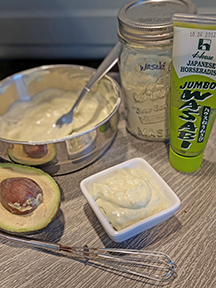
An often overlooked source of spicy in our Midwestern world is wasabi. Though essentially all the wasabi you’ll encounter around here is going to be horseradish dyed green, it’s still delightful and that little extra pop of color can’t hurt in this winter wonderland. Its spiciness can sear through our nostrils and its piquant flavor can stampede through our tastebuds, energizing us physically and mentally. The wasabi/horseradish burn tastes ironically like a cold hot, a nice complement to these wintry, yet hopefully warm, days.


Creamy Avocado Wasabi Sauce

Some people who don’t handle spicy food well can still enjoy wasabi-style heat (like Brian), since it burns and then leaves, instead of lingering like chile-based spice. We are hosting a sushi-making night this week, so it’s perfect timing for me to whip up some wasabi sauce, but I need to remember to use it on more than just sushi — it was already delicious dipped with baby carrots, but I’m thinking roasted cauliflower, scrambled egg sandwiches, or even swirled into other warm-food favorites like chowders or creamy pasta for a little zing. 

Prep tips: I used two kinds of wasabi because I had them, but just one style will work. Keep in mind different brands may have highly variable heat levels, so you do you. 

¼ cup mayonnaise 

¼ cup thick plain yogurt or sour cream

1 avocado

2 teaspoons powdered wasabi

2 teaspoons prepared wasabi

2 teaspoons hot or regular honey

½ tablespoon rice vinegar

¼ teaspoon salt, or to taste

Smash/whisk all ingredients together; adjust to taste.