Tuesday, February 3, 2026
Home Blog Page 289

Kansas scientists say they’ve found a cheap fix for a source of potent greenhouse gases on farms

0
Sorghum is one plant sometimes used for silage. Scientists at Kansas State University say fermented livestock feed produces nitrous oxide, a potent greenhouse gas, but that they have uncovered a cost-effective treatment.
New research suggests silage has been overlooked as a substantial producer of nitrous oxide. A team at K-State figured out why – and a potential way to tackle the problem.

A common fermented feed for livestock churns out a potent greenhouse gas, but scientists in Kansas say they’ve figured out an affordable way to one day tackle the problem.

A team of scientists at Kansas State University has published the best estimate yet of how much nitrous oxide enters the atmosphere from silage, which they suggest could be the country’s third-largest farm source of the gas.

Now, they want to grab the attention of federal regulators and the agriculture industry to address the problem.

“So that we can do something to minimize it,” civil engineering associate professor Jeongdae Im said. “Luckily, we have a simple solution.”

The new research suggests silage may churn out 30 times as much nitrous oxide as does another common practice, burning corn stubble and other crop residue after harvest. But while the U.S. Environmental Protection Agency regularly factors field burning into its reports on emissions, the impact of silage gets overlooked, K-State scientists say.

The scientists’ proposed fix involves an inoculant. Treating 1 ton of silage with it would cost 4 cents, K-State researchers concluded. Im says $5 million could treat all the silage produced in the U.S. each year.

“It’s really, really exciting,” Im said. “We can reduce 2% of (the U.S.’) total nitrous oxide emissions.”

Im, who is also an environmental microbiologist, won one of the National Science Foundation’s most coveted awards to carry out this research.

The K-State team’s findings appear in last month’s issue of the National Academy of Sciences’ PNAS Nexus journal.

Trapping heat and depleting the ozone

The Intergovernmental Panel on Climate Change says the Earth’s atmosphere now contains 20% more nitrous oxide than before the Industrial Revolution.

Unlike the rise in carbon dioxide that primarily comes from fossil fuels, humans add nitrous oxide to the atmosphere mostly through agriculture.

Though this gas makes up a small slice of global greenhouse emissions, its potency worries scientists. Compared to carbon dioxide, nitrous oxide is about 265 times more effective at trapping heat over a 100-year period, a report from the EPA says. It also depletes the ozone layer that shields humans and other life on the Earth’s surface from harmful solar radiation.

Im and his colleagues carried out lab experiments with several kinds of silage as a first, crucial step to figuring out how much of the gas comes from that source.

Silage is chopped plant material — often corn, sorghum or alfalfa — that is fermented and stored in silos, bunkers and plastic-covered mounds across the country.

The team homed in on the bacteria in it that produce nitrous oxide and tested a variety of additives and inoculants to deal with them.

The bacteria produce nitrous oxide under stress, Im said, when they don’t have access to enough carbon compounds. So the team found a combination of ingredients that kills off most of the bacteria and then reduces this stress on the survivors. It gives the lingering microbes a boost of carbon compounds.

This two-pronged approach prevented 99% of the nitrous oxide emissions in the scientists’ silage experiments.

Verifying the safety of the treatment

Scientists and policymakers use formulas to tally up the estimated toll that different kinds of emissions take on society, such as by harming human health and property.

Those formulas suggest that the nitrous oxide wafting off of silage may cost society hundreds of millions of dollars annually in the U.S., Im said.

Several steps must happen, though, before it’s likely that a fix of the type proposed by K-State civil engineers and agronomists would potentially gain widespread traction.

Researchers will conduct larger-scale studies to verify their findings.

They’ll also further investigate to what extent chlorate, one of the ingredients in the treatment, remains in the silage after fermentation.

This will be vital to verifying the treatment’s safety.

“Anything toxic to microorganisms can be toxic for humans,” Im said. “So one of the things that we have to answer is the fate of this chlorate at the end of this silage process. And we are looking into it.”

But eventually, Im hopes carbon markets or other incentives could make treating silage to reduce emissions an attractive option for farmers.


Kansas News Service ksnewsservice.org.

What is The Longest Road in Kansas?

0

While Kansas may be known for its straight roads, it’s also home to some surprisingly long ones. And the longest of them all? That title belongs to K-4, stretching an impressive 369 miles across the state. This highway isn’t just about length, though; it offers a glimpse into the heart of Kansas, connecting rural communities and showcasing the state’s diverse landscapes.

K-4 begins its journey in western Kansas, north of Scott City at US-83. From there, it heads east, traversing the High Plains and passing through small towns like Healy and Quinter. As it continues eastward, the scenery gradually shifts, with rolling hills and farmlands becoming more prominent.


Key Connections and Overlaps

Along its route, K-4 intersects with several major highways, including US-283, US-183, and US-281. It even shares a stretch of road with I-135 and US-81 in Saline County, offering a brief taste of interstate travel. And as it approaches eastern Kansas, K-4 joins forces with I-70 in Topeka, providing a convenient route through the state capital.

More Than Just a Road

K-4 isn’t just a way to get from point A to point B. It’s a window into the soul of Kansas, offering glimpses of its agricultural heritage, its small-town charm, and the resilience of its people. Whether you’re a road trip enthusiast, a history buff, or simply looking to experience the beauty of the Sunflower State, K-4 provides a unique and memorable journey.

Exploring K-4

Driving K-4 is like taking a cross-section of Kansas. You’ll encounter historic landmarks, charming towns, and breathtaking scenery. So, if you’re looking for an authentic Kansas experience, hop on K-4 and let the road lead you through the heart of the state.


Lettuce Eat Local: Now This Is My Jam

0

Amanda Miller
Columnist
Lettuce Eat Local

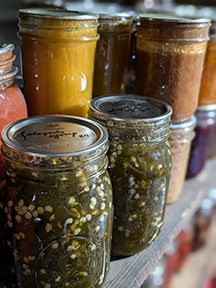
Jellies, jams, marmalades, preserves and conserves; the list goes on and on. There are all sorts of terms to describe all sorts of different sweet fruit preparations intended for all sorts of different usages. I enjoy making pretty little jars of these things, and those different colors always look so cute and satisfying sitting on the wooden shelves in the fruit cellar.

The problem is that that’s about all they do: sit and look nice, year after year. We’re just not a jam-eating family. The occasional peanut butter and jelly sandwich barely accounts for enough consumption to legitimate even having a jar open in the fridge, and often I end up having to pitch the last dregs. 

The one type of jam that at least I personally am more prone to use is something with a little edge, a spicy zing to it (intentionally, from the addition of hot peppers, not because it’s too old…). Raspberry jalapeño, blackberry habanero, I’ll take it. I was thinking about this as I was picking all the peppers on the predicted last frost-free date of the year, which actually was the last day before a frost and thereby necessitated a combing through of the garden for anything I wanted to save. I didn’t really want the hot peppers, because they were too hot, and I was having a hard time even giving them away.

A vision of the jalapeño jelly sitting on the shelves downstairs came to mind as I carried in my pepper loot. I call it jelly, but it’s more like jam, and actually it’s more like syrup. It failed to set up — but on purpose this time. 

A friend and I had made some a couple years back, and I was disappointed to find that something had gone amiss in our pectin process (you may have noticed I am not always the most precise recipe-er…that may or may not have something to do with it) and while the flavor was sweet-spicy delicious, it was thin and runny. My friend, however, was not disappointed. She thought it was perfect that way, raving about the jam-syrup, and so now we make it together that way on purpose. 

Something that started off as a bug became a feature; something that seemed like a problem turned out to be an advantage. This got me looking around and asking a question I first heard on a podcast. “Is this a bug, or a feature?” I’m not a whiny person, but this simple perspective shift is working on my eyesight. 

Suddenly the oatmeal smashed into Kiah’s hair was a sweet cinnamon aroma to breathe in as I laid her down in her crib. Picking her back up shortly thereafter because she prefers to only sleep while touching me was less annoying when I told myself it was a feature of her personality, one that allows the two of us a treasure trove of snuggles. 

The living room is perpetually covered in intermittent mountains of toys, since Benson needs “all the small things” to make his heifer feed piles; I don’t need to feel guilty about how messy it can get, because it’s a precious feature of having a 3-year-old who can lose himself in creative play. 

It is a bummer that the frost came when my tomato plants were covered in hundreds of cherry tomatoes, but maybe it’s also a timely advantage of the season since we have to let go of the garden at some point — and it pairs well with a feature of the dilapidated chicken coop that allows the door to keep blowing open in these strong winds, just in time for the hens to go enjoy all those tomatoes that froze. I was tempted to complain when explaining to Benson why our windows were all frosted over on that cold morning, but stopped myself when thinking perhaps gorgeous ice crystals and icy privacy screens are actually a feature of poorly insulated windows. 

So is it a bug, or a feature, that all these jalapeños I picked are too spicy? I guess it depends on how you look at it.


Chunky Jalapeño Syrup

I’m not sure that this is the best title for the product, yet I have to call it something. This non-jammy jam is the perfect thing for a non-jammy fam, since it doesn’t follow the typical routes of jelly usage. While it does work oddly deliciously with peanut butter, it pairs better with cream cheese & crackers, drizzled in a grilled cheese sandwich, or spooned alongside ham or lamb. 

Prep tips: there is no positive “feature” of not using gloves to work with this many hot peppers. Trust me on this one and just put them on.

½ pound jalapeños (or other chiles)

1 pound bell peppers (any color)

1 cup white vinegar

1 cup apple cider vinegar

4-6 cups white sugar

1 package pectin

Cut stems off peppers and cut into chunks; blend in a food processor with vinegars until finely minced. Bring to a boil along with sugar and pectin in a large saucepan; simmer for 10 minutes (don’t breathe in too deeply). Ladle into half-pint jars, lid, and either water-bath process for 10 minutes, or let cool and refrigerate to eat/give away. 

Who You Gonna’ Call

0

About this time each year we begin to hear and read stories that all center on the illegal taking of Kansas wildlife. Whether it’s Bald Eagles being shot, outfitters being investigated for assisting their clients in illegally taking and transporting game or numerous game law violations intentionally and knowingly committed by people mistakenly calling themselves hunters, it all amounts to theft from those of us who attempt to abide by all the game rules and regulations of our state.

Kansas is divided into 105 counties and currently a drastic shortage of natural resource officers (NRO’s) are saddled with the intense responsibility of patrolling all those counties, making Kansas wildlife some of the least protected in America. Each year those NRO’s check tens of thousands of hunters and fishermen in the field and about 96% of them are found to be law-abiding. Unfortunately, many non-hunters associate ethical hunters with the small percentage who are not.

Kansas Dept. of Wildlife, Parks and Tourism has an excellent tool to help fight wildlife crimes called Operation Game Thief. It’s a toll-free telephone hotline, 1-877-426-3843 that can be accessed anytime of the day or night, any day of the year. Callers are given the choice to remain anonymous and each call is immediately relayed to the natural resource officer nearest the violation. Examples of activities that can be reported over the game thief hotline are road hunting, trespassing, littering, vandalism, drinking while hunting, taking more game than allowed by law, using illegal equipment, hunting out of season or taking wildlife for which there is no legal season.

Two important rules to remember when observing illegal wildlife related activities are;

· Never confront the suspects you observe committing these crimes, (meaning you must refrain from marching them to the nearest police station at gunpoint like Clint Eastwood.)

· Be observant and be prepared to provide as much information as possible about what you observe, such as detailed descriptions of the people and vehicles including license plate numbers, and location and time of the incident. My wife also reminds me that everyone these days has a cell phone with a camera at their fingertips, making it easy to help document what you see.

Calls to Operation Game Thief have resulted in arrest and convictions on violations from vandalism to deer poaching and everything in between. Drug operations have even been uncovered as a result of calls to this number. Perhaps the worst result of wildlife related crimes is the damage caused to the image of those of us who attempt to abide by all the wildlife rules and regulations. I refuse to be categorized with those who call themselves “hunters” but refuse to abide by the rules. If they insist on being known as “hunters” then perhaps the rest of us should find a different term for what we enjoy. Remember, Operation Game Thief, 1 877-426-3843. Continue to Explore Kansas Outdoors!

Steve can be contacted by email at [email protected]