
Kansas one of 10 states with no medical cannabis program, could provide relief to hundreds of thousands of Kansas patients.
Senate Bill 135 was introduced in the Kansas Legislature that, if approved, would launch a pilot medical cannabis program allowing patients diagnosed with at least one of 16 covered medical conditions to seek relief through their primary care physician.
Hundreds of thousands of Kansans suffer from these medical conditions, with often no treatment option other than prescription narcotics. Kansas is one of 10 states that does not currently have a medical cannabis program.
“This bill is the culmination of a thoughtful and collaborative process by legislators and industry experts to ensure that Kansas legalizes medical cannabis the right way to enact the nation’s most conservative and safe program,” said Sam Jones, Chief Operating Officer of Kansas Natural Remedies.
Kansas Natural Remedies is the state’s largest indoor hemp producer whose expertise in the industry was sought to create this bottom-up bill.
“This bill was written to comprehensively address the concerns legislators had with previous bills,” said Jones, “and to ensure that Kansas has the most conservative and controlled medical cannabis program in the nation.”
For instance, restricting the product types such as gummies & edibles, and restricting how it is distributed are big differences from other states. One key to eliminating the issues that plagued Oklahoma was to ensure that licensees are sophisticated operators capable of complying with regulations, and implementing a program that requires a close relationship between regulators and operators. This professional and clinical approach ensures that Kansas implements a safe medical cannabis program that avoids the issues plaguing other states’ medical cannabis programs.
Many Kansans are crossing into adjacent states like Colorado and Missouri to obtain relief through medical cannabis. However, it is not legal to cross back into Kansas with cannabis products. Furthermore, Oklahoma has become the primary supplier of unregulated black market cannabis products in Kansas.
The bill does not allow many forms of consumption, such as gummies, smoking or vaping. Medicine is not administered in these forms, and this medical program avoids the safety issues to health, children and pets often linked to these forms of ingestion. Prescribed products under this program are limited to tinctures, pills/tablets, flower, ointments, and patches. A tincture is a concentrated liquid that you consume by placing the measured dosage drops in your mouth. All forms of delivery will be in tamper-proof, child-resistant packaging.
Medical cannabis is of special concern to military veterans, as reported by the American Legion1, an advocate of medical cannabis nationally. In an independent survey of its members, 82% support legalizing medical cannabis. According to the report, 60 percent of veterans returning from combat deployments and 50 percent of older veterans suffer from chronic pain.
Medical cannabis has been shown to be effective for pain relief, helpful in stopping vomiting2 during chemotherapy, relieving stiffness associated with multiple sclerosis, alleviating clinically diagnosed anxiety, and alleviating symptoms of PTSD including insomnia. The drugs currently prescribed in Kansas to treat some of these illnesses include prescription opioids and sleeping pills, which carry significant side effects including overdose and death. Medical cannabis is, in many ways, a safer alternative to these prescription drugs, and Kansans should be given the medical freedom to choose these products instead of opioids and other narcotics.
Medical cannabis plugs an existing gap in pain relief options that reduces opioid prescriptions. According to a 2019 report from the Kansas Health Institute3, some studies suggest that medical cannabis augments the analgesic effects of opioids, thereby allowing for a lower dose of opioids. Other studies found that states with operational networks of medical cannabis may experience a greater decrease in opioid prescribing than states without these networks.
Medical cannabis is a relatively benign alternative treatment compared to many commonly prescribed drugs for which the side-effects are often worse than the symptoms they are treating.
Another key feature of the bill is that pharmacies will be the sole distributor of medical cannabis to patients. Other states’ medical cannabis programs typically distribute cannabis to patients through dispensaries, which lends these supposedly medical programs the appearance of recreational use.
“It is very important that physician-ordered medication goes through a pharmacist,” said Jared Holroyd, executive director of the Kansas Pharmacists Association. “Receiving medication through a pharmacist, versus a dispensary such as in other states, gives patients a needed level of confidence in the prescription with expert answers to their questions.”
He continued, “If Kansas is to pass a true medical cannabis bill, it only makes sense that licensed pharmacists dispense to the public based on a physician’s order, as is the case with nearly all other medications. This bill does that while also not opening the door to the recreational industry, and we are therefore supportive of our inclusion in the legislation.
Jones said the bill would also provide benefits to Kansas from taxation and newly created economic activity.
“Kansas will retain taxes that are now being levied by other states from Kansans who cross the border for their purchases,” Jones said. “New jobs will be broadly created as a new industry is created in the state, including for businesses that service this new industry. Businesses such as accountants, contractors, attorneys, laboratories and even universities will all experience the economic benefit of a medical cannabis program in Kansas.”
1. https://www.legion.org/veteranshealthcare/239814/survey-shows-veteran-households-support-r esearch-medical-cannabis
2 https://www.ncbi.nlm.nih.gov/books/NBK425767/
3 Kansas Health Institute, Medical Marijuana Health Impact Assessment Update, April 2019
Newly Introduced Bill could launch Kansas’ first Pilot Medical Cannabis Program

Lettuce Eat Local: Tasty Pastry
Amanda Miller
Columnist
Lettuce Eat Local
The first time I asked the question, most of the kids raised their hands excitedly. “Ooh, me, me!” Wait a minute…I could see our kindergarten and first-grade class needed me to rephrase the question. While I didn’t know all their personal histories, I was pretty sure none of them had died and come alive again.
After explaining being born and alive now wasn’t what I meant, with the second try I could see the understanding sweeping across their intent little faces. None of them had “gotten not dead” before — no one can do that!
No one, of course, except Jesus, which is what I was getting at. Life itself is a miracle, but life again after dying is crazy. It’s tricky to know how to talk about death with such young kids, especially kids that are not mine, yet it’s also impossible to talk about Easter’s new life without death in the picture. We had a very quick, surface discussion in our kids’ class that night — I think they could sense that there were plastic eggs with candy yet to find — just a sentence or two about how seeds have to die to grow and eggs have to break for chicks to hatch, but what I hope they understood and remember for now is that Easter means Jesus loves them.
My consideration of the intertwining of death and life within Easter is a bit more nuanced of course, and I’m thinking about it in some special ways this year. We made a quick trip to Ohio this week, needing the rest of the family to meet new baby Kiah and for us to meet an even newer baby niece. These sweet tiny babies stand (or rather, are held) in contrast to the other person for whom we needed to visit Ohio: my 97-year-old grandpa. He’s on the other spectrum of this thing we call life, the babies with only a short span of days under their belts (/diapers) and Grandpa with only a short span of his long life left.
I also can’t be around Grandpa without thinking of Grandma, whose birthday is this week and who’s been gone for almost eight years. She died on April 12, the day before my birthday, and so forever her death and my birth are on the calendar close to Easter. Now I bring my baby girl, and forever I have that pang of sweet sorrow knowing Kiah and Grandma would have adored each other if they’d gotten the chance. Life and death, intertwined.
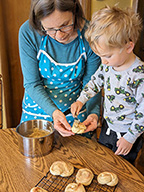
Mom had the beautiful idea of making Grandma’s famous Danish pastries while we were together, a tangible and literally sweet way of remembering her. While four-month-old Kiah was much more interested in sleeping than helping, it did feel like we had four generations of mothers and daughters working together. It was a much longer process than we had anticipated, realizing after we actually read the recipe that these signature knots are essentially frosted croissants; it was another sweet glimpse into the life of my grandma who didn’t love to cook but invested so much time and effort into making these precious pastries for the people around her. She was a quiet woman, yet she loved so well.
I swung by her grave real quick as we left church on Sunday. I know she won’t “get not dead” and that I won’t see her here again, no matter how many Danish pastries I make in her honor. But I’m not so sad, because like we tell Benson, she just didn’t need her body anymore. She gets to be with Jesus now, the One who did rise again, the One we really remember every Easter with death and life intertwined.
Grandma Mayer’s Danish Pastries (greatly abbreviated version)
These are a bit of a legend around here, and for good reason. I remember seeing these caramel-frosted knots filling up Grandma’s table as she finished them, and arranged in Tupperwares and on paper plates to keep eating and to give away. I had no idea they were so much work — I’ve made laminated dough before, but I think only once, because it was A Thing. Fortunately, that experience already in my repertoire greatly assisted my experience following Grandma’s recipe, which was definitely not what I would call overly complete (it reminds me of the technical round in the Great British Baking Show, if that tells you anything). It’d be much too long for this column if I rewrote it in a more helpful fashion, so look up homemade puff pastry if you want to start from scratch for yours. It felt like a shame to frost such incredibly layered, flaky pastries, but they did go from amazing to phenomenal, at least with our attached memories.
Prep tips: Grandma’s recipe said “shape as desired,” but this is how Mom and I remember them looking. Honestly, we think she might have used margarine in her pastry dough (it was the era for it) because ours baked up so much flakier and possibly even tastier than we remembered.
a batch or package of puff pastry dough, cold
1 cup light brown sugar
5 tablespoons salted butter
½ teaspoon salt
¼ cup whole milk
1 ½ cups powdered sugar
a splash of vanilla or maple flavoring
Cut pastry into strips approximately 6”x1”x ½”. Roll like a rope and shape into a pretzel-ish knot. Bake as directed; let cool fully (eat some hot). Mix and melt the brown sugar, butter, and salt together, then add milk and bring to a boil. Cook and stir for a couple minutes, then let cool slightly. Whisk in powdered sugar and vanilla to spreading consistency, and frost the pastries.
KU News: Distinguished professor to share future of developing tiered systems to meet K-12 students’ multiple needs

From the Office of Public Affairs | http://www.news.ku.edu
Headlines
Distinguished professor to share future of developing tiered systems to meet K-12 students’ multiple needs
LAWRENCE — Kathleen Lynne Lane has co-written 14 books and published 242 journal articles and 56 book chapters on how to prevent and respond to learning, behavioral, and social and emotional well-being challenges. Much of the University of Kansas researcher’s work focuses on systematic screening within school-based tiered systems. Lane, Roy A. Roberts Distinguished Professor of Special Education, will present her inaugural distinguished professor lecture at 5:30 p.m. April 3.
KU centers to host conference: When Global East Meets Global South
LAWRENCE — Members of the University of Kansas community and the public are invited to an interdisciplinary East-Asian and Latin America conference that will bring together scholars from a variety of fields to explore the historical and contemporary links between the regions. The When Global East Meets Global South hybrid conference will take place from 9 a.m. to 5 p.m. March 29. Topics will include trends in and outlook for Latin America’s relationship with China and other Asian partners.
Full stories below.
————————————————————————
Contact: Elizabeth Barton, Office of Faculty Affairs, [email protected], @kufacaffairs
Distinguished professor to share future of developing tiered systems to meet K-12 students’ multiple needs
LAWRENCE — A top scholar in special education, Kathleen Lynne Lane has co-written 14 books and published 242 journal articles and 56 book chapters on how to prevent and respond to learning, behavioral, and social and emotional well-being challenges. Much of the University of Kansas researcher’s work focuses on systematic screening within school-based tiered systems.
Lane, Roy A. Roberts Distinguished Professor of Special Education, will present “Wouldn’t It Be Great If … Systematic Screening in Comprehensive, Integrated, Three-tiered (Ci3T) Models of Prevention” at her inaugural distinguished professor lecture at 5:30 p.m. April 3 in the Malott Room of the Kansas Union.
Individuals can register to attend the lecture, and a recording will be posted on the Office of Faculty Affairs website.
Lane will provide a look back at the research on three-tiered models of prevention and share her team’s work in progress aimed at building the capacity of school leaders and educators as they strive to support students’ multiple needs. She will provide an overview of Ci3T, illustrating how systematic screening data are used by educators to shape instructional experiences with the goal of creating positive, productive learning environments.
“It has been such a gift to collaborate with such amazing pre-K-12, school-based educators from coast to coast across the United States to determine how best to meet students’ multiple needs in a way that also prioritizes educators’ well-being,” Lane said. “It continues to be an honor for our Ci3T research team to collaborate with such talented educators, families and students to learn more about ‘what works’ over the course of several research grants funded by the Institute of Education Sciences and managed by the Life Span Institute during my time at the University of Kansas.”
The mission of Lane’s research is to examine how educational leaders design, implement and evaluate Ci3T models of prevention in pre-K-12 schools with the intention of preventing challenges to the development of students’ learning, behavior, and social and emotional well-being and responding to existing instances, with an emphasis on systematic screening.
Lane is principal investigator for several grants funded by the Institute of Education Sciences, which currently include Project Enhance (Network), Project SCREEN (Measurement) and Project Engage (Pandemic Impact). Lane is also a co-editor of Remedial and Special Education, and co-leader of the Productive Scholars Writing Group, designed to support other scholars in establishing their own programmatic lines of inquiry.
Additionally, Lane serves KU as an associate vice chancellor for research. In her administrative role, she provides support to four of KU’s designated research centers and serves as the institutional official for human subjects research.
“I am humbled to be a Roy A. Roberts Distinguished Professor at the University of Kansas,” Lane said. “I am deeply thankful to our Ci3T research team, our district partners, the Life Span Institute and the KU community as a whole. I am beyond grateful to work with people I admire and respect so deeply. I am also thankful to my family: Craig, Nathan, Katie and Ben for their support, kindness and grace.”
The first distinguished professorships were established at KU in 1958. A university distinguished professorship is awarded wholly based on merit, following exacting criteria. A complete list is available on the Distinguished Professor website.
-30-
————————————————————————
Don’t miss new episodes of “When Experts Attack!,”
a KU News Service podcast hosted by Kansas Public Radio.
https://kansaspublicradio.org/podcast/when-experts-attack
————————————————————————
Contact: LaGretia Copp, Center for East Asian Studies, 785-864-0307, [email protected], @KUEastAsia
KU centers to host conference: When Global East Meets Global South
LAWRENCE — Members of the University of Kansas community and the public are invited to an interdisciplinary East-Asian and Latin America conference that will bring together scholars from a variety of fields to explore the historical and contemporary links between the regions.
The When Global East Meets Global South hybrid conference, organized by the centers for East Asian Studies, Global & International Studies and Latin American & Caribbean Studies, will take place from 9 a.m. to 5 p.m. March 29. Attendees can attend on Zoom or in person at Watson Library.
Luciano Tosta, director of the Center for Global & International Studies, said research on the growing connections between these two regions is essential.
“This conference will bring together scholars from 10 countries to study the important relationship between these two parts of the world from an interdisciplinary perspective,” Tosta said. “As an organizer of this conference, the Center for Global & International Studies fulfills its role as a catalyst for interdisciplinary comparative studies at KU and works to keep various parts of the globe in dialogue.”
It also highlights the importance of co-organizers the Center for East Asian Studies and Center for Latin American & Caribbean Studies as national resource centers at KU and brings their regional expertise to the forefront.
The first keynote speaker Junyoung Verónica Kim, assistant professor of visual culture and media at the University of Pittsburgh, will examine alternative conceptual frames through which scholars trace overlooked histories of migration and connections in the Pacific Rim.
The second keynote speaker, R. Evan Ellis, research professor in Latin America studies at the Strategic Studies Institute, U.S. Army War College, will discuss the latest trends in and outlook for Latin America’s relationship with China and other Asian partners.
Conference panel topics include political models, historical connections, economic engagement, representation in film and media, and perspectives on migration.
Additional information and registration are available on the conference website.
-30-
————————————————————————
KU News Service
1450 Jayhawk Blvd.
Lawrence KS 66045
Phone: 785-864-3256
Fax: 785-864-3339
http://www.news.ku.edu
Erinn Barcomb-Peterson, director of news and media relations, [email protected]
Today’s News is a free service from the Office of Public Affairs
KU News: Dole Institute announces second half of spring semester programs
From the Office of Public Affairs | http://www.news.ku.edu
Headlines
Contact: Jackson DeAndrea, Dole Institute of Politics, 785-864-4900, [email protected], @DoleInstitute
Dole Institute announces second half of spring semester programs
LAWRENCE — The Robert J. Dole Institute of Politics at the University of Kansas has announced the second half of its spring 2024 programming lineup, featuring a student-led program on the 2023 Kansas Speaks opinion survey, the annual Easter Egg Roll, the 2024 KU Security Conference keynote address featuring retired U.S. Gen. Philip Breedlove, the annual Dole Lecture and the return of The Counselors program.
Kansas Speaks
This spring’s Student Advisory Board Program, Kansas Speaks: The Crossroads of Policy and Public Opinion, will take place at 7 p.m. March 25. The program features Kansas Speaks Policy Fellow Alexandra Middlewood as well as Kansas State Reps. Christina Haswood and Nick Hoheisel — both of whom are members of the Kansas Future Caucus.
The program will include a discussion on insights from the 2023 Kansas Speaks public opinion survey, which is produced by the Docking Institute of Public Affairs at Fort Hays State University. The survey addresses issues such as marijuana legalization, Medicaid expansion, abortion rights, climate change and others. This event will explore crucial topics affecting young people and the wider community in Kansas, combining data-driven insights from the survey with real-world experiences and legislative perspectives. This program is presented by the Dole Institute Student Advisory Board (SAB) and moderated by coordinator Allie Haggar.
Easter Egg Roll with Dole
The Lawrence family-favorite tradition of the Easter Egg Roll with Dole will take place from 10 a.m. to 1 p.m. March 30. Free and open to the public, the event will feature an egg rolling race inspired by the White House Easter Egg Roll, egg hunt, bunny corral, live music, story time, children’s musician, game, crafts and more. The Easter Egg Roll is sponsored by Walmart with special thanks to partners the Lawrence Public Library and the Lied Center of Kansas. For more information, please visit the Dole Institute’s website.
KU Security Conference
On April 10, retired U.S. Gen. Philip Breedlove, former NATO Supreme Allied Commander Europe, will open the 2024 KU Security Conference with a keynote address at the Dole Institute of Politics. This address will kick off a two-day conference at KU aimed at bringing together scholars and practitioners from academia, the intelligence community and the military.
This program is presented in partnership with the Intelligence Community Center for Academic Excellence and the Center for Russian, East European & Eurasian Studies.
Dole Lecture
The annual Dole Lecture will take place at 7 p.m. April 16 and will honor Bill Kurtis, a KU alumnus, journalist, network news anchor, producer and rancher. Kurtis will join Dole Institute Director Audrey Coleman for a discussion of his Kansas roots and the news that shaped the nation over the course of seven decades in journalism.
The Counselors
On April 23, SAB members and Washburn University School of Law students will join attorneys Ed Duckers and Pedro Irigonegaray for The Counselors program. The program, reimagined in 2022 to incorporate student involvement, contains qualities of both a mock trial and a debate — featuring expert witnesses, cross-examination and student-led research.
SAB members Nathan Binshtok, Jaspreet Kaur, Riley Keiter and Matvey Tabakh will join Washburn Law students Caitlin Riffer and Sarah Vargas for the program, which will focus on whether to implement term limits for Supreme Court justices. The program is presented in partnership with the Washburn University School of Law.
Detailed information on programs can be found at the Dole website. All programs will take place in-person at the Dole Institute and be livestreamed on the institute’s website and YouTube channel.
-30-
————————————————————————
KU News Service
1450 Jayhawk Blvd.
Lawrence KS 66045
Phone: 785-864-3256
Fax: 785-864-3339
http://www.news.ku.edu
Erinn Barcomb-Peterson, director of news and media relations, [email protected]
Today’s News is a free service from the Office of Public Affairs
KU News: Study shows narrative conversion messages boost attitudes about COVID vaccinations among unvaccinated adults

From the Office of Public Affairs | http://www.news.ku.edu
Headlines
Study shows narrative conversion messages boost attitudes about COVID vaccinations among unvaccinated adults
LAWRENCE — New University of Kansas research shows that a specific type of narrative message can directly improve attitudes and indirectly reduce resistance among people who have never been vaccinated for COVID-19. A New Faculty Research and Development Award from KU supported the study, published in the Health Communication journal.
Theatre design students advance to Kennedy Center national festival
LAWRENCE — Two Department of Theatre & Dance students will represent the University of Kansas in April at the national Kennedy Center American College Theater Festival in Washington, D.C., following regional competition. Hana Rose North, from Salina, earned a National Sound Design award for “Collective Rage: A Play in Five Betties.” Edmund Ludlum, from Topeka, earned a National Costume Design award for “Cabaret” and a Representation, Equity, and Diversity Principles in Design award. Other honorees include students and recent graduates from Lawrence and Wichita who received commendations.
KU sociology faculty member honored with 2023 Woodyard award
LAWRENCE — Mehrangiz Najafizadeh, associate professor of sociology at the University of Kansas, is the recipient of the 2023 George and Eleanor Woodyard International Educator Award. She will give a talk on her work at 4 p.m. April 9 in the Kansas Union’s Big 12 Room. The award recognizes Najafizadeh’s extensive collaboration and connection with international scholars in Eurasia and Central Asia, including two Fulbright Scholar awards to Azerbaijan, and her efforts to build institutional partnerships in that region.
Full stories below.
————————————————————————
Contact: Mike Krings, KU News Service, 785-864-8860, [email protected], @MikeKrings
Study shows narrative conversion messages boost attitudes about COVID vaccinations among unvaccinated adults
LAWRENCE — Public health communicators have tried numerous methods to encourage people to accept COVID-19 vaccinations and boosters. And while some messages were ineffective, new University of Kansas research discovered a specific type of narrative message — a conversion message — can directly improve attitudes and indirectly reduce resistance among people who have never been inoculated for COVID-19.
The experimental study also found that people were persuaded differently depending on their pre-treatment levels of general vaccine hesitancy beliefs.
Researchers tested two-sided conversion messages — in which a person told a story about how they were initially resistant to getting vaccinated for COVID-19 but eventually refuted these beliefs and changed their mind after infection — against one-sided advocacy messages, in which people said they always intended to get vaccinated after contracting COVID-19. The results confirmed that conversion messages improved attitudes.
Jeff Conlin, assistant professor of journalism & mass communications, led the study, in which participants were randomly assigned one of three conversion messages or one of three advocacy messages. After reading the message, participants answered questions assessing how they perceived the strength of the argument and the extent to which the author of the message was similar to themselves.
“Overall, compared to advocacy messages, conversion messages were more effective in increasing positive attitudes toward COVID-19 vaccines. Since the entire sample was unvaccinated, we were also interested in how conversion messages could reduce their resistance,” Conlin said. “Our findings revealed the route to decreasing resistance was circuitous but also significant.”
The researchers employed an analytical method called structural equation modeling to reduce measurement error and understand the broader relationships, or paths, between the message manipulations and cognitive variables. The analysis showed significant indirect effects of conversion messages on resistance to vaccination through intervening cognitive processes. Results in the final accepted structural equation model showed that resistance was significantly reduced following conversion message exposure through a path that initially included homophily, or participants’ perceived similarity of the author to themselves. It was then tested through argument strength, or participants’ assessment of how convincing the message seemed; and finally, through elevated attitudes about COVID-19 vaccination.
“We wanted to better understand the relationships between intervening variables, or what was happening after message exposure but before people formed their attitudes and resistance intentions, because these constructs represent different mechanisms of cognitive processing — fast and slow thinking,” Conlin said.
The authors’ explanation for the results was that there was likely a high degree of matching between the conversion message author’s perceived psychological state and the beliefs held by the unvaccinated sample. As participants moved from homophily, or from a less effortful mode of fast-processing to argument strength, an effortful slow-scrutinizing process, they may have recognized that their judgment about vaccination was called into question. More effortful processing was needed to compensate for a reduction in their confidence in self-judgments and resulted in a need to more closely evaluate the arguments in the message.
“What’s interesting is that participants were not just relying on a mental shortcut of recognizing similarity between the author and themselves before forming attitudes and intentions — they were also scrutinizing the argument,” Conlin said. “Ultimately, participants found the outcome of the message was acceptable. Along with increasing positive attitudes, these results showed that participants’ intentions to resist COVID-19 vaccines were indirectly reduced.”
The researchers also found different indirect routes to reduce vaccination resistance depending on participants’ self-reported levels of general vaccine hesitancy. Participants who exhibited higher levels of hesitancy (prior to receiving the message treatment) showed reduced resistance through homophily, followed by argument strength. Meanwhile, participants who exhibited lower levels of vaccine hesitancy used only argument strength, not homophily, when processing the message. For this group, however, indirect message effects on intentions to resist were not significant.
According to the authors, the findings lend empirical support to established dual processing theories such as the Heuristic Systematic Model that describe additive and biased serial processing, which also can be applied to practice. Practically speaking, if public health communicators know that both types of processing occur serially, as opposed to simultaneously, and that homophily plays a default role, they can look for matches between a storyteller with a compelling conversion story and the target audience, Conlin said.
“What the author of the conversion message reveals about their former beliefs should overlap with current beliefs held by the target audience. Not only that, but the reasons the author shares about their conversion experience need to be convincing and well-told,” he said.
The study, co-written with Sushma Kumble of Towson University and Michelle Baker and Fuyuan Shen of Penn State University, was published in the Health Communication journal. A New Faculty Research and Development Award from KU supported the study.
The work builds on research Conlin and colleagues previously conducted that showed two-sided conversion messages were more effective in persuading vaccine-hesitant participants than one-sided advocacy messages prior to the mass availability of vaccines.
-30-
————————————————————————
The official university account for X (formerly Twitter) is @UnivOfKansas.
Follow @KUnews for KU News Service stories, discoveries and experts.
————————————————————————
Contact: Lisa Coble-Krings, Department of Theatre & Dance, 785-864-5685, [email protected], @KUTheatre, @KUDanceDept
Theatre design students advance to Kennedy Center national festival
LAWRENCE — Two Department of Theatre & Dance students will represent the University of Kansas in April at the national Kennedy Center American College Theater Festival (KCACTF) in Washington, D.C., following their recent KCACTF-Region V competition.
Hana Rose North, a sophomore in theatre design from Salina, earned a National Sound Design award for “Collective Rage: A Play in Five Betties.” Edmund Ludlum, a senior in theatre design and history of art from Topeka, earned a National Costume Design award for “Cabaret” and a Representation, Equity, and Diversity Principles in Design award.
Outstanding work from the department was also recognized through 13 regional commendations, which were all tied to fully realized University Theatre productions in 2023. The following is a list of those commendations:
For the production of “Collective Rage: A Play in Five Betties” by Jen Silverman
Cast for Ensemble Performance.
North for Sound Design.
Kennedy Tolar, a junior in theatre from Tulsa, Oklahoma, for Stage Management.
“Cabaret” by John Kander and Fred Ebb
Cast for Ensemble Performance.
Ludlum for Costume Design.
Jonah Greene, doctoral candidate in theatre studies, for Dramaturgy.
Leah Mazur, a guest artist, KU graduate and area head of the BFA in Design and Technology for the Department of Theatre & Dance at the University of Texas-Arlington, for Scenic Design.
“Love and Information” by Caryl Churchill
Greene for Dramaturgy.
Sara Baird, an MFA in scenography student from Tulsa, Oklahoma, for Lighting Design.
Kieran Spears, a recent KU graduate from Lawrence, for Sound Design.
“Milking Christmas: A New Musical” written by Friend Dog Studios and Ryan McCall
Connor Maloney, a junior in theatre design from Wichita, for Stage Management.
Brad Mathewson, a freelance writer and recent KU graduate, for Dramaturgy & Lobby Design.
Tara Leigh Burgat, a senior in dance and freelance choreographer and performer based in Kansas City, for Choreography.
“We’re extremely proud of our students’ talent and hard work,” said Henry Bial, chair of the theatre & dance department. “These achievements — the latest in a long line of regional and national recognitions for KU — also highlight the outstanding education and mentorship provided by our faculty and staff.”
Kelly Vogel, head of scenography and associate teaching professor in the department, said getting to share in the growth of the students is always a treat.
“This conference gives them a chance to receive feedback on their work and experience workshops from professionals outside of our region,” Vogel said. “They leave the conference with a new understanding of how to achieve their goals and a new sense of how their work speaks to other artists.”
The KCACTF-Region V annual conference and awards took place in January 2024 in Des Moines, Iowa. Region V includes Kansas, Iowa, Minnesota, Missouri, Nebraska, North Dakota and South Dakota. Throughout 2023, KCACTF representatives visited Lawrence to judge the submitted plays and provide responses.
KCACTF is a national theatre program created through the John F. Kennedy Center for the Performing Arts, which celebrates excellence in university and college theatre programs.
The University Theatre is a production wing of the University of Kansas’ Department of Theatre & Dance, offering public productions throughout the academic year. The University Theatre productions are funded in part by KU Student Senate fees with additional support from Truity Credit Union.
-30-
————————————————————————
Don’t miss new episodes of “When Experts Attack!,”
a KU News Service podcast hosted by Kansas Public Radio.
https://kansaspublicradio.org/podcast/when-experts-attack
————————————————————————
Contact: Christine Metz Howard, International Affairs, [email protected], @KUintlaffairs
KU sociology faculty member honored with 2023 Woodyard award
LAWRENCE — Mehrangiz Najafizadeh, associate professor of sociology at the University of Kansas, is the recipient of the 2023 George and Eleanor Woodyard International Educator Award. She will give a talk on her work in international education during an award presentation and reception at 4 p.m. April 9 in the Kansas Union’s Big 12 Room.
The award recognizes Najafizadeh’s extensive collaboration and connection with international scholars in Eurasia and Central Asia, including two Fulbright Scholar awards to Azerbaijan, and her efforts to build institutional partnerships in that region. In addition, the award honors Najafizadeh’s 30-year association with the Center for Latin American & Caribbean Studies and her work with the centers for Russian, Eastern European & Eurasian Studies and Global & International Studies as well as her excellence in teaching and her commitment to incorporating international and cross-cultural perspectives into the classroom.
“Dr. Najafizadeh has devoted her career to teaching and mentoring, research and service related to international issues. Her commitment to the internationalization of the curriculum and to enhancing the international perspective of students represents the ideals of the Woodyard International Educator Award,” wrote Joane Nagel, University Distinguished Professor of Sociology, in a nomination letter.
Najafizadeh earned her master’s degree and doctorate at KU and began teaching as an associate professor in 1993, the same year she was named associate director of CLACS. She held the position for six years and has been a pillar of Latin American and Caribbean studies and among the center’s top faculty contributors since then, noted Brent Metz, director of CLACS and professor of anthropology.
“She has made a tremendous impact on our center, sacrifices for Latin Americanist students across campus, and has much to do with its Title VI successes over the decades,” Metz wrote in a nomination letter.
International partnerships and research
Over the past 20 years, Najafizadeh’s research has centered on Eurasia, where she traveled to Azerbaijan as a Fulbright Scholar in 2004 and 2022 and as a Fulbright senior specialist in 2005 and 2008.
Saadat Aliyeva, rector of Azerbaijan University, noted that university colleagues were so impressed with Najafizadeh as a recent Fulbright Scholar that they encouraged her to apply for another grant so she could return and are looking to collaborate further with KU.
“Her international and global perspective, teaching style, research activities and her mentoring of our students have enriched our university’s mission of internationalization of the curriculum and educational programs,” Aliyeva wrote in a nomination letter.
Najafizadeh has also led efforts to develop international partnerships with Azerbaijan’s Khazar University and Baku State University and is a founding member of the American Research Institute of the South Caucasus Azerbaijan Research Center.
Recognized by scholars globally, Najafizadeh’s research focuses on gender, religion, culture, and internally displaced persons and refugees from the Nagorno-Karabakh War.
In her nomination letter, Linda Lindsey, senior lecturer at Washington University in St. Louis and professor emerita at Maryville University of St. Louis, noted that Najafizadeh’s ability to speak the Azerbaijani language fluently and her in-depth cultural knowledge has allowed her to connect with women who are refugees in their homeland.
“These women offer narratives that few researchers have uncovered. Dr. Najafizadeh displays the essential cultural sensitivity to effectively dialogue with women on such difficult issues,” Lindsey wrote.
Najafizadeh and Lindsey co-edited the anthology “Women of Asia: Globalization, Development, and Gender Equity,” which contained 32 original chapters from 40 scholars representing countries across Asia. Najafizadeh, as the lead co-editor of the anthology, wrote the chapter “Women in Azerbaijan: Decades of Change and Challenges.”
“I cannot imagine a better partner than Dr. Najafizadeh for academic rigor as we navigated this challenging but successful process,” Lindsey wrote.
Mentoring and teaching
Multiple nominators also highlighted Najafizadeh’s dedication to students. Najafizadeh has been recognized with 15 teaching and mentoring awards during her time at KU and has served as a chair or member of 126 master’s and doctoral student committees.
Najafizadeh has made extensive contributions to KU’s mission of internationalization, Nagel noted, through her teaching of such courses as Comparative Societies for undergraduates and graduate seminars on globalization, development, gender and social change.
“She seeks not only to provide core knowledge but also create a learning environment where students are inspired to explore alternate perspectives and theoretical lenses to examine issues of international significance,” Nagel wrote.
Father Michael Hermes, vicar for Hispanic ministry in the Archdiocese Kansas City in Kansas, believes taking Najafizadeh’s graduate seminar Global Social Change and Development had a profound impact on how he serves the Latin American immigrant community and made him a more effective priest.
“It helped me understand better the push and pull factors of migration and helped me to focus more attention on gender roles and to consider the immense pressure on family life,” Hermes wrote in a nomination letter.
Meredith Church Pipes, former student and current global and civic engagement specialist at Walker College of Business at Appalachian State University, recalled in her nomination letter the essential role Najafizadeh played in guiding her through the thesis process, helping her choose lines of inquiry, narrow her focus and hone in on important themes.
“Dr. Najafizadeh is not merely a teacher; she is a mentor, a guide and a source of inspiration,” she wrote. “Her commitment to fostering international awareness, cross-cultural understanding and academic excellence is noteworthy.”
In a nomination letter Lisa-Marie Wright, former student and current associate teaching professor of sociology, noted that Najafizadeh is one of the most knowledgeable, devoted researchers and educators she has encountered. Wright highlighted that Najafizadeh inspires students to broaden their knowledge and further their understanding of issues at the intersection of gender and global political-economic development.
“I have experienced first-hand the extraordinary amount of labor and effort that she puts into mentoring her students and the deep intellectual and emotional connections she forges with her students,” Wright wrote.
The late George Woodyard, the first dean of international studies, and his wife, Eleanor, endowed the award, which KU International Affairs coordinates. The award includes a $1,000 stipend. A full list of previous recipients is online.
-30-
————————————————————————
KU News Service
1450 Jayhawk Blvd.
Lawrence KS 66045
Phone: 785-864-3256
Fax: 785-864-3339
http://www.news.ku.edu
Erinn Barcomb-Peterson, director of news and media relations, [email protected]
Today’s News is a free service from the Office of Public Affairs
