Ear Biscuits (Best Of)
Ogallala Aquifer Summit set for March 18-19 in Liberal
Event will draw participants from eight states to discuss water management issues.
A proverbial Who’s Who of water management in the High Plains region is expected for the 2024 Ogallala Aquifer Summit, set for March 18-19 at the Seward County Fairgrounds in Liberal, Kansas.
The conference marks the third time that an inter-disciplinary group of water specialists, users, regulators and others from eight states will gather to discuss the condition of the mighty Ogallala, a vast underground reservoir that covers 174,000 square miles and touches parts of South Dakota, Wyoming, Nebraska, Colorado, Kansas, Oklahoma, New Mexico and Texas.
“One of the key values that I see to the Ogallala Aquifer Summit is the opportunity to hear from other states on the condition of the aquifer in their region, discuss shared challenges and learn ideas that may be adapted to Kansas in order to improve our water management,” said Susan Metzger, director of the Kansas Center for Agricultural Resources and the Environment, and the Kansas Water Institute at Kansas State University.
Registration is available online at www.irrigationinnovation.org/2024-ogallala-summit. The cost is $150, which includes meals and all conference sessions.
Metzger said this is the third time that the Summit has been held, each three years apart beginning in 2018. It is organized by the Irrigation Innovation Consortium, a group of water researchers and management specialists mostly working at universities throughout the eight-state region.
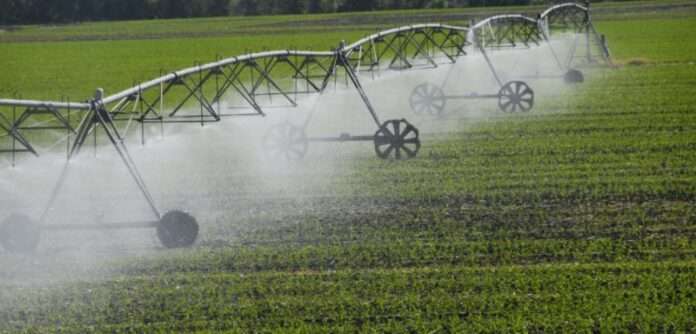
The Ogallala Aquifer is critical to the economies of the regions it touches. It is estimated that 95% of groundwater pumped from the aquifer each year is for irrigated agriculture, though it also supports livestock and municipal needs. The aquifer supports approximately $35 billion in crop production.
In Kansas, the Ogallala covers a majority of the western one-third of the state, which is one of the most productive agricultural regions in the entire country.
But the Ogallala Aquifer is rapidly depleting; some estimates indicate that in 50 years, 70% of the aquifer will be depleted. Diminished availability of water will also impact municipal water supplies; and in 2022 K-State agricultural economists reported that if current water depletion rates continue, Kansas land values may drop as much as $34 million in the next 40 years.
All of that makes get-togethers like the March 18-19 Summit even more important, according to Metzger.
“In the short term,” she said, “I hope the Summit inspires new partnerships and strengthens existing collaborations. But in the long-term, I hope we can identify practices and policies that collectively can extend the useful lifetime of the aquifer.”
Some topics on this year’s agenda include:
- New opportunities with conservation-related legislation.
- Understanding water risk as part of climate risk and economic risk.
- Advances in science and data application.
- The power of peer networks.
- Workforce and leadership development.
The full agenda is available online.
In addition, Metzger said researchers and water specialists from each state in the Ogallala Aquifer region have prepared updates on their water management progress and challenges. The topics – which will be featured in facilitated roundtable discussions — include water management technology and outreach; sustainable feed and forage; local enhanced management areas (known as LEMAs); reusing water in a municipal setting; a Kansas partnership with NASA’s Earth Sciences division; and more.
Metzger said the Summit’s attendee list is “intentionally diverse,” including farmers and ranchers, non-profit organizations, city and state government, universities, federal agencies and representatives of groundwater management districts.
The Summit is open to all interested. More information and registration is available at www.irrigationinnovation.org/2024-ogallala-summit.
Kansas City Renaissance Festival celebrates Tenth Annual Kegs ‘n’ Eggs
Good Samaritan bill shielding Kansans reporting overdoses from prosecution passes House
The Kansas House has passed a good Samaritan bill that would shield people from prosecution when they call emergency services to report an overdose.
Legislators took up the issue after overdose deaths more than doubled over the past five years, largely due to fentanyl.
Kansas and Wyoming are the only states that haven’t enacted some form of a good Samaritan law. The Kansas House passed the bill unanimously last week and had sponsors from both sides of the aisle. It now goes to the Senate.
“The aim for this is to keep drug users, drug addicts, however you want to refer to them, alive long enough for them to seek treatment,” said Rep. Nick Hoheisel, R-Wichita, a sponsor of the bill.
Good Samaritan laws aren’t uniform, though, and some give blanket amnesty for people calling for emergency medical services while others have more conditions the caller must meet. The bill in Kansas doesn’t cover calls if the overdose occurred during a drug deal or if there’s a trafficable amount of drugs.
The person who calls 911 must also provide their full name, remain at the scene and fully cooperate with medics and police.
“I ask this body not to view this not as a soft on crime bill, but a pro-life bill,” Hoheisel said. “We have to keep these individuals alive long enough for them to seek treatment.”
Hoheisel was joined in his sponsorship by Rep. Pat Procter, R-Leavenworth; Rep. John Alcala, D-Topeka; and Rep. Jason Probst, D-Hutchinson. Probst has been a longtime advocate for harm reduction policies in the Statehouse and was one of the leaders of decriminalizing fentanyl test strips in the state.
“I think it’s worth noting, and I feel proud of the evolution I’ve seen in this body over the last few years, about substance abuse and the recognition that it’s not necessarily a moral failing and it’s not necessarily that someone is doing wrong, so to speak, but that we have a broader understanding of addiction,” Probst said.
Proctor mirrored this sentiment, saying if someone told him three years ago that he’d be advocating for immunity from drug crimes that he wouldn’t have believed it.
“But then I had a chance to meet some of the families in my district impacted by this fentanyl crisis,” Proctor said. “If you feel as helpless about this problem as I do, this flood of fentanyl that’s coming across our border, this is our chance to do something. This is our chance to keep these folks alive who are dying from this poison.”
As reported in the Topeka Capital Journal
Consignment Art Auction is March 30
The 2024 Spring Consignment Art Auction at the Hutchinson Art Center is just a little over a month away.
This auction will feature over 100 works by local, regional, and national artists, including Jack Stout, Martha Hamilton, Birger Sandzen, and Leyster Raymer.
The auction is Saturday, March 30th. Doors open at 9:00 a.m., with the auction starting at 11:00 a.m. Lunch will be available, there will be plenty of seating, and admission is free and open to the public.
All artwork from this auction will be on display in the Main Gallery from March 15th – 29th. It will be a great opportunity to view the artwork in-person. Additionally, images of the artwork will be available for online viewing on the Art Center website starting in early March.
A portion of the funds raised by this event support future arts programming at the Hutchinson Art Center.