

Lettuce Eat Local: My Funny Valentines

Amanda Miller
Columnist
Lettuce Eat Local
I’m guessing the toddler/pre-K demographic isn’t the primary intended audience for supermarket shelving and displays, but they might as well be tailor-made for my three-year-old. Especially for holidays — bright colors, pretty ribbons, and of course, candy. Often there are even soft or squishy stuffed animals of some sort, on their own or attached to additional appealing paraphernalia, themed for the particular special day or season.
Again, I don’t envision consumer panel discussions being held at daycares or playgrounds, although, maybe. Catch the kids’ eyes and you might catch the parents’ wallets.
The Valentine’s Day setup definitely worked on Benson. We had already talked a little about what the holiday is since we had made valentines at our weekly kids’ program, and of course someone had already fed him SweetHearts. The fact that it also brought cute little teddy bears holding cute little jars full of cute little candies, not to mention an entire aisle of chocolates, did not hurt his opinion of Valentine’s Day.
And as soon as I explain it’s a special day to tell people we love them, of course we’ll need to buy this and this and this for all the people — which is adorable as well as not financially feasible. Fortunately, Benson was up for some compromising; I told him we have things at home that are similar to the gift packs, so he put it down. I told him he could hang onto the bright red squishmallow (super squishable stuffed-animal-pillow-thing) while we were shopping, so he put it back on the shelf when we were ready to check out.
AND I told him we could have an ice cream picnic for Valentine’s Day, so he left the candy where it belonged. I know when to bring out the big guns.
We used to do ice cream picnics in the living room every week when our foster girls would come back from their visitation, spreading out my old “picnic quilt” on the carpet and watching a Bluey episode or two. It’d been a long time since, but I broke it out again for the evening of Benson’s birthday for something special, this time with a Nat Geo animal show. He was clearly a fan, bringing it up again often with an earnest “Mommy, I have a great idea!”
Our family is an ice cream loving one, so while we won’t be making any valentines for Ice Cream, it makes sense that I should make ice cream for my valentines. One of Brian’s self-proclaimed love languages is browned butter ice cream, which pairs perfectly with how Benson’s current obsession is “butter buttons” (more on that in another article), and with how Kiah doesn’t care what I eat as long as I eat calories so that she gets plenty. It seems the hearts have aligned to point straight towards that recipe.
I’ll still try to whip up a nice meal, but let’s be honest, this is not the best season in our life to strive for the classic romantic experience. Candlelit dinners don’t have the same vibe when your three-year-old usually insists on climbing on the table and will one-hundred-percent demand ketchup for his steak, when your three-month-old has an uncanny ability to be starving right when I sit down to eat and will likely have a diaper blow-out right around that same time. Brian will smell like the farm; I will smell like the children. Time to start singing, “Cannn you feel, the love, tonight….”
But really, I can. I’m in love with this sweet crazy family of mine, and I’d rather have them than an entire display of dark chocolate and pink squishmallows. Benson would too, even though he might not always know it, but this brown butter ice cream will help remind him.
Browned Butter Pecan Ice Cream
Why yes, it IS ice cream flavored with butter. Talk about decadence! — although honestly, you only use a small portion of the butter here. Use the ladled off part, which is essentially clarified butter, as you would any other butter, and expect delightfully rich and nutty aftertones. You can serve this ice cream with almost any toppings you like or as part of a banana split, but really, why would you want to? One bite as is and you’ll be hooked, too. Consider this my Valentine to you.
Prep tips: this is the right amount for our ice cream maker, which is the 1 ½ quart frozen-bowl kind. If you can make a bigger batch, do.
3 cups whole milk
2 tablespoons cornstarch
1 pound salted butter
2 cups cream
⅔ cup sugar
1 ounce cream cheese, softened
4 ounces toasted pecans
Mix the cornstarch with ½ cup of the milk and set aside. In a large saucepan over medium heat, heat the butter, whisking often, until it’s just beginning to brown. Remove from heat and let set for a couple minutes, until butter solids have settled. Ladle off the clear butter (reserve for another use!), leaving only the browned bits in the saucepan. Pour the remaining milk plus the cream and sugar into the pan with the browned bits, and bring to a boil for a couple minutes. Reduce heat to low and whisk in the cornstarch slurry; bring back to a low boil, stirring constantly with a spatula until it just shows signs of thickening, about a minute or two. Remove from heat and gradually whisk some of this hot cream base into the cream cheese until smooth, and then whisk cream cheese mixture into remaining base. Chill overnight, then freeze in an ice cream maker, adding pecans in the last few churns.
2024 Youth Lawn Mowing Clinic

Wednesday
March 13, 2024
Two Sessions:
9:20 a.m.-11:30 a.m. & 1:20 p.m.-3:30 p.m.
New Location!
Oaklawn Activity
Center
4904 S. Clifton,
Wichita, KS 67216
K-State Research & Extension, in partnership with the Derby Recreation Commission, is excited to announce plans for the upcoming 2024 Youth Lawn Mowing Clinic. The clinic, scheduled for Wednesday, March 13th, 2024, is moving to a new location this year and will be held at the Oaklawn Activity Center, 4904 S. Clifton in Wichita. Youth in grades 5-9 who are looking for a way to earn summer income and gain lawn care knowledge are encouraged to attend.
The clinic will acquaint attendees with the different types of lawn grasses that grow in our area and how to properly care for each type. In addition, the training will provide youth with information on lawn mower safety, lawn mower maintenance, and the business skills necessary to run a successful lawn mowing business. Each youth will also receive a lawn care information packet, business cards, and safety equipment.
At the conclusion of each clinic, a short graduation ceremony will be held and each participant will receive a certificate of completion. In addition, all graduates will also be awarded $10 in order to support establishing their lawn mowing business.
Two sessions of the Youth Lawn Mowing Clinic are being offered:
• 9:20 a.m. – 11:30 a.m., with check-in beginning at 9:00 a.m.
• 1:20 p.m. – 3:30 p.m., with check-in beginning at 1:00 p.m.
The cost is $10.00 to register through March 2nd, or $15.00 after that date. Space is limited so please register early, as classes do fill up. Register online at www.sedgwick.ksu.edu/events.
The Youth Lawn Mowing Clinic is sponsored by K-State Research & Extension – Sedgwick County, the Derby Recreation Commission, and the Sedgwick County Extension Master Gardener Volunteers.
As drought tightened cattle production, 2023 markets soared
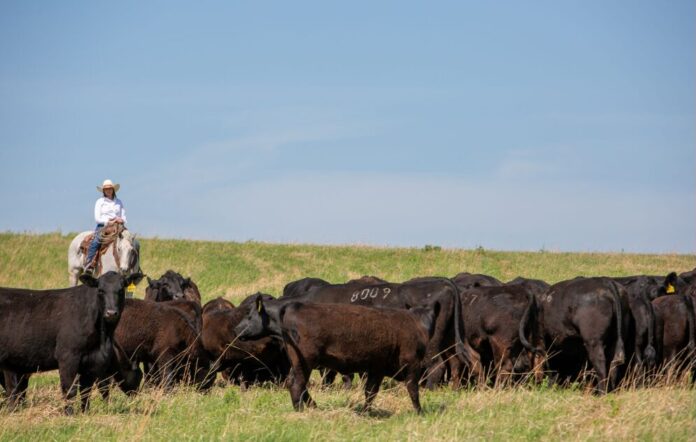
Cattle market prices are as high as they’ve been in a decade. That’s good news for producers who have been able to maintain their herds in recent years, but a missed opportunity for those who weren’t.
Throughout most of the year, both futures and cash markets for steers, calves and more marked a vast improvement over 2022. By the last week of November, prices for medium and large No. 1 steer calves weighing 500 to 600 pounds) were above $270 per hundredweight, more than $80 per hundredweight higher than the same time in 2022 and more than $100 higher than the average from 2017 to 2021.
James Mitchell, assistant professor and extension economist in the Department of Agricultural Economics and Agribusiness at the University of Arkansas System Division of Agriculture, said that the benefits of high prices largely fell to those with access to good grazing and forage.
“It was an exciting year in terms of markets for cattle,” Mitchell said. “Cattle prices leading up to the fall were as high as we’ve seen them in 10 years—that had lots of people excited about the future. On the production side, it was exciting depending on who you asked.”
A wide swath of droughty conditions has made its way down the middle of the United States over the last several years—affecting first the Northern Plains states such as Montana and Idaho in 2021-2022, then the Southern Plains of Kansas and Texas and finally the Southeast in 2023.
“About three-quarters of Arkansas was heavily affected,” Mitchell said. “The southeastern United States has been hit incredibly hard by drought. All of our neighbors to the east—Tennessee, Mississippi, Alabama, Georgia, Kentucky, Florida—are in a pretty tough spot, still very much in a drought. So for them, here’s not much they can do with these high prices, because they don’t have any grass or forage. There was nothing they could really do this winter, in terms of retaining calves.
“So you’ve got significant portions of cattle-producing states suffering through drought, forcing them to shrink or liquidate their herds because of a lack of forage,” he said. “When you have three consecutive years of that, you’re going to have a tightening of beef cow availability, which means you’ve got fewer calves being born each year. So you have tighter and tighter supplies, which of course leads to higher prices—assuming demand holds steady.”
In January, the U.S. Department of Agriculture reported that the total U.S. beef cattle inventory was at its lowest since 1962, declining more than 3% from the previous year to 28.9 million head. The inventory reported an entire cattle inventory of 89.3 million. Mitchell said he believes the forthcoming USDA Cattle Inventory report, expected in January 2024, will reflect a fourth consecutive year of contracting cattle supply in the United States.
Of course, there’s almost nothing that can’t price itself out of the market. At a certain point, Mitchell said, consumer resiliency will give way to more competitive pricing for—in this case—other animal proteins, such as poultry, pork and fish.
“People consume less of something when it gets more expensive—it’s just a law of economics,” he said. Mitchell said that rebuilding the country’s beef cattle inventory will be a multi-year process—one that can’t really even begin under the persistence of drought.
“Pastures are going to have to recover before we see any discussion of expanding cattle numbers,” he said. “Even if that does occur, it’s going to take a couple of years for that expansion to be noticed. We don’t have the cows; it’s going to take a year to develop heifers, another year for them to give us calves, and so on. So we’re looking at a few more years of declining cattle numbers.
“An important thing that’s different from 2014-2015, is that it’s going to be more expensive to buy back in and expand herds,” Mitchell said. “Interest rates are higher than they were 10 years ago. We expanded the herds very rapidly in 2014, we did that with low interest rates—so capital was inexpensive. That should lead to more careful calculation in terms of how we decide to expand herds.”
Bayer faces $2.2. billion verdict

A jury in the Pennsylvania court of Common Pleas ordered Bayer to pay $2.2 billion on Jan. 26. to a man who claimed his lymphoma resulted from use of Bayer’s Roundup herbicide.
John McKivision’s claimed his non-Hodgkins lymphoma came from using Roundup for yard work at his house over a period of several years. The verdict includes $250 million in compensatory damages and $2 billion in punitive damages.
Bayer plans to appeal the verdict, the latest in a string of losses after an earlier string of wins for the chemical company, and the biggest single verdict yet.
In a statement, Bayer said it disagreed “with the jury’s adverse verdict that conflicts with the overwhelming weight of scientific evidence and worldwide regulatory and scientific assessments, and [we] believe that we have strong arguments on appeal to get this verdict overturned and the unconstitutionally excessive damage award eliminated or reduced.”
Bayer said previous damage awards have been reduced by 90% or more.
Since Bayer paid $63 billion to acquire Monsanto in 2018, about 165,000 claims have been filed in the United States against the company for personal injuries allegedly caused by Roundup. They have all come from the lawn and garden side of the Roundup business; Bayer has already announced it is discontinuing glyphosate, the effective ingredient in Roundup, from its lawn and garden division, although it remains available to farmers.
In 2020, Bayer tried to consolidate all its outstanding Roundup cases. It settled most of them for about $9.6 billion but failed to get a settlement covering future cases. More than 50,000 claims remain pending.
Bayer’s legal troubles led its new American CEO to publicly say the company was considering separating out its crop protection business from its other units, but the company has since walked back that speculation, saying only that it is focusing on internal reorganization.
