Wednesday, February 25, 2026
Home Blog Page 582

Kansas and Renewable Energy

0


In this modern day and age we have come across many different kinds of technology, the development of AI, satellite systems never before thought of, and more recently on the table of discussion, the matter of how we power that technology. For those of you who have been keeping up with county news of policies and practices that have been supported and dismissed, you know full well that Harvey County recently agreed to a moratorium on renewable energy builds in the commercial district of Harvey County. This decision does not come easily, and in a world where renewable energy is the path of the future, we must for ourselves decide what We have to do for our children and the generations from then on. Join me in looking at where renewable energy puts us in the future.

You might have seen a couple of things on the news recently about how the world is gradually shifting to clean renewable energies. And that the tipping point of renewable energy development has been reached. That statement is true in many ways. In fact, projection charts already show that solar energy will be the energy of the future, and it’s not even close. Global demands for oil, natural gas, and coal are expected to peak by the end of this decade. Overall, this is great news. It may not be great news for oil and gas workplace environments, but, it is good news for all of us who enjoy breathing clean air and not living in sweltering summers. So what does this mean for our small towns and populations in rural Kansas? As stated in the opening paragraph, Harvey County has some words.

Not only that, but after heated debates in October meetings county commissioners approved modified regulations for a wind project and continued on to implement a moratorium on commercial wind energy projects after intense objections by county civilians. Basically, they halted all progress on implementing these projects and suspended the decision to a later date. Not only that, but they also suspended the commercial development of solar panels with one of the concerns being the potential harm to the agricultural industry.

To be honest, I think it’s fair to say that people don’t like change. Especially, in rural Kansas, I mean really, let’s own up to it. I know I don’t like change. Being brought up on a farm in the middle of a drought-ridden prairie taught me that change is the enemy of farming progress and harvest. Why would we like it? But in many cases, change can bring good things. I mean, just look at the crazy massive 9700 combines they have nowadays, and who knows what else. Developments are made to help us do things more efficiently and expediently. Renewable energies could be the bringer of both, so long as we’re willing to allow the change to happen.

The world is changing and developing in new ways each and every day. Years of experience will tell us that Kansas may be one of the last places to change with the rest of the world. Additionally, I think it’s important to remember that the policymakers of Kansas really don’t like change either. They’ll make sure to do right by us, if Harvey County has shown us anything in this past week, it’s that policymakers do listen to their constituents. The concerns expressed and heard are one of the greatest strengths of our democracy. I for one, have hope that the two can work together in order to find the best way for everyone to navigate a future of clean and sustainable energy production.
Wimpy and the Woodchuck

0


Just the other day, I was reminiscing with someone else my age the days of our youth, and though I’ve told this story before, it came to my mind amidst the memories, and is just too good not to repeat. So, grab a snack, sit back and enjoy “Wimpy and the Woodchuck.”

As a kid growing up in the farm country of central Ohio, my summer income came from the same source as all other farm boys near and far; baling hay! I know I’m aging myself here, but we’re talking pre-round bale days; we’re talking wagon load after wagon load of at least 100 small square bales apiece, loaded on wagons pulled behind the baler, taken to the barn, unloaded onto an elevator and stacked into the loft. The farm boys in our neighborhood were the usual ornery, free-spirited lot, but we all knew how to work hard, and come hayin’time each year we became a necessary commodity to most local farmers. Such was the case with Chester Campbell. “Chet” as he was known, lived across the road from me, was a grouchy ol’ cuss and for reasons unknown, didn’t seem to care much for us neighborhood boys. I think the feelings were mutual, but like I said, once his hay was down, we became “golden.”

Ohio has groundhogs like Kansas has coyotes; wherever there is ground there are groundhogs. Groundhogs, best known as woodchucks, look like overgrown prairie dogs, short stumpy tail and all, and can easily grow to weigh ten pounds or more. They have two sharp incisor teeth in the front of their mouth, much like a beaver, and eat all types of green plant life. They dig their burrows in fence rows and woodlots where they can easily sneak out into fields of young growing crops and wreak havoc. Like mini combines they choose a row of tender young soybean plants, straddle the row and eat every plant off to the ground for several feet.

We had a dog named “Silly” who was a groundhog slayin’ machine. Silly knew just how and where to grab them, and would shake them till their teeth rattled. One day we heard a huge ruckus coming from the cornfield by the house. Upon investigation, it was Silly who had caught a groundhog, probably sneaking through the cornfield on its way back to the safety of its den. When the fight was over, Silly was victorious as usual, the groundhog was dead and a patch of corn the size of a pickup was flattened from the fray.

Now old man Campbell also had a dog, sort of a cross between a Beagle and a Bassett, named Wimpy. As I remember Wimpy was a good old dog, just not the “sharpest knife in the drawer,” if you know what I mean. This particular day, Campbell’s hay was ready to bale, and, as usual, three of us neighbor boys suddenly became handier to him than sliced bread! The hay field was bordered by a creek on one side and by woods on one end, and those borders were riddled with woodchuck dens.

Empty wagons were pulled behind the baler, and when one was loaded, we stopped long enough to unhook the loaded one, hook up to the empty behind us and go again. In the middle of one such exchange, we heard the most awful wailing, screeching and thrashing imaginable coming from the nearby field edge. The three of us ran to investigate and

found Wimpy in the weeds with a big groundhog fastened securely to the end of his snout! Around and around they went, the woodchuck showing no intentions of letting go. We all knew better than to try and interrupt the festivities barehanded, so we scrambled to find something to end the brawl and save Wimpy’s snout. The back of all the hay wagons had metal “pockets” welded to them into which wooden racks could be inserted to provide something solid to stack the back row of hay bales against. One wagon happened to have just single 2×4’s in those pockets, so someone grabbed one and ran back to the brawl. After taking careful aim amidst the ball of thrashing fur, a well placed wallop across the groundhogs back dropped it to the ground and sent it diving for its burrow minus Wimpy, who raced shrieking toward the house. So ended Wimpys close encounter with the woodchuck, and I sincerely doubt he ever saw one that close again.

Although I’ve not heard of groundhogs in my neck of the woods, they are in Eastern KS and will probably someday make their way here much like the armadillos have. Each time I go to Hutchinson I marvel at the prairie dog “city” there around the mall, and I think to myself that if our commercial food supply was ever cut off and I wanted something different than fish or venison, I’d simply head to the mall with a pellet gun and fill my freezer; I’m sure prairie dog tastes just like chicken!…Continue to Explore Kansas Outdoors.

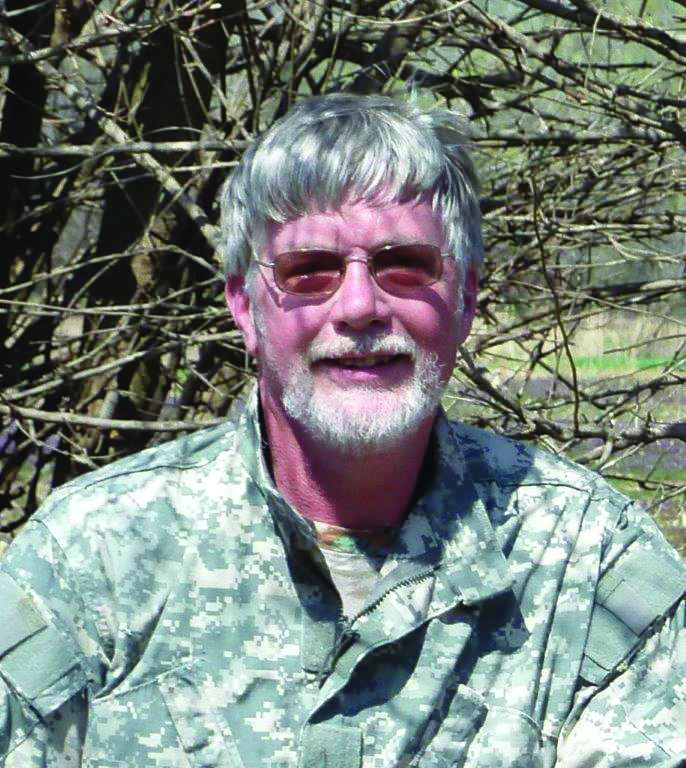
Steve can be contacted by email at [email protected].

Fall Season Photograph of Downtown Buhler, KS to be Spotlighted by TV Show, Small Town Big Deal

0

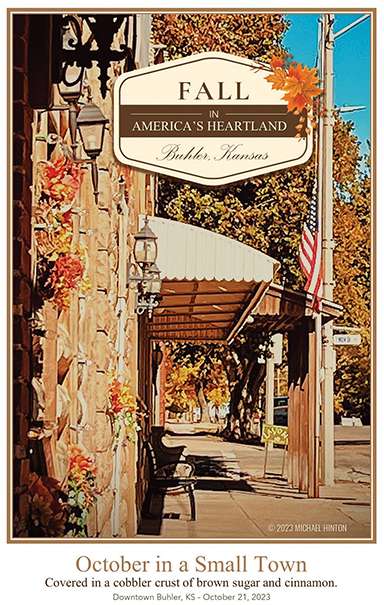
HUTCHINSON, Kan. (October 24, 2023) – A fall season photograph of downtown Buhler,  KS will be featured on the social media pages of the Nationally Syndicated TV Show Small  Town Big Deal

The photo, entitled: “Fall in America’s Heartland | October in a Small Town” was taken  by Michael Hinton, a rural Kansas native and Hutchinson, KS resident; during a recent  weekend visit with his wife, Tonya. Buhler, KS (Pop. 1,297) is a city in Reno County, KS,  located 12-miles northeast of Hutchinson, KS (Pop. 39,138). Buhler offers visitors a great  experience and exquisite small town charm all year round.  

Hinton shared he took the photo while walking the couple’s adopted rescue Sheltie (Winston), along the sidewalk in front of Buhler’s Grand Staff Thrift Boutique. “The view  was absolutely picturesque, so I had Tonya hold Winston’s leash while I snapped a picture.  I have a passion for visual arts & communications, and I’m constantly mindful of scenery that  speaks to capturing a given moment in time, for sharing its splendor with others.” 

Michael added, that he and his wife Tonya have a genuine and enduring love for the State  of Kansas and rural, small town America; each having been raised 15-miles apart from one  another: Michael in the rural countryside between Newton, KS (Pop. 18,241) & Walton, KS  (Pop. 213); and Tonya in Peabody, KS (Pop. 922). 

Hinton’s photo of downtown Buhler, KS is slated to post on the Show’s social pages  [Facebook, Instagram, & Web Blog] on Wednesday, October 25.  

ABOUT SMALL TOWN BIG DEAL: 

Small Town Big Deal is hosted by Rodney Miller and Jann Carl, and is currently viewed by  nearly 500,000 viewers across America every week, and Broadcast on more than 300  television stations in the U.S. Rodney created the Show following a long career in farm  machinery manufacturing & sales, serving as CEO of both McCormick International and  Montana. He was instrumental in establishing US operations for Valtra Tractors and in  territory management for Long and Mahindra Tractors. Jann is an Emmy Award-winning  news reporter, TV show producer, and served 14-years as an anchor of “Entertainment  Tonight” (CBS). She too, has a farm background.  

ABOUT MICHAEL HINTON: 

Michael Hinton is a distinguished rural-raised Kansan, University of Kansas Alumni, and the  Founder of Antique Tractor Preservation Day. He is profoundly recognized as America’s  premier antique tractor enthusiast. Michael has devoted a lifetime to promoting America’s  heritage farm machinery, fulfilling his dream as serving as an unwavering advocate for  agriculture and raising national awareness about the ways the tractor changed American  farming. Michael serves as Director, Sales & Marketing at AgTrax, the leading global  Agribusiness Software Technology Solutions Company located in downtown Hutchinson,  KS. He and his wife Tonya call Hutchinson, KS home. Their daughter Melissa and her  husband Dylan, reside in West Plains, MO.

CONTACT: Michael Hinton 

[email protected] 620.888.5605

If You See Purple Paint In Kansas, Turn Around and Leave

0

With hunting season slowly coming upon us and bringing cooler weather, you may find yourself hunting, hiking, walking, or running out in nature. It’s always fun to make your own path in those unique areas.

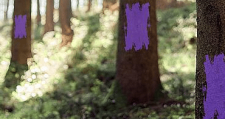
While you’re enjoying the beauty that Kansas has to offer, you may come across trees marked with purple paint. It’s important that you know what this means, and why you should turn around immediately.

Are These Markings Even Important?

The short answer is yes. These markings are able to take the place of a warning sign that you should know so you don’t end up in legal trouble. Fourteen states have laws regarding purple paint, including Iowa and Kansas.

According to Kansas Law

According to the current laws in Kansas, these markings on trees and fence posts are a more discreet and nicer-looking way of marking property lines.

“Any landowner or person in lawful possession of any land may post such land with signs stating that hunting, trapping or fishing on such land shall be by written permission only. It is unlawful for any person to take wildlife on land which is posted as provided in this subsection, without having in the person’s possession the written permission of the owner or person in lawful possession thereof.”
According to Kansas Legislature

Kansas has also adopted these purple paint laws, to make sure hunters and hikers know the difference between public land and private land.

“… any landowner or person in lawful possession of any land may post such land by placing identifying purple paint marks on trees or posts around the area to be posted.”

Purple paint is able to be used as an alternative to signage to show property lines and private land posting.

There are some rules to how the paint is hung, however.

“Each paint mark shall be a vertical line of at least eight inches in length and the bottom of the mark shall be no less than three feet nor more than five feet high. Such paint marks shall be readily visible to any person approaching the land.”

Stay safe out there, and stay vigilant so you stay where you’re supposed to stay.