Friday, March 27, 2026
Home Blog Page 6

Winter Cold Continues as Lovina Starts to Prepare for Upcoming Church Services

0

Lovina’s Amish Kitchen
Lovina Eitcher,
Old Order Amish
Cook, Wife &
Mother of Eight


Our ground is covered again with snow so even though the calendar tells us Spring begins on Friday, we will be patient and wait. I’m sure a lot of you readers are having much more. Hopefully you are all safe and warm.   

I have been busy cleaning corners and organizing the house so when we start washing walls and ceilings it will be easier. Is it just me or does everyone have a few drawers that have a little bit of everything in it? It’s like if someone doesn’t know what to do with something it gets put in that drawer. Or if you aren’t sure if you should keep it or throw it away then you think you will keep it awhile to see if you might need it. Then a few years down the road it is still there just gathering dust. Well, that is one thing I’m trying to accomplish is get rid of the clutter. If it’s something still good to keep but if I don’t need it then I put it in a basket and ask the family if anyone wants it. If it passes all of them and is still considered junk, then I’ll trash it. I don’t think my daughters appreciate it when I try to give their children things that are halfway broken but still too good to throw away. They absolutely do not need more clutter in their homes. 

It gives me a sad feeling when I go upstairs and the bedrooms are so empty. With only son Benjamin sleeping up there we have so many empty beds. Son Kevin had his bedroom up there but he can’t get up there anymore. Hopefully someday we can put in a platform lift that he can use to get back up to his bedroom. We put in a stair lift but since he can’t get out of his mobility scooter and to the chair, he just sleeps down here on the main floor. If we had known everything, we would have not put the stair lift in and put in a platform lift. On the platform lift he could drive his scooter on there to go up to his bedroom. That is our goal so we will wait and see. He is really patient about it. The cushion on his scooter was so worn and the bars from the seat were sticking out. Nephew Jacob had someone give him a seat that he couldn’t use and he gave it to Kevin. Saturday my husband Joe and son Benjamin worked to get the new seat to fit on the scooter and it just wouldn’t fit. So they took parts off the old one and had son-in-law Dustin weld some parts on and they got it to work. It sits so much more comfortable for Kevin. He was stuck on the recliner until they were done with the seat but I’m sure it was worth the wait. We also bought brand new batteries for his scooter so now it can go all day without a charge. It was getting very annoying for him to have the batteries die and he would have to sit and wait until his battery was charged enough. We are so thankful for the solar power we have to charge his scooter. Kevin is 6 feet 4 inches tall and so he’s a pretty big guy and needs a bigger size mobility scooter. He was fortunate to buy this scooter secondhand for a reasonable price. Well enough about that. We do have so much to be thankful for. I’m so glad that my children are so patient with me when they need assistance and I do not always get there to help them right away. I know that I would have a lot to learn if I would have to depend on someone all the time. May God help me to be a cheerful caregiver. Never take your good health for granted. 

Thursday I went with Joe to his doctor’s appointment. The doctor was concerned about his fast heart rate. He doubled his blood pressure medication after his last visit and it made a difference. His pain is mostly coming from arthritis in his back and legs. I never knew that arthritis can get so painful. 

My work is still waiting on me. It doesn’t seem to disappear. Haha! God’s blessings to all!

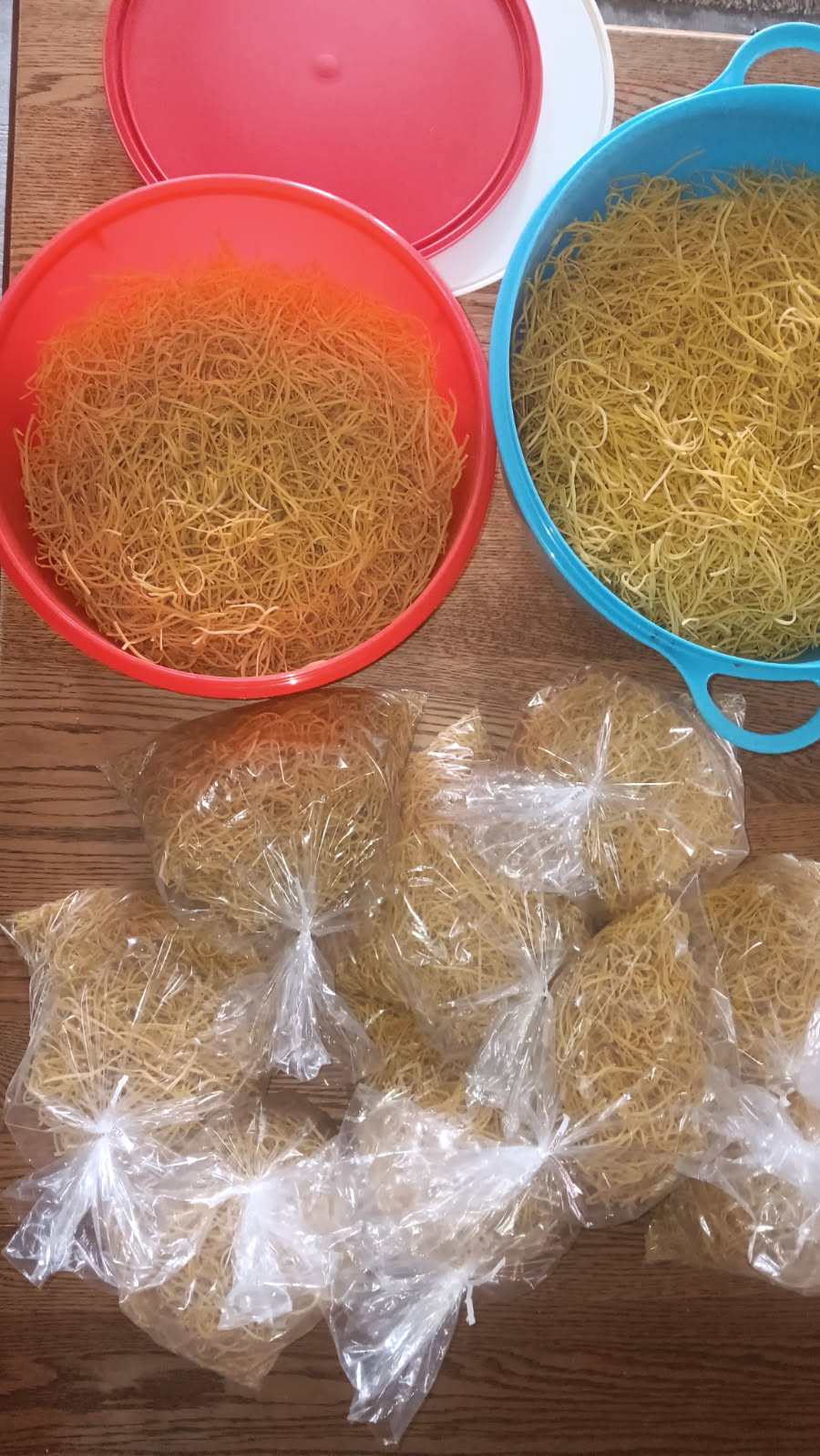
NOODLES

2 cups egg yolks, beaten

1 1/2 cups boiling water

9 cups flour

Beat egg yolks, add boiling water and beat quickly until foamy. Pour into flour. Stir until most of the flour is mixed in. Put a lid on the bowl and let it stand for 10-15 minutes. Put dough on a floured table and roll out. Cut into squares and put through a noodle maker or cut by hand. Either cook noodles right away or dry for future use. To dry, lay out and turn daily for a week, then store in an airtight container. After drying, the noodles can be frozen.
Lovina’s Amish Kitchen is written by Lovina Eicher, Old Order Amish writer, cook, wife, and mother of eight. Her three cookbooks, The Cherished Table, The Essential Amish Cookbook, and Amish Family Recipes, are available wherever books are sold. Readers can write to Eicher at Lovina’s Amish Kitchen, PO Box 234, Sturgis, MI 49091 (please include a self-addressed stamped envelope for a reply); or email [email protected] and your message will be passed on to her to read. She does not personally respond to emails.

NOTES TO EDITORS: text=837 words; end material=80 words 

Contact: [email protected] or 708-466-0471

A Desert in Bloom

0

Dawn Phelps
Columnist


Covered wagons lumbered along, heading west, as weary travelers looked forward to “better days” and the gold in California.  The year was l849—the Gold Rush.  

Many families from the Northeast had loaded their possessions and families into the slow-moving covered wagons, risking their money and lives.  Their journey was not easy as they crossed prairies, mountains, and deserts in search of a new life, and many graves marked the wagon trails, ominous warnings to those following.  

Some of the “Forty-Niners” traveled in the San Joaquin Company wagon train which left Salt Lake City in October, 1849, after stocking their wagons with supplies for the journey.  It was getting late in the year to cross the looming Sierra Nevada Mountains, and the story of the Donner Party who had tried to cross the Sierras about two years before was still fresh in travelers’ minds.  The Donner Party had been caught in a snowstorm and believed to have resorted to cannibalism to survive.  

The San Joaquin Company wagon train could only travel as fast as the slowest wagon, so some in the party decided to strike out on their own on a southerly route, following a fictitious map with a “short-cut” which was supposed to save them time and miles.

But they encountered unexpected obstacles on the way—gaping canyons to cross, not enough water to drink, and more.  So, by the time they arrived in the desert of Death Valley, it was Christmas Eve, 1849, and food was scarce.  Some slaughtered their oxen, used their wagons for firewood, and cooked the meat into jerky.  From there on, they would have to traverse the desert on foot.

Some pioneers in the wagon train decided to send two young men across the mountains for supplies, to wait for their return.  Others decided to keep moving in spite of the heat, lack of food, and water.  But even with the hardships, only one older man in the San Joaquin wagon train died in the desert.

When the Forty-Niners crossed the desert, they probably faced a brown, dry terrain with treacherous, shifting sand.  So, it was probably hard for the weary travelers to imagine anything beautiful ever emerging from the desert, of all places.  After successfully reaching the other side of the desert, while looking back from a mountain, one man supposedly proclaimed, “Good-bye, Death Valley!” thus giving Death Valley its name.

But when the setting sun and evening shadows mingle in Death Valley during the winter, the sand dunes take on a breathtaking orange glow as the desert is transformed into a spectacular scene of beauty!  And in the spring, with sufficient rain, some real surprises emerge.  Bright colors begin to pop up across the desert with flowers pushing their way through cracks, between rocks, and through the sand. 

Flower seeds which may have lain dormant on the desert floor for months or years begin to sprout and grow!  Blossoms of blue lupines, yellow California poppies, and daisies add their brilliance, and violet sand verbenas show off their colors.  Blue bells, wild snapdragons, evening primrose, and desert marigolds!  

Ocotillo cacti add their splash of red-orange blossoms as the desert literally comes alive with flowers, birds and desert critters, and about 400 species of birds live in Death Valley.

It is hard to imagine the wonder and joy the travelers in the covered wagons must have felt when they saw flowers blooming in a brown, dry, sandy, desert land.  One hundred and seventy-seven years later, their story of “a desert in bloom” in 1849 is still being told!  Maybe we feel a little of that kind of joy when we see the first blossoms in springtime, and soon spring will be bursting out all around us!

Hummingbirds will return, trees will leaf out, and lush green grass will again cover the countryside.  Officially spring will begin on March 20 at 10:46 a.m.—it is almost here!  Soon we can say, “Good-bye Winter, Hello Spring!”  So, watch for the flowers!   


[email protected]

St. Patrick’s Day: Time to rock your shamrock knowledge

0

If a leprechaun leaps from the faerie den this St. Patrick’s Day to ask if you know a shamrock from a clover, what will you answer?

“If you said the shamrock is a clover, you’re in luck,” says University of Missouri Extension field horticulturist Kathi Mecham.

In short, all shamrocks are clovers, but not all clovers are shamrocks.

The word shamrock comes from the Gaelic word semróg, which translates to “little clover.” Shamrocks are the most common and recognizable symbols of Ireland.

While a shamrock is a clover with three leaflets, some clovers have four leaves and are thought to bring luck to anyone who finds one. “There is about a 1 in 10,000 chance of finding a four-leaf clover,” says Mecham. As an Irish proverb says, “A good friend is like a four-leaf clover: hard to find and lucky to have.” Even rarer is the five-leaf clover.

By most accounts, the original shamrock is thought to be either yellow clover (Trifolium dubium) or white clover (Trifolium repens). Both plants have three oval green leaflets with tiny, ball-shaped floral clusters.

Clover draws bees, butterflies and other pollinators to the nectar of its lightly scented flowers.

“The shamrock has long been a part of Irish history and culture,” says Mecham. Legend has it that the Emerald Isle’s patron saint, Patrick, used the three-leaf clover to teach about the Holy Trinity of Christianity: Father, Son and Holy Ghost.

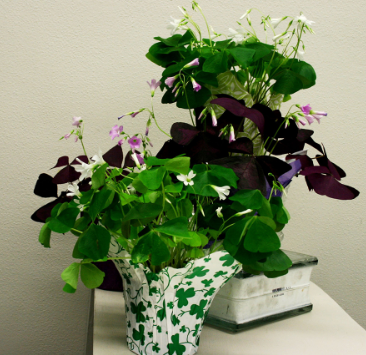
As St. Patrick’s Day approaches, grocery stores or floral shops will sell an attractive “shamrock plant.” This imposter is a plant from the genus Oxalis, a member of the wood sorrel family. It hails from mountainous regions of South and Central America, not Ireland.

Oxalis triangularis looks like clover with its three triangular leaflets. This eye-catching plant produces small white to pink flowers. Its leaves may be green, variegated or deep maroon.

While true shamrock has a fibrous root system, many oxalis species produce tubers, or bulb-like structures, says David Trinklein, MU Extension state horticulturist. “In fact, the plump, juicy tubers of Oxalis tuberosa have long been cultivated as a food source in Colombia and other South American countries. Referred to as oca by people indigenous to the area, it is second only to potato in acreage planted in the Central Andean region.”

Shamrocks prefer a porous medium that is barely moist. Fertilize only when growing. Place in indirect bright light to keep plants from becoming leggy. However, too much sun scorches the tender leaves.

Oxalis’ leaves begin to decline after a few months. Don’t despair, says Mecham. Your plant just needs a rest. When leaves start to die back, stop watering and allow leaves to dry. Remove the dead leaves and put the plant in a cool, dark spot for 2-3 months. Purple-leaf plants only need about a month’s dormancy. After the rest period, move the plant back to a window and begin watering again.

The leaves of oxalis and other shamrock plants fold up at night and reopen in the morning light, giving a wee “top o’ the morning” tip of the hat to its owner.

“With the right care, this attractive houseplant can be enjoyed for years,” says Mecham.

For more history of the oxalis, see “Oxalis: Shamrock’s Imposter” at https://ipm.missouri.edu/meg/2019/3/oxalis/.

Learn more about another favorite Irish plant, Bells of Ireland, at https://extension.missouri.edu/news/bells-of-ireland-a-st-patricks-day-favorite.

Selecting The Right Pruning Tool:

0

When pruning trees, shrubs, and other plant material, it’s important to remember that pruning is the act of intentionally damaging a plant, in order to remove a portion of that plant for a specific purpose. That purpose might be to limit size, control growth, encourage flowering or fruit, or address issues with plant health. Whatever reason we prune, it’s important that we use the right tool to minimize injury to the plant.

Pruners and loppers usually come in one of two styles: anvil or bypass. Anvil pruners have a blade that is sharp on two sides, and cuts downward against a flat surface, like a knife against a cutting board. This type of pruner has a greater likelihood of crushing plant tissue against the flat (anvil) surface during the cut, and should be avoided. Instead select a bypass style pruner, which has a blade sharpened on one side, that cuts downward and past a stationary surface, much like a pair of scissors. Bypass pruners usually make the cleanest cut, minimizing injury to the plant, and making them the better choice of pruners.

When selecting a pruning tool, it’s also important to consider the diameter of the cut we need to make. Hand pruners can be used when pruning branches up to ½ inch to ¾ inch in diameter. Loppers should be used when branches reach up to 1½ inches to 2 inches in diameter. Anything larger than 2 inches in diameter should be cut using a saw.

Whatever pruning tool you use, ensure that it has a sharpened blade and is clean from debris or plant sap. For tips on How to Select Quality Landscape and Garden Tools, visit: https://bookstore.ksre.ksu.edu/pubs/how-to-select-quality-landscape-and-garden-tools_MF3390.pdf

The Impact Of Cold Temperatures On Fruit Trees:

0

With a warmer than average winter, and springtime temperatures on the rise, many trees are starting to break dormancy. For fruit trees, this can be a concern, as temperature fluctuations will continue for many more weeks and can impact fruit production (especially when temperatures dip below freezing).

The closer a tree is to flowering, the more sensitive it becomes to cold injury damaging flowers and buds. When flowers and buds are damaged, the fruit crop the tree produces can be greatly reduced or eliminated.

As flower buds begin to swell and open, they become susceptible to damage and may be killed at temperatures below 24 degrees Fahrenheit. At full bloom, flower buds will start to suffer damage as the temperature reaches 28 degrees. Injured flowers may still appear normal but have internal damage causing the tree not to bear fruit. All fruit trees have this concern, but apricot and peach trees are most vulnerable to late frosts, as they are often the first fruit trees to bloom.

The amount of damage sustained by flowers and buds will depend not only on the temperature, but also the duration of the cold and at what stage of development the tree is in.

The table below shows the critical temperatures (in Fahrenheit) at which fruit flower buds are injured.

Type of Fruit 10% Bud Kill 90% Bud Kill Bud Stage
Apple 28°F 24°F First White (Pink)
Pear 25°F 19°F First White (White Bud)
Apricot 24°F 14°F First White
Cherry (Sweet) 27°F 24°F First White (White Bud)
Peach 25°F 15°F First Pink (Pink)
Plum 26°F 22°F First White

For more information on how temperatures can affect fruit trees at various stages of development, visit the charts and full color photos of the Critical Temperatures for Frost Damage on Fruit Trees publication from the University of Utah Extension: https://extension.usu.edu/productionhort/files/CriticalTemperaturesFrostDamageFruitTrees.pdf

How To Protect Fruit Trees From Late Frosts Or Cold:

Late spring frosts and freezes are the normal part of any spring in Kansas. The damage to fruit trees during such events, however, depends on the time of year, the temperature, length of cold, wind speeds, relative humidity, dew point, cloud coverage, and microclimates on the site.

While it may be difficult to believe, some light frosts or freezes can be beneficial in fruit production. Not all buds open at exactly the same time on fruit trees, so light frosts or freezes, for short periods of time, may act as a form of fruit thinning, leading to larger, more attractive fruit. While fruit thinning is normally accomplished by pruning after the fruit begins to set, frost can have the same effect. Heavy frosts or freezes, on the other hand, can be detrimental to fruit tree yields.

Selecting later blooming trees, planting in locations that are more protected or have a warmer micro-climate, planting on higher ground or on a hillside, and keeping soil moist can all help protect fruit trees from frost damage.

Other methods of protecting trees from cold damage are usually difficult, and its practicality depends upon the size and number of trees. When heavy frost is expected, covering small trees with a bed spread, blanket or similar fabric may prevent bud or blossom injury if temperatures do not fall too low and the cold period is short. Hanging incandescent, or old-style Christmas tree lights that produce small amounts of heat, underneath the cover during frost periods can further protect fruit buds.

Commercial growers can heat their orchards with industrial heaters to protect against frost. Some gardeners will add a heat source under a tree during cold nights, such as heat lamps or charcoal briquettes. Safety and the risk of fire should always be considered when determining whether or not to provide heat.

Overhead sprinklers are effective when temperatures dip below 32 degrees Fahrenheit. As ice forms on the flower buds, heat is released, which protects flower buds until temperatures rise above freezing. Buds will not be harmed as long as unfrozen water remains on the ice. All ice should melt before turning off the sprinklers. Tree limbs can break if ice build-up is excessive.

For more methods of active frost protection in commercial orchards, visit New Jersey Agricultural Experiment Station’s websitehttps://njaes.rutgers.edu/e363/