Sunday, March 1, 2026
Home Blog Page 638

As Farm Bill deadline nears, what does the major ag package mean for Kansas farmers?

0

Members of Kansas’ congressional delegation say they remain optimistic about the fate of the once-every-five-year Farm Bill — though there is an acknowledgement that lawmakers could blow their Sept. 30 deadline in advancing the key agricultural package.

Extensive negotiations over the bill, which must be passed once every five years, are commonplace, as are delays requiring a short-term extension of the many programs that must be authorized.

Kansas officials have made clear their desire to see a deal reached sooner rather than later.

“I know the rest of the delegation is working every single day to make certain that that happens,” said U.S. Rep. Jake LaTurner, R-Kansas. “We have to protect crop insurance for our farmers. We have to provide certainty for them. We are going to work diligently to get this done.”

But there are signals that conflicts over spending could make for a more contentious dynamic than in years past.

And while agriculture groups say they are optimistic about a deal, their message is similar to that of Chris Tanner, a northwest Kansas farmer.

“If you have to get an extension to get it right, well, that would be worth it,” said Tanner, who is vice president of the Kansas Association of Wheat Growers. “But, from a farmer’s standpoint, if we get an extension so we can play politics, well, that’s kind of disheartening as an American citizen.”

Farm Bill unlikely to be done on time, lawmakers acknowledge

The behind-the-scenes work of crafting the Farm Bill has been going on for years and it is the first time in years that former U.S. Sen. Pat Roberts, of Kansas, won’t be involved in shepherding it through the legislative process.

But lawmakers have not yet begun the process of rolling out a final version of the bill and advancing it to the U.S. House and Senate floors.

There is concern that the Farm Bill will be coming to a head at the same time as a series of key spending bills needed to avert a government shutdown, meaning lawmakers will have to prioritize.

“The challenges perhaps are greater than they normally are,” U.S. Sen. Jerry Moran, R-Kansas, said in an interview Friday. “Congress is, sadly, historically slow. There’s no reason that you can’t reach an agreement in advance of a deadline instead of after a deadline. But it seems that Congress always is waiting for them.”

With a price tag expected to top $1 trillion for the first time ever, conservative Republicans may take a more hardline approach to the Farm Bill than in years past, creating worries that the process could resemble a contentious fight to raise the debt ceiling earlier this year.

Lawmakers have said they expect the most conservative members of the U.S. House Republican caucus to be on board, something LaTurner echoed.

“We’ve had folks second-guess the ability of the House Republican Conference to come together to pass meaningful legislation,” LaTurner said. “And we’ve done it time and time again since January and I’m confident we’re going to do it on this.”

Despite its name, the Farm Bill is overwhelmingly comprised of programs focusing on nutrition, notably the Supplemental Nutrition Assistance Program, or food stamps.

Some members want to use the reauthorization of the nation’s largest food safety net program as a way to leverage change, such as an expansion of work requirements for recipients or requiring that benefits be used only on healthy foods.

Others want to spin SNAP off from the Farm Bill entirely. Past delays in passing the measure have often been because of the program, which affects 40 million Americans.

U.S. Sen. Roger Marshall, R-Kansas, noted that delays in the Farm Bill are often de rigeur and would necessitate a short-term extension, with the hope of getting a permanent solution to President Joe Biden by the end of the calendar year.

“The challenge in D.C. is that it seems like we just go from one crisis to another and it doesn’t give us the ability to make good long-term plans,” Marshall said in an interview following a Topeka event this week. “So I’m trying to get it right and we’ll get it done by Dec. 31.”

Crop insurance and safety net programs key for agricultural groups

The biggest priority for the state’s agricultural groups is reauthorizing crop insurance, which must be done in the Farm Bill.

In the U.S., the federal government helps subsidize and regulate the most commonly used plans sold by private insurers. Typically, those plans will cover any number of naturally occurring issues that farmers might encounter and payouts are based on the value of a specific crop.

Ryan Flickner, senior director of public policy for the Kansas Farm Bureau, said avoiding a situation where crop insurance access could be restricted or means tested was imperative.

“Crop insurance is the cornerstone of risk protection in a state like Kansas,” he said.

But advocates are seeking some tweaks to the program nonetheless.

Wheat production in Kansas typically falls into two categories. Farmers might plant wheat in the fall after previously harvesting soybeans or corn in that same spot over the summer months. In other cases, they might leave those fields fallow in the spring and summer before using them for wheat.

If a hailstorm or other natural disaster wreaks havoc on their crop, the two methods would be treated the same way for crop insurance purposes, even though they require different levels of investment and have different yields.

Then there are two programs that provide aid to farmers who either are hit with lower-than-expected crop prices or who are seeing a period of high-income bottom out.

Payouts in the Price Less Coverage and Agriculture Risk Coverage programs, however, are tied into per-acre rates set by Congress. Tanner said he hadn’t availed himself of either in years because the rates have not been updated and are out-of-whack with the increased costs farmers now face.

While funding can vary depending on the commodity involved, Tanner said wheat farmers would need a 20% increase to bring the programs up to market rate.

“It’s not a safety net. It’s safety asphalt,” he said of the current setup.

How can Kansas farmers be supported in drought conditions?

The Farm Bill negotiations come against the backdrop of a challenging few years for many Kansas farmers.

Currently, there are 83 counties in the state that have received a drought disaster designation from the U.S. Department of Agriculture. Nearly 70% of the state remains in some form of drought, with 30% of the state in extreme or exceptional drought.

For Tanner, this was a much better growing season than last year, which he termed a “devastating” moment for Kansas agriculture.

“As an agriculturalist, you go out and you plant your crop and hope for a harvest,” he said. “Just seeing things not even make it to a reproductive stage in the field because they burned up due to drought is not the reason I started farming.”

A rainier than usual July has helped in much of western Kansas, but there are wide swaths of the state that would need as much as a foot of rain to relieve the drought conditions, according to National Weather Service data.

Using the Farm Bill to help farmers weather more extreme climatic conditions has been a priority for many policymakers.

“Instead of placing burdensome regulations on farmers and ranchers with already thin margins,” Gov. Laura Kelly wrote in a letter to congressional agriculture committees last year, “the next Farm Bill should invest in voluntary conservation programs, drought-resistant crops like sorghum and cotton, robust crop insurance, and biological and technological innovation that will drive down the cost of regenerative agriculture in the long run.”

For Zach Pistora, a lobbyist for Kansas’ chapter of the Sierra Club, the goal was to invest in local food systems that are more resilient in the face of drought and other environmental hazards.

Critics have said crop insurance in its current form isn’t always the best way of doing that and could make farmers less likely to adapt in the face of climate change.

Encouraging conservation programs, investing in training and promoting technological innovations to use less water were all important areas of emphasis, Pistora said.

“As we’re adapting to the new normal or new circumstances with harder weather challenges, then agriculture will have to adapt,” he said. “And then we need those tools to help adapt.”

Flickner noted that uncertainty isn’t confined to drought but also the roller coaster of commodity prices that has blasted farmers in recent years, not to mention the COVID-19 pandemic, a trade war with China and rising prices for fertilizer and other materials.

“Where we are at as an agricultural state, as producers and growers across the state and the nation, times are a lot different here in 2023 than they were in 2018,” he said.

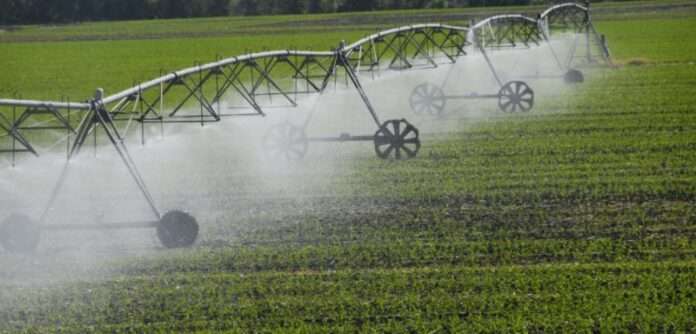
But Marshall said while he believed Kansas farmers were on the cutting edge of learning how to irrigate their crops more efficiently, he noted that the drought was just a part of the inherent risk that comes from being an agricultural producer.

“I grew up a fifth-generation farm kid,” he said. “We had droughts about every three to five years, a very common thing. And when it wasn’t drought, it was too much rain. And if it wasn’t too much rain, it was a hailstorm. And my dad used to say that farming is the biggest gamble there is out there. Farming has always been tough.”
As reported in the Topeka Capital Journal.

It’s the Start of Another School Year for Lovina’s Grandchildren

0

Lovina’s Amish Kitchen
Lovina Eitcher,
Old Order Amish
Cook, Wife &
Mother of Eight

First of all—a very happy 57th birthday to dear sister Verena. May she have many more happy, healthy years. She still misses sister Susan so much. We all do, but Verena most of all because they lived together all their lives. Yes, life brings us many changes. It’s good we can’t see the future and only take one day at a time. God is a great help as we travel into the unknown future. 

Family night was held at daughter Verena’s house on Friday evening. It was also granddaughter Kaitlyn’s seventh birthday. Daughter Lovina made a cake for her and decorated it. Kaitlyn was so excited to blow out the candles. She kept telling Lovina how it was her “bestest” cake ever. It’s cute how everything is her bestest at this age. She’s a darling and has won our hearts since she joined our family. I asked her what she wanted for her birthday, and she said craft things, so we gave her a few different craft sets, and she was so excited about it. She had also said she likes fruity ChapSticks, so we added that to the gift. Her eyes lit up when she saw what she had in the bag. 

Kaitlyn started school last week. She attends the Amish school in our church district. She is in first grade. 

On Monday, Abigail, six; Jennifer, five; and Isaiah, five, started at our small public school, which our children have attended since our move to Michigan. There are less than 300 students in K–12. It is a small, close-knit village about three miles from here. Abigail is in first grade, and Jennifer and Isaiah are in kindergarten. They were all excited to go to school. I’m sure daughter Susan’s house felt extra empty this morning when three of her five children left. She has Ryan, four, and Curtis, three (He will be four next month) at home with her. 

Wednesday night, most of our church families gathered at neighbors Joas and Susan’s house for their annual fish fry. Joas loves to fish and always has plenty of fish to fry. Everyone brought a dish, and the tables were filled with lots of food for everyone. 

My husband Joe stayed home because he has some sores on his legs that won’t heal. The boards at work bang against them, and it seems that once he gets a sore, it won’t heal very fast. I have been putting bandages on them with a medicated cream from the doctor. We did find out his sugar level was higher than normal, so that could be a reason for it not healing fast. He’s been trying to cut back on foods that aren’t good for that. His legs were so swollen, so he decided to stay home and elevate them, so I took Stormy and the pony wagon to pick up sister Verena to go to the fish fry. 

On the way home, some of the grandchildren wanted to ride with me and Verena. Sister Emma and nephew Benjamin, Crystal, and son Isaiah were stopping in at daughter Loretta and Dustin to meet their sweet little Byron Liam. I asked sister Verena if she wanted to stop in there too to see the baby again. So Tim and Elizabeth and Ervin and Susan also came to pick up their children, who had been left with us. Tim and Elizabeth had just left with the children when we heard a crash outside. A car had run the stop sign by Dustin’s house and hit a young girl heading east. We ran to help the girl, who was very shaken up. An ambulance was called, and there was quite a commotion for the next few hours as police and fire rescue trucks came. 

Son Joseph had gone home earlier from the fish fry and walked our mower down to sister Verena’s house to mow her grass. This same car that had run the stop sign earlier that night almost hit him and the mower. So we were thankful no one was killed. There are bad memories when we hear of an accident. I always feel bad for the ones involved. 

It is just after 5 a.m. now. Daughter Lovina walked over to be with Loretta and the little ones when Dustin left for work. Joe and son Joseph left for work, and son Benjamin will leave in an hour. 

Take care, and God’s blessings to all!

Peaches and Cream Pie

Pie Crust:

1 1/2 cups flour

1 1/2 tablespoons sugar

1/4 cup corn oil

1/8 teaspoon salt

2 tablespoons milk

Filling: 

8 ounces cream cheese

2 tablespoons milk

2 tablespoons sugar

2–3 fresh peaches, diced

16 ounces whipped topping, divided

1 (3.4 ounces) box instant vanilla pudding

1 cup milk

1/4 teaspoon almond flavoring

Crust: Mix ingredients and press into a 9-inch pie pan. Bake at 350 degrees for 15 minutes. Set aside to cool.

Filling: Mix cream cheese with 2 tablespoons milk and sugar, and fold in 2 cups whipped topping. Spread in pie crust. Press diced peaches into the filling. Mix pudding with 1 cup milk and almond flavoring. Let set for 5 minutes, fold in the remaining 2 cups of whipping topping. Put on top of peaches. Garnish with whipped topping and peaches, as desired. 

Lovina’s Amish Kitchen is written by Lovina Eicher, Old Order Amish writer, cook, wife, and mother of eight. Her newest cookbook, Amish Family Recipes, is available wherever books are sold. Readers can write to Eicher at Lovina’s Amish Kitchen, PO Box 234, Sturgis, MI 49091 (please include a self-addressed stamped envelope for a reply); or email [email protected] and your message will be passed on to her to read. She does not personally respond to emails.


Improving Poor Soil: Turning Lemons into Lemonade

0

The soil that sustains plant life is very complex and quite variable. One classic definition for soil states that it (soil) is the “chemically and physically weathered, biologically molded upper layer of the earth’s regolith.” The definition, in part, describes the intricate nature of soil both from the standpoint of its origin and composition.

The source of all soil is rock. In particular, it results from the weathering of the mantle rock which is the layer of disintegrated rock fragments that exist in varying depths above the soil rock of the earth’s crust. This component of the earth’s cover often is referred to as the regolith.

In the upper portions of the regolith, rapid weathering takes place. It is this weathering that leads to the development of soil as we know it. Soil covers the earth in a very thin layer when compared to the regolith and bedrock below it. Remarkably, it is this thin layer combined with the proper amounts of air and water that supports life. Only when soil exists can land plants and all the animals they sustain grow and thrive.

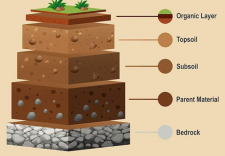
For those who have gardens and landscapes, the details of soil complexity may not seem that important. However, without any special training we know that plants grow very well in good topsoil, and very poorly in subsoil. Erosion, construction, and a variety of other processes often leave gardeners and homeowners only with subsoil, or something closely akin to it in structure and appearance, after the topsoil has eroded away or removed purposefully by man.

The question arises then, “Is it possible to grow plants in subsoil?” The answer is “yes,” but with the understanding that the conditions needed for good topsoil—proper proportions of air, water, mineral materials, and organic matter—must be developed in what currently is subsoil. In essence, gardeners and homeowners need to create topsoil as much as possible from subsoil in a few years—a process that takes nature thousands of years to accomplish.

The major portion of any soil consists of its mineral components. The mineral component of soil is made up of particles raging in size from large sand particles, to smaller silt particles, and (finally) to very fine particles of clay. The ratio of sand, silt, and clay is known as soil texture. A mixture of these three particle sizes (in proper proportions) creates a soil texture known as loam. The latter is considered to be soil good for gardening because of its ability to retain water and nutrients, while at the same time allowing excess water to drain through freely.

Another important component of a garden loam is organic matter which is essential for good plant growth. Organic matter improves soil structure by acting as a bonding agent that holds soil particles together in aggregates. Without organic matter, aggregates are less stable and can be easily broken apart. Soil aeration, water drainage, root growth, and biological activity all are affected by the organic matter content of soil.

The average upland mineral topsoil contains from only two to four percent organic matter (by weight). This rather small amount is caused by the continual decay of organic matter by soil microorganisms. Since organic matter is constantly being broken down, it needs to be replaced either by nature of by the gardener on a regular basis. Ideally, soils destined for growing ornamental flowers and vegetables should contain a minimum of five to ten percent organic matter.

Subsoil differs from topsoil in several ways. Perhaps the most important of these is that in subsoil organic matter content is greatly reduced to less than one percent or, in certain cases, none. As mentioned above, organic matter is important for creating soil structure. The latter, in turn, greatly influences the pore space of soil which represents the area in which air and water move, providing essential nutrients and oxygen to plant roots.

In a good soil, such as a silt loam, the pore space may comprise as much as 50 percent of the soil (by volume). Of the 50 percent, ideally half (25 percent) is air space and half (25 percent) is made up of water-holding space. Subsoils, and particularly clay subsoils, contain much less pore space which reduces root activity and (consequently) shoot growth as well.

Since, in nature, organic matter is important in converting subsoil into topsoil, the frequent application of organic matter to poor garden soils will start the process of topsoil development. Compost is ideal but, in many cases, in short supply. Therefore, materials such as tree leaves, grass clippings, straw, organic mulches such as bark and wood chips can be added to decompose and contribute to soil organic matter.

Where large areas must be improved, the use of green manure crops is an inexpensive way to help build organic matter in soil. Grasses with fine, extensive root systems such as annual ryegrass (Lolium multiflorum) are ideal. Because of its vigor and rapid growth rate, a warm-season grass such as a Sorghum-Sudangrass hybrid (a.k.a., Sudex) can add significant amounts of organic matter to poor soil at a time when cool season grasses go dormant.

With the addition of nitrogen and other nutrients to assist organic matter decomposition by soil microorganisms, the process of soil improvement can be hastened. Tilling soil to work the organic matter more deeply into the soil in the early stages of development also speeds the development of a good growing medium from poor soil.

In closing, it is important to be patient since it takes time to accomplish the transition of creating topsoil out of subsoil or, “turning lemons into lemonade.”

Anthracnose of Tomatoes

0
Photo courtesy: KSU

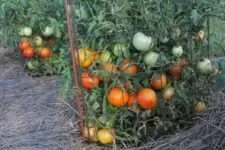
Reports of tomato anthracnose are increasing so it’s time to share some information about how this disease spreads and what can be done about it. As with many problems of the garden, preventative efforts go a long way.

Description: High humidity and frequent rainfall favor development of the fungal disease, anthracnose. Most often seen in the later part of the growing season on ripe fruit, anthracnose reduces the quality and yield of the tomato harvest.

Damage: Symptoms begin as small, circular lesions that are slightly depressed on the surface of the fruit. Spots grow both in diameter of the circles and the depth of the depressions. The sunken lesions give a water-soaked appearance beneath the skin of the fruit. At the center of the lesions are black, concentric rings which are small fruiting structures (acervuli). This is the disease-causing fungus.

During humid weather, the fruiting structures release buff-colored fungal spores (conidia). As lesions grow, they can join and cause the fruit to decay which promotes microorganisms to invade and rot the fruit entirely.

Control: Anthracnose spores survive in plant debris and soil. Spores can get splashed onto fruit during a heavy rain or even with overhead watering. This continues the spread of the disease. Proper cultural practices can prevent this by using mulch over the soil around the tomato plants and removing plant debris from the ground. Promote air flow to reduce humid conditions by staking the tomato plants. Use drip irrigation or a soaker hose to prevent splashing spores onto plants.

Chlorothalonil is effective and has a 0-day waiting period from application to harvest. Products that contain chlorothalonil include, but are not limited to, Fertilome Broad Spectrum Landscape & Garden Fungicide; Ortho Garden Disease Control; Bonide Fungonil Concentrate; Hi-Yield Vegetable, Flower, Fruit and Ornamental Fungicide and GardenTech Daconil.

Cynthia Domenghini, Extension Agent

Composting: What to Add

0
Photo credit: K-State Horticulture

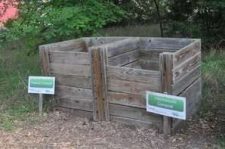
The recipe for the most efficient compost is the right combination of carbon and nitrogen. “Browns” are the materials that have higher amounts of carbon than nitrogen. These are dried items such as leaves, twigs, straw, wood chips and sawdust. It is best to chop up the dried materials to expedite decomposition. “Greens” are the materials that provide a good source of nitrogen such as coffee grounds, egg shells, fruit and vegetable scraps and fresh plant parts. Manure is another green waste that can be added but ensure it is manure from farm-type animals such as cows, sheep, etc. and not pets (dogs, cats, etc.) Pet waste may introduce diseases into the compost

Layer the compost pile alternating between six to eight inches of brown waste and two to three inches of green waste until the pile reaches three to five feet tall. You can wet down each layer of “browns” as you build the pile. This combination of materials creates an ideal environment for microorganisms to get to work decomposing. If you do not have enough “greens,” you can use a garden fertilizer to get the nitrogen benefit.

Cynthia Domenghini, Extension Agent