Tuesday, March 3, 2026
Home Blog Page 662

The Ties That Bind

0
People are creatures of habit and like most folks I get attached to things. I’ve been married for nearly 50 years to the only girlfriend I’ve ever had. We are cut from the same cloth in that both of us are fiercely loyal to products we grew up using.
I’ve been a lifelong customer of Union Oil because they employed me in the oilfields when they really didn’t have to. I was paid $5.85 an hour when the minimum wage was $1.25 and I could never have gone to college without them.
In the course of writing my syndicated column for 40 years I’ve used a hardbound Webster’s New Collegiate Dictionary every day that was given to me by a school teacher when I graduated from high school. It’s got my name imprinted on it in gold and it’s the best gift I’ve ever received. I bought my Macintosh computer in 1984 and it made me a much better writer at a time when I could use all the help I could get. I became a lifelong fan of everything Apple.
In the lefthand pocket of my jeans is the Case knife I bought after I sold my first Grand Champion steer. Although it has cut me to the bone on a couple occasions I don’t think it did it on purpose and you’ll never find me without it. For as long as I can remember I’ve worn Pendleton shirts, Justin roper boots and J.C. Penney underwear.
Every time I grab one of my great grandfather’s wood planes it feels like we are shaking hands across the ages. In my shop rests the family anvil that was made in 1845 and it still rings true. I could never go into a Sears store without buying a Craftsman tool and now I have a shop full of them. The new Craftsman tools that are made in China just aren’t the same.
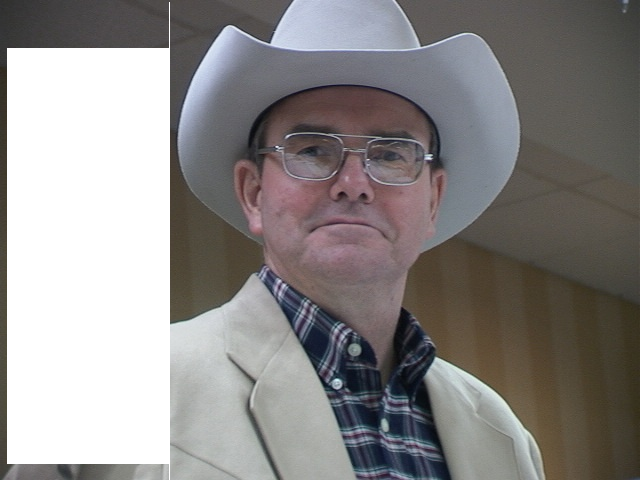
Whenever I mounted up it was in my Grandpa’s saddle and I’ve never used a bit, reins, or a pair of spurs that weren’t his. I wear a Stetson hat because he did. I used the same trucker to haul our cattle until he retired because he always had the latest copy of our livestock newspaper in his cab.
My wife and I drew up the plans to our home and have been the only ones to live in it now for 36 years and I can’t stand the thought that someone someday will be living in OUR house. I can find my way to the bathroom in the black of night without ever turning on a light and know all our home’s groans and moans. Practically every piece of furniture in our house came from my family or my wife’s. She sleeps in the same bed her parents did and I write on my great-grandma’s desk and eat off the same table I did when I finally escaped the baby’s high chair and got to sit with the grownups.
I’ve never owned a bulldozer but if I did you can bet it would be a Caterpillar because the Cat dealer in my county bought my second Grand Champion steer which allowed me to buy my first cows which set me on my cattleman course for life. I wore the Cat hat they gave me until it was in tatters and used a pocket watch just so I could attach it to the watch fob they gave me.
I’ve been a General Motors fan for life ever since a GM dealer bought another Grand Champion steer which allowed me to escape a toxic home life. My wife and I bought eight Oldsmobiles in a row from a GM dealer who became one of our best friends. When GM stopped making Oldsmobiles our friend took us to the Buick dealer and told him to treat us well. He did and we’ve driven the same Buick Lucerne now for 15 years. We drove our last Chevy truck for 25 years.
Why am I telling you all of this? If you own a business and are sitting on the fence about buying an FFA or 4H animal at the fair this summer let my life be a lesson. You’ll not only be helping a youngster you could very well be buying a lifelong customer as well.

Lettuce Eat Local: Winning the apricot-tery

0

Growing fruit in Kansas is a strange endeavor. I’m not a fan of gambling, yet as I consider our orchard, I’m wondering how much distinction there is between planting a fruit tree and playing the lottery. 

Brian knew of my attachment to the 70-tree apple-plus orchard I left behind at my family’s home in Ohio when we got married. So in sweet forward-thinking, years before we actually moved to the farmstead, he already began building our future in fruit. 

Or at least, he tried to. I’m not sure how many trees he’s planted in total, from apple to plum to nectarine to apricot to peach to pear to cherry, but our success rate is so far below even 50/50 that I don’t want to think about it too much. He even put in a dozen grape starts, and while one yielded a handful of uber-flavorful green grapes for a couple years, even that one gave up now. Currently we have two galas, a honeycrisp, and a pear — but of course I know to hold them lightly, as the red delicious tree that produced well for several seasons literally just fell over with no warning a couple years ago. 

Even the big old peach tree that Brian’s grandma “planted” when she threw scraps to chickens needs to come down. For decades it’s been there between the weathered coop and the red diesel tank, sturdy enough to climb up its branches and onto the chicken-house roof in order to pick infrequent yet incredible peaches.

Speaking of infrequent…that’s the other part of the gamble. As if basic survival weren’t enough of a challenge, seasonal weather patterns render any annual fruit harvest pure luck. There’s always hope — and while hope deferred doesn’t make the heart sick in this case, it does make the belly empty. Our two well-established gala trees have been heroes at producing at least some apples almost each year, but otherwise picking fruit every other year is really the best we can ask for. I feel like some fruit crops follow the biblical jubilee idea, having their rotation be more like every seven years. 

But on those years, I tell you what. Kansas can come through in a flurry of pent-up generosity, effectively erasing the memories of famine and instilling a hope as bold and heady as the rush of natural sugars to your bloodstream as you eat the harvest. 

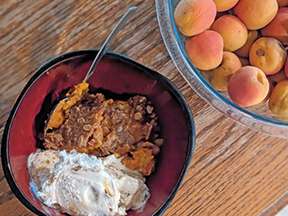
I would know; that’s where I’m at. Because while our apricot tree finally finished its slow march to death, our friends enjoyed one of those effusive harvests. Their tree was suddenly yielding more than they could keep up with, and although we weren’t their first recipients of overflowing fruit, they still showed up at our door with an apricot-heavy trash bag of fruity gold. The apricots were tiny and harvested early to avoid the birds, but there were hundreds of them; allowed to ripen in the basement, they transformed into explosions of orange-fleshed sweetness that melted in your mouth. I couldn’t help but grab a handful of them every time I neared their vicinity, savoring the juicy richness all the more knowing it could be (will be) years before the next windfall harvest. 

But thanks to the in-their-nature generosity of our friends and the capricious generosity of Kansas nature, our apricot experience this year was very sweet. We won the lottery in this case for sure. 


Classic Cozy Apricot Crisp

Our friends simply requested a crisp in return for the load of (picked for us!) apricots, and of course I was more than happy to comply. Brian loves both apricots and crisps, so naturally he was happy for me to comply as well since I made us one too. I typically play with my food in how I modify recipes, but I knew the apricots needed to be the star of the show so I kept things very classic. No one was sad.

Prep tips: the most important part of this recipe is that you pronounce it ap-ri-cot crisp, not ape-ri-cot. That is all. 

4-6 cups fresh (or frozen, thawed) apricots, roughly chopped  

a splash of lemon juice

1 tablespoon cornstarch

¼ cup sugar or honey

¾ cup all-purpose, whole-wheat, or oat flour

¾ cup brown sugar

a good pinch of salt

1 teaspoon cinnamon

8 tablespoons butter, room temp

½ cup rolled oats

Toss together the apricots, lemon, cornstarch, and sugar, and transfer to a glass pie pan. 

Separately, stir together the remaining ingredients, cutting in the butter until it’s distributed well. Crumble this evenly over the apricots. Bake at 385° for 30-40 minutes, until fruit mixture is bubbly and topping is golden.

What Judges Look for When Placing Exhibits

0

Well, it is county fair time in Kansas. Most judges consider the following factors. Some assign points for each and record them on a scorecard. Others keep score mentally while evaluating the specimens. Entries are judged on the following factors, from the most to the least important.

Individual Entries Condition – Free from disease, insect or mechanical damage, or similar types of problems, including dirt or stains. (30%)
Quality – Exhibits that are at the peak of perfection for eating. Specimens should be crisp, firm, mature but not overripe, and flavorful. (25%)
Uniformity – Uniform in size, shape and color. Attractiveness of an exhibit is enhanced by all specimens being uniform. (20%)
Typical of variety – Specimens should be typical of the type and variety of vegetable and fruit. Avoid unusual or atypical exhibits for show purposes. (15%)
Size – Size of specimens should conform to market demands. In general, very large specimens may be undesirable because they are not as tender or flavorful as medium-sized specimens. Do not select specimens based on size alone. (10%)

Good luck with your fair entries! For more information please see this link: C405 Exhibiting Fruits and Vegetables (ksu.edu)

KU News: ‘Understanding Islamic Law’ book thoroughly updates text on changing legal world

0

From the Office of Public Affairs | http://www.news.ku.edu

Headlines

Contact: Mike Krings, KU News Service, 785-864-8860, [email protected], @MikeKrings
‘Understanding Islamic Law’ book thoroughly updates text on changing legal world

LAWRENCE — The world has changed radically since 2016. The COVID-19 pandemic, Trump presidency, dissolution of the Trans-Pacific Partnership, re-emergence of the Taliban in Afghanistan and continued Iran nuclear showdown are among several happenings that have profoundly influenced the Islamic legal world. A University of Kansas international trade law expert has written the third edition of his landmark 2011 text, “Understanding Islamic Law (Shari’a),” thoroughly updating it to account for the shifting legal and geopolitical landscape.

Raj Bhala, Brenneisen Distinguished Professor of Law at KU, spent six years on the latest edition of his comprehensive textbook on Islamic law. Its previous two editions have been used globally: They are noted for the thorough coverage of the history, religion and law of Islam, and he is known as the first non-Muslim American legal scholar to offer such a work. The textbook contains updates to all previous chapters, plus several new chapters exploring Islamic constitutions, changes in and debates about Islamic law, and related topics for law students, professors, practicing lawyers, politicians, diplomats, and interested readers. The second edition was published in 2016.

Among the updated content is the edition’s first analysis of constitutions of countries that practice Islamic law, such as Iran and Saudi Arabia, and the origins, nature and ideology of the Taliban and its return to power in Afghanistan. Unlike previous editions, this one is accompanied by a publicly accessible website maintained by the publisher, Carolina Academic Press, for further updating. On the website, for example, is a comprehensive tabular summary of America’s longest war, the 20-year Afghan conflict.

“I personally find, and I think many Americans would find, Iran a very interesting case study, given the ongoing, unsteady relationship our countries have had,” Bhala said. “It teaches us a lot about the structure of the Islamic government, and I think it’s good to understand. Lawyers are supposed to be problem solvers, and we need to understand the other side and their thinking – empathize, but not necessarily sympathize — to do that.”

Likewise, the full-circle story of the rise, fall and rise again of the Taliban, coupled with the counter-cyclical exit, entry and withdrawal of American forces, contains lessons in dealing with violent extremist organizations. Bhala examined what that means not only for the nation the hard-line group now governs, but also for those with legal, economic and diplomatic relationships with them. The topic is especially relevant to him as he has taught U.S. Special Forces at Fort Leavenworth for nearly a decade.

“It’s made me wonder, ‘Where is Shari’a headed?’ To me you have no clear trends across the board,” Bhala said. “But it’s heartbreaking to see a violent extremist organization and put things back to where they were before 9/11.”

The textbook also explores contemporary topics such as blasphemy and how it relates to events such as the recent attack on author Salman Rushdie, and alcohol sales in Islamic countries and the fraught issues they can cause, as illustrated by the recent World Cup held in Qatar.

The new third edition, available as an e-book, also takes a look at idiosyncratic governmental developments and their effects on law, such as Islamization of governance in Turkey, but not in Malaysia.

“Understanding Islamic Law (Shari’a)” is necessarily more than a legal textbook, because Islamic law is more than a legal system, according to Bhala It has a rich history, and it is rooted in one of the world’s great religions. So, one need not be a law student or professor, or an attorney to benefit from its contents. The interdisciplinary book is of appeal to those working in business, such as Shari’a-compliant investing, the diplomatic corps, such as the U.S. State Department or foreign ministries in other countries, and humanitarian groups or NGOs that deal with or operate within Islamic countries, Bhala said.

Additionally, those entering the field of international law or practitioners — such as new or long-standing members of the International Bar Association, those working with or within Islamic judicial systems, or seasoned scholars and practitioners within Islamic countries who want to know how Islamic legal issues are viewed in the non-Muslim west — all can find material relevant to their inquiries.

“This remains the only comprehensive textbook that is designed to have everything in one place and assumes no prior knowledge of Islamic law or languages,” Bhala said. “If you want to do a survey or specialty course, or just understand this amazing subject, this is the book.”

-30-
————————————————————————

KU News Service
1450 Jayhawk Blvd.
Lawrence KS 66045
Phone: 785-864-3256
Fax: 785-864-3339
[email protected]
http://www.news.ku.edu

Erinn Barcomb-Peterson, director of news and media relations, [email protected]

Today’s News is a free service from the Office of Public Affairs