
Wednesday, March 4, 2026
Home Blog Page 673

KU News: Alumnus Murli Tolaney and son donate $100K for environmental engineering scholarship

0

From the Office of Public Affairs | http://www.news.ku.edu

Headlines

Contact: Cody Howard, School of Engineering, 785-864-2936, [email protected], @kuengineering
KU Engineering alumnus Murli Tolaney and son donate $100,000 for environmental engineering scholarship
LAWRENCE — University of Kansas School of Engineering alumnus Murli Tolaney is donating $50,000 to strengthen the Tolaney Family Scholarship he established 15 years ago. His ongoing goal: help KU environmental engineering students follow in his academic and professional footsteps, a career that included building MWH Global into an international powerhouse for water projects.
His son, Neil Tolaney, also is donating $50,000 — even though he’s never obtained a KU degree or enrolled in a class on Mount Oread.
“Kansas was the foundation for my father’s career and, in many ways, the foundation for our family,” said Neil Tolaney, who is a general partner in the venture capital industry in the Bay Area. “It’s only appropriate that my wife, Neetu, and I convey a small token of our appreciation with a gift that may allow those same possibilities for that next generation of students who come to Kansas and the great things they can accomplish.”
The combined gift adds to the $100,000 Murli Tolaney donated in 2008 upon his retirement as chairman of MWH Global. It’s the firm where he’d started 35 years earlier, working his way up to CEO from 1992 to 2001, when he led the firm through 13 acquisitions and grew revenue from $200 million to $1 billion.
From 2001 to 2009, Murli served as chair of MWH.
And to hear him tell it, none of it would have happened without the School of Engineering. It’s where he landed after leaving India, moving to Canada to be with his sister, and sending applications to 10 schools with hopes for resuming his engineering education.
Enrolling at KU with “no money,” he said, Murli Tolaney landed a 20-hours-a-week job in the Environmental Engineering Lab — doing homework while experiments “cooked” in the evening — on the way to earning a bachelor’s in civil engineering. After working two years in Kansas City, he went on to earn a full scholarship and a master’s in environmental engineering.
Now the Tolaney Family Scholarship is going strong, too. It is given each year to a promising master’s or doctoral student who, like Murli Tolaney, could use a boost on the way to make a big difference.
“Without people helping me, I probably wouldn’t have gotten a degree even — forget about becoming CEO or chairman,” he said. “And, frankly, very little would have happened for my family. I’m so grateful, so thankful. I owe a lot to KU, no question, and this is a way of giving back.”
“We are grateful to the Tolaney family for their support over the years. This gift helps to raise the national stature of KU Engineering and truly benefits our students,” said Dean of Engineering Arvin Agah.
KU Endowment is the independent, nonprofit organization serving as the official fundraising and fund-management organization for KU. Founded in 1891, KU Endowment was the first foundation of its kind at a U.S. public university. For more information or to make a gift, visit www.kuendowment.org.
-30-

————————————————————————

KU News Service
1450 Jayhawk Blvd.
Lawrence KS 66045
Phone: 785-864-3256
Fax: 785-864-3339
[email protected]
http://www.news.ku.edu

Erinn Barcomb-Peterson, director of news and media relations, [email protected]

Today’s News is a free service from the Office of Public Affairs

KU News: Professor spreads the gospel of ‘good fire’ through an eco-cultural lens

0

From the Office of Public Affairs | http://www.news.ku.edu

Headlines

Contact: Rick Hellman, KU News Service, 785-864-8852, [email protected], @RickHellman
Professor spreads the gospel of ‘good fire’ through an eco-cultural lens
LAWRENCE — A pyromaniac is someone unhealthily obsessed with the destructive power of fire. Melinda Adams instead is pulled toward the term pyromantic – a lover of “good fire” for the benefits it can bring to people, communities and the environment as a whole.
The Langston Hughes Assistant Professor in Indigenous Studies & Geography & Atmospheric Science at the University of Kansas, Adams extols the benefits of cultural or ceremonial fire in a new paper she has co-written for the journal Ecopsychology.
Adams collaborated on the paper, titled “Solastalgia to Soliphilia: Cultural Fire, Climate Change, and Indigenous Healing,” with Erica Tom, instructor in English at the Santa Rosa (Calif.) Junior College, and Ron Goode, honorable chairman of California’s North Fork Mono Tribe. They detail the benefits to university students and community members who took part in a series of ceremonial burns on Indigenous lands in California that they organized as part of ongoing community-based participatory research project in partnership with the University of California-Davis (where Adams obtained her doctorate) and the Southwest Climate Adaptation Science Center.
The researchers wrote that by taking part in a ceremonial burn (the term Goode and Adams both use) a few acres at a time — usually through pile burning or grass burning for the restoration of culturally significant plants — and guided by traditional environmental knowledge, the participants shifted in significant ways from the “Solastalgia” of the paper’s title — a word coined by Australian philosopher Glenn Albrecht for looming environmental dread — to “Soliphilia,” defined as a heightened state of environmental awareness and concern, which the authors say also engenders feelings of control.

“Whether you are a Native person that’s learning about fire, an allied person that’s wanting to learn about the presence of Indigenous peoples and our land stewardship and climate solutions, or community members that care about the places that we all live and work in and hopefully all care about, there’s a role for everybody in learning about good fire,” Adams said.
As wildfires have grown larger and more frequent as the result of climate change, so, too, has the fear of them grown in the Western states.
“We’ve had young people and students who experienced the Carr Fire or the Paradise fire, so they’ve lost their family homes or been affected in some way,” Adams said. “Or they were already afraid of fire from engrained ideas that all fire is bad fire. So students participated in the ceremonial burn demonstrations to learn an Indigenous perspective of not running from fire but working with it as a land stewardship tool. The experience is powerful as a healing concept. … There’s growing interest in cultural fire because it’s a mitigation tool that people are starting to educate themselves about. These are practices that we have held onto, as Indigenous peoples, since time immemorial.”
Adams studies and leads cultural/ceremonial fire from an Indigenous lens and invites others to learn from traditional practices, with Indigenous peoples always leading these demonstrations. She says her eco-cultural work serves to reiterate what Indigenous communities have always known: Through close connections with lands and waters, and scientific observation over time, there are numerous benefits to purposely lit cultural fire.
“In addition to the cultural-social effects of cultural fire, I also study the soil effects of cultural fire, of native fire, and its potential for carbon storage — everybody’s raving about carbon storage with climate effects – and I also talk about the water-holding capacity that good fire invites to soilscapes,” Adams said.
The authors wrote that the benefits of “placing fire on the land” can be expanded from an individual to an environmental level as participants in programs like the one Adams helped lead in California take the lessons they’ve learned into their careers in the field.
Adams, who joined KU’s faculty in spring 2023, led her first ceremonial burn at the KU Field Station in March. She looks forward to more, working with tribes, nearby Haskell Indian Nations University (of which Adams is also an alumna), faculty and community members and Indigenous peoples in the Midwest.
“That’s part of my work in trying to widen the scope of good fire,” Adams said. “We say good fire, meaning it’s purposeful, it has an ecological, cultural or social benefit that it’s bringing, as opposed to catastrophic wildfire, forest fire, which in most of us it’s ingrained to be dangerous and something to stay away from. … Not all fire is bad fire.”

-30-

————————————————————————

KU News Service
1450 Jayhawk Blvd.
Lawrence KS 66045
Phone: 785-864-3256
Fax: 785-864-3339
[email protected]
http://www.news.ku.edu

Erinn Barcomb-Peterson, director of news and media relations, [email protected]

Today’s News is a free service from the Office of Public Affairs
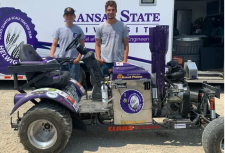
K-State engineering students place second in quarter-scale tractor design contest

0

The agriculture industry is one that we as humans will always need, which is why it is so important that people continue to enter that field — no pun intended.

Engineers are a vital part of said field, which makes things like student design competitions important for today’s workforce.

Students are able to design and build their own tractors, and once a year they take them to compete against other universities across the nation. These competitions are very beneficial to students, as they gain experience in both the design and presentation aspects.

The official name of the competition is a bit of a mouthful: The American Society of Agricultural and Biological Engineers’ International Quarter-Scale Tractor Student Design Competition.

Out of the last 26 years of this competition, the Kansas State University Quarter-Scale Tractor Team has finished among the top two teams 18 times. It continued this tradition last June, when it took second place at the competition in Peoria, Illinois.

This year, two locals were on K-State’s team and helped lead them to second-place victory once again.

Hayden Peirce and Cale McCabe are both Kansas State University graduates in biological systems engineering as of last May.

Peirce, 22, originally from Reno County, initially joined the tractor team because it seemed beneficial to his major.

“I want to design farm equipment, so it seemed right up my alley,” Peirce said.

This year, the K-State tractor team had 15 members, including him and McCabe. He noted how well the team worked together on the shared project.

The competition is international, putting K-State against other teams from across the United States and Canada. Only four or five of the teams were from Kansas, as many came from places like Nebraska, Missouri and Tennessee.

The team worked together on one tractor, with different members working on the different parts, such as steering and transmission. Peirce and McCabe both headed the design portion of their team’s tractor.

The student-made tractors are not full-sized, but instead a quarter of the size of a regular tractor — hence the name of the competition.

“They’re about the size of a garden tractor,” Peirce said. “We build as much from the engine to the ground as possible.”

McCabe, 22, is originally from Buhler. He was introduced to the tractor team during a campus visit to K-State and joined in order to assist his career.

“It seemed like it would be good for my resume,” McCabe said.

He explained that there are many different factors in which the tractors are judged.

The main event is the tractor pull, where judges see how far the student-made tractors can pull weighted trailers. The student-made tractors are also criticized based on steering, durability, marketability and design.

But the most challenging part about the competition, McCabe said, is the process of building the tractor itself.

“They pretty much give you an engine and say ‘Here you go,’” McCabe said. “There are a lot of late nights if things don’t work.”

When asked about their favorite part of the competition, both McCabe and Peirce said the same thing — watching their team’s tractor run for the first time.

“After all the time we put into it, it’s so rewarding watching something you dreamed up running for the first time,” McCabe said.

Since graduating, both Peirce and McCabe are pursuing careers in design engineering.

More information about the event can be found on the International Quarter-Scale Tractor Student Design Competition’s Facebook page.

Lovina and Family Camp Out to Celebrate a Special 50th Birthday

0

Lovina’s Amish Kitchen
Lovina Eitcher,
Old Order Amish
Cook, Wife &
Mother of Eight


The month of July is bringing us some hot weather. July 4 was a hot day as well. On July 3, our whole family—except son Benjamin—and sister Emma’s whole family and sister Verena all gathered at Emma’s house. We are a total of 39 now when we all get together. We all set up tents in her backyard. Her children wanted to do this for Emma’s 50th birthday, which will be on July 19. They brought and made all the meals and did all the outdoor cooking.
Everyone set up their tents and air beds when they arrived. A total of 11 tents were set up. They also had a 30-foot water slide, which kept the children and some of the adults quite occupied.
There was a water balloon fight that resulted in a big water fight. The men playing cornhole were cooled off with the water balloons as well. The water battle kept going until no one remained dry. It felt good on this hot, humid day. It was fun and reminded me that our families are keeping up the legacy of the “Coblentz” family. There were always water battles at my father’s family reunions. It was always so much fun!
We were served a lot of good food, with niece Emma and Menno serving a supper of hot dogs, jalapeño poppers, breaded mushrooms, french fries, shrimp, and frog legs. Plus, all kinds of snacks were brought in, as well as a cake for Emma.
The next morning, niece Elizabeth and Manuel made another good meal of bacon, smokies, tater tots, scrambled eggs, biscuits and sausage gravy, tomatoes, hot peppers, etc. Also, cookies, whoopie pies, peaches, Rice Krispie treats, and fresh fruit (watermelon, muskmelon, strawberries, and pineapples) mixed together. Orange and apple juice, chocolate milk, strawberry milk, and coffee were the drinks. I’m sure I forgot some of the food, but there was more than enough.
A cake made and decorated by Emma’s daughter-in-law Crystal was brought out with “5” and “0” candles on it for Emma. I am sure celebrating her 50th without her beloved husband Jacob by her side was not easy. Emma does well to hide her loneliness for her family’s sake. Emma has moved her bedroom to an upstairs bedroom. She let her son Jacob, 23, have her bedroom on the main floor, since he can’t get upstairs with his disability (limb-girdle type 2A muscular dystrophy). Emma has two children that use mobility scooters with a disability, and three of our children do as well. With five mobility scooters, we need lots of space.
It was nice to have our tent close by the grandchildren and to hear their cute little chatter in the morning. This was a time where many memories were made that they will cherish for years to come.
Son Benjamin was missed at our family event as well. He left with friends and is spending time in New York. Also missed were sister Susan and son-in-law Mose. Susan would’ve been the main thrower in the water fight. May they rest in peace. God’s ways are not always our way.
It was so cute when granddaughter Kaitlyn, 6, was sitting on my lap at bedtime by the campfire. She said, “Grandma, this is the bestest and favoritest holiday I ever had.” Sweet, innocent little ones can melt our hearts. May God always watch above them and guide them in life!
God bless!
Zucchini Pizza
4 cups grated zucchini
2 eggs, slightly beaten
3 tablespoons Bisquick
1 teaspoon salt
1 cup mozzarella cheese, shredded (reserve half)
1 cup cheddar cheese, shredded (reserve half)
Pizza toppings of choice
Mix all ingredients (minus those reserved) together thoroughly and press into a greased 11×15 inch pan. Bake at 400 degrees for 15–20 minutes or until set. Put on your favorite pizza toppings and add rest of cheese. Bake at 375 degrees for 15 more minutes until cheese is melted.

Lovina’s Amish Kitchen is written by Lovina Eicher, Old Order Amish writer, cook, wife, and mother of eight. Her newest cookbook, Amish Family Recipes, is available wherever books are sold. Readers can write to Eicher at Lovina’s Amish Kitchen, PO Box 234, Sturgis, MI 49091 (please include a self-addressed stamped envelope for a reply); or email [email protected] and your message will be passed on to her to read. She does not personally respond to emails.

Lovina Enjoys Laundry Day with a Repaired Machine

0

It is 9 p.m. as I sit here on our front wrap around porch—a cool place to relax at night. My patio table and chairs are in the corner, so I get the west and north breeze. It is so peaceful. Daughter Verena is here tonight. I can hear her and daughter Lovina talking in the distance. Typical sister chatter, but it warms my mother’s heart. They love to catch up when they get a night together! I am always glad when Verena comes for a night or two. Verena drove her mobility scooter over to my sister Verena’s house this afternoon to visit with her for a while.
Sons Benjamin and Joseph left right after they came home from work. They are helping son-in-law Tim put in some hay. Church services will be held at daughter Elizabeth and Tim’s place in four weeks, Lord willing, so their work is extra right now to clean and prepare for that. They will have the services under a big tent in their yard.
With the boys not being home for supper, we had an easy supper for the rest of us. Fried eggs, toast, and Colby cheese were on the menu.
This is Monday night, so we did laundry today. My Maytag washing machine had been giving me problems for a long time—the wringer would swing around when a thick piece of clothes went through it, so I would always have to hold on to it to prevent this. On Saturday, son Joseph took it to our neighbor and he fixed it, plus did other repairs that needed to be done.
By Saturday afternoon it was ready to come back, so son Benjamin went to bring it home. I told the girls this morning that it probably sounds stupid to say, but I felt like I had a present, having a remodeled Maytag washer to wash our laundry in. Haha! It worked great today! Oh, how happy I was to have it working good again.
Today, July 10, is grandson Denzel’s first birthday (Dustin and Loretta’s son). The year sure went by fast. On Sunday night, Dustin and Loretta hosted both sides of their families in honor of Loretta’s 23rd birthday and Denzel’s first. Loretta and Lovina made the cakes, and I think they did a wonderful job with them. Denzel wasn’t too thrilled to have a little cake to dig into. I think he was tired, though, from having been to church earlier in the day. On the menu were grilled hamburgers and all the trimmings, french fries, lettuce salad (brought in by Tim and Elizabeth), mocha pudding (brought in by Ervin and Susan), cherry and butterscotch pies (brought in by me), cake, and ice cream.
Now I will share some sweet stories about sweet little granddaughter Allison, age 3. Allison asks, “Mom, does it make God happy that I prayed?”
Mom Elizabeth replies, “Yes, it makes Him very happy.”
Allison—“Then will He take us along?”
Not sure what she meant, her mom asks her, “Along where?”
“To heaven,” says Allison. “Will He take us along to heaven if I pray?
On the way home from Dustin and Loretta’s house, she asked her Daddy Tim if she could have a drink of water. She remarked, “Water makes me grow bigger and bigger.” Also, one day as she was eating lunch, her brother Timothy (T.J.) wanted her to come see the dump trucks go by. She said, “I can’t, I’m eating.”
T.J. says, “Come anyhow.”
She said, “No, food is important. Dump trucks are not important.” Such sweet innocence. Allison is a blonde-haired, blue-eyed little sweetheart. God’s blessings!
Icebox Butterhorns
1 (1/4 ounce) package active dry yeast
2 tablespoons warm water (110–115 degrees)
2 cups warm milk (110-115 degrees)
1/2 cup sugar
1 egg, beaten
1 teaspoon salt
6 cups all-purpose flour
3/4 cup butter, melted
Additional melted butter
In a large mixing bowl, dissolve yeast in water. Add milk, sugar, egg, salt, and 3 cups flour; beat until smooth. Beat in butter and remaining flour (dough will be slightly sticky). Do not knead. Place in a greased bowl. Cover and refrigerate overnight.
The next day, punch the dough down and divide in half. On a floured surface, roll each half into a 12-inch circle. Cut each circle into 12 pie-shaped wedges. Beginning at the wide end, roll up each wedge. Place rolls, point side down, two inches apart on greased baking sheets. Cover and let rise in a warm place until doubled, about one hour. Bake at 350 degrees for 15–20 minutes or until golden brown. Immediately brush tops with melted butter. Yield: Two dozen.
Lovina’s Amish Kitchen is written by Lovina Eicher, Old Order Amish writer, cook, wife, and mother of eight. Her newest cookbook, Amish Family Recipes, is available wherever books are sold. Readers can write to Eicher at Lovina’s Amish Kitchen, PO Box 234, Sturgis, MI 49091 (please include a self-addressed stamped envelope for a reply); or email [email protected] and your message will be passed on to her to read. She does not personally respond to emails.