
Mission Monday May 8th is Reno County Crime Stoppers. 10% of sales will benefit this week’s Mission at The Barn, Burrton, KS 4-9 PM. Please help support a local restaurant and a worthy cause at the same time.

Mission Monday May 8th is Reno County Crime Stoppers. 10% of sales will benefit this week’s Mission at The Barn, Burrton, KS 4-9 PM. Please help support a local restaurant and a worthy cause at the same time.

We are already into the fifth month of the year—May! Hopefully May will bring warmer temperatures again. The gardens are really wet yet from all the rain we had this past week.
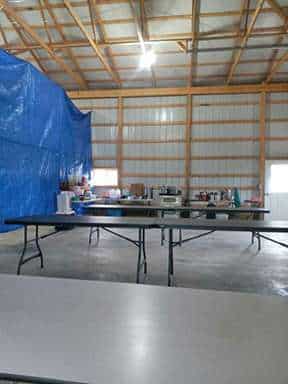
It was a cold, rainy day on Sunday when communion services were held at Dustin and Loretta’s. It was a challenge to keep the pole barn heated. It isn’t insulated, so quite a few tanks of propane were burned to heat the big building. The barn was divided in half with canvas hung from the rafters. On one side, the benches were set for the church services. On the other side, tables were set up as well as a small area for a nursery for the mothers with small children and babies.
For those of you new to this column or the Amish lifestyle, I’ll try to explain how we do communion.
Everyone gathers by 9 a.m., and church services start at 9 or before. Around 11 a.m., we (the family that hosts church and their help) have lunch ready. Tables are set, one for the men and one for the women. With our church being so big, we set a third table for the young boys and girls to eat at. At each place setting is a glass for water, a cup for coffee or hot water, a bowl, spoon, fork, and knife.
On Sunday, we could serve 50 people at once. On the menu was chicken noodle soup (I made four 12-quart kettles), homemade wheat and white bread, ham, cheese spread, peanut butter spread, pickles, pickled red beets, hot peppers, strawberry jam, butter, coffee and spearmint tea, and a variety of four different cookies (chocolate chip, oatmeal, sugar, and lemon). When someone was finished eating, their spot at the table would be cleaned and reset. By 12:30, everyone was fed and back in the services.
Around 3 p.m. communion is held, with the bread and wine being passed out, then the feet washing, etc. By 4 p.m. everything is done, and everyone leaves for home. Grandson Isaiah (Ervin and daughter Susan’s son), 4, was sitting beside me when the members were washing each other’s feet. He was trying to figure all this out. I asked him if he wants his feet washed and he said, “No, I do not want to.” He was quite entertained watching one after another come to wash their feet. It made me smile to see him so deep in thought.
It was a long day for Loretta, but she is glad everything is now cleaned and back to normal. Grandson Denzel popped through his first two teeth! He holds his mouth different trying to feel the teeth. He can feel something is there now and found out pretty fast to not chew on his fingers. His two top ones are almost through, too.
On Monday, Ervin and Susan’s four children, Jennifer, 5, Isaiah, 4, Ryan, 3, and Curtis, 3, were here while Susan went to help in preparation for a wedding that she will be cook at on Friday. Kaitlyn, 6, was in school.
Today our plans are to all go help niece Elizabeth (Manuel) clean. Elizabeth and Manuel will host next church services at their house.
Daughters Loretta and Lovina and I will go together with our horse Midnight and Dustin and Loretta’s buggy. Their buggy is a handicap buggy and has a lift in the back so Loretta can get in with her mobility scooter. Also going today to help are sisters Verena and Emma, nieces Emma and Crystal, and daughters Elizabeth, Susan, and Verena. I made a casserole, and Loretta made a salad to take along. It’s nice to have lunch made so we can keep cleaning. God’s blessings to all!
I will share the cheese spread recipe. It is also in my cookbook, The Essential Amish Cookbook.
Homemade Church Cheese Spread
6 pounds processed cheese spread (Velveeta)
1 1/2 cups butter
8 cups cream
Put all three ingredients in a big roasting pan and bake at 150-200 degrees Fahrenheit, stirring every 15 minutes, until all is melted.
Cover with plastic wrap to prevent it from getting a crusty top while cooling. The spread is served on a sandwich with or without meat. It is good just spread on bread with some pickles.
Lovina’s Amish Kitchen is written by Lovina Eicher, Old Order Amish writer, cook, wife, and mother of eight. Her newest cookbook, Amish Family Recipes, is available wherever books are sold. Readers can write to Eicher at Lovina’s Amish Kitchen, PO Box 234, Sturgis, MI 49091 (please include a self-addressed stamped envelope for a reply); or email [email protected] and your message will be passed on to her to read. She does not personally respond to emails.
NOTES TO EDITORS: text=716 words; end material=75 words
Contact: [email protected]; 316-281-4413
Creek Plantation, Martin, South Carolina, will receive the Best Remuda Award from the American Quarter Horse Association (AQHA).
It recognizes Creek Plantation’s dedication to producing outstanding working ranch horses, said Karl Stressman, AQHA president.
William S. Morris III began Creek Plantation in 1968. Today, the operation produces working American Quarter Horses for use in its 2,000-head commercial cattle operation.
The family run Creek Plantation has bred more than 1,750 American Quarter Horses. They have earned more than $3.2 million in competition across various disciplines, including 81 AQHA Registers of Merit.
Creek Plantation features a commercial horse, cattle, and timber operation combining Morris’ passion for land and resource stewardship. It is southeast of Augusta, Georgia, on the Savannah River where rolling upland hills give way to the flood plains.
The horse program began in earnest with the purchase of the stallion King Of Clubs and five mares in 1970. Through the years, the program grew slowly, with emphasis on performance, disposition, and conformation in foundation bloodlines.
During the middle ’70s, a large-scale breeding program was developed with a definite focus on the production of cutting horses. The basic plan was to assemble outstanding mares from the three foundation families of King, Old Sorrel, and Leo.
These mares were then outcrossed on the Doc Bar bloodline. It was determined that stallions from each family would allow production of the line-bred foundation breeding stock within each family.
In 1984, Creek Plantation became a shareholder in Smart Little Lena. After a brief lease, Morris purchased Tanquery Gin, from B. F. Phillips, AQHA Hall of Fame inductee.
“The Best Remuda Award recognizes dedication to raising conformationally correct, good-minded working ranch horses,” said Karen McCuistion, AQHA programs director.
“For more than 50 years, Creek Plantation has done just that. We are honored to recognize their efforts in raising high-quality, using American Quarter Horses.”
In addition to the agribusiness operation, Morris is chairman of Morris Communications LLC. The corporation produces the Road to the Horse colt-starting event and owns the National Barrel Horse Association. Morris contributes to disciplines across the board to support his fellow horsemen.
Creek Plantation will receive a specially designed award during the AQHA Breeder Banquet at the AQHA Convention in Las Vegas.
CUTLINE
Creek Plantation, Martin, South Carolina, will receive the Best Remuda Award from the American Quarter Horse Association (AQHA).

It’s been my observation that real horsemen who know how to ride also know how to fall. This is a true story of one who didn’t.
I used to work ring at a lot of horse sales: Quarter horses, Thoroughbreds, Arabs, Paints, Appaloosas, fast horses, slow horses, warmbloods and horses that were not so hot. It was always exciting to sell a multi-million dollar race horse or an $18,000 mule. I also remember the low-lights, like the consignment sale back in the 1970’s when only 10% of the horses sold because the consignors thought too highly of their horses. There is one episode that stands out above all the rest.
At Quarter Horse sales it has been a tradition that the consignor would ride the horse into the ring and spin him around so fast that everyone sitting in the front row ended up with a pile of wood chips and the byproduct of digestion in their lap. At the auctioneer’s coaxing the rider would then dismount and remove the saddle so that everyone could see the horse’s back. At every sale there was a very young kid piloting the horse to show how gentle the horse was and there’d also be at least one knucklehead who, when asked to dismount by the auctioneer, would instead stand up in the saddle and twirl his rope. I’ve also seen them crack a whip and one numbskull even fired off a blank round that made the pavilion shake, but the horse slept right through it. Later the new owner discovered that his newly acquired horse was deaf and dumb.
Standing up on the saddle was the rider’s moment in the sun; his 15 seconds of fame, so to speak. I’m using the masculine instead of feminine here because I’ve never seen a female perform such ridiculous antics. Or, I should say, attempt to. I’ve witnessed a few disasters when the horse either moved a little, or in one case left the building entirely with great urgency after the consignor lit a cherry bomb which he’d obviously NOT rehearsed with his horse prior to the sale.
The worst crash landing I ever saw occurred in front of 2,000 hushed spectators when the horse in the ring backed up a half-a-step causing the rider to fall with great velocity right on top the saddle horn. I swear you could hear the THUMP two counties away. The rider didn’t really fall off the horse as much as he melted off it with his only padding being the handkerchief in his back pocket. The crowd let out a collective “ooow” as the rider alternated between being beet red from embarrassment and “A Whiter Shade of Pale,” to quote the song. As the rope he’d been twirling fell down around his shoulders the embarrassed rider hunkered down on one knee trying to resume normal breathing, suffering terribly from what we can only politely describe as “a groin injury.” It’s a feeling only a man can explain but really there are no words in the English language to adequately describe the extent of the poor man’s suffering.
Meanwhile the bidding on the horse stopped cold and the auctioneer gaveled down the horse for two-thirds of its real value to a rancher friend of mine. As the auctioneer tried to coax the rider out of the ring so we could resume our business the rider walked what we would call “a little daintily.” A bystander carried his saddle out for him in an act of compassion.
A couple years later I ran into my rancher friend who purchased that horse and I asked him whatever happened to the rider. “He quit training horses after that,” my friend replied, “and who can blame him? I hear he still walks a little funny, hasn’t sired any offspring, he went from singing bass to soprano in the church choir but there is one bit of good news: he’s no longer cross-eyed. But that horse I bought from him sure turned out to be a dandy. Initially I bought him to add to the remuda but when I saw what a great horse he was I saved him for my own personal use. Whenever I call out that horse’s name it reminds me of that sale. We call him THUD!”
Even though no early morning hunt has ever failed to provide me something entertaining to see or hear from God’s Creation, the older I get, the more difficult it has become to drag my aging carcass out of a warm bed to head to the deer blind or the turkey woods. Yet here I sat, bundled-up on my camp chair in the chilly darkness, hoping to at least figure-out where to best get a shot at a strutting gobbler another day, if nothing else.
I hunt on family-owned ground where there has been a small flock of turkeys every year since I can remember, but those turkeys are also notoriously hard to hunt in the morning. They roost in a several acre woodlot / pasture where they are difficult to get near unseen and unheard, plus there are several different directions available for them to go once they’re on the ground for the day.
I had built myself a small makeshift blind, just enough to break-up my silhouette, in an area of trees and overgrowth along a drainage ditch that stuck out into the surrounding wheat field. In the meager light from my headlamp, lugging my shotgun, decoy and chair, I clamored down a steep bank and followed the drainage for a hundred yards to where the brushy area stuck out into the field. I put the decoy out beyond the trees where it could be seen from where the turkeys would begin their day, then began making my way to the blind. In the daylight, I had tried to clear a path, but on this unusually calm morning, the leaves and debris littering the ground surely made every measured step I took sound like fireworks to roosted turkeys. I found the blind, sank into my chair, adjusted my shooting stick to hold the shotgun at the right height then sat quietly to listen.
In the darkness, three gobblers began to rustle around, gobbling at every noise. I sat facing north, and the turkeys were roosted a couple hundred yards to my right. When the sun had crawled up onto the horizon enough to see around me, I used a box call to shout out my best imitation of a sad lonely hen, hoping to cause the three lovesick gobblers to see my decoy as a lost lady they could corral into their harem. I had two calls that each made different pitched sounds, and I tried to alternate between the two to give the three “fellas” different sounds to think about.
There is possibly no greater debate among spring turkey hunters than what calls to use, and when & how often to use them. I probably call too often, but when a tom is constantly gobbling, I have a hard time sitting there quietly and not answering his every cry. The other camp says that once the tom knows the decoy is there, calling sparingly better entices him to approach her, which is exactly what I wanted.
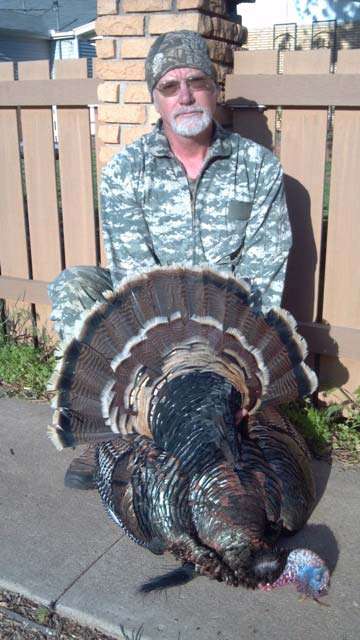
I could hear that two of the toms had gone the other direction and were probably in a nearby hayfield, but the third hung around. I only got occasional glimpses of him through the trees, but I could tell he was gobbling, strutting and moving back-and-forth like a mechanical target at a carnival shooting range. Finally, after a good twenty minutes of acting like he was “all-that” in hopes of enticing what he saw as a “lost hen” to come to him, the gobbler went completely silent. Now, I have read many stories by turkey hunters who have given up on a gobbler when they suddenly became silent, only to later catch them sneaking quietly up on them and their decoy. I gingerly clicked the safety of the shotgun off and watched the edge of the trees and brush intently. Sure enough, there he came, slowly but steadily making his way along the trees toward what he saw as a hen he could claim as his own. He would take a few steps, then stop and fan his tail out completely, strut around a little then go forward some more. The decoy was placed well past where I sat so as not to draw attention to me, and when he passed me, I harvested my spring turkey. He was a nice young bird, probably hatched last year, that will taste great on the smoker.
The antics of wild turkey gobblers in the spring is something that must be seen to believe, so even if they can’t yet hunt, take a kid along turkey hunting to enjoy the show; trust me, they’ll be hooked. Continue to Explore Kansas Outdoors!
Steve can be contacted by email at [email protected].
© Rural Messenger
