
After several nasty scuffles, a long-heated argument has been settled with changes for the Kansas Governmental Ethics Commission, the agency that enforces the state’s campaign finance, conflict-of-interest and lobbyist disclosure laws.
Recently the Commission has been in Republican cross-hairs because the director, Mark Skoglund, had subpoenaed several party officials during an investigation into alleged campaign finance violations. Republicans, who dominate the House and Senate, responded with bills to throttle Skoglund, neuter the Commission and gut the state’s campaign finance and disclosure laws.
In the end, better heads prevailed. The governor’s chief of staff got involved as mediator. Opposing lawyers began talking, legislators relaxed, and compromise was reached. Most agreed to modest reforms, some of them needed. For example, Commission subpoenas will now involve the courts, and an administrative judge (rather than the Commission) will hear evidence to determine probable cause, and so forth.
Basic laws remain essentially the same, regulating the conduct of politicians and lobbyists, enforcing election finance and lobbying laws. The fiery components in this fight were dropped with promise of a special committee this summer to study state ethics laws and campaign finance.
This prompts discussion of this agency, its reason for being, and the trouble that incubated its creation 50 years ago.
*
By Autumn 1973, the ongoing Watergate scandal had provoked a burst of American suspicion and waning confidence in government. White House officials, one after another, began to sink under evidence from federal prosecutors. Vice-president Spiro Agnew pleaded no contest to tax evasion and resigned. President Nixon tried to stop the Watergate probe by firing the special prosecutor; instead, two U.S. attorneys general resigned one after the other, and a new prosecutor had emerged.
In Kansas, a Topeka grand jury investigated state architectural contracts and allegations of bribery and kickbacks. At every level of government, officials feared the effect of election-year indictments. (Politicians and contractors would go to prison.) Public trust had turned to doubt and cynicism.
In January 1974, the leadership of the Kansas Legislature declared that the session would be “the year of morality” in state government. Little could be done in Topeka about the crisis in Washington but in Kansas, legislators vowed to chip away suspicions of government with a fresh beginning.
Senate President Robert Bennett (who would be elected governor later that year) warned of “the perilous crossroads” at which democracy had found itself.
The commitment in Topeka was for new campaign finance and conflict of interest laws, and greater regulation of lobbyists. A new 11-member Governmental Ethics Commission would direct the administration and enforcement of those laws with a fulltime staff ‒ an executive director, six auditors and an attorney .
The legislation sailed through both houses and was signed into law. A few weeks later Lynn Hellebust, the Commission’s executive director, began a grinding series of public meetings across Kansas to explain the reforms; they would apply to every campaign chairman and treasurer for every candidate for public office in Kansas. The statutes were to shed light on private and corporate influence in campaigns, limit donations, and require prompt reports and audits. They ordered lobbyists to register and to report whom they represent and what they spend.
The early rolls of the Commission comprised citizens of statesmanship and integrity, among them former House Speaker Calvin Strowig, Kansas Supreme Court Justice Harold Herd, Nancy Kassebaum (later a U.S. Senator), retired editor Clyde Reed, and Michael Davis, dean of the Kansas University School of Law.
*
The road to reform was paved with good intentions, but with no provision for maintenance. In less than a year, legislators were criticizing the new laws. When reminded that they were complaining about laws they had themselves written, lawmakers began calculated criticism of the commission, accusing it of interpreting those laws too strictly.
Legislators seemed to believe that their hearts were pure, that problems with lobbyists and campaign money were Washington problems. Kansans should have no fear of foul play in Topeka, they said.
But in March 1975, a year into the new law, John Henderson, president of Washburn University and the first chairman of the ethics commission, resigned after he learned of threats against the school’s future state aid requests. A message went out that Henderson’s role as chairman could jeopardize the school’s programs.
Three months later Drew Hartnett, a distinguished attorney from Salina, resigned from the commission in disgust. Legislators, he said, “should not tamper with the commission for the same reason they should not tamper with the courts.”
(Next: Strife and suspicion)
Ethics fog (1)(First of three articles)

Topeka Angler Sets New Kansas Record for Crappie
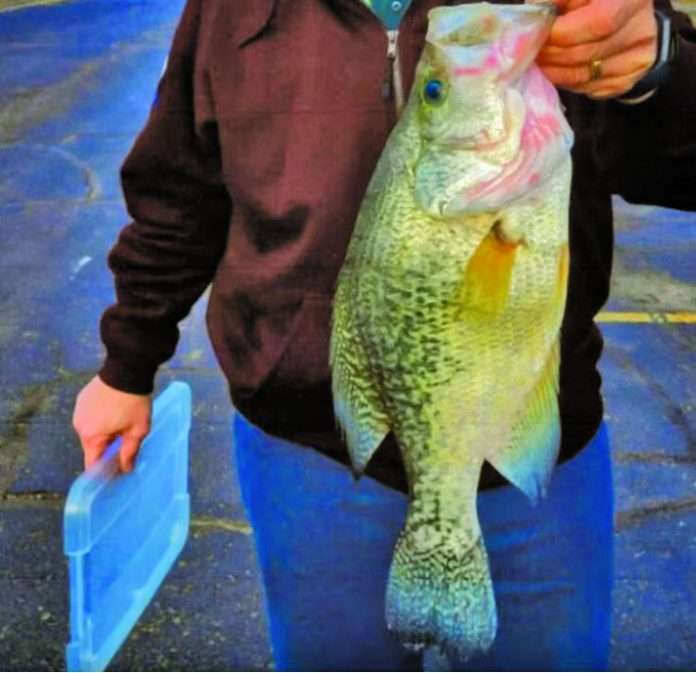
Topeka resident, Bobby Parkhurst, was fishing at Pottawatomie State Fishing Lake No. 2 when the catch-of-a-lifetime came into contact with his lure. Little did Parkhurst know that what loomed beneath the surface, ready to strike, would break a Kansas state record set the very same month, nearly 60 years prior.
The enormous white crappie caught by Parkhurst on March 5, 2023, was taken with rod and reel and a minnow as bait. After inspection and measurement by John Reinke, assistant director of Fisheries for the Kansas Department of Wildlife and Parks, the lunker catch was put on a certified scale where it was recorded as weighing 4.07 pounds – the equivalent of six cans of soup.
“As fisheries biologists, we get the chance to see a lot of big fish but this one is certainly for the books,” said Reinke. “This crappie measured in at 18 inches long and 14 inches in girth, so it truly deserves a spot on the state record list.”
The previous Kansas state record for white crappie was set in 1964 by Frank Miller of Eureka when he reeled in a 4.02-pound crappie that measured 17.5 inches long. Miller used a rod and reel and minnow, too.
Trophy catches such as these end up as a Kansas State Record if:
The fish is caught by a licensed angler using legal means
The fish is identified by a Kansas Department of Wildlife and Parks district fisheries biologist or regional fisheries supervisor
The fish is weighed on a certified scale prior to being frozen
The fish is photographed, in color, and a state record application is filled out
The mandatory 30-day waiting period has passed.
The 30-day waiting period for Parkhurst’s catch ends today, April 4, making his white crappie the biggest catch for the species in Kansas history. For now, that is.
Click https://ksoutdoors.com/Fishing/State-Record-Fish to see a complete list of current Kansas state record fish.
Caught a big fish but not quite a state record? Apply for a “Master Angler Award” and be recognized for your catch if it exceeds the measurements listed https://ksoutdoors.com/Fishing/Special-Fishing-Programs-for-You/Master-Angler-Award-Program.
For more on fishing in Kansas, visit ksoutdoors.com/Fishing.
Nature Stinks

One of my commandments is never write about politics and/or religion. To which I would add a third subject. Speaking from experience it’s generally journalistic suicide to write about manure. I know this because I once wrote a story called ‘The Many Sides of Manure’. The blowback from readers was almost as bad as the time I pulled an old loaded manure spreader with a cab/free tractor with a gale force wind blowing from directly behind me.
We’re all uncomfortable talking about this byproduct of digestion, so much so that we’ve worn out a thousand dictionaries coming up with words that sound more hygienic. Feedlot scrapers and lagoon builders are sanitary engineers and manure composting companies are called Environmental Services, Organic Inc. or The Green Corporation. You’d never know by their names that their gross profit really was.
I’ve always taken great pride in the fact that I’m a hard guy to gross out. I wasn’t even fazed back in college when we had to dissect cow pies to determine the effectiveness of dung beetles. (Talk about a creature that’s hard to offend!) I once judged an FFA public speaking contest where an ill-advised FFA member chose manure as her topic. It was a good speech but my fellow judges, a home ec teacher and a banker, turned white during the talk that left no cow pie unturned. I’m told many students have done their doctoral dissertations on the subject of manure management, which I’d think would be hard to brag about in a job interview.
The former opera singer Mike Rowe starred in a reality TV show called Dirty Jobs in which he tried to make our unattractive jobs look sexy. Mike looked great scooping pig poop but most of us are not that photogenic. So we hold our collective nose and clean water troughs, drain lagoons, load manure, drive tallow trucks, gut animals in packinghouses, and run the hot line behind a row of show cattle at the county fair. And who amongst us while working ringside or chuteside hasn’t had their mouth open at the wrong time when a cow on washy feed swished her mop-like tail?
Just for the fun of it, if you really want to make a city slicker turn green go into detail about how we get up close and personal with the reproductive tract of farm animals. Just the thought of sticking ones arm into the rear end of a cow is enough to make any urbanite have nightmares. The only thing worse than describing the preg checking or artificial insemination process is to inform them how a bull’s semen is collected! (I won’t go into detail here for obvious reasons.)
There really is a big double standard going on about what grosses out city folks. While they faint at the thought of sticking ones arm into the fistulated stomach of a steer they turn around and pick up their pooch’s poop with a plastic bag. Don’t give me any of that phony nasal sensitivity nonsense when they hold your nose every time they pass a feedlot but don’t clean their multi-user litter box in the kitchen for a month. And there’s not a wet feedlot or chicken coop in America that smells worse, or is more gross, than a bus stop bathroom, a broken septic tank, an unkempt parakeet’s cage or a jar of stink bait.
The fact is, nature stinks. And it’s not just animals. A bale of moldy alfalfa smells far worse than a feedlot after two inches of rain and the most my olfactory senses have ever been assaulted was when I drove through a town, that shall go nameless, that turned tomatoes into tomato paste. I swear, it was almost enough to make me give up pizza.
This is not to suggest that we don’t do some things in animal agriculture that come close to grossing even me out. Please don’t remind me of the time in high school when I had to castrate a lamb with my pearly whites. I almost had to go into therapy as a result and I’m still haunted by the memory. Now that was gross!

“I Can See Clearly Now”

Johnny Nash may have started his song with “I can see clearly now, the rain has gone,” but what about someone with cataracts. They cannot easily see “all the obstacles in their way”, and there are not “dark clouds that make you blind” like in the song, but cataracts do cause vision clouding.
Cataracts is the name given to the clouding of the lenses in the eyes. These lenses allow light to pass through the eye to the retina, where the signal is sent to the brain so we can perceive the world around us. Common symptoms of cataracts include blurred, clouded, or dimmed vision. They can also make it more difficult to see at night or cause “halos” around lights.
While anyone can develop cataracts, it is most common as people age, with over 50% of people over the age of 80 having cataracts. However, there are some infants who are born with cataracts due to genetic issues, trauma or infection prior to birth. Most commonly cataracts develop due to age related changes as the proteins and fibers that create the lenses of the eye break down or clump together causing clouding of the lenses.
Because cataracts typically develop slowly over time, the effects may not be obvious until the progression is advanced. While it is common for cataracts to affect both eyes, often one eye progresses faster or is worse than the other. Cataracts can also affect different areas of the eyes. The area affected will result in different problems with vision. Cataracts affecting the center of the lenses may cause issues with reading or yellowing of vision. While cataracts at the edges of the lenses causes issues with judging distance, difficulty differentiating colors, and can cause double vision in the affected eye. The last type of cataracts is when the back of the lenses are affected reducing vision in bright light and making reading difficult. This type also tends to be faster growing than other types of cataracts.
Factors that can increase the risk of developing cataracts include modifiable and unmodifiable things. Factors that you can change include excessive exposure to bright sunlight, excessive alcohol use, smoking, obesity, and prolonged use of corticosteroid medications. While age is the only truly unmodifiable factor; diabetes, previous eye injuries or surgeries, and high blood pressure can be controlled.
The most common treatment for cataracts is surgery. This surgery involves removing the clouded lens and replacing it with a clear, artificial lens. Once placed, these lenses are permanently left in the eye. This is generally an outpatient surgery, meaning you do not need to spend the night in the hospital. The procedure is relatively quick with low risk of complications. Most people heal within a few weeks. Afterwards you can enjoy “that rainbow that you’ve been praying for” and enjoy every “bright, bright, sunshiny day!”
Jill Kruse, D.O. is part of The Prairie Doc® team of physicians and currently practices as a hospitalist in Brookings, South Dakota. Follow The Prairie Doc® at www.prairiedoc.org and on Facebook featuring On Call with the Prairie Doc®, a medical Q&A show providing health information based on science, built on trust, streaming live on Facebook most Thursdays at 7 p.m. central.
