Tuesday, March 17, 2026
Home Blog Page 828

Unhappy Hour

0
lee pitts

If you’re a country music fan, like me, you’ve no doubt heard the song, “Tequila Makes Her Clothes Fall Off”. Well, my wife doesn’t like Tequila but white wine does make our VISA card run hot.

You know how wives are always complaining that their husbands never take them anywhere? Well, for the 40 years I was a road agent I took my wife places even she didn’t want to go, like the cocktail parties I drug her kicking and screaming to the night before big cattle auctions.

“Do we really have to go?” she’d plead.

“Yes, it’s part of my job and if I didn’t show up it would hurt the host’s feelings who just spent $3,000 advertising his production sale with me.”

Usually these events were harmless but I also took her to happy hours the night before big cattlemen’s conventions that were usually sponsored by a big drug company and featured a no-host bar. I usually found these events to be a big bore because alcohol hasn’t touched my lips for over 30 years and my wife has never been a big drinker either, although she’d have a glass of white wine or two. Such events were also harmless unless they also featured a silent auction. WARNING! DANGER! The combination of alcohol, an angry wife and a silent auction can put you in the poorhouse!

I blame the problem on purebred cattle breeders. If you’ve ever taken the time to notice at cocktail parties the men are usually hovering around a purebred breeder who is talking about what bulls a rancher should breed his cows to. (His of course.) I found such discussions stimulating because I learned a lot about what bulls were hot and which ones were not and because I found the subject of animal breeding very interesting. The problem arises because wives would rather have their fingernails ripped off than listen to men talk about EPD’s, sire summaries and DNA. My wife is a really quiet person and she’s the best listener I’ve ever met but even her eyes start to glaze over and roll to the back of her head after listening to ten minutes of EPD numbers. I realize this and so I try to turn the subject around to something the wives would be interested in but I have no idea what that would be. I try to talk about sports and computers thinking this might interest them but all the men turn the subject back around to pedigrees, rate of gain and loin eye area. This is when things can go terribly wrong for a family’s fortune.

Too late, the men will notice that their wives have wandered off and where do they always go? Stupid question. Where do wives usually go when they’re mad? Of course, they go shopping! This is where the silent auction comes in. Wives have somehow figured out how to turn a harmless cocktail hour into a competitive shopping event.

Knowing this in advance I try to corral my wife the minute she starts meandering towards the silent auction where all the other wives are congregating and taking taking turns bidding against each other. The reason I quit going to cocktail parties was because I couldn’t keep tabs on my wife 100% of the time. Realizing too late she’s escaped the scintillating discussion we menfolk are having, I’ll rush over towards the silent auction. “Where have you been?” I ask.

“Oh, I’ve been doing a little shopping.”

“Uh, okay. Did you find anything to buy?”

“A few things.”

“I’m tired. Don’t you think we ought call it a night? You’re the one who didn’t want to come to this party in the first place,” I remind her.

“You go ahead honey. I’ve got to wait around until ten when the silent auction closes.”

“So far how much would you estimate this free cocktail hour is gonna cost?

“Thus far I bought a 4-wheeled wheelbarrow for only $1,200, one night at Motel Six for only $350 and five 100 pound bags of dog food that we’ll have to take to our room when the auction closes. And I’m in an ongoing battle to see who gets the $100 gift certificate to that new restaurant I’ve been wanting to try. I’m ahead but I’m afraid Gloria is gonna up my $700 bid.”

Cecil “Tom” Thomas Litchfield

0

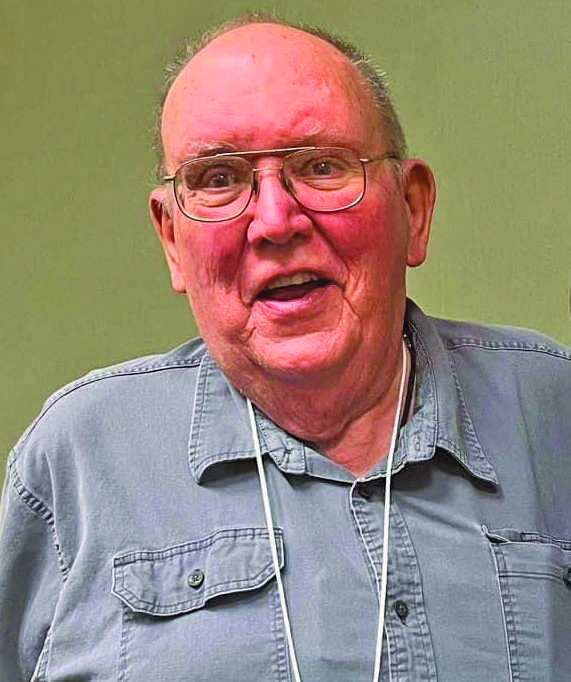
Our hero, Cecil “Tom” Thomas Litchfield, extraordinary story & joke teller left us on January 13, 2023. We are certain the first thing he did was tell God his latest joke & then a grandkid story as these were his favorite things to do on this earth.
Dad was born to Lloyd Thomas & Helen June (Reynolds) Litchfield on November 27, 1940, in a farmhouse north of Preston, KS. He loved telling people he wasn’t born in a city, but on the NE corner of the farmstead and his sister Lucretia on the SW corner, in Pratt County. He spent his youth in Cunningham KS., before his family moved to Medicine Lodge, KS., where he graduated High School in 1958. Dad enjoyed his HS reunions & the Medicine Lodge Peace Treaty & treasured the decades of friendships he had with his former classmates. After graduation, Dad served in the Army in Germany from 1962-1965, being honorably discharged, then spent 3 years in the Army reserves. He decided to continue his education at Hutchinson Community College & graduated from Salt City Business College. He worked in various salt plants for 35 years before retiring. During retirement, Dad delivered/picked up cars for Midwest that took him daily to different towns across KS & NE. The Rural Messenger was his final ‘job,’ working for one of his best friends, the late Mike Alfers. He liked to joke that he started his working career as a paper delivery boy and ended it the same way.
Dad married Judy Ewing on November 27,1967, to this union they had twin daughters Sheila & Sonya. They later divorced but remained lifelong friends, spending holidays & family events together. At one of the dinners his granddaughter asked him, do you know my Grandma Judy, to which he replied, Yeah, I might have met her before. Humor & sarcasm were staples in our family, most often referring to Dad’s stellar driving skills. Dad tried marriage two more times, but alas he was meant to be single and ready to mingle! He loved telling us that each of our marriages are longer than the three of his combined.
Dad felt his greatest blessings after his twins were his grandkids, Tara Esguerra (Josh Hearne), Jacob Goalden (Spencer), Cody Martin (Sara), Kaitlynn Goalden, & Darion Esguerra (Bailey). His 2nd favorite title after Dad was Papa & were the absolute joys of his life. He spent his time going to all their various sporting events. He was often heard from the stands telling the refs what a wonderful job they were doing in his own special “Tom” way. The joke was whichever daughter’s kid was playing had to sit with Papa to keep him controlled & not get thrown out. He traveled many miles watching his grandkids in whatever sport they were playing. He loved watching them play football, softball, baseball, basketball, & volleyball. Fridays were “breakfast with Papa” day. When they reached school age, then it was Sunday lunch with Papa. He would squeeze in breakfasts, lunches & dinners whenever they were available. His great-grandkids, Aydan Wieser, Patch Esguerra, Maverick Esguerra, Delaynie Goalden, Porter Goalden, & Ezra Martin lit up his world more. He loved to travel, do trips to Dubuque, IA. & Watford City, ND to see them were no problem.
Dad turned his life over to his higher power & AA on May 16, 1967 & began his 12 steps to his sobriety. He became dedicated to helping so many others with theirs, until the day he died, with 55.5 years of sobriety. He went all over KS and to many states for meetings & annual conventions, he met lifelong friends who became chosen family. In 2004, he fell off a porch and broke both of his shoulders & an elbow. When the Dr. was stitching his face, he told Dad he would be sending him over to the hospital for surgery. Dad informed him he needed to wait until Monday, he’d not missed the Salina Round Robin in 19 years & he didn’t intend to miss this one. Short story, he only got a 19 yr. run streak with that Round Robin! Going anywhere would turn into a 2-hour event, as Dad would run into a friend or two. Instacart would have been awesome back when we were growing up – HA! Dad took us to so many states, & one year to Canada for vacation. We walked into a restaurant to eat, & someone called out “Hey Tom, good to see you,” we couldn’t even catch a break in another country- HA! We did enjoy the benefits of Dad’s meetings though, we got to meet a real-life Canadian Mountie & hold so many more of his treasured friends in our hearts forever!
When the Dr. came in to tell Dad the severity of his diagnosis & that without surgery, he would only have 2-5 days left, Dad didn’t miss a beat & said no to surgery. Dad told him since there were no guarantees he would survive the surgery, he had lived a very blessed life, he was good. Instead, he chose the next days to be with his family & friends, saying his goodbye’s, his way. We had 29 amazing days with him. Dad’s favorite thing to say during this time was that he couldn’t even die right & that he was flunking hospice. We are grateful for the love & care that Dad received at Pleasant View & Hospice House. The nurses & staff were fabulous & made his last days on this earth comfortable, peaceful, & full of love. We cannot thank everyone enough for all the care.
He is survived by his daughters & their spouses: Sheila & Augie Esguerra, Sonya & Mike Goalden; his beloved grandchildren & great grandchildren; sister, Helen Howell, brother-in-law, Frank Sheehy, & many beloved nieces, nephews, cousins & friends.
He was preceded in death by his parents; sister, Lucretia Sheehy, & brother-in-law, James T. Howell.
Per his wishes, Dad has been cremated & did not want a funeral. But we are having a come & go Celebration of Life at Inman Community building in Lambert Park, Inman KS, on Saturday, January 21 from 1- 4 p.m., with an AA meeting from 1-2 p.m. You can sign his book at Hutchinson Funeral Chapel & Crematory. In lieu of flowers, please donate to your local animal shelter/rescue, Hutchinson Hospice House, Pleasant View in Inman, AA, Oxford Houses, or your favorite charity and these can be sent in care of Hutchinson Funeral Chapel, 300 E. 30th Ave., Hutchinson, KS 67502. Dad loved animals, & now has been reunited with his 3 beloved rescue dogs, Molly, Rocky & Buck. Full obituary is at www. hutchinsonfc.com.

Ada H. Eash, 87

0

Ada H. Eash, 87, passed away at Mennonite Friendship Communities, in South Hutchinson, Kansas, on January 14, 2023. She was born at Haven, Kansas on August 5, 1935, the daughter of Harvey “H.E.” and Lena (Keim) Borntrager.
She was a member of The Old Order Amish Church. Ada was a homemaker.
On May 8, 1958, she married Perry E. Eash at Haven. They lived in matrimony 64 years.
Survivors include her five children, Ernest (Mary) Eash of Haven, Larry Dale (Loretta) Eash of Haven, Edith (Larry Allen) Keim of Haven, Marvin (Dorothy) Eash of Hutchinson, and Freda (Kenneth) Keim of Cashton, Wisconsin, 31 grandchildren; and 71 great-grandchildren.
Preceding her in death are her parents, 3 brothers, 4 sisters, and one great-granddaughter.
Family will receive friends Tuesday, January 17, 2023, from 2-4 and from 6-8 at the Larry Dale Eash residence; 10410 S. Obee Road, Haven, Kansas. Funeral services will be held at 9:00 a.m., Wednesday, January 18, 2023, at the residence at 10410 S. Obee Road, Haven. Burial will follow at the Yoder Amish Cemetery. Family requests in lieu of flowers, memorials be made to Enhabit Home Health & Hospice, in care of Ott Funeral Home, PO Box 217, Haven, Kansas 67543.

KU News: Grant to expand research that supports Kansans with disabilities and their families

0

From the Office of Public Affairs | http://www.news.ku.edu

Headlines

Contact: Jen Humphrey, Life Span Institute, 785-864-6621, [email protected], @kulifespan
Grant to expand research that supports Kansans with disabilities and their families

LAWRENCE — Building on more than 50 years of federal funding, a University of Kansas research center focused on intellectual and developmental disabilities has received a five-year, $2.9 million grant to expand its work that supports Kansans with disabilities and their families.

The grant from the Administration for Community Living, Office of Intellectual and Developmental Disability funds the core activities of the Kansas University Center on Developmental Disabilities, or KUCDD, based at the KU Life Span Institute. The center is part of a network of 67 such university centers.

The center’s core activities — research, community service, training and education, and information dissemination — directly benefit Kansans, said Karrie Shogren, a Ross and Marianna Beach Professor of Special Education and director of KUCDD.

“This grant will provide continued support for KUCDD’s efforts directly engaging people with disabilities and their families in research and training, in building inclusive communities and in disseminating information that has an impact in Kansas and across the nation and world,” she said. “This recognizes the power that there is in the community to partner to develop practices that work to change systems and promote self-determination for people with disabilities.”

To build on its history of improving outcomes for Kansans with intellectual and developmental disabilities, or IDD, and identify the most pressing needs in the disability community, KUCDD recently supported statewide listening sessions to capture the voices of people with disabilities and family members. Researchers focused on Kansans’ experiences with services, examined the impact of the COVID-19 pandemic on the lives of people with IDD and their families, and collaborated with schools and community partners to identify new and emerging education and transition needs. They also conducted feedback sessions with members of the center’s Consumer Advisory Council (CAC), research partners and Kansas developmental disability network organizations. The work identified:

1. the pressing needs of transition-age youth in Kansas, including concerns about moving from school to competitive employment, postsecondary education and community participation;
2. an increase in behavioral and emotional support needs across the life course due to social isolation and decreased supports during the pandemic;
3. the synergy and potential growth of the priorities pursued by KUCDD, statewide community and governmental partners, and additional university partners creating new potential partnerships, research directions and community services.

The new KUCDD grant will continue to provide infrastructure support for new projects to address these priorities and allow KUCDD to expand its focus on inclusive research, or research that is co-developed, co-implemented and co-disseminated by people with lDD. For example, in FY2022, the center received almost $6 million in additional federal and state funding supporting these priorities and will continue to grow this support in coming years.

“We seek to do good science that’s rooted in values,” Shogren said. “We want to be doing research that makes a real impact and is truly driven by this value of self-determination — that people with lived experience have the right to be centered in all phases of the research process, telling us what matters to them.”

KU Life Span Institute Director John Colombo said the center’s continued federal support means directly improving the lives of Kansans.

“Since 1969, KUCDD faculty and staff have led groundbreaking research in family supports, inclusive education, self-determination and positive behavior supports,” Colombo said. “This foundational work is a part of our commitment to impact policy, practice and research while promoting opportunities for empowerment, self-determination and inclusive community participation for people with developmental disabilities and their families.”

-30-

————————————————————————

KU News Service
1450 Jayhawk Blvd.
Lawrence KS 66045
Phone: 785-864-3256
Fax: 785-864-3339
[email protected]
http://www.news.ku.edu

Erinn Barcomb-Peterson, director of news and media relations, [email protected]

Today’s News is a free service from the Office of Public Affairs

“Extending the Golden Hour”

0

When I was a young physician, we talked with almost religious zeal about the “Golden Hour.” Early on, this principally focused on the idea that within the first hour after an injury, a patient needed to receive definitive treatment in order to maximize the chances of survival, and recovery. We usually interpreted this to mean that the patient needed to be in the hands of the trauma surgeon before this hour was up. We took ATLS classes so we could make sure that the patient in our emergency room got the best treatment we non-surgeons could provide, until the surgeon could take over.

Of course, in the rural upper midwest, the nearest surgeon, and even the nearest emergency room, might be more than an hour away.

Fortunately for those of us living in more sparsely populated areas, time to the surgeon isn’t the only factor that impacts our chances in an emergency. The care we receive before we get to the hospital matters. In fact, it matters a lot.

Gone are the days of “scoop and run” when the only goal of the first responders was to get the patient to the hospital as fast as possible. As with so many roles in modern society, a first responder today has a more complicated job. They need the training and flexibility to address what they see when they meet their patient. A person who has overdosed on fentanyl needs naltrexone, to reverse the opioid and get them breathing. A person in cardiac arrest needs a shock delivered, to restart their heart. A person who has lost a limb in a car accident needs the bleeding stopped. These things need to be done well before the patient could arrive in an emergency room, even if they were delivered there by helicopter.

Certainly some emergencies require care that is still well beyond what could be provided outside of a hospital. If they can receive it in time, approximately 25% of stroke victims could benefit from clot busting medications. Another 10-15% have strokes that are actually caused by bleeding. It’s a distinction that can’t be made in an ambulance, and the wrong call could be catastrophic.

We all know that the pandemic has radically changed the workforce. Employers around the country are facing a shortage of workers, from fast food to finance. Health care is no different. This includes ambulance services, where the situation is further complicated by the reality that many rural EMS providers rely on volunteer labor. Those volunteers need to know more than just how to drive the ambulance. They need to know how to provide effective interventions, to extend that “Golden Hour.” This particular labor shortage has grave consequences. It is quite literally a matter of life and death.

Debra Johnston, M.D. is part of The Prairie Doc® team of physicians and currently practices family medicine in Brookings, South Dakota. Follow The Prairie Doc® based on science, built on trust, at www.prairiedoc.org and on Facebook featuring On Call with the Prairie Doc® a medical Q&A show, streaming live on Facebook most Thursdays at 7 p.m. central.