
During the 1960’s there was an oil boom in Morrow County, Ohio where we grew up, and either there were no regulations on anything or no one followed them, because oil rigs appeared on tiny podunk patches of ground barely big enough to contain the equipment, and the drilling rigs were so thick and close together, that at night the countryside looked like the Emerald City. A company drilled a well on our place and told dad they hit oil, but one morning we awoke to find everything gone, oil tank and oil included, without him every seeing a cent. The area was left a mess, with lengths of oil well pipe, huge wooden timbers and chunks of steel cable laying everywhere in the weeds. The oil company never came back to clean up their mess, but Dad had decided to get something for our trouble in case they did, so he hooked onto several long well-casing pipes and drug them to a fencerow a ways behind the barn.
One of our favorite winter pastimes was rabbit hunting. We didn’t have a dog so we’d just wonder through the woods and along fencerows looking for tracks and rootin’ through weed and briar patches to kick out rabbits hiding therein. One snowy Saturday afternoon we departed on a rabbit hunting excursion that followed our usual route, starting behind the barn and turning right at the end of a short pasture, then following a drainage ditch that was overgrown on both sides with all manner of briers, blackberries and other stellar rabbit hiding places. Several inches of soft snow made for slow going, but the snow made rabbit tracks show-up like chocolate chips in pancakes. The drainage ditch ran for a couple hundred yards and where it ended against the next fencerow was where the high-jacked oil well pipes resided. Rabbit tracks littered the ground all around the pipes; one pipe in particular had a highway of tracks going into one end but none going out the other. A quick glance inside showed complete darkness, telling us Brer rabbit was certainly holed up inside. Eureka! But it seemed terribly unsportsman-like, even to us just to shoot him in the pipe, not to mention a complete waste of tasty rabbit meat, so how would we get him out? Surely pounding on the outside of the pipe would get him moving. With Ralph standing near one end, his old 12-gauge canon at the ready, I proceeded to jump around on the pipe. I tap-danced, kicked, beat and pounded all up-and-down one end of the pipe, but nothing. Since we couldn’t actually see him in there, maybe he was facing the other direction, we thought, so we traded ends and tried again, still nothing. Somewhere we found a long stick of some sort that reached part way through the pipe. While Ralph stood on guard, I poked and prodded from both ends, but still nothing! Curses, we were getting’ nowhere! Then suddenly I had a two-word epiphany that would solve our problem; John Deere!
We hiked back to the barn, started the old JD 3010 with a loader on front and headed through the snow back to the pipe. As we chugged along, we could almost taste the freshly fried rabbit, as surely no cottontail alive could keep its footing inside an oil well pipe with one end hoisted toward the sky. I swung the tractor around in front of the offending pipe, slid the loader bucket beneath it and lifted it a few feet in the air, all the while awaiting the thunder of Ralph’s old 12 gauge as Brer came sliding out the other end. Nothing, so I hoisted the pipe even higher, and still nothing. What, had we found a bionic bunny with 4-wheel drive? I dropped the pipe back into the snow, pulled it away from the fence and slid the bucket under the other end. This would surely do it we figured. Once again, I raised the pipe, awaiting the roar of the 12 gauge, and once again, nothing. I tried it all; jerking the pipe up and down, dropping it onto the ground with a thud, even sticking one loader tine into the end and whipping it up-and-down like a symphony conductor’s baton, all with the same results…nothing! If ole’ Brer was in there, I suppose by then he was either dead or passed out from fright. It was about then the realization hit us that whatever was blocking the pipe might not be a rabbit, but a clod of dirt dad scooped up when he dragged the pipe to its new home, a nest of some sort or maybe a dead possum. Lucky for us it was not a skunk! I have a friend that was bit by a skunk that came sliding out of an irrigation pipe. Anyway, whatever was in there was either inanimate or dead and was not going to taste real good fried, so we accepted defeat and moved on.
Guys stake down old barrels in lakes as lairs for catfish, often noodling big flatheads out of them during the summer. Maybe we should have looked into renting out our oil well pipes to neighbors as “cottontail condos,” accepting a bunny or two each year as payment. With all the forgotten, left-behind oil well pipes there must have been in that county, we could have had dozens, perhaps hundreds of cottontail condo rentals. We could have become real estate moguls while we were still in high school! Yup, I can see it all now; Cottontail Condos, the full taste of the wild for only half the work! Continue to Explore Kansas Outdoors!
Steve can be contacted by email at [email protected].
Farm Kid Rabbit Hunting
The Tree Farm: A Christmas story
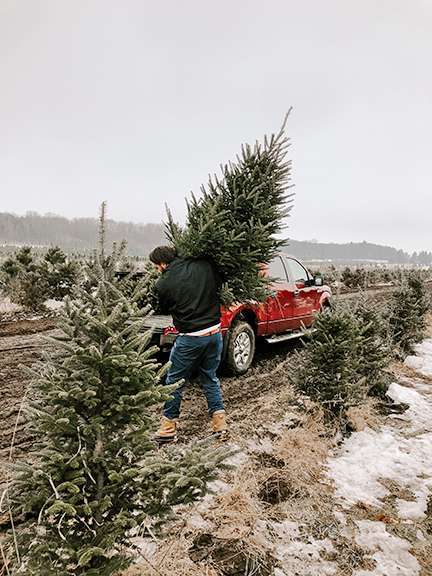
For generations, the MacDowells had sold cut-your-own Christmas firs. But was it time to exit now? Or was there a little magic left?
Greg BorowskiMilwaukee Journal Sentinel
Published 6:00 AM CST Dec. 15, 2022 Updated 6:00 AM CST Dec. 15, 2022
After a final pull of the twine, Clifton MacDowell tugged at the tree to make sure it was set, tapped the rooftop and offered a wave as the car rolled down the long driveway, into the blur of snow. It was evening, the snow-filled sky and snow-covered ground blending into a gray broken up by only the long rows of Christmas trees on either side.
MacDowell watched the car fade into the distance, waiting for the wink of the brake lights before the turn onto Highway 19, east toward town. It was the last car of the day, bringing it all closer to the last day of the season. He pulled down his hat, shook off a shiver and hunched his shoulders under his faded old coat.
He had to round up his granddaughters, and knew even before turning which one would be missing.
“Sarah Jane,” he called out.
Inside the battered old shed, a teenage girl startled to attention, a thump as her feet dropped from the ledge to the floor, then a bang as she swung open the door. A single bulb lit the inside of the shed, casting her shadow across the ground.
A string of white lights ran from the top of the shed to a nearby tree. There was a stack of wreaths, all with perfect red ribbons, resting on a bench. Dozens more sat on the ground or leaned against the shed. He had been too optimistic again this year, what with the economy. The whole situation had left him surly and sour, conflicted about whether it was time to listen to his doctor, his family and his tired old bones and call that developer back and sell.
“Addy, where’s that sister of yours?” MacDowell asked.
“Sarah Jane?”
“Is there another?”
Addison, now 14, did that teenage thing, where she wanted to smart back, realized this was her grandfather she was talking to, and offered a sheepish shrug instead. Sarah Jane was only 10, and Addy was supposed to be watching her, but instead had gotten lost in a book.
“She came in a while ago and said she needed her mittens,” Addy said.
MacDowell waited. Addy gave a slight shake of her head, as if even she didn’t believe what she was remembering, then continued:
“She said she needed them because the reindeer’s foot was bleeding.”
There was a set of small footprints, heading off into the trees. Every few feet, there was a spot of red.
“Come on,” MacDowell said. “This way.”
Was it finally time to sell?
The tree farm had been in MacDowell’s family for four generations. It would have been five, if his son had shown any interest along the way – six if it could be handed off someday to the girls.
But now its future was uncertain, and fading.
As a boy, MacDowell’s grandfather had once walked him along the rows and told him all he needed to make a go of the Christmas tree business was a strong back, a little sunshine and a lot of patience. And that was true for a long time. But now every year the business danced on the edge of unpredictable prices and changing tastes that always made it seem as if he had planted the wrong varieties a decade ago.
MacDowell wasn’t sure when the place had lost its magic. Maybe it was when he got that new hip, and his walk became more shuffle than stride. Maybe it was when Scout got too old to chase along on those mornings when he walked the rows with a pruner looking for wayward branches. Maybe it was when Eleanor passed and he was left to puzzle over the books himself.
But when the family gathered at Thanksgiving and voted again on whether to sell, he was the lone holdout, though really only his vote mattered. So, that evening he repainted the sandwich board sign – “Christmas trees, you cut” with an arrow – and set it out the next morning.
The farm had made his father a living, had sent him to community college and sent his own son off to the state university. It provided a comfortable routine. In the spring, he would plant the seedlings. In the summer, during dry spells, he would lug buckets of water from the faucet by the road. In the fall, he would mark which trees were ready to be cut and sold.
And on Christmas morning he’d make out his order for next year’s seedlings.
Amid the uncertainty, his son had sent the granddaughters out a week before Christmas to help tend to the customers. They were meant to pitch in, but Addy always had her nose in a book or was fiddling with some device, while Sarah Jane was always off exploring – as likely to build a snow fort as to chase a squirrel or to tromp out a “Merry Christmas” message with her footprints.
At least someone, MacDowell thought, knew the wonder of the place.
A mitten and a tear
Now, halfway down a row of trees, MacDowell stopped to catch his breath and spotted a bright blue mitten on the ground. It was one his wife had knitted for the girls. He stuffed it in his pocket, looked up and saw Addy pointing.
“She’s down here.”
Addy disappeared down the next row. McDowell lumbered on, turned and – before he could get mad – spotted his two granddaughters: Sarah Jane sat on the ground, her face red, tears ready to spill down her cheeks. Addy knelt next to her and had pulled her close.
There were spots of red on the ground. MacDowell scooped up a handful of snow, and realized the red was just the berries that had been set aside for the wreaths.
“Hey, little girl,” he said softly. “Did you get lost?”
He knelt next to them both, put his hand on Sarah Jane’s cheek, caught a tear with his thumb. She looked down and shook her head.
“Then why are you crying?”
“He was hungry,” she blurted out, and showed the remaining berries in her hand. “But you made him disappear.”
MacDowell looked around. There was no sign of anything, just a little girl’s footprints in the snow, and a spot where everything was tramped down – the spot where she now sat huddled beneath a blue spruce, maybe 8 feet tall. In the growing darkness, there was no sign of the second mitten. He summoned his gentlest voice.
“Who’s gone, honey?”
She took in a deep sniffle and looked up with the saddest of faces.
“Blitzen.”
‘Turn toward the magic’
Truth be told, Sarah Jane wouldn’t be one to get lost.
From the time she was old enough to visit with her sister, she made the tree farm her own. Where every year Addy grew more aloof, Sarah Jane was more excited, eager to learn about all the varieties, always ready to get the sled and help families haul the trees back to their cars.
She knew where to find trees with just the right shape, which had branches strong enough to hold heavy ornaments, and which variety had needles that wouldn’t drop until January.
But as each day passed, it became harder to keep her focused. While Addy was busy checking out the customers, and while MacDowell helped tie down the trees, Sarah Jane would only appear with talk of Blitzen and a new, different request: The first day, it was for a piece of wood. The next, it was cardboard, then tape, then string.
One morning, as Addy was filling her thermos for the day – always hot chocolate for the girls, black coffee for Papa – she saw Sarah Jane slipping extra sugar cubes into her coat pocket.
Now, the week had all but disappeared. It was the day before Christmas and, as the stragglers looked for a last-minute tree, Sarah Jane walked up and asked if she could borrow the blanket Addy kept on her lap in the shed.
“Are you kidding?” Addy replied. “Don’t you realize how cold it is?”
“But we need it –”
“Not Blitzen again,” she said, with an eyeroll.
“Just because you can’t see him,” Sarah Jane said, “doesn’t mean he’s not there.”
“Actually,” Addy replied, “that’s kind of exactly what it means.”
The girls had been through this debate before, and quickly fell into their familiar roles. Addy said it was time for Sarah Jane to grow up, to put all this Santa stuff behind her. Sarah Jane reminded Addy about the time they both had stayed up past midnight, snuck downstairs and saw Santa Claus eating cookies, and – shoot – why couldn’t she just believe her now?
“Just take the blanket and get lost,” Addy said. “But I’m tired of telling Papa you’re out helping customers when you’re not.”
There were enough customers that a small line had formed as the girls argued.
“Excuse me,” one woman said, stepping forward. “Did you say Blitzen?”
The woman wore a long, heavy coat. A knit hat covered her graying curls. Wrinkles danced around her eyes when she smiled, which she did now and added: “I haven’t seen Blitzen in a long, long time.”
When the two girls turned, she offered a wink toward Sarah Jane.
“Now, if Sarah Jane says she saw Blitzen, well, then I believe her,” she said. “And Addy, you should, too. How old are you now anyway?”
It was not unusual for customers to remember the girls or, it being a small town, to have heard all about who was in dance and who was playing tennis and who got braces.
“Fourteen.”
“Yeah,” the woman said, sizing her up. “That’s about when it happens. Once you hit a certain age, seeing is believing, but before that it’s the reverse – believing is seeing. And, I’ll tell you, I always try to stay on Sarah Jane’s side of things. That’s where the magic is.”
The woman was unrushed, despite the impatience of those waiting. She held a wreath under one arm, and a pocketbook in her hand. Her voice carried a gentle wistfulness, making the girls feel as if just listening to her could carry them wherever she was going.
MacDowell had walked up, and interjected: “I know what’s coming …”
And they both said it – he and the woman – one with disbelief and one with hope: “Always turn toward the magic.”
“Beatrice Merriweather,” MacDowell said, introducing her to the girls, then offering a hug. “Great to see ya, Bea.”
“Now, Clifton, you know it’s good advice,” she said, and looked toward the girls. “Once you start to believe, you’ll find yourself seeing things everywhere.”
MacDowell explained that Beatrice Merriweather had lived across the street when they were kids. They walked to school together (“Uphill both ways,” he said, nudging Addy), played in the field behind their houses (“Where the car dealership is now,” she said), and had all manner of adventures.
That included, Bea reminded him now, of the time she saw reindeer on his rooftop one Christmas Eve, and as proof that Santa had been there, the next morning showed him a mitten that had fallen to the ground (“He never did believe it,” she whispered to the girls.)
Truth be told, on that night, back at age 11, MacDowell had heard footsteps before he fell asleep. Had heard them clear as a bell. But when Bea showed him the mitten, he realized it matched one his father had been missing. And in a snap, the magic was lost, perhaps for good.
“Back to work now, girls,” he said.
Addy headed for the shed, but before she sat down, she passed the blanket out to Sarah Jane, who promptly excused herself and disappeared into the trees.
“By the way,” Beatrice said. “Your sign’s wrong.”
Addy offered a puzzled look, and the woman pointed. Indeed, the sign in the window beneath the shed’s window said: “Closed.”
Addy waited until no one was looking, then reached outside and turned it around.
Getting that guy home
After a while, as the customers wound down, Sarah Jane ran back up, out of breath. Her grandfather had just sent a car home, and two final families stood waiting to pay.
“He’s back,” she said. “Addy, he wants to see you.”
This time, Addy did not roll her eyes. Instead, she looked at her grandfather, who shrugged and nodded toward the tree line.
“Go,” he said, playing along. “Tomorrow’s Christmas, and we need to get that guy home.”
Addy turned and followed her sister, who zigzagged ahead. At one point, Addy slowed, thinking she spotted a hoofprint in the snow. She shook her head, and kept running. Finally, she turned a corner and nearly ran into Sarah Jane, who raised a finger to her lips.
“Ssshh,” she said. “He can get nervous.”
In the clearing, Addy spotted a cardboard contraption, criss-crossed with tape, pressed up against a fir tree. The blanket was spread on the ground. The snow around it was a mess of footprints, and some snow was piled to support the cardboard. Addy’s heart sank. There was nothing there. Why had she bothered?
But then there was the slight jangle of a sleigh bell, and a reindeer stood up from behind the tree and stepped – cautiously – toward them. The reindeer raised his head to sniff the air, shook his head quickly, and stomped a foot. A mitten was awkwardly forced onto a hoof, and his leg was stiff – a stick held in place against it with a wrap of yarn.
Addy slowly stepped forward, reached up and ran a hand along the creature’s neck, stopping at the collar. The reindeer snorted, blowing a dusting of snow from her shoulder. Addy took the silver tag and turned it over in her hand, revealing the letter “B.”
She glanced toward her sister, a look of wonder on her face.
“We were under the dining room table,” Addy said, closing her eyes, “and he was sitting in Dad’s favorite chair.”
The two said the next line in unison: “And then he dropped the cookie.”
Yes. That was what had happened: Santa dropped the cookie, and Addy pulled Sarah Jane back, and shushed her, as they took it all in. But somewhere along the way, Addy had relegated that memory to just a dream, or some made up thing. She had pushed the magic to the margins.
“You do remember!” Sarah Jane said. “You said you didn’t.”
“Well, I did,” Addy said. “And then I thought I didn’t.”
The blanket and the splint
By the time their father pulled down the driveway, the girls were on the bench waiting and caught him in a hug as he opened the car door. They tag-teamed what had happened: The reindeer, the injury, the blanket and splint.
“I see,” their father said, with an exaggerated nod. “So, it’s kind of like that time you guys spotted Santa eating cookies in my easy chair?”
“You don’t believe, do you?” Addy said.
“Let’s talk about it in the car,” he said. “Papa will meet us at church.”
“But you believe,” Sarah Jane said, looking at her grandfather. “You believe, Papa. Don’t you?”
He paused to consider it all. He wanted to, he really did. He wished he could see things like the girls, wished he could do what Beatrice had admonished, and always turn toward the magic. He remembered how as a boy he woke up each Christmas morning to notes from Santa left next to an empty cookie plate, and how he saved them in a box until a friend said it was probably just his Dad writing with his left hand.
He offered a warm smile, and said the most honest thing he could say:
“I’m trying.”
A burst of a jangle
After they drove off, MacDowell walked to the end of the long driveway, the snow again drifting down. He took the wooden sign, folded it closed, and set it on the sled.
As he pulled the sled back down the drive, he thought back to when he first painted the sign, to all the times he painted it. He thought about every time someone said he needed something fancier – flashing lights or bright flags or a snappy slogan – to make the farm go. He thought about how he had worked and finagled and strained to keep the place afloat, how hard it had become.
He realized it was time, and vowed to make the call next week.
It was dark now, so he tracked the tire marks in the moonlight, pulling the sled back to the shed, where the lone light bulb shined through the frosted glass. He leaned the sign against the wall and after a pause, he took a deep breath, and turned the sign to read “Closed.”
As he did, he noticed a glow in the distance. Families would sometimes leave lanterns or flashlights behind. He followed the glow into a clearing, but there was no flashlight, no lantern.
Instead, there was a small tree with a single string of white lights, a battery pack at the end. The tree was in a black, plastic pot, where it could stay until a spring planting. He reached out, mystified, and pulled off a wayward branch, as if to prove to himself it was real.
As he did, he felt a rush blow past him and heard a burst of a jangle, and turned. But there was nothing but the chill night sky. For a moment, he thought he saw a movement in the shadows, but shook his head free of the thought. No. There was nothing.
Then he spotted something on the ground, next to the tree.
He bent to pick it up – a hand-made mitten. It had been stretched and the yarn was stiff and discolored. He took out the mitten he had stuffed in his pocket a few days ago. They matched, of course. He thought about that mitten Beatrice had found so many years ago and her admonishment that afternoon: “Always turn toward the magic.”
He said it aloud, and hoped. He was trying.
As he approached the shed, his footsteps light and easy, he noticed a pair of long, thin tracks pressed into the snow, and something else. He took the branch from the tree, pulled loose a handful of needles and tossed them across the ground. When they landed, it revealed a cluster of reindeer tracks.
He stepped inside the shed to turn off the light. On the ledge there was a pink piece of paper – a receipt for a season’s worth of seedlings, with a “Paid” stamp in the corner. He picked it up and turned it over.
There was a message on the back – in a scrawl he recognized from his childhood.
He smiled and felt a warmth that belied the cold. He rummaged through the drawer and found a roll of tape, turned the paper around and taped it to the window, so that message could be seen by anyone who would happen to wander up in the months ahead:
“See you next Christmas.”
Greg Borowski, a Milwaukee Journal Sentinel editor, writes a Christmas story every year for his family and friends. Some of his previous Christmas stories are collected in two books, “A Christmas Wish” and the earlier “The Christmas Heart.” He can be reached by email at [email protected]. Follow him on Twitter at @GregJBorowski.
Slow Roasted Beef Tenderloin
If you’re looking for a main dish that looks as good as it tastes, then look no further! Our Slow Roasted Beef Tenderloin is fancy-looking and mouthwatering-good. This beef tenderloin is simply seasoned, cooked to perfection, and topped with a homemade mushroom sauce that’s absolutely divine.
Serves: 6
Cooking Time: 45 minutes
- 2 pound beef tenderloin
- Garlic powder for sprinkling
- Kosher salt for sprinkling
- Coarse black pepper for sprinkling
- 2 tablespoon vegetable oil
- MUSHROOM SAUCE
- 3 tablespoon butter
- 3 cup sliced mushrooms
- 3/4 cup dry red wine
- 3/4 cup beef broth
- 1/4 teaspoon salt
- 1/4 teaspoon black pepper
- 1 tablespoon water
- 2 teaspoon all-purpose flour
What To Do:
- Preheat oven to 300 degrees F. Coat a roasting pan with cooking spray. Sprinkle beef evenly on all sides with garlic powder, kosher salt, and coarse black pepper.
- In a large skillet over medium-high heat, heat oil until hot. Cook beef until browned on all sides. Transfer beef to roasting pan.
- Roast 30 to 35 minutes for medium-rare doneness. Let beef rest 20 minutes before slicing.
- Meanwhile, in the same skillet over medium heat, melt butter; saute mushrooms 3 minutes, stirring occasionally. Add wine, broth, the 1/4 teaspoon salt, and the 1/4 teaspoon pepper and cook 5 minutes.
- In a small bowl, whisk water and flour until smooth. Slowly stir into skillet and heat 2 to 3 minutes or until thickened. Serve mushroom sauce over sliced beef.
January Orientation Class for Prospective Childcare Providers

The Reno County Health Department will be offering an orientation class for those interested in becoming a childcare provider. The class will be held via the Teams app on January 5th , 2023, from 3:00pm to 5:00pm. Reserve your spot by calling Jeanette or Tammy at 620-694-2900. The cost to attend this adult only class is $20.
Reminder: state law requires childcare to be given in regulated facilities.
CHILDCARE CONCERNS SHOULD BE REFERRED TO THE RENO COUNTY HEALTH DEPARTMENT
If you have any concerns about a child’s care at a daycare or center, please call Jeanette or Tammy at 620-694-2900.
My Idol

My idol in the cattle business has been dead now for over a century but the lessons he taught are timeless. His name was Heinrich Kreiser but that was before the man used his political influence to get his name changed by an act of the California legislature to Henry Miller. (This was the name of the ship that brought Henry from Germany to the U.S.) You might recognize Henry more by his nickname, ‘The Cattle King’, or by the ranching operation he built (with a Frenchman named Charles Lux) called Miller and Lux.
Henry was a German butcher who was making a nice living feeding the gold miners and the gold rich boomtown that itself had gone through a name change from Yerba Buena to San Francisco. It didn’t take long for Henry to see there was more money to be made raising cattle than butchering them. So he spent $1.15 per acre buying up old Spanish Land grants and when he died he owned 1.4 million acres, making him the largest landowner in the U.S. (He controlled 14 million acres or 22,00 square miles). Using irrigation he began transforming California’s San Joaquin valley into the richest farmland in the world and when he died he was also the largest farmer in the country. He owned nearly 80,000 head of cattle plus all that land and was worth 40 million dollars, or a cool one billion in today’s money.
It was said that Henry could start at the Mexican border and ride in his buckboard, (never horseback) to British Columbia and sleep on his land and eat his own beef every night. But I doubt this story because Miller would never eat his own cattle but would dine on his neighbor’s beef instead.
A man after my own heart, Henry Miller got rich by being a penny-pincher. For example, there was a law in California at the time that proclaimed that state land that was subject to flooding and could be crossed by boat was worth less money. So Henry built a boat, mounted it on a wagon and ‘boated’ all over the state buying prime land for pennies on the dollar. I guess you could say Henry Miller was a ‘land pirate’.
When visiting his far flung empire Miller would go through cookhouse garbage to see if cooks were wasting food by being too aggressive in peeling the potatoes. If the peelings were too thick the cook got canned. There is also the well-documented story of how one day while being driven in his wagon across one of his ranches he stopped at a wire gate and in a fit of rage he retrieved his axe from the wagon and proceeded to chop the recently built gate into pieces and when he got back to ranch headquarters he fired the foreman and the cowboy who’d built the gate because he squandered Henry’s money by building the gate out of finished lumber.
Although he was kind to his horses he didn’t like for them to be too gentle because that made them easier to steal. He called well trained horses, “sheepherder horses”. Henry also assailed another foreman for using two cats to kill mice when one would do the job just as well. It was said that Henry lived to be almost 90 years old because he wanted to put off for as long as possible the costs associated with a funeral.
All of these stories are well-documented but there’s one story that may or may not be true but it sounds like something The Cattle King would do. With two friends Henry went to pay his last respects to a fellow rancher. As the three men looked at the body in repose in a coffin one rancher said, “Where I came from in Italy it’s a custom to leave a few dollars in the casket so that when the deceased met St. Peter he’d have some bribe money to buy his way into heaven.”
So the man tucked ten dollars under Henry’s pillow. The second friend did likewise but when it came to Henry’s turn the tightwad wrote the deceased a check for forty dollars, placed it under the pillow and took back the $20 in change.
