Wednesday, March 25, 2026
Home Blog Page 938

Ag Heritage Park Celebrates Fall & Barn Quilts; September 24

0

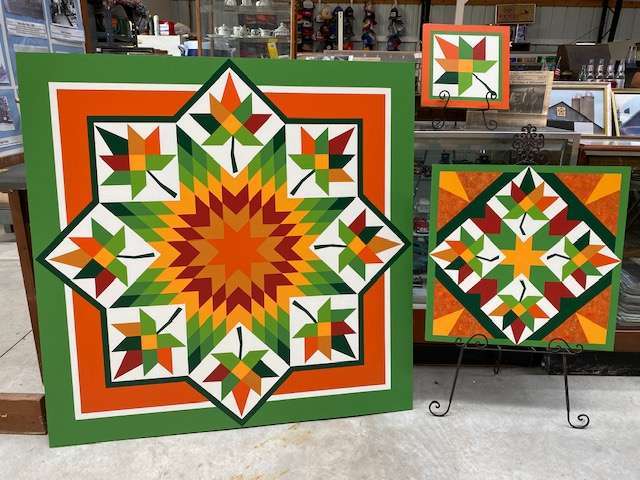
Ag Heritage Park plans a fun day Saturday, September 24th in Alta Vista, celebrating fall and barn quilts. The highlight of the day will be the barn quilt drawing scheduled for 3:30 p.m.


The barn quilt drawing offers three chances to win – the first drawing for the 4 x 4, a 2 x 2 drawing following, and then a third drawing for a two-sided 1 x 1. Connie Larson and Cindy Zimmerman have donated their talents for this popular means of supporting Ag Heritage Park. See the barn quilt details and ticket opportunities, including ticket availability using PayPal, at www.AgHeritagePark.com and Facebook. Tickets will be available on the 24th prior to the 3:30 drawing.


Plans for the day include fall décor, pumpkins, corn shocks, produce and more for sale and a fun barn quilt day is in the works.  Barn quilts will be on display with visitors welcome to display their artwork, and a barn quilt contest with the winner announced at 3:00 p.m. is planned. For the contest bring an 8 x 10 photo of your barn quilt on display at your home/farm, any size will be accepted for the contest. Also, an assortment of barn quilts will be for sale, benefitting Ag Heritage Park.


A bake sale, with proceeds for the upkeep of Ag Heritage Park will offer a variety of goods, and lunch, as well as snacks and drinks will be available all day.


Kids games, including ring toss, pumpkin walk, scavenger hunt and a craft table are planned from 10:00 to noon.  Of course, children of all ages will enjoy the exhibits of agricultural history at the Ag Heritage Park.


Ag Heritage Park, birth place of the Kansas Flint Hills Quilt Trail, will celebrate 10 years of the quilt trail, which blends the art of quilting with barn quilt artwork promoting  tourism and celebrating rural heritage throughout the Flint Hills. The organizational meetings developing the quilt trail were held in the fall of 2012. Quickly the Kansas Flint Hills Quilt Trail grew to be celebrated in 22 counties throughout the Flint Hills.


Visitors are encouraged to “Step back in time,” experiencing the exhibits in the museum and vintage buildings.  The Park, located at 103 S Main, Alta Vista, is handicap accessible, and will be open 9-4 on September 24th. Please follow www.AgHeritagePark.com and Ag Heritage Park Facebook for updated details on the schedule of events. You may call Connie Larson at 785-532-8393 or Kirby Zimmerman at 620-767-2714, for more info.

Frankfort Cowgirl Promoting ‘Western Life’ As New Miss Rodeo Topeka

0
Frank J Buchman
Frank Buchman

“I’m anxious to promote rodeo and the Western way of life to more people who don’t know about it.”
Macey Wapp, Frankfort, is excited to fulfill duties coming with her title as Miss Rodeo Topeka 2022-23.
Crowned at this year’s rodeo in the North Topeka Saddle Club Arena, the 15-year-old cowgirl competed in six pageant categories.
“I was so nervous shaking all over when they announced my name, it took a while to soak in,” Macey admitted.
Horsemanship, public speaking, modeling, interview, rodeo knowledge, and impromptu speech divisions were in the competition with three judges.
Runner-up for this year’s Miss Rodeo Topeka title was Evalynn Saffer of Lawrence.
“My experience riding and competing with horses since I was seven-years-old was sure to my advantage,” Macey commented.
She has participated in youth rodeos throughout the area and collected several highpoint awards in saddle club shows.
“I’m really fortunate to have a pair of outstanding horses to ride,” Macey appreciated. “I rode my sorrel mare called Ginger in the pageant because she has more experience in such activities. But my dark brown mare Snickers is a great rodeo event horse too.”
Serving as Miss Rodeo Topeka seems to be a Wapp family tradition. “My sister Sydney, 17, was the 2018-19 queen, so being crowned this year was extra special to me,” Macey said.
“I really appreciate the strong support given to me by my parents Joe and Jodie Wapp,” Macey acknowledged. “I count on Sydney and our older sister, Tiffany McGuire, also a cowgirl, for encouragement and advice.”
Joe Wapp works at the Frankfort Co-op, while Jodie Wapp is dietician at the Marysville hospital. “Mom is responsible for helping me with my outfits and other preparations,” Macey said. “Dad takes care of our transportation making sure my horses are ready to go at showtime.”
A freshman at Frankfort High School, Macey is a versatile athlete. Besides being a cowgirl, she participates in volleyball, basketball, softball, and track.
“I am really interested in agriculture, so I’m enrolled in vocational agriculture classes and plan to join FFA.” she said.
A leader in 4-H club work, Macey had the grand champion horse entry at the Marshall County Fair in Blue Rapids.
Excited about rodeo promotion in the months ahead, Macey has no plans for slowdown in horse event competition.
“I will continue participating in barrel racing and other speed events,” she said. “I’ve done limited goat tying and hope to expand that as well as possibly start doing some breakaway roping.”
While high school graduation is sometime away, Macey anticipates attending Highland Community College. “I intend to study animal agriculture and hopefully go on to Kansas State University in Manhattan,” she said. “I would like to be on the rodeo team and also participate in other college sports if it works out.”
Optimistic for rodeo, Macey said, “This great sport helps teach youth responsibility developing opportunities and relationships for all aspects of life. I sure expect to be riding horses and competing in rodeo events throughout my lifetime.”

CUTLINE
Macey Wapp, Frankfort, is excited to fulfill duties coming with her title as Miss Rodeo Topeka 2022-23.

Beware Of Those Grasshoppers

0

“Grasshoppers are sure a menace jumping around when going for a morning horseback ride.”
While there have been no cautionary reports about grasshopper problems this year, there are still a lot of the “bugs.”
It’s easy to see how the thousands jumping around just in a 50-acre brome field could cause damage when multiplied.
Can’t help but think how devastating grasshoppers were in the 1870s and Dirty 30s when swarming to blacken the skies.
People from the 1930s remembered swarms of grasshoppers eating entire crop fields, even farm implements and household items. The grasshoppers would eat anything.
Conventional wisdom was that grasshoppers liked salt, so they would eat wherever perspiration, sweat from livestock and people, landed.
Stan Jensen, a plant scientist, believes that there are natural fungi that control the grasshopper populations in wet years. In dry years, grasshoppers often will thrive.
Walter Schmitt remembered grasshoppers chewing wooden tongues of horse-drawn equipment to get the salt from the sweat that landed there. Others said grasshoppers chewed hoe handles.
Elroy Hoffman recalled being hit in the face by grasshoppers when he was doing tractor field work.
There were recollections of cars squishing so many grasshoppers that the roads became slick. Trains sometimes could not get up hills because the grasshoppers’ bodies “greased” the tracks.
Grasshoppers will hatch into “nymphs” that look like small adults but usually don’t have wings. Nymphs will grow and shed the hard outer casings of their bodies four to eight times before becoming adults. Finally, the adults arrive complete with wings and the ability to reproduce prolifically.
Farmers tried burning, plowing, capturing, and stomping the grasshoppers. Then they mixed wheat bran, molasses and saw dust with water and sodium arsenate. That killed the grasshoppers, but arsenic was hazardous causing respiratory problems for farmers.
Although it didn’t have any effect on populations, grasshoppers were used for fish bait in Beman Creek during the 1950s. Caught in a nearby wheat stubble field, the grasshoppers spit tobacco on hands before being put in a quart jar. On the fishing line hook, grasshoppers were snatched by six-inch bullheads every time.
Reminded that the plague of the locusts was the eighth that God sent upon the Egyptians. They would not let the children of Israel go, as He commanded. In Ecclesiastes12:5: “The grasshopper shall be a burden.”
+++ALLELUIA+++
XVI–37–9-11-2022

Horses Remain Integral Learning Experience For Generational Washington County Ranch Family

0
Frank J Buchman
Frank Buchman

“Three cowgirls with long braided blonde pigtails ordered around by a handsome teenage cowboy wearing shades riding a bay horse. Ample sideline coaching from a more mature blonde cowgirl on a palomino and a visibly hardworking farmer-rancher in bib overalls.”
Obviously, it’s a Keesecker ranch family affair where everybody has their own unique niche at the horseshow.
Bill and Quincie Keesecker with their twins Witt and Rowley, plus Kyah and Cooper are popular Washington County diligent workers.
“Living in a small town like Washington means you are often involved in everything,” Quincie admitted.
Bill grew up in a Washington County farming-ranching family, while Quincie was a “wannabe farm kid” in nearby Clay Center.
“Bill had horses and competed in 4-H, FFA, and rural school activities with his family as a youth,” Quincie said. “I always loved animals and my parents finally agreed to horse lessons when I was in junior high. I was hooked.”
Highlight of Quincie’s youthful years was being crowned the Clay Center Rodeo Queen. “I befriended everyone with horses and took every opportunity to ride,” she said. “I first went to Colby Community College and was on both the equestrian team and livestock judging team.”
Bill was on the Kansas State University rodeo team. “He trained young horses and became instilled with a love for reining on his favorite horse named Babe,” Quincie said.
The couple both graduated with degrees in animal science from Kansas State University and were married in 2005. They moved to their Washington County farm home as the fifth generation of Bill’s family to live on the land.
“We worked to fill the family feed yard,” Quincie said. “As the cattle came so did Quarter Horses to work on the ranch and in horseshows. Mares and baby colts were soon filtering through the pens too.”
Serving as 4-H horse leaders, the couple worked with their niece Lauren riding horses through junior and senior high school.
Witt and Rowley were born in 2009. “They were riding and traveling to horse shows before they could walk,” Mom said. “The Eastern Kansas Horseman’s Association (EKHA) helped build their confidence while riding in the six-and-under timed events.”
The twins joined the Farmington 4-H Club when they were seven years old. “Both enjoy showing horses and livestock,” Mom said. “As seventh graders, they are excited to start competing in junior high school sports.”
Witt rides a Quarter Horse called Doc. “They excel in the trail and horsemanship classes, and Witt has been working on building his roping skills,” Mom noted.
Rowley rides Porscha, a home-raised palomino registered Quarter Horse mare. “These two blond ladies are a tremendous team and love the ranch rail and pattern classes. Their goal is to be competitive in reining next year,” Quincie commented.
Kyah, eight, is a third grader and a 4-H member too. Riding her “sassy” Quarter Pony gelding Bailee everywhere, the pair is the “perfect match for determined personality.”
Loving all kinds of animals, Kyah already has her mind set to become a veterinarian. “She has a tribe of friends of every age, loving people just as much as dogs and horses,” Mom said.
Cooper, five, just started kindergarten. Riding her retired team roping heeling horse Jack, Cooper goes everywhere at a trot.
“She is so proud to ride her own horse and Jack loves Cooper as much as she loves him. They ride all over the yard and are working on the horseshow race patterns” Quincie said. “Small but mighty, Cooper has a magical imagination and a very creative soul.”
At the recent EKHA state show in Washington, Rowley was crowned EKHA Queen; Witt, EKHA King; and Kyah, EKHA Princess.
Diversely educated in nursing, Quincie works at Centerpointe Physicians as a nurse practitioner, yet keeps up with her family and agriculture operations.
Both Bill and Quincie serve a number of community leadership roles. “We continue as 4-H leaders and assist in activities of the Washington Saddle Club. We both help coordinate and run the Washington EKHA shows,” Quincie said. “Bill is on the Washington County Fair Board and part of the church leadership team.”
Despite the long days and economic hardships involved in production agriculture, Bill and Quincie both believe in the legacy.
“Bill’s ancestors purchased the ground from the first homesteaders,” Quincie said. “Crops and beef cattle have kept the place going for more than 100 years.”
Though not easy, the couple believes in raising their children on the ranch. “We intend to show the next generation the importance of tradition and perseverance with attention to innovation,” Quincie said. “We’re always looking for ways to diversify and be more efficient.”
Future of the horse industry lies with their children too, the Keesecker couple insists. “We want to teach them not only how to ride, but also to train, show, and raise horses,” Quincie said. “We want them to be stewards of the horse industry by sharing their horses and knowledge whenever possible.”
Horses instill in youth a special kind of work ethic, according to Bill and Quincy. “One that takes daily care, training, constant growth, practice, and perseverance all in preparation for that perfect ride,” Quincie said. “Maybe they won’t win the class or the rodeo, but the partnership they created with that animal will never be forgotten.”
The journey is as important as the final result, the Keeseckers parents contend. “It keeps them coming back, putting their foot back in the stirrup even after they fall,” Quincie said. “Hopefully, lessons learned from horses will help them be successful in whatever they choose and keep coming back to horses and agriculture.”
+++30+++

CUTLINES
Horses are truly a family activity for Witt, Bill, Rowley, Quincie, Cooper and Kyah Keesecker, a generational Washington County ranch family. (Photo from the Keesecker family.

Children of Bill and Quincie Keesecker at Washington are enthusiastic horseback riders. Shown top left through bottom right are Rowley, Witt, Kyah, and Cooper. (Keesecker family photos collage)

S.A.V.E. Farm Provides Hands-On Agriculture Experience For Veterans Returning To Civilian Life

0

Transitioning from military service to civilian life sometimes creates mental difficulties and hardships for veterans.
“For our freedoms we so cherish in this country, we are most indebted to those service men and women,” said Melissa Wahl.
To assist in that important transition, S.A.V.E. Farm was started. “One of the best ways to help those who have served is an opportunity to work in agriculture,” Wahl said.
S.A.V.E. Farm stands for Servicemember Agriculture Vocation Education. “Near Riley, the 308-acres operation is a five-month program to help veterans transition into agriculture,” explained Wahl, farm manager.
“It is a healing process for those who have served our country,” Wahl continued. “There are many areas of agriculture which they can study and learn about through firsthand experiences.”
Concept for S.A.VE Farm began nearly a decade ago. Retired Colonel Gary Lagrange and his daughter saw results from training beekeepers and providing therapy to soldiers at Fort Riley.
A non-profit was formed in 2016 by a diverse group of veterans, farm and ranch experts and educators.
“We have received Department of Agriculture grants and major support from John Deere corporation,” Wahl said. “We also get educational support from the Board of Regents.”
The program provides therapy as needed and hands-on teaching to veterans and transitioning servicemembers through experienced professionals. “They learn how to successfully and sustainably manage cropland, livestock animals, orchards, horticulture, and beekeeping,” Wahl explained.
While the program focuses on veterans, it is open to beginning farmers and anyone interested in agriculture.
Scholarships are available to help cover part of the tuition. “The farm is working towards becoming eligible to accept veteran students’ GI Bill benefits,” Wahl said.
In partnership with Cloud County Community College, the first students were enrolled in 2019. “Then coronavirus shut us down like it did much of the country,” Wahl said. “We are now just graduating our first class of three students.”
With agriculture production certification, they will become involved in various phases of agriculture. “A couple plan to work in area agriculture operations, and then possibly eventually develop programs of their own,” Wahl indicated.
Richard Linton, new president at Kansas State University in Manhattan, was recently welcomed by S.A.V.E. Farm
“We had a program in one of the farm hay meadows discussing the opportunities provided here at S.A.V.E Farm,” Wahl said. “Mr. Linton is the 15th president serving the university.”
Several S.A.V.E. Farm affiliates were represented at the noon hour session. Among them were The Nature Conservancy, Department of Agriculture (USDA), Natural Resource and Conservation Service (NRCA), Kansas Association of Conservation Districts (KSCD), and Farm Service Agency (FSA).
“The Riley County Extension Service has been a big help in developing our programs and was also represented,” Wahl said.
While some of the cropland on the farm needed conservation repairs, the Kansas Land Improvement Contractors (KLICA) provided that service. “They did that free gratis, which we appreciate very much, and also acknowledged that group during the program,” Wahl continued.
To give the group a more authentic feeling of Flint Hills ranching, four representatives of the Kansas Horse Council (KHC) rode horseback in the pasture. Among them were Justine Staten, KHC executive director, and Kallie Emig, KHC president.
“We appreciated that group’s participation as it helped emphasize the cow-calf operation we have in our program,” Wahl said.
Appropriately, a real chuck wagon dinner featuring Hereford beef burgers and cowboy beans was savored by the group.
“It’s a win-win opportunity for all of us. For so very many,” Wahl added
S.A.V.E. Farm sponsors farm tours on several Fridays during the growing season. “They are to familiarize participants with a diverse variety of agribusiness operations and methods,” Wahl said. “They also visit local crop or animal farms and agribusiness programs.”
Printed S.A.V.E. Farm Mission is “To be a nationally-recognized farming, ranching and agribusiness training and healing program for veterans and others.”
The group’s Vision is: “To serve as a sustainable model for hands-on agriculture and agribusiness training and education. That’s integrated through behavioral health therapy, with an emphasis on servicemembers, veterans, and their families.
“Our values are a visible statement of who we are and what we stand for,” Wahl quoted. “They serve as our behavioral compass. We believe that our commitment to live out our values, mission, and vision make us a premier agricultural training organization.”
They have received the HIRE Vets Platinum Medallion award from the U.S. Department of Labor for the hiring, retention, and training of military veterans all over the country.
Tod M. Bunting, retired Air Force Major General, is chairman and chief executive officer of S.A.V.E. Farm Board of Directors.
Additional directors include Wahl, Jason Tucker, Rob Manes, John Farley, Ken Woods, and Jennifer Graham, Eric Peck, Joel Anderson, Susan Metzger, Pat Murphy, Lucinda Stuenkel, John Armbrust, Tiffany Cutting, Ken DeVan, Don Teske, and Bruce McMillan.
Further information can be found by calling 785-775-1212, or at [email protected].

CUTLINES

S.A.V.E. Farm (Servicemember Agriculture Vocation Education) program to help in transitioning individuals from military service to civilian life recently hosted a noon event at the 308-acres Riley County farm. (S.A.V.E Farm photo)

Tod M. Bunting. chairman and chief executive officer of S.A.V.E. Farm Board of Directors, welcomed Kansas State University’s new president Richard Linton during a recent program at S.A.V.E Farm near Riley. (S.A.V.E Farm photo)

Jon Ungerer, executive director of the Kansas Land Improvement Contractors Association (KLICA), spoke at a recent S.A.V.E. Farm program. Representative Mike Dodgson, retired Army lieutenant general, and Kansas State University Provost Charles Taber were among those attending. (S.A.V.E Farm photo)

To give the S.A.V.E. Farm program at Riley a more authentic feeling of Flint Hills ranching, four representatives of the Kansas Horse Council (KHC) rode horseback in the pasture. (KHC photo)