Monday, March 30, 2026
Home Blog Page 978

Field to Fork: Youth get up-close look at food on the farm

0

Pat Melgares
K-State Research and Extension news service

As America’s communities grow more urban and the number of family farms continues to shrink, Kaitlyn Peine has a pretty good idea that an increasing number of youth today are not aware of where their food is grown.
“Most families are now two to three generations removed from a family farm,” said Peine, a community health and wellness agent with K-State Research and Extension’s office in Douglas County.
Peine recently organized an effort to help kids learn about and appreciate food production. The three-day program, called Field to Fork, allowed 30 kids ages 6-11 an opportunity to see food being grown on a farm – and even get their own hands dirty.
According to Peine, Field to Fork included activities on soil conservation, food production, botany, animal science, food preparation and nutrition. She called it “a deep dive into learning about how their food makes its journey from field to fork.”
“Not only did these kids gain a greater appreciation for how their food is produced,” Peine noted, “they also learned about making healthier choices for their own food.”
The program included field trips to Lawrence-area farms, including the Giving Garden, Kalb Farms and South Baldwin Farms.
“Field to Fork allowed kids to receive a hands-on experience of the way our food is grown and prepared,” said Rachel Pratt, a student intern this summer in the Douglas County office. “Working with the kids gave me the chance to experience it with them, and I loved working with them, helping them learn and learning alongside them.”
In addition to student interns, Peine said members of the Douglas County extension staff – including experts in agriculture, horticulture, 4-H and community development – helped to present the program.
“It was really rewarding to teach part of the nutrition lesson,” said summer intern Hannah Reidy. “The kids were super excited to learn and loved the snack that they prepared themselves.”
Peine said Field to Fork was funded by a grant from the Kansas Department of Education. More information on programs to benefit youth and promote community development is available at local extension offices in Kansas.

Application Period Open for Fall, Winter Special Hunting Opportunities

0

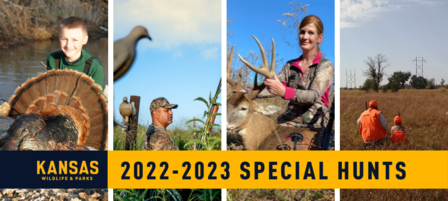
Kansas City, Kan. – The Kansas Department of Wildlife and Parks (KDWP) is currently accepting applications for 2022-2023 “Special Hunts” – hunts conducted on lands not normally open to unrestricted hunting, which include select KDWP-managed properties, refuges, Walk-in Hunting Access areas (WIHA), city and county properties, and other locations. KDWP’s Special Hunts also limit the number of participants to ensure a quality experience or to achieve specific management goals, such as herd reduction.
This fall and winter, more than 370 special hunting opportunities will be held on the following properties:
21 – KDWP Wildlife Areas
6 – Kansas State Parks
3 – State Fishing Lakes
3 – County-owned Properties
2 – Private Lands
2 – National Wildlife Refuges
1 – U.S. Army Corps of Engineers Lake
Hunters have the option to apply in four categories, including youth, mentor, disabled, and open hunts. Youth hunts require parties to include at least one youth who must be accompanied by an adult mentor, and the adult(s) may not hunt. Mentor hunts are open to both youth and/or inexperienced (novice) hunters who are each supervised by a licensed adult mentor, during which time both the novice and mentor may hunt. Disabled hunts are designed for individuals with disabilities. And lastly, open hunts are available to all persons, with no age or experience restrictions.
Hunters should note, prior to applying, that KDWP’s Special Hunts program only provides access to properties; Licenses, permits, tags, stamps, and Hunter Education are still required, unless exempt.
KDWP’s Licensing staff will draw applications for fall and winter special hunts on August 8 (for hunts taking place in September/October 2022), September 26 (for hunts taking place in November/December 2022) and again on December 12 (for hunts taking place in January/February 2023).
For a complete list of available Special Hunts, eligibility requirements and instructions for applying, visit https://ksoutdoors.com/Hunting/Special-Hunts-Information.

Wheat Scoop: Young millers team from the Middle East/North Africa explores Kansas wheat industry

0
Kansas Wheat

Contact: Marsha Boswell, [email protected]

For audio version, visit kswheat.com.

Members of the next generation of flour millers and commodity buyers from operations in Morocco, Algeria, Egypt and Oman discussed the science behind the hard red winter (HRW) wheat crop as part of a 12-day tour to Idaho, Kansas and North Dakota.

The team, organized by U.S. Wheat Associates (USW), was comprised of future industry decision-makers. Some attendees were students and had part-time jobs in their family’s flour mills to prepare them to take over from their parents. USW used this opportunity to introduce information about the U.S. grain marketing system at an early stage in the careers of these young professionals and build strong relationships to lay the foundation for future opportunities like potential combination cargos.

“These young generation millers represent their family businesses and are exposed to the U.S. grain marketing system at a very early age,” said Tarik Gahi, milling and baking technologist in the USW office in Casablanca, Morocco, who accompanied the team. “Visits to different states on this trip were an opportunity to introduce different classes of U.S. wheat and learn about efforts implemented by organizations and facilities to produce the best quality wheat.”

Overall, the Middle East/North African region imports primarily HRW wheat in addition to soft white (SW) and soft red winter (SRW) wheat. However, the region is composed of more than 30 countries, meaning there is a wide variation in the sophistication of local flour milling operations and wheat importation.

Egypt is the world’s largest wheat importer due to high per capita consumption, driven by government flour and bread subsidies. While the country imports from multiple origins, the largest market share is traditionally given to Black Sea suppliers.

In the MAGHREB countries (Algeria, Libya, Mauritania, Morocco and Tunisia), imports depend heavily on domestic wheat production as well as crop quality from geographically closer suppliers. As a result, U.S. wheat exports to these countries fluctuate greatly from year to year, although these countries are consistent buyers of U.S. durum.

Taking advantage of market opportunities in the Middle East/North African region requires a long-term commitment to building relationships within the industries of individual markets, like the up-and-coming leaders of the young millers team. As part of this work, USW organizes in-person tours to the United States to provide firsthand insights into the current year’s wheat harvest. Kansas Wheat staff regularly participates in these programs to provide personalized information to each market and receive feedback directly from customers.

From July 17 to July 20, the team spent time in Kansas learning about HRW production, visiting research facilities and meeting with leading wheat researchers. At the USDA Center for Grain and Animal Health Research, the team discussed how USDA scientists in the Hard Winter Wheat Genetics Unit focus on different diseases that affect the wheat plant, including leaf rust, stem rust or Fusarium Head Blight. They also discussed how both basic and applied research help ensure a high-quality U.S. grain supply by evaluating the end-use of breeding lines through biochemical and physical characterization.

The team toured the Grain Science Complex on the north campus of Kansas State University, including the Kansas Wheat Innovation Center, IGP Institute and Hal Ross Flour Mill. Participants received an overview of how U.S. wheat classes are graded, including a hands-on grading practicum. The team also visited Research Productions Company in Salina, which provides innovative ideas, services and products for the milling and baking industries.

The team left with a greater understanding of the science behind HRW development in Kansas and the commitment of U.S. wheat producers to continue to grow the world’s most reliable supply of high-quality wheat. Both lessons will stick with these young leaders throughout their burgeoning careers and contribute to future sales of U.S. wheat.

Learn more about how USW works with wheat buyers around the world or track commercial sales at https://www.uswheat.org/.

###

Written by Julia Debes for Kansas Wheat


KU News: New estimation method achieves optimal forecasts when market experiences structural breaks

0

From the Office of Public Affairs | http://www.news.ku.edu

Headlines

Contact: Jon Niccum, KU News Service, 785-864-7633, [email protected]
New estimation method achieves optimal forecasts when market experiences structural breaks
LAWRENCE — In econometrics and statistics, a structural break is revealed when a sudden change occurs in the way a business or market functions. Ignoring these breaks leads to forecast failure.
New research by Shahnaz Parsaeian, assistant professor of economics at the University of Kansas, addresses how to make an optimal forecast (in the sense of mean squared prediction error) in the presence of possible structural breaks.
Her article, titled “Optimal Forecast under Structural Breaks,” develops a combined estimator to forecast out-of-sample under structural breaks by proposing a new estimation method that exploits the pre-break sample information. It appears in the Journal of Applied Econometrics.
“We’ve seen many examples of breaks in the past decade,” Parsaeian said.
“For instance, the oil price shock is an example of a structural break that affects the country’s outward growth. Or whenever we have a change in tax policy, it affects firms’ investment decisions. Even the COVID-19 shock hits in 2020 dramatically altered the way that the market is functioning.”
Co-written with Tae-Hwy Lee and Aman Ullah, both with University of California, Riverside, Parsaeian discloses a novel combined estimator using the full-sample estimator (i.e., both the pre-break and post-break data) and one using only the post-break data. The full-sample estimator is inconsistent but efficient when there is a break, and the post-break estimator is consistent but inefficient. Therefore, depending on the severity of the breaks, the full-sample and post-break estimators can be combined to balance the consistency and efficiency.
“One common solution practitioners use when doing forecasts under structural breaks — given that the break has already happened — is to just look at the observations after the most recent break point,” she said.
“Let’s say the most recent break is COVID in 2020. One can look at the observations after this break point, use those observations to estimate the model and then use that to forecast. But there is a problem with this method because if there is a case like COVID that we have only a few observations after the most recent break point, then estimation uncertainty is high due to a relatively small number of observations in the post-break sample, and that directly affects the performance of the forecast. And then the question is: Why should we ignore the whole observation data set that we have before the break point?”
Parsaeian’s approach exploits the pre-break sample observations. Her research theoretically and numerically shows how this method outperforms the case which relies on the forecast with the observations after the most recent break point.
“There is no cost in using this new combined estimator. It always results in a much better forecast. Or in the worst-case scenario, it performs as equal to the post-break estimator, the one that only relies on the most-recent observations,” she said.
A native of Iran, Parsaeian majored in computer engineering while in college. But even when she pursued economics in graduate school, she was still “obsessed with computer coding” and continues to apply these techniques in her research.
“During my econometrics studies, I became familiar with the idea of model averaging that we can combine different approaches. Then the idea came to my mind, ‘Why not apply these model-averaging techniques to the structural break models and see if we can improve the forecast?’” said Parsaeian, who came to KU two years ago and was recently named a member of George Washington University’s H. O. Stekler Research Program on Forecasting.
“We always need to test for a break, and depending on the result of that, use the appropriate estimator,” Parsaeian said. “Otherwise, the forecast will not be accurate as ignoring breaks results in forecast failure.”
-30-

————————————————————————

KU News Service
1450 Jayhawk Blvd.
Lawrence KS 66045
Phone: 785-864-3256
Fax: 785-864-3339
[email protected]
http://www.news.ku.edu

Erinn Barcomb-Peterson, director of news and media relations, [email protected]

Today’s News is a free service from the Office of Public Affairs