Tuesday, March 31, 2026
Home Blog Page 980

Healthy Broodmares Can Raise Foals Every Year

0
Frank J Buchman
Frank Buchman

“Is it advisable to breed a mare year after year?”
Most horse breeders continue to breed their mares every year because foals pay the bills.
Yet, there are some who consider that stressful even harmful to the mare, claimed Dr. Katherine Joos, equine reproductive specialist.
“I find no reason not to breed a mare back year after year,” said Dr. Joos of Gainesville, Texas.
“That is as long as the mare is able to maintain a healthy weight while nursing a foal,” she clarified.
Whether a mare carries a foal every year or every other year does not affect the foal’s quality, the veterinarian insisted.
“In my experience, mares tend to cycle more consistently and normally when bred every year,” Dr. Joos said.
Therefore, with no uterine trauma or other health problem, she prefers that a mare be bred to carry every year.
“In fact, I recommend that embryo donor mares carry a foal every three to four years,” Dr. Joos said. “It helps them maintain normal cervical function.”
In that regard, the American Association of Equine Practitioners leader recommended embryo transfers for old mares. “It is easier on a 20-year-old mare than carrying a foal,” she said.
“At this age, likelihood the mare develops placental insufficiency is much higher,” said Dr. Joos from North Texas Equine Veterinary Service.
However, many mares carry foals into their twenties with no problems.
“In my opinion, it is more important to consider the overall health of the mare,” Dr. Joos continued. “That’s more important rather than just her age when deciding whether or not to allow her to carry a foal.”

CUTLINE

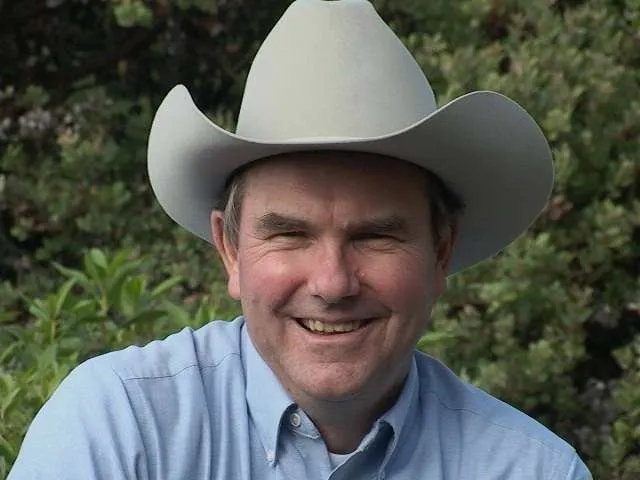
Dr. Katherine Joo, equine veterinarian, said, “I find no reason not to breed mares back year after year.”

‘God And Tractors’ Powers Analogized During Large Urban Church Pastor’s Summer Revival

0
Frank J Buchman
Frank Buchman

“Farm tractors are such a great metaphor for God’s power in the Christian spiritual life.”
That’s the heartfelt belief of Reverend Adam Hamilton.
“I grew up in Kansas City, but always had a love for the country,” said Rev. Hamilton at the United Methodist Church of the Resurrection.
A multi-site United Methodist megachurch in the Kansas City metropolitan area, Rev. Hamilton started the church at Leawood in 1990.
Maintaining five campuses, membership now totals more than 25,000, with average weekly attendance of 30,000. That is in person, on internet and television with sermons available for later viewing.
“Everybody relates to tractors in one way or another whether they’ve ever been directly involved with farming,” Rev. Hamilton insisted. “Some of their families through the generations have been in production agriculture. And everybody’s food comes from farms whether they completely realize it or not.”
So, Rev. Hamilton titled his Summer Revival series “God and Tractors” with four sermons analogizing the power of tractors and God.
Bringing the message to more real life for his vast urban congregation, Rev. Hamilton brought his own tractor into the main church for July services.
“I live on 13 acres in Johnson County and have a 1964 John Deere 3020 gas tractor with some implements,” Rev. Hamilton said.
“Any day I can get on my tractor is a good day. I always feel a sense of closeness to God when on my tractor,” Rev. Hamilton said. “My July sermons have been aimed at helping people see how God works in our lives using various analogies related to tractors.”
Mud and grease were cleaned from his John Deere before Rev. Hamilton displayed it on the chancel of the Leawood church.
“I was able to drive the tractor in from the lower level of the church. It was raised on the orchestra lift for display 18-inches above the floor in the sanctuary,” Rev. Hamilton said. “The congregation had a sense of awe that first Sunday. But I feel like they’re better understanding, appreciating, and enjoying the sermons relating to power of both tractors and God.”
The first weekend, Rev. Hamilton spoke of getting his tractor stuck. He needed a larger tractor to “save” or “deliver” him, likening this to the “human need for God to rescue us.”
On the next Sunday, Hamilton related about his farm pond becoming silted in and needing to be rebuilt. Three large tractors cleaned the muck out and restored the pond.
He associated this to how people need repentance and God’s power to clean out the muck in their lives. “Jesus speaks about this as being born again,” Hamilton said. “We must admit mistakes, repent sins, invite God to clear out muck, so He can help us start over.”
During the third weekend, Hamilton likened the tractor to the power of the Holy Spirit and implements as the gifts of the Holy Spirit. He contrasted harvesting wheat with a hand sickle versus harvesting with a combine.
“This is like the difference between living life with the power of the Spirit, or trying to do life on our own power,” Hamilton said.
Excitement was apparent as Rev. Hamilton talked about his final July sermon. “Wheat harvest is nearing completion in many areas,” he said. “In Jesus days, wheat was harvested with a sickle, then a scythe, later a threshing machine powered by a steam engine. Today, farmers have giant self-propelled combines.
“With a sickle, one-third of an acre of wheat could be harvested in a day. With a large combine today, a farmer can harvest 30 acres in an hour.
“As the power of harvest equipment has increased, so we as followers of Jesus Christ must increase his word to others,” the pastor said. “Our calling is to spread the word of God throughout the world empowering his Spirit for bountiful harvest and salvation.”
Following Sunday sermons, the congregation could view additional tractors displayed in the church yard.
“We had a local dealer bring tractors, there was an antique tractor display and farmers brought their equipment,” Rev. Hamilton said. “The congregation just loved it throughout the month.”
While growing up a city boy, Rev. Hamilton’s grandparents farmed in Oklahoma for a time fostering his appreciation for farm life. “My great grandparents, the Lorson family, farmed and some still do near Hope,” he noted. “I haven’t seen the Lorson’s since I was a kid but keep up a bit through Facebook.”
Deciding his future spreading faith beliefs when he was just 16 years old, Rev. Hamilton graduated from Oral Roberts University in Tulsa, Oklahoma. Master’s degree in theology was completed at Southern Methodist University in Dallas, Texas.
Returning to his home community, Hamilton, then 25-tears-old, and his wife LaVon started the United Methodist Church of the Resurrection with just four members. Today, it is one of the largest United Methodist congregations in the world.
“Now 58-years-old, I am committed to the renewal of the mainline church, especially the United Methodist Church,” Hamilton assured.
In 2012, he was invited by the White House to deliver the message at the National Prayer Service as a part of President Obama’s second inauguration.
The United Methodist Saint Paul School of Theology moved its facility from Kansas City, Missouri, to the Church of the Resurrection in the fall of 2013.
With multiple services each week in various locations throughout Kansas City, Rev. Hamilton has several assistants. “The sermon is presented live at our Leawood location and viewed on screens in the other locations,” he said.
Father of two daughters, Hamilton credits his wife and his entire family for assistance in spreading God’s word.
“Our daughter Danielle Hamilton Slate, an attorney, and her husband JT, with their eight-year-old daughter live on 20-acres south of Lawrence,” he said. “They produce and market fresh cut flowers.”
His daughter, Rebecca also has a tropical plant business. “We are all tied to the farming profession in a certain sense of the word,” Hamilton grinned.
Climax for Rev. Hamilton’s July tractor revival is proudly starting his John Deere tractor right in the church sanctuary. “Now with all of this power lets go to work spreading God’s word,” he challenges.
Sermons can be listened to at https://cor.org/leawood/sermons.

CUTLINES

Rev. Adam Hamilton displayed his John Deere 3020 in the sanctuary of the United Methodist Church of the Resurrection at Leawood for his July Summer Revival sermons “God and Tractors.” (Dave Webb photo)

When Rev. Adam Hamilton got his tractor stuck, a larger tractor was required to “save” or “deliver” him, likening this to the “human need for God to rescue us.” (Hamilton family photo)

His John Deere 3020 was displayed on the chancel of the sanctuary behind Rev. Adam Hamilton when he was preaching one of his July Summer Revival sermons “God and Tractors” at his United Methodist Church of the Resurrection in Leawood. (Hamilton family photo)
A confirmation class from Nebraska visited the United Methodist Church of the Resurrection at Leawood for July’s Summer Revival sermons “God and Tractors. Rev. Adam Hamilton is with the group in front of Miami County farmer Nick Guetterman’s 8320R tractor he displayed outside of the church. (Hamilton family photo)

Food Futures (Best Of)

0
lee pitts

Floating around in my empty head I have more get rich quick schemes than a six term congressman. I was recently discussing my latest ploy to become wealthy without working with a cluster of calloused cowboys who had gathered ’round me at the Beef Palace Restaurant.

“Food Futures,” I exclaimed. “That’s how we are all going to get rich.”

“You’re dumber than a sack of hammers,” said my friend Drip. We call him Drip, by the way, because he is constantly irritating and it’s impossible to shut him off. “They already invented futures markets.”

“No, beer breath, they invented commodities futures markets. I am talking about food futures. Let me explain. Say a Chicago flood trader knew that he was going to be eating ham for Thanksgiving or prime rib for Christmas and he wanted to make sure he got one. I would sell him a ham futures contract for November delivery that would insure that his family would not have to eat turkey for Thanksgiving. But food futures wouldn’t just be for holidays. If a New York Investment banker knew his Anniversary was coming up and he wanted to take his show girl wife out for a hamburger to celebrate, he could buy a Big Mac contract to guarantee they didn’t get stuck with Chicken Nuggets. It would be a hedge against having to eat tofu.”

“Yeah, but what if he got divorced in the meantime and didn’t want to go out by himself?”

“He would have the right to sell his contract to someone else… for a small commission of course. There will be dessert futures, salad futures, glass of milk futures and cookie futures and who better to control them than the ranchers and farmers who produced the food in the first place?”

Drip was warming up to the idea. “Yeah, the first thing the urbanite investor will do every morning is read the Wall Street Journal to see how his December rump roast is doing.”

“And the prices wouldn’t be controlled in Chicago either. Cheese slice futures would be determined in Fresno and pork chop futures out of Des Moines. But the best part is that we would never have to borrow money from bankers again.”

“Why not?” asked Drip.

“Because we get a commission up front for selling the futures and if we need money to buy medicine or fix the truck we just issue a margin call.”

“You mean that if I needed to borrow money to buy a new bull so my cows could have sex on a regular basis all I would have to do is ask?”

“It’s not that simple. What you’d do is leak a story that your bull is shooting blanks and the speculators in New York would worry about their January roast beef sandwich lunch futures and they would beg you to take their money to insure that they got their lunch.”

“What a scam. But aren’t you afraid that you will be handcuffed by the F.B.I. or CFTC?”

“Oh I am sure after the idea catches on that we will have to pay off a few politicians, but it is worth the risk believe me. And the futures industry can’t say that food futures are a bad thing because they’e spent a fortune telling us all how great they are. Farmers and ranchers will finally make a fortune and go around wearing three piece suits all the time.”

“Agriculture might get as good as it was before they invented the darn futures things in the first place,” Drip speculated in a dreamy haze. “And with farmers and ranchers in charge food prices will once again be controlled by supply and demand. What a revolutionary thought!”


Early Day Cowboy Profession Much Different Than In Movies

0
Frank J Buchman
Frank Buchman

“Cowboy life in days long-gone-by was far from a high paying profession.”
Yet, according to early West historian, Daniel Baker, “It was a job, and doing anything for wages wasn’t that readily available following the Civil War.”
Being a cowboy at the turn of the previous century, before and after, sure wasn’t romantic as silver screens portray.
“It was a hard, dirty, often unappreciated profession,” Black said. “I have read that cowboys typically earned $25 a month on a cattle drive. On the ranch it would have probably been less.”
Reading Charles Siringo’s autobiography, Black learned about a “Texas cowboy in 1874 getting $35 a month including railroad fare back home.”
However, another cowboy worked on a Texas ranch for $15 a month in 1873.
Most cowboys did not own a horse, generally only a saddle and bridle. “One accounting book from 1881 describes a saddle and bridle being sold for $18,” Black said.
“A horse was loaned to the cowboys from the rancher’s or trail boss’s remuda while on the job,” Black explained.
Horse prices varied hugely by age, weight, sex, location, color, breed, and other personal characteristics of the horse.
In 1874, a “bad-tempered male horse was sold to a stranger for $30,” Black said. “But a year later, another horse was purchased for $25.”
Horse trading was a profession in those early days, too. “A Texas rancher bought an ‘old mare’ from a cowboy for $20,” Baker noted. “The mare was traded for a ‘pony’ that brought $45 within a few days.”
A trader named Charles Word is claimed to have bought his choice out of several hundred horses from Mexican dealers for $18 a head.
In 1875, a Texas rancher paid $55 for a three-year-old “California pony,” intending “to make him into a racehorse.”
A “fifty-dollar horse” was won in an 1876 horse race bet. Dispute arose when three men claimed they owned the horse and that the bettor had only borrowed it. However, the men eventually agreed to return the horse for $20.
Cowboys did have guns in the Old West, but seldom, other than lawmen, were they used shooting at each other. “Guns were cowboy tools to hunt wild animals for food and for shooting destructive wolves and rattle snakes,” Baker clarified.
Guns were not nearly as high priced as nowadays. “I’ve seen a late 19th century advertisement for an Iver Johnson hammerless revolver selling for $5.50,” Baker said.
In 1868, a St. Louis, Missouri, gun owner got “$10 from a Texas rancher for a fancy little ivory-handled five-shooter.”
A congressional report from 1880 said that revolver ammunition for the Army cost $18 per thousand rounds. “That would be 1.8-cents per cartridge. Although if you were not purchasing in bulk, I imagine the price would be much higher,” Baker noted.

CUTLINE
Working cowboys in the late 19th century were far different from portrayed in silver screen movies. (Daniel Baker photo)

Training Required For Horses To Have Feet Handled

0

“Horses don’t naturally pick up their feet for a handler, so training is required.”
Inexperienced horse owners don’t realize how awkward it is for a horse to have its feet picked up, said Martin Black.
“The next time you see a horse standing still with a hind leg cocked,” Black urged. “Walk behind the horse and make note of how that leg hangs down under the hip. It’s straight down, not angled out from the body.”
According to the horse clinician, “Such an observation is key to helping a horse learn to accept holding up a foot. That’s especially true with young or untrained horses.”
It is the easy place natural place for a horse to hang the foot. “So that’s where I try to hold it, and where I try to do my work,” Black clarified. “The lower the better on a green horse.”
It’s easier for the person to hold the leg out, at an angle. “But that makes it more difficult for the horse to balance,” Black pointed out.
“¬That’s all right, if your horse is tolerant of it,” Black said. “But on a young horse, I would keep my knees bent, more underneath, closer to where the foot naturally hangs.”
Over time a horse will learn to accept having its foot being held up and at an angle, the clinician added.
“If I’m trimming broodmares or yearlings, I try to keep the foot barely off the ground,” Black explained. “They’ll accept it a lot faster than if I insist on picking their leg up high where I can stand up straighter.”
Helping the horse stay balanced lessens the chances a horse leans on a handler while the foot is held. “I try to work from where the horse is balanced.” Black emphasized.
“If I don’t ever give the horse an opportunity to lean on me, he’ll never learn that habit,” Black continued. “A little shift in balance can help when teaching a horse to accept having its foot held. It’s a little bit of a yoga move, using thigh muscles you’re not used to using. But it’ll pay off.”

CUTLINE
When working with a young or green horse, Martin Black holds its hoof closer to where it naturally hangs to help the horse balance better. Doing this helps a horse accept having its foot held.