
Wednesday, January 7, 2026
Home Blog Page 4759

Shocker Hall is revitalizing and unifying Wichita State

0

The opening of Shocker Hall – Wichita State’s new state-of-the-art, centrally located residence facility – is redefining what it means to be a student at WSU.

Shocker Hall opened to all of its residents Aug. 16. With nearly 800 students on five floors, top-notch dining, a coffee shop open 19 hours a day – all in a beautiful, modern setting – Shocker Hall is one of the most exciting updates to campus in decades.

And it’s already changing the way students think about their college experience.

“When you live at Shocker Hall, you develop a sense of belonging – a feeling like you belong at this university,” says junior Alex Van Pelt. “You join a community of people who all have one passion in common: being a Shocker. I think people who live off campus can see this, and more and more people will want to join us here at Shocker Hall.”

The new facility truly defines WSU’s commitment to residential living – a big change from the university’s tradition of being mostly a commuter college.

“There’s a distinction between living near people and living with people, and living on campus, especially in Shocker Hall, we get to really live with one another,” says junior Megan Stessman. “More people are attracted to housing now.”

‘People want to live here’

Shocker Hall is made up of four buildings, one of which has a laundry room, community kitchen and lounge area (referred to as an LKL) on each of its five floors.

There are spacious rooms, high-tech lounges and unprecedented Wi-Fi capabilities. But it’s the social aspect that’s taking Wichita State by storm.

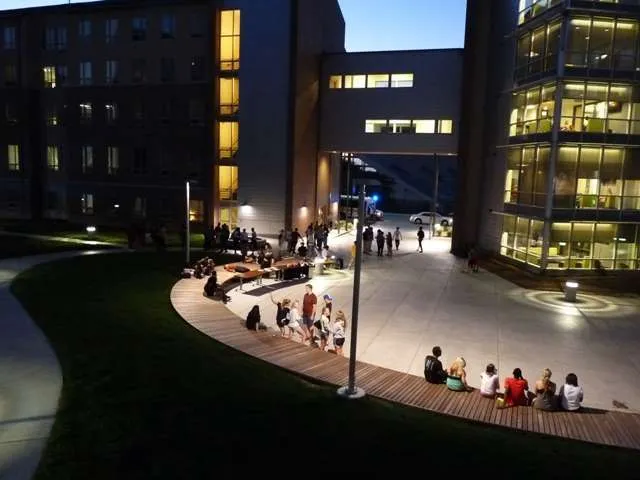
Van Pelt says one of the best parts of Shocker Hall is its outdoor courtyard, which has turned into a social hub for students to gather after class and on weekends to meet with friends or make new ones.

There are also a lot of impromptu get-togethers now in the lounges and game room, says Stessman, a resident assistant in Shocker Hall.

As an RA, she’s in charge of planning educational and social programs for her floor that connect residents with each other and to resources in the university. Most of those planned programs happen at night when people are out of class.

There’s no doubt there is a renewed sense of after-hours life at WSU now that so many students are living in the heart of campus.

“Now that Shocker Hall is here, people want to live here,” says Van Pelt. “That is a complete turn-around from just a year ago. People want to be right here in the middle of all the action which is Wichita State University. Campus is becoming a place you want to be, not just a place for classes. With all the activities and friends right here, who wants to live anywhere else? In my mind, that is a vast improvement.”

Feeling connected

Before moving to Shocker Hall, Stessman lived in Fairmount Towers – located just off campus at the corner of 21st Street and Hillside – and the now closed Wheatshocker Apartments and Brennan Hall. She says student residents used to be in their own bubble, but now there is more of a community culture – and that’s after only a few weeks since Shocker Hall opened.

The dining facility is bringing in WSU professors, administrators and staff who residents wouldn’t have seen previously in the cafeteria, allowing students more interactions with others on campus.

“It is astonishing how much more connected I feel to the campus when I live in its center,” Stessman says. “The energy that has been put into this building and the community has a positive impact on our residents; you can tell that they feel valued and important.”

Van Pelt says the innovative design of Shocker Hall creates a closer sense of community, with large rooms that still let students feel close to their classmates living down the hall. And, he said, it’s not bad to look at either.

“It is simply beautiful. Everything from the rooms to the brand new dining facility have been wonderfully designed to be functional and gorgeous,” Van Pelt says. “I live at Shocker Hall because every time I see it, I can’t help but smile. This place is already my home, and I couldn’t imagine living anywhere else.”

Source: Wichita State University

Crawford State Park to host country music jamboree Spetember 27

0
Amanda

Live music begins at 3:30 p.m. and will continue through the night

PRATT – Camping, chili, and country music – what more could you ask for? Thanks to the Friends of Crawford State Park, all this and more will be part of a one-night event, Sept. 27 at Crawford State Park’s Oak Point Campground. Crawford State Park is located just nine miles north of Girard on K-7. The first event of the day will be a chili cook-off beginning at 12 p.m. with a cook’s meeting, followed by cooking from 12:30 to 4 p.m., judging at 4 p.m., tasting session at 4:30 p.m., and awards at 5:30 p.m. There is a $20 entry fee for anyone wanting to enter the chili contest.

Following the cook-off, an “end of the season” campers’ pot luck will take place at 6:30 in the back of the campground amphitheater. Those interested in staying are asked to bring a covered side dish as spaghetti red (chili) will be provided.

Apart from good eats, park goers can also enjoy the park’s Country Music Jamboree beginning at 3:30 p.m. and running through the night. A host of local musical acts including The Duling Band, Jeff Simpson, Kinley Rice, and Jason Richison will perform.

The Duling’s are a local legend and part of a musical family that have entertained for over 50 years. The variety they bring to the stage is sure to please young and old.

Jeff Simpson, a resident of Cherokee, has been performing blues and jazz harmonica for the past 17 years. He is a regular with several area country, bluegrass, and classic rock bands.

Source: Kansas Department of Wildlife, Parks and Tourism

Kinley Rice, a 15-year-old country singer from Fort Scott, is currently a regular on TV’s “Kelly’s Kountry Junction.” Her musical influences are Loretta Lynn, Tammy Wynette, Hank Williams, and many other country legends.

Jason Richison, another Fort Scott resident, will perform classic country music with energy and an edgy guitar. He is also a member of the Fort Scott Jubilee Hot Band and lead guitarist for Kelly’s Kountry Junction television program.

Campsites will be available and can be reserved by visiting ReserveAmerica.com.

For more information on the chili cook-off, contact Kevin Smith at (620) 362-3237, or by e-mail at [email protected].

To reach the Crawford State Park office, call (620) 362-3671.

Tailgate Saturday event at Lovewell

0

Friendly competition expected for chili cook-off, 3-D archery shoot

PRATT – Lovewell State Park is sponsoring its final events of the season September 6-7 with  “Tailgating Saturday,” a chili cook-off and a 3-D archery shoot on Sunday. Sunday is also a free park entrance day at Lovewell State Park. Vehicle permits are not required to enter the state park on that day; however, camping permits are still required if camping overnight.

For Tailgating Saturday, campers are encouraged to show their football pride with decorations at their campsites for their favorite team. This is a fun event, and registration is not necessary.

The fun will continue Sunday with a chili cook-off and 3-D archery shoot. Shooters can register from 9 a.m.-10 a.m., and must complete the course by 12 p.m. Participants may compete in either the men’s, women’s, or youth categories. There is no fee to enter, however a $10 donation is encouraged. A steel deer target competition will start at noon, with a $5 donation suggested for participation. Prizes will be awarded at 1:30 p.m. for the 1st, 2nd, and 3rd place shooters at the Lovewell Marina Area.

The Lovewell Marina will also host the chili cook-off  on Sunday where park visitors can taste a variety of hearty dishes. Cooks must register no later than 9 a.m. at the park office. Judging will be done by the first 100 visitors who contribute a $5.00 donation for a taste-testing ticket. Judging tickets will also be available at the cook-off area beginning at 11:30 a.m. Entries will be judged from 12 p.m.-1 p.m., followed by the award presentations for 1st, 2nd and 3rd place entries by popular vote.

For more information on these events, contact the Lovewell State Park at (785) 753-4971.

Source: Kansas Department of Wildlife, Parks and Tourism

Author to speak at Eisenhower Library about the privatization of national security

0

ABILENE, Kan. –  Author Ann Hagedorn will speak about the privatization of American’s national  security at the Eisenhower Presidential Library, Museum and Boyhood Home on Thursday, September 11. The free public program begins at 7 p.m. in the Visitors Center Auditorium.

Hagedorn’s latest book, The Invisible Soldiers: How America Outsourced Our Security, was released in August. It is an investigation into the world of private military contractors. The book exposes where this industry came from, how it operates, where it’s heading, and why we should be concerned.


Hagedorn has been a writer for The Wall Street Journal, special projects editor for the New York Daily News and has taught writing at Northwestern University’s Medill School of Journalism and at Columbia University’s Graduate School of Journalism. Her previous books are Savage Peace, Beyond the River, Ransom and Wild Ride.


Copies of The Invisible Soldiers: How America Outsourced Our Security will be for sale at the Presidential Gift Shop. A book signing will follow the presentation.

The Eisenhower Presidential Library, Museum and Boyhood Home, a nonpartisan federal institution, is part of the Presidential Libraries network operated by the National Archives and Records Administration. Presidential Libraries promote understanding of the presidency and the American experience. We preserve and provide access to historical materials, support research, and create interactive programs and exhibits that educate and inspire.

Sorghum and Millet Innovation Lab announces selected projects

0
 Projects funded through the Feed the Future Innovation Lab for Collaborative Research on Sorghum and Millet, funded though USAID and established at Kansas State University, are aimed to help improve the adaptation and resilience of these crops in East and West Africa. K-State Research and Extension
Projects funded through the Feed the Future Innovation Lab for Collaborative Research on Sorghum and Millet, funded though USAID and established at Kansas State University, are aimed to help improve the adaptation and resilience of these crops in East and West Africa. K-State Research and Extension

MANHATTAN, Kan. – Project funding through the Feed the Future Innovation Lab for Collaborative Research on Sorghum and Millet has been announced. The projects will contribute to improving food security, household resilience and private sector growth in the Ethiopia, Senegal and Niger through the enhancement of production and value-added product development.

The 2014 funding recipients were identified through a competitive call for proposals, with 10 projects selected from the 58 proposals received, from the recommendations of the Lab’s external advisory board and dozens of ad-hoc reviewers.

Six projects were selected in West Africa, led by five leader institutions with 16 collaborating institutions, and four projects were selected in Ethiopia, led by three leader institutions and 16 collaborating institutions.

“These projects represent the best ideas and strategies, drawn from around the world, to tackle hunger and undernutrition in some of the world’s most difficult agricultural regions,” said Timothy Dalton, associate professor of agricultural economics at Kansas State University and director of the Lab. “The process will require patience, hard work and dedication, and we’ve assembled a fantastic team to attack these problems.”

The Feed the Future Innovation Lab for Collaborative Research in Sorghum and Millet is a consortium of cutting-edge research aimed at improving the adaptation and resilience of sorghum and pearl millet to the semi-arid climates of East and West Africa, with a focus on Ethiopia, Senegal and Niger.


Established in July 2013 at Kansas State University, the Lab contributes technologies and knowledge toward the adaptation, resilience and improved profitability of sorghum- and millet-based production systems and value chains through a grant from the United States Agency for International Development (USAID) as part of Feed the Future, the U.S. government’s global hunger and food security initiative (www.feedthefuture.gov).


The Lab links U.S. and international universities and research organizations in a collaborative effort to build human and institutional capacity in Ethiopia, Niger and Senegal to make sorghum and pearl millet the crops of the future. Additional information regarding the Sorghum and Millet Innovation Lab can be found at http://www.k-state.edu/smil.


Funded projects:

Developing superior functionality in sorghum for food applications to promote sorghum value chain in Ethiopia


Principal investigator:
                                    Joseph Awika (Texas A&M University)

U.S. collaborating institutions:                     Texas A&M University

International collaborating institutions:     Ethiopia – Hawassa University
South Africa – University of Pretoria

Award amount:                                               $809,941

Focus country:                                                 Ethiopia
Genetic enhancement of sorghum to promote commercial seed supply and grain market development in Ethiopia

Principal investigator:                                    Gebisa Ejeta (Purdue University)

U.S. collaborating institutions:                     Purdue University, Kansas State University

International collaborating institutions:     Ethiopia – Ethiopian Institute of Agricultural Research (EIAR) (Melkassa Research Center, Sirinka Research Center), Holleta Biotechnology Center, Tigray Regional Program, Oromia Regional Program, Haramaya University

Award amount:                                               $912,703

Focus country:                                                 Ethiopia


Genetic improvement of sorghum for resistance to fungal pathogens

Principal investigator:                                    Tesfaye Mengiste (Purdue University)

U.S. collaborating institutions:                     Purdue University, Kansas State University

International collaborating institutions:     Ethiopia – EIAR (Asosa Research Center, Pawe Research Center, Bako Research Center), Holleta Biotechnology Center

Award amount:                                               $842,963

Focus country:                                                 Ethiopia


Improved crop genetics and processing methods for increased productivity and nutrition for smallholder sorghum producers in Ethiopia

Principal investigator:                                    Tesfaye Tesso (Kansas State University)

U.S. collaborating institutions:                     Kansas State University, USDA-ARS, Purdue University, KSU – Hays Research Station

International collaborating institutions:     Ethiopia – EIAR (Melkassa Research Center, Sirinka Research Center, Pawe Research Center), Tigray Agricultural Research Institute, Haramaya University

Award amount:                                               $821,421

Focus countries:                                              Ethiopia


Improving sorghum adaptation in West Africa with genomics-enabled breeding

Principal investigator:                                    Geoffrey Morris (Kansas State University)
U.S. collaborating institution:                      Kansas State University

International collaborating institutions:     France – Centre de Coopération Internationale en Recherche Agronomique pour le Développement (CIRAD)
Senegal – Institut Sénégalais de Recherches Agricoles (ISRA), Centre d’Etudes Régional pour l’Amélioration de l’Adaptation à la Sécheresse (CERAAS), Centre National de Recherche Agronomique (CNRA)

Niger – International Crops Research Institute for the Semi-Arid Tropics (ICRISAT), Institut National de la Recherche Agronomique du Niger (INRAN), LSDS (farmer organization), HALAL (farmer organization)

Award amount:                                               $1,090,093

Focus countries:                                              Niger, Senegal


Development of biotic stress-resistant sorghum cultivars for Niger and Senegal

Principal investigator:                                    Bonnie Pendleton (West Texas A&M University)

U.S. collaborating institutions:                     West Texas A&M University, Texas A&M AgriLife Research

International collaborating institutions:     Senegal – ISRA, CNRA, CERAAS
Niger – INRAN

Award amount:                                               $876,284

Focus countries:                                              Niger, Senegal


Sorghum trait development pipeline for improved food and feed value


Principal investigator:                                    Mitchell Tuinstra (Purdue University)

U.S. collaborating institution:                     Purdue University

International collaborating institutions:     Senegal – Institut de Technologie Alimentaire (ITA), CERAAS, ISRA, CNRA
Niger – INRAN

Award amount:                                               $1,044,323

Focus countries:                                              Niger, Senegal


Biological control of the millet head miner in Niger and Senegal


Principal investigator:                                    Malick Ba (ICRISAT – Niger)

U.S. collaborating institutions:                     Virginia Tech University, IPM Innovation Lab

International collaborating institutions:     Senegal – ISRA, CERAAS, University Cheik Anta Diop de Dakar

Niger – University of Maradi, INRAN

Award amount:                                               $638,788

Focus countries:                                              Niger, Senegal


Optimization of the seed ball technology for pearl millet, and agronomic and socio-economic evaluation in the context of smallholder farmers in Senegal and Niger


Principal investigator:                                    Ludger Herrmann (University of Hohenheim – Germany)

International collaborating institutions:     Senegal – ISRA, FAPAL (farmer organization)

Niger – INRAN, Fuma Gaskiya (farmer organization)

Award amount:                                               $172,600

Focus countries:                                              Niger, Senegal


Expanding markets for sorghum and millet farmers in West Africa through strengthening of entrepreneur processors and nutrition-based promotion of products


Principal investigator:                                    Bruce Hamaker (Purdue University)

U.S. collaborating institutions:                     Purdue University

International collaborating institutions:     Senegal – ISRA, CNRA, ITA

Niger – INRAN

Award amount:                                               $816,328

Focus countries:                                              Niger, Senegal