Monday, January 19, 2026
Home Blog Page 126

The Kansas River used to be a dumping ground. These kayakers are helping clean it

0

The Kansas River is cleaner today than half a century ago, but pollution and trash remain problems. Kayakers and others who love this river are helping the river’s sandbars by hauling away tons of garbage.

Dawn Buehler spent her childhood helping out on the family farm in De Soto, next to the Kansas River.

But when her chores were done, the river beckoned. She and her family would canoe and fish. Sometimes they would camp on a sandbar.

“You felt like you were in the last wild place in Kansas,” she said. “You could go out to the sandbar in the middle of the river and be away from everything.”

With memories like that, it’s not hard to understand why she is so motivated to clean up the decades-old trash sites in the river.

Buehler is the executive director of Friends of the Kaw, a nonprofit group focused on protecting a watershed that drains part of Colorado and Nebraska and about half of Kansas.

This basin is, according to the U.S. Army Corps of Engineers, the world’s longest prairie-based river.

By some measures, water quality has improved greatly in recent decades because of the 1972 Clean Water Act that regulated what cities and most industries can dump into waterways.

But the Kansas River, like other bodies of water in the U.S., still faces a host of challenges that range from fertilizer running off of farms and lawns to invasive species squeezing out native wildlife.

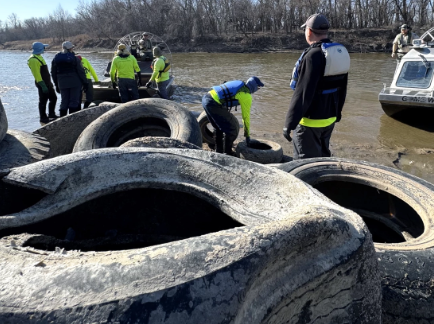
Another challenge: Tires and other garbage have stayed for decades at some sites along the river, slowly releasing chemicals and marring the beautiful, golden sandbars that endear it to fishermen, canoers, birdwatchers and others.

This is my home and it’s the home of people before me and people after me,” kayaker and retired geology teacher Lynne Beatty said. “And I want to make sure it’s something that they can come out and enjoy.”

Beatty used to bring her Johnson County Community College students to the river to learn about sandbar geology and watersheds firsthand.

Over the past decade, these are the kind of people — with a strong connection to the Kansas River — who have set about cleaning up sites that have long needed attention.

Volunteers for Friends of the Kaw — many of them skilled kayakers — monitor the river year-round and keep a detailed list of these sites.

With help from hunting and fishing groups, college students, Rotary clubs, construction crews, county governments and other hands on deck, they’ve made real progress toward a 2030 goal to work through every site on their list.

In July’s episode of the Kansas News Service podcast Up From Dust, hear the history and the ongoing challenges — and meet some of the kayakers, game wardens, construction workers and others putting muscle into saving the Kansas River from literal tons of garbage.

“It feels like we’re helping out the wildlife, the fish — getting the chemical levels to reduce,” said Malik Nash, a worker with Garney Construction.

Yet even as they remove tires and vehicle battery cases by the thousands, a different source of pollution has gotten worse.

A relentless supply of plastic items — such as water bottles and candy wrappers – is washing off the streets of each city in the watershed. This trash accumulates in pockets of the river called eddies.

In recent years, Friends of the Kaw has added cleaning up these eddies to its list of daunting tasks. The group is determined to reduce the amount of garbage making the journey to the Gulf of Mexico, which is already awash in microplastics.

As word spreads, the group’s cleanup events have started attracting crowds that number as much as a few hundred people willing to help pick up litter in or near the river.

“Our goal is to make sure that Kansas sends as little as possible downstream,” Buehler said. “We’d like to take care of our own trash here in our own space, but we really need the public’s help to do it.”

Kansas invited amateur archaeologists to dig out ruins from the state’s ‘bloody’ past

0

The Kansas Historical Society’s archaeological field school this year gave volunteers a chance to dig into the state’s territorial history at the site of an 1850s-era mansion near Lecompton.

Just a few stone walls remain of what was once a stately, three-story stone mansion on the bluffs of the Kansas River near Lecompton, Kansas.

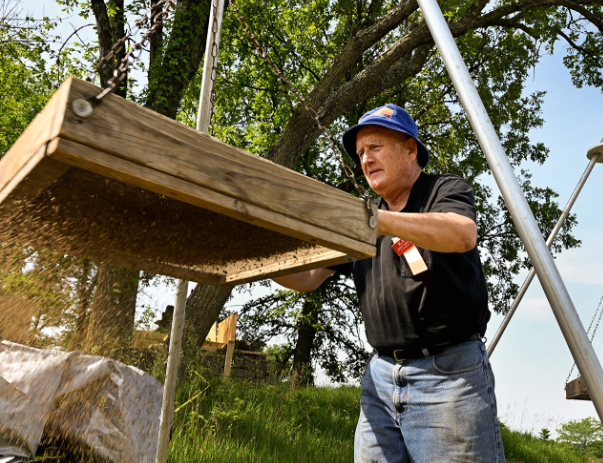
Among the ruins, amateur archeologist Debi Aaron is hunched over a dry-screening tripod carefully sifting the dirt and rock she collected from the site of a pre-Civil War home.

“Anything that stays in the screen is collected,” said Aaron, a 911 operator. “If you do it long enough, you may have an artifact left in the screen that you couldn’t see otherwise because it was covered with dirt.”

Since 2009, Aaron’s been a regular fixture at the Kansas Historical Society’s archaeological field school. The Hebron, Nebraska, resident has traveled south to work more than a dozen digs, and has learned some days are more productive than others.

“So far, above the 30 centimeter level, the most exciting thing is probably a couple of square nails and a very tiny ceramic fragment that had, like, a glaze on top,” Aaron said.

In June, around 100 students and volunteers worked side-by-side with professionals to piece together history from the ruins of the home, built during the violent clashes of Bloody Kansas.

The 10-day field school, started five decades ago by the historical society and the Kansas Anthropological Association, is a chance to do real science. Attendees assist archeologists surveying sites, excavating relics, and cleaning and cataloging artifacts.

“It’s my passion. It’s my hobby. I love it, and it’s not just the archeology, it’s all the people that I meet,” she said. “You just come back year after year, and some of the same old people come back because it’s what they love to do.”

At the Mount Aeolia mansion, Aaron and other volunteers are slowly digging around was once the home of Frederick P. Stanton, who served two brief stints as acting governor of the Kansas territory in 1857, before it became a state. Stanton’s structure was so tall, visitors to its roof could see Lawrence, 15 miles east, and Topeka, 19 miles west.

At the time it was built, it was one of the most expensive houses in Kansas. Wood for the interior was purchased from Pennsylvania and was brought by steam boat from St. Louis, according to the Lecompton Historical Society. Doors, mantles and paneling in each room were carved from walnut.

Assistant site supervisor Angelo Ruiz, a historical society vice president, helps new students get to work.

“We have really experienced people who’ve been doing this for decades — we have that extreme — all the way to the brand new person who just is (a) little interested in history and wants to come see how that process is,” Ruiz explained.

The school has received national recognition for excellence in public education. The Society for American Archaeology lauded the June digs in 2015 for “creating a community of citizens who appreciate and advocate for archaeology.”

“Our goal is to teach people about what archeologists do when they’re doing excavation, so that hopefully they take that back with them and support archeology, support history, support saving these sites from just being destroyed,” Ruiz said. “Because once that information is gone, it’s gone forever.”

In another corner of the ruins, Liam Bevitt, from Oskaloosa, Kansas, scraped into the soil around a large piece of corrugated metal.

“Right now we’re just digging through the rubble of the house, trying to get down to the floor to see what the floor was made of,” Bevitt said. “It’s definitely a little bit more challenging with all the rocks and bricks.”

Bevitt, a history major at Washburn University in Topeka, is 22 and has been coming to the field school since he was 12.

“Bleeding Kansas is my favorite time period in U.S. history, and so I knew this was going to be a pretty fun one since the guy who built this house was the territorial governor.” Bevitt said.

Nearby, Lindsborg, Kansas, volunteer Mike Wallen uncovered a handful of glass and what he suspects might be a broken chicken bone.

“This may seem insignificant when you first look at it, but even little pieces of window glass can be something that we can use for diagnostics,” Wallen said. “Because of the thickness of the glass, this might be telling us this is something from the 1850s to 1870s.”

Before each artifact is carefully bagged and catalogued for the historical society’s permanent collection, they’re delivered to a lab for analysis, where Mary Conrad supervises the cleaning.

She’s seen thousands come through the program since attending her first dig, almost 40 years ago at El Cuartelejo, built in the 1600s by the Taos Indians. The site is the northeasternmost pueblo known in North America and the only one in the state, according to the Kansas Historical Society.

“Some people just try it once, then they find out, ‘This isn’t exactly what we thought it would be,’” Conrad said. It’s dirty, time-consuming work, and once you’ve answered some puzzles, others tend to pop up.

“Other researchers — five years from now, 25 years from now — may have other questions,” she said.

Despite Conrad getting hooked on archeology from that first day back in 1987, she admits it’s not for everyone.

“Archeology can be tedious,” she said. “You may dig a whole square, 10 centimeters down, and not find a whole heck of a lot.”

Kansas News Service

3 tips to pick out a sweet watermelon By Mary Leigh Meyer │ Texas A&M AgriLife June 30, 2025

0

A ripe, juicy watermelon can be a mouthwatering snack on a hot summer day.

Looking for the perfect summer snack? A ripe, sweet watermelon is hard to beat — if you know how to pick a good one.

This season, Texas watermelons are high quality and prices are lower for shoppers. So now is a great time to enjoy this refreshing, healthy fruit. An expert shares how watermelon sweetness is measured and how to spot the best one at the store or farmers market.

Sweetness that is off the charts

Watermelon sweetness is measured using the Brix scale, which indicates the sugar content. On this scale, 10 is considered standard, while 11-12 means a melon is extra sweet.

This year, Juan Anciso, Ph.D., a Texas A&M AgriLife Extension Service vegetable specialist, Weslaco, and associate head of the Department of Horticultural Sciences in the Texas A&M College of Agriculture and Life Sciences, said Texas watermelon producers are reporting exceptional quality and consistently finding fruit with 11 Brix.

Here are three tips from Anciso to choose the best fresh watermelon.

Tip 1: Find the yellow belly, or the field spot

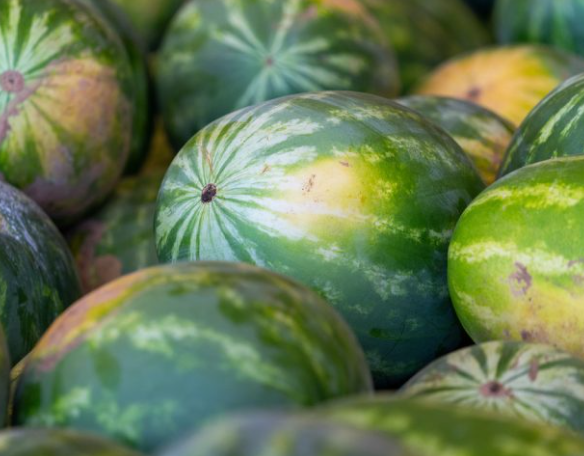
Other than cutting open a watermelon to see the inside, the field spot may be the best sign of ripeness. This spot shows where a melon was lying on the ground while attached to the vine.

If the watermelon is ripe, the field spot should be a large yellow patch on one side. The color should be a creamy, almost butter-like yellow. The bigger the yellow belly and the creamier the color, the more time the melon ripened on the vine. However, if the spot is small or looks more white than yellow, the melon may not be ripe.

Tip 2: Tap the underbelly and listen for a deep sound

Another way to find a ripe watermelon is to knock on the outside with your knuckles gently. A ripe melon will have a deeper sound, as opposed to an overripe one. A hollow thud, paired with an oversized yellow spot, indicates a melon may be mealy and overripe.

Tip 3: Look for a dull color and heavy watermelon

Although they may not be the prettiest or the easiest to carry to your car, the best watermelons are dull in color and heavy.

A shiny melon means the insides are underripe. Also, the best melon of the bunch will most likely be the heaviest one. A heavier melon likely holds more water. On average, a watermelon is 92% water, which is what makes it so juicy.

A Frank Discussion (Best Of) Hot diggity dog July is National Hot Dog Month!

0
lee pitts

Lest you think National Hot Dog Month was just a scheme dreamed up by mustard makers to sell more condiments, I’ll have you know that Congress declared July to be National Hot Dog month way back in 1957. I think you’ll agree that whether you call them wieners, franks, or hot dogs they are dog-gone good and they deserve a month of their own.

A Babylonian named Frank Furter was the first person to stuff a bunch of meat and sawdust into animal intestines. Just kidding. Actually, the frankfurter is thought to have originated in Frankfurt, Germany over 500 years ago. (This was the same time that wieners were invented in Vienna.

The sausages made their way to this country with early immigrants but it wasn’t until 1904 that the frankfurter was Americanized. A vendor at the St. Louis Exposition was selling sausages but they were “too hot to handle.” So with each sausage he handed out a glove. When the vendor ran out of gloves he asked his brother in law, a baker, to make some buns to fit around his sausages. Thus the hot dog was born and now there are 3,000 licensed hot dog vendors in New York City alone!

Before the wieners were referred to as “hot dogs” they were known in this country as Dachshund sausages, named after the wiener dog of the same general conformation. The term “hot dog” crept into our vocabulary when a cartoonist, Tod Dorgan, drew a picture of a Dachshund sausage but, like me, didn’t know how to spell Dachshund. So he just called them “hot dogs” and the name became part of our jargon just as hot dogs became part of our diet..According to the National Hot Dog and Sausage Council Americans purchase 9 billion hot dogs per year from grocery stores! Adding in what would be consumed at restaurants or ball parks, the NHDSC estimates that the total number consumed in a year is approximately 20 billion hot dogs!

Babe Ruth is said to have once downed 12 hot dogs between games of a doubleheader but that doesn’t even come close to the record set In 2021 when Joey Chestnut set the world record for hot dogs and buns eaten with 76. Chestnut set the world record twice in the prior three contests: He makes almost half a million dollars per year competing in eating contests and selling his own line of condiments.

Between Memorial Day and Labor Day five billion hot dogs will be consumed, most of them at sporting events. During one World Series game there were enough hot dogs ingested that if laid end to end they would have stretched for five miles. (Who calculates these things I wonder?)

It’s estimated that 95% of American households purchase hot dogs and that over 50 million are consumed daily. They come in all shapes and sizes. The longest hot dog on record was a 1,983 foot hot dog made in 1983 in Michigan and the heaviest was a 681 pounder made in 1987 in Chicago. That’s a lot of mustard!

Surprisingly, adults eat more hot dogs than children and women eat more than men.

All this information still does not answer the most often asked question about hot dogs. “Why are hot dogs sold ten to a package but the buns come eight to a pack?”