Tuesday, January 13, 2026
Home Blog Page 4733

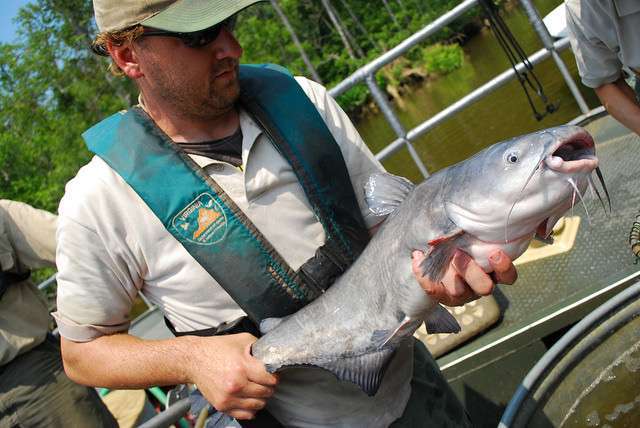
Blue catfish showing promise at Cheney Reservoir

0
Chesapeake Bay Program

About 10,000 blue catfish have been stocked into Cheney Reservoir annually since 2006; however, the success of
these stockings has been relatively unknown. Periodic reports from anglers are received, and catches in standard gill
net samples usually amount to around10-20 fish each year. Generally, the best gear for collecting large numbers of
blue catfish is a specialized kind of electrofishing, which is far different
from the electrofishing technique used to capture other fishes like bass
and walleye. This method effectively stuns blue catfish in water up to 40
feet deep, and is most effective in late summer. In previous years, very
few blue catfish were sampled with this technique at Cheney Reservoir;
however, during sampling this summer, large schools of over a hundred
blue catfish were observed while electrofishing. These blue catfish varied
from five inches to 20 pounds. Some anglers have even patterned
blue catfish and have had success catching a few. Remember, as this
fishery develops, blue catfish are protected by a 35-inch minimum
length limit. Since blue and channel catfish look very similar, be sure of
your catfish identification. For identification tips, visit this link.

Source: Jeff Koch, District Fisheries Biologist

USDA invests $68 million in 540 renewable energy and energy efficiency projects nationwide

0
usda
Funding includes loan guarantees and grants for solar energy to create jobs, promote energy independence and advance the use of renewable fuels

BUNN, N.C., Sept. 18, 2014 – Agriculture Secretary Tom Vilsack today announced that USDA is investing in 540 renewable energy and energy efficiency projects nationwide.

“These loan guarantees and grants will have far-reaching impacts nationwide, particularly in the rural communities where these projects are located,” Vilsack said. “Investing in renewable energy and energy efficiency will continue the unprecedented increase in home-grown energy sources and American energy independence we’ve seen in recent years. This is creating jobs, providing new economic opportunities and leading the way to a more secure energy future.”

Secretary Vilsack made the announcement while in North Carolina to highlight USDA’s investments in rural renewable energy projects, as part of the Obama Administration’s ‘all-of-the-above’ energy strategy. It is the most recent of a series of USDA actions to strengthen the country’s energy sector. Two weeks ago, Vilsack announced a $105 million loan guarantee to a company that will produce jet fuel from municipal solid waste.

Today’s funding is being provided through USDA Rural Development’s Rural Energy for America Program (REAP). REAP was created by the 2008 Farm Bill and was reauthorized by the recently passed 2014 Farm Bill.

The announcement comes on a day when President Obama is announcing new executive actions to further advance the development of solar technologies across the country. These new investments in solar will reduce America’s energy consumption, cut carbon pollution by nearly 300 million metric tons – equivalent to taking more than 60 million cars off the road for a year – and save businesses nearly $45 billion on their energy bills. The renewed effort to invest in solar energy also includes commitments from a broad coalition of 50 public and private sector partners, including leading industry, community development organizations and housing providers in 28 states. To learn more about this new Obama Administration initiative to increase the use of solar power, visit the White House website.

“USDA is proud to play a key role in Obama Administration’s efforts to promote the use of solar technologies,” Vilsack said. “Of the REAP projects funded today, 240 projects are for solar investments of $5.2 million in grants and $55.3 million in loans.”

During Secretary Vilsack’s trip to North Carolina, he visited Progress Solar in Bunn, N.C., which received a $3.4 million REAP loan guarantee in 2012 for installation of a solar array. Progress Solar now produces enough solar energy to power 540 average-sized homes each year. The 4.5 megawatt array was developed by North Carolina-based O2 Energies, Inc. The Progress Solar site is a dual-use solar power plant and a working farm where a 10th generation farming family raises free range sheep and lambs. The project serves as a test site for herd management best practices on a solar farm, and the goal is to model future collaborative efforts that marry solar-energy production with agriculture production. This is the seventh solar farm venture that O2 Energies has developed in North Carolina.

In North Carolina alone, Vilsack announced $55.3 million in new REAP program loan guarantees and grants for 22 solar energy projects. For example, USDA is awarding a $3 million loan guarantee to Broadway Solar Center, LLC to help finance a 5 megawatt solar array in Columbus County, a $4.9 million loan guarantee for a similar project in Hertford County and a $2.1 million guarantee for a project in Warren County.

In total, Vilsack announced $68 million in REAP loan guarantees and grants today. Funding is contingent upon the recipients meeting the terms of the loan or grant agreement.

Eligible agricultural producers and rural small businesses may use REAP funds to make energy efficiency improvements or install renewable energy systems including solar, wind, renewable biomass (including anaerobic digesters), small hydroelectric, ocean energy, hydrogen, and geothermal.

Since the start of the Obama Administration, REAP has supported more than 8,800 renewable energy and energy efficiency projects nationwide. During this period, USDA has provided more than $276 million in grants and $268 million in loan guarantees to agricultural producers and rural small business owners.

President Obama’s historic investments in rural America have made our rural communities stronger. Under his leadership, these investments in housing, community facilities, businesses and infrastructure have empowered rural America to continue leading the way – strengthening America’s economy, small towns and rural communities.

BVD testing could pay off big

0

A K-State veterinarian reviews a new study about the economic value of testing calves for bovine viral diarrhea.


MANHATTAN, Kan. – The name of the disease is somewhat misleading. Although symptoms of this problematic virus—bovine viral diarrhea, or BVD—in beef herds include respiratory disease, and of course, diarrhea, it can lead to even greater problems for beef producers.


“Diarrhea is such a minor part of this disease,” said Gregg Hanzlicek, a Kansas State University veterinarian. “On a cow-calf operation, BVD’s biggest impact is on cow reproduction. It depends when the cow is exposed during pregnancy on what’s going to happen to her or happen to her fetus.”


Cow infertility, early embryonic death within 42 days of gestation, aborted calves and calves born with skeletal abnormalities, can all occur in a BVD-infected herd, he added. When BVD enters feedlots and stocker units, it can suppress the immune system of calves and result in issues with bovine respiratory disease.


Because BVD has the potential to affect all of these beef industry segments, many in the industry are paying closer attention to it and paying a premium for calves that test negative as persistently infected (PI) with BVD.


In fact, video auction data (http://www.thecattlesite.com/news/46373/new-analysis-shows-bvdpi-testing-pays-netting-producers-14-more-per-head) show calves marketed in 2013 that had been tested and declared PI negative brought $2.97 more per hundredweight, a 23 percent increase from 2012. This translates to an additional $14 per head on a 600-pound calf.


Hanzlicek said if a producer sent samples from a group of calves to the Kansas State Veterinary Diagnostic Laboratory for PI testing, it would cost a little more than $2 per head, so the return more than covers the cost. Producers can choose to send two different types of samples—tissue, such as ear notches, or blood.


“For herds that are at a high risk of having BVD, testing is economical, and it’s a good part of a biosecurity program to keep BVD out of the herd,” Hanzlicek said. “It’s not typically for whole-herd testing. Test the youngest animals first. If there are no positives, then you can be fairly comfortable there is no BVD in the herd. If you find a calf that is PI positive, then you’ll have to go back and test the dam.”


Hanzlicek recommends that producers talk with their local veterinarian, because BVD PI testing is not for every herd. Some herds are more at risk and should consider testing.


A complicated disease


PI calves are calves that carry BVD, and they silently shed the virus to other animals in the herd, unbeknownst to the producer.


“A PI calf is a calf that was exposed to the virus while it was in the uterus its first 40 to 120 days of gestation,” Hanzlicek said. “If it’s exposed during that time, the calf does not recognize that virus as being something foreign. When it’s born, it thinks that virus is part of it. That virus keeps reproducing within the calf and makes it basically a walking virus.”


The U.S. Department of Agriculture’s (USDA’s) National Animal Health Monitoring System conducted a study (http://www.bvdinfo.org/wp-content/uploads/2013/supporting-articles/Overview-NAHMS-BVDPrevalence.pdf) in 2007-2008 and found that approximately one in 12 herds had at least one PI calf. The prevalence of PI calves within the positive herds was anywhere between 1 and 16 percent.


If producers decide to test their herd after discussing it with their local veterinarian, they should test the calves before weaning.


“My recommendation is to test when you’re going to ear tag them, right after birth at maybe a day to a few days of age,” he said. “You can freeze the ear notches and send them all in at the same time. We need to get those PI calves identified and out of the herd as soon as possible after birth, certainly before the breeding season starts.”


Hanzlicek said producers should not take PI-positive calves to the sale barn.


“What happens is someone who doesn’t know they are PI calves takes them home in a group of calves, and they have a bovine respiratory problem or other problems,” he said.


Instead, some options producers might need to consider would be to place the animal in a quarantine pen and feed to slaughter, or euthanize the animal.


According to the USDA’s Animal and Plant Health Inspection Service (APHIS), humans are not susceptible to BVD. Producers also can consider vaccines to protect against BVD. Learn more about BVD through APHIS (http://www.aphis.usda.gov/animal_health/emergingissues/downloads/bvdinfosheet.pdf) or by visiting http://www.bvdinfo.org.

Story by: Katie Allen

K-State agronomists help co-author newly revised “Midwest Cover Crops Field Guide”

0


MANHATTAN, Kan. – Farmers interested in planting cover crops to improve soil health now have an updated and expanded resource in the second edition of the Midwest Cover Crops Field Guide.


The pocket guide, released Sept. 22, was produced by Purdue University and the Midwest Cover Crops Council, with input from DeAnn Presley, K-State soil management specialist; Peter Tomlinson, K-State environmental quality specialist; and other agronomists in the Midwest.


“This is a great resource on cover crops. It is objective and thorough, and applicable to conditions of Kansas as well as neighboring states,” Presley said.


Growers plant cover crops for a variety of reasons and possible benefits, Presley added.


Cover crops can trap nitrogen left in the soil after cash-crop harvest, scavenging the nitrogen to build soil organic matter and recycling some nitrogen for later crop use. They also can prevent erosion, improve soil physical and biological characteristics, suppress weeds, improve water quality and conserve soil moisture by providing surface mulch.


The first cover crops guide was released in February 2012. The updated guide is in response to the increasing interest in cover crops in the Midwest and to requests for additional information


“All this new information will help farmers better choose appropriate cover crops for their situation and better manage the cover crops they grow – all for greater potential benefit for their soils and cash crop growth,” said Eileen Kladivko, Purdue professor of agronomy, and editor of the new publication.


The updated guide features seven new topics:

* Getting started in cover crops

* Rationale for fitting cover crops into different cropping systems

* Suggested cover crops for common rotations

* Cover crop effects on cash crop yields

* Climate considerations including winter hardiness and water use

* Adapting seeding rates and spring management based on weather

* “Up and coming” cover crops


There also is more information about herbicide carryover, manure and biosolids applications, and crop insurance issues.


Four states have been added to the new guide to round out information for cover crops in the Midwest. They are Kansas, Missouri, Nebraska and South Dakota.


The guide’s second edition is available for purchase at Purdue Extension’s The Education Store at www.the-education-store.com. There is no online version of the publication.


Kansas producers may be able to get a copy of the new publication from Presley later this year.


“I bought 500 copies for Kansas producers which I’ll be giving away at K-State Research and Extension winter extension meetings,” Presley said.


For more information, contact DeAnn Presley at [email protected] or 785-532-1218.

Rick Funk Memorial Youth and Women’s Pheasant Hunt, Ocotber 4

0

Activities will be available for all family members in attendance

PRATT – The Johnson County chapter of Pheasants Forever (PF) is hosting an Outdoor Family Fun Day and Rick Funk Memorial Youth and Women’s Pheasant Hunt Saturday, October 4 and invite you to join. Both family activities and hunts will take place at Eckman’s Hunting Preserve, 988 E. 1900 Rd., Baldwin City, from 7:30 a.m. to 3 p.m.?

Youth hunts will be open to hunters age 12-15 with an adult sponsor. Women’s hunts will also be offered. Space is limited and hunts will be awarded on a first-come, first-served basis. For information on license requirements, visit ksoutdoors.com and click “Services/Education/Hunter.”

The days activities will begin with a hunter safety refresher, warm?up clay shooting, followed by morning and afternoon hunts. Those not hunting may shoot additional clays or enjoy the family fun day activities, including GPS geocaching, an archery range pellet gun shooting and a casting challenge.

There is no cost to attend this event and lunch will be provided. Registered youth will receive a PF Ringnecks membership and be eligible for a gun raffle.

For more information, or to find out how you can help contribute to this event, visit jocopheasantsforever.org, or contact event coordinator, Jim Milazzo, at (913) 636?3369 or by email at [email protected].

Source: Kansas Department of Wildlife, Parks and Tourism