Sunday, January 18, 2026
Home Blog Page 107

“Reduced Chance of Life” EPD

0

Trent Loos
Columnist

I clearly remember the very first presentation I sat through at a livestock meeting where the presenter was talking about a “Social License” to produce food for people. Honestly, at the time, I was mostly falling prey to the nonsense of thinking that if we don’t do things a certain way to please consumers regarding how we produce their food, they may tell us to quit. Twenty years later I realize that was actually the food Nazi’s of the world implementing total control rather than consumers sending signals about preferences. The experts (farmers and ranchers) are not going to make progress if we listen to the profiteering cubicle dwellers instead of the folks who actually get their hands dirty doing the job.
That brings me to the world of “climate change” where there is no greater example of the controlling Nazi’s of the world trying to shape the future of humanity than by implementing measures of food and fuel production that are not grounded in reality. In Oct. of 2011, I was speaking in Queensland, Australia to a group of 300 cattle feeders just as the Australian government started implementing a “carbon tax” on cattle owners to curb climate change. In fact, their tax was based on Dr. Pierre Gerber’s UN model that had already been proven to be wrong. Yet when the official who spoke after me addressed that topic I had pointed out, her response to cattlemen was, “we know it is flawed but it seems like a good place to start.”
Hey! I have news for you. The entire world is still attacking cattle owners for the methane and CO2 emissions from cows based on that flawed model that wasn’t about improving the environment but rather about eliminating ruminant animals. If you don’t believe me, just ask the dairy and beef producers in the European countries who have been told point blank that they must deplete their cow herds by 1/3 in order to improve the climate.
I hear the board members of the American Angus Association shouting at me, “Yes Trent; that is why we are going to take $4.85 million from the Bezos Earth Fund/Global Methane Hub to prove that cows are the solution and not the problem.” Now I am confused. Are we trying to prove the cow is not a methane contributor or are we trying to determine which cows are genetically more efficient in grass consumption based on an indicator that suggests lower methane means less grass consumed?
I am going to tell you straight out, getting in bed with people who have invested in ending your life is simply the quickest was to die. Do you know how many actual studies have been released since the flawed data from Dr. Pierre Gerber was released in 2006? To be honest, I don’t either, but it was quite easy to find this from the University of Manitoba that was a direct result of the big lie.
Greenhouse gas emissions of Canadian beef production in 1981 as compared with 2011. Link to full research report. CSIRO PUBLISHING | Animal Production Science
In summary it says: The efficiency and environmental footprint of beef production in Canada have improved significantly in the last 30 years. Researchers at the University of Manitoba and Agriculture and Agri-Food Canada (AAFC) Lethbridge found that producing each unit of Canadian beef in 2011 compared to 1981:
– used 17% less water,
– required 29% less breeding stock, 27% fewer harvested cattle and 24% less land,
– reduced greenhouse gas emissions by 15% and ammonia emissions by 20%.
Yet even with this data clearly available to the public for the past 14 years, who references it? Certainly no one who has invested in meat alternates and is trying to kill cattle ownership. Instead of American Angus Association board of directors saying, “We screwed up” and giving the money back, they have doubled down on this efficiency rhetoric which also doesn’t hold water. All you need to do is look at the announcement on the Global Methane Hub website to see how they positioned this partnership in April 2025.
“Reducing methane from cattle is one of the most elegant solutions we have to slow climate change,” said Dr. Andy Jarvis, Director of the Future of Food at the Bezos Earth Fund. “Thanks to collaboration with the Global Methane Hub, we’re backing an effort that uses age-old selection practices to identify and promote naturally low-emitting cattle – locking in climate benefits for generations to come.”
I can’t bring to light only this decision by the Angus folks when the University of Nebraska received $2.3 million from this Bezos Earth Fund, along with a long list of other research institutions around the world. As an interesting side note, the one person in the world that has been studying ruminant emissions for all 25 years that I have known him, Dr. Frank Mitloerner at the University of CA in Davis, was NOT contacted by the American Angus Association about any of this.
In closing, the most important point I want to make is that all living things create emissions that enable the cycle of life. Maybe the Angus folks should just call this new genetic parameter the “Reduced Chance of Living” EPD.
Rooted in the Land: Legacy, Stewardship, and the Power of Playas

0
Screenshot

GREELEY COUNTY, KS – When Alicia Allen returned to her family’s farm in western Kansas at age 24, she never expected that a patch of water-holding ground — one her dad had always said “just shouldn’t be farmed” — would turn into a cornerstone of their conservation legacy.
“When I think about the power of playas, it’s really about their ability to recharge the aquifer.”
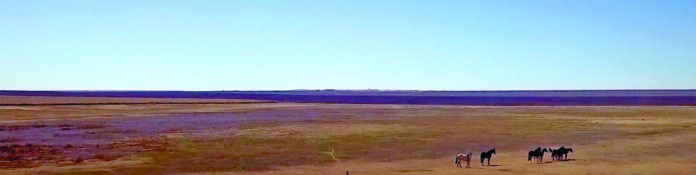
That water-holding patch is a playa — a shallow, round wetland that fills with rainwater and runoff. Playas are vital for recharging the Ogallala Aquifer and provide essential habitat for wildlife. Even though they may remain dry for extended (Continued on page 3)
(PLAYA Continued from page 1) periods, when filled, they support a rich variety of plants and animals.
“My dad didn’t know what a playa was at first,” Alicia admits, “but he knew that soil was different. It supported wildlife, and it just felt like it needed to be conserved.” That instinct led her father to explore a Wetland Reserve Easement (WRE) through USDA Natural Resources Conservation Service (NRCS) — but enrolling wasn’t straightforward. With half the mineral rights owned by an outside entity, the family spent over a year navigating legal channels before finally securing permission to move forward.
Today, that once-overlooked playa wetland spans about 100 acres including grass buffers, bursting to life with birds and deer after a good rain. “It’s always fun to go there after a storm and just see who shows up,” Alicia says. “It’s like a magnet for wildlife.”
Alicia and her family now have multiple playas enrolled in conservation programs, including a second WRE site added just last year. They’ve also used the Conservation Reserve Program (CRP) Migratory Birds State Acres for Wildlife Enhancement (SAFE practice to protect additional playas. “They dot the landscape out here,” she says. “You just have to know what you’re looking at.”
But their work goes beyond the technical. For Alicia, playas represent a deeper purpose.
“When I think about the power of playas, it’s really about their ability to recharge the aquifer,” she explains. “Water is life out here. And if we want this place to be sustainable — for my daughter, for the next generation — then we have to take care of that.”
That commitment also means managing challenges. “Some of the maintenance practices available through CRP just aren’t great fits for our region,” she notes. “Interseeding is effective, but it’s expensive. Burning’s risky during dry spells. I wish there were more farmer-friendly, land-friendly options.”
Still, she wouldn’t go back. “You get this sense of pride seeing deer come in for water or ducks resting during migration. It just makes your farm really pretty — and it feels like the right thing.”
Alicia hopes more landowners will consider enrolling their playas, even if the process takes time. “With WRE, it’s a bit of a journey,” she says, “but you’ll be glad you did it. It benefits the land, the wildlife, your operation — and the future.”
That long view is what keeps her going. “In 50 or 60 years, I’ll be gone,” she says, “but what we did with this land — that’s what the next generation will remember. It’s a relationship we’re building, not just with the land, but with those who come after us. And I think that’s exactly how it was meant to be.”

After Harvest Visit To Farm

0
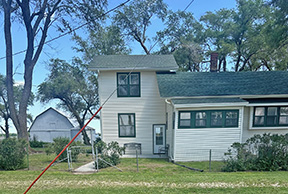
The home and barn in background are the oldest structures on the Shank farm.

Richard Shank
Columnist


Readers have asked what happens on a farm between completion of the wheat harvest and cutting the fall crops of corn, milo, and soybeans. The answer is that one is never caught up on the farm and there remains plenty to do at all times. 

On July 23, I traveled back to the farm near New Cambria in Saline County to check things out. 

Unlike most hot days in North Central Kansas during July, the ground was damp and wet following 1.7 inches of rain from the preceding three days. 

The ears of corn on an 80-acre field  south of the homeplace were bulging in the stocks, which must mean we will have a corn crop fall, but it is too early to predict the yield. A crop of lush-looking soybeans surrounds the homeplace as we and our neighbors hope for a couple more rains to seal the deal on the crop. 

At the entrance to the Shank farm, the road switches from sand to dirt, which makes one wonder why anyone would drive the path after a heavy dew let alone a substantial rain. No one seems to agree with me on this one. I had no more than parked my pickup when a vehicle drove north of the entrance, creating a track deep enough to bury a cat. 

A check of our small garden showed the pumpkin patch is starting to produce bright orange produce suitable for conversion to pumpkin pie, which was a major dessert item during my growing up years. Thanks to modern refrigeration, the pumpkins can be frozen and thawed out for Thanksgiving dinner. 

Lunch with an old friend in nearby Bennington seemed like a great noon time break. Census figures list Bennington’s population at 641, and driving down the one block Mainstreet, it looked like a couple dozen pickups were parked by those eating a noon time meal at Westside Ventures, a restaurant/grocery store combination. 

Inside a sea of area farmers seemed cheerful for the recent rains, in spite of low grain prices. 

Westside Ventures can leave customers with a full stomach, and for those wanting to catch up on the local news, the Minneapolis Messenger is sold here for a meager $2. 

Back at the farm, a deputy from the Saline County Sheriff’s office on patrol of our neighborhood, stopped to visit. Those who reside in rural Saline County appreciate Sheriff Roger Soldan’s commitment to areas outside Salina. 

Walking past the house where I spent a part of my formative years, was a little nostalgic. To put the house in perspective, the east two-thirds of the house is observing a 125th birthday this year. According to the Saline County Assessor’s office, the original house was built in 1900. Nineteen years later, Dr. Isaac Culp, a retired doctor who owned the place at the time, added an addition, which we call the “West Wing,” being a master bedroom and upper-level room. 

Then, in 1920, Dr. Culp added a barn, which remains to this day. The barn sits on the north side of the farmstead and one cannot imagine how much north wind it has endured for more than a century. 

When non-tornadic winds struck the farm in 2022, the old barn endured the wrath of a bad storm. On the other hand, three structures less than 20 years old, within feet of the barn, lost roofs. 

Driving the highway and byways of Kansas, I often see dilapidated old barns leaning waiting for the next gust of wind to take it down. Occasionally, you can pass a totally restored barn that, perhaps, looks better than it was when new. 

Gary Johnson, a neighbor to the west of the Shank farm did a perfect job restoring his barn, which adds beauty to the old neighborhood. 

Bill Came, Jr. who farms the Shank spread, was busy mowing the road ditches on the land he farms, a perk appreciated by all landowners. 

With more than 60 trees on the farmstead, I have yet to visit the homeplace when there weren’t limbs on the ground, and this day was no exception. 

Fifteen years ago, we parked three antique implements on the farmstead. I guess we could call this yard art, but each was a part of early 20th century agriculture. When I saw a Krause one way plow at an estate sale, the asking price of $40 was hard to resist. After all, on the front was emblazoned, “Made

In Hutchinson, Kansas.” 

Then, we have an old disk with no wheels underneath it, meaning it was manufactured before 1960. 

When Lloyd Craig, Publisher of the Winfield Courier, offered to give his dad’s sulky rake to the farm, my brother-in-law and I drove to Cowley County to pick it up, making a long-term display at the farm. 

The next trip to the farm will be allocated to mowing approximately three acres, which make up the farmstead. Whoever invented the zero-turn lawnmower made this job easier and is deserving of kudos. 

The home and barn in background are the oldest structures on the Shank farm.

Lovina Welcomes Granddaughter Sharlene Lovina

0

Lovina’s Amish Kitchen
Lovina Eitcher,
Old Order Amish
Cook, Wife &
Mother of Eight

I am excited to announce the birth of our fourteenth grandchild. Sharlene Lovina Yoder was born to Susan and Ervin on July 17th at 6:13 p.m. She weighed 7 pounds 11.8 ounces and 20 inches long. She is greeted by two sisters and four brothers. Sharlene evens out the grandsons and granddaughters for Joe and I. I went along to the hospital to attend the birth. Once again I am amazed at the miracle of birth and how God created such uniqueness. Mother and baby are doing as well as can be expected. Little Sharlene has already won this grandma’s heart. She’s a precious bundle of joy and has plenty of attention from her six siblings. 

I stayed with Ervin and Susan’s six children this afternoon while they took Sharlene to her first doctor’s visit. I made spaghetti and meatballs before I left to take along for their supper. Susan doesn’t have anyone helping her during the day while Ervin is at work. Kaitlyn and Jennifer are good at helping out. I did some of Susan’s mending and did some cleaning while I was there. I brought the rest of the mending home and also all their dirty laundry. I will wash it here tomorrow. That will help out to not have to worry about getting their clothes washed. 

While I was at Ervin and Susan’s house I asked the children a few questions about the new baby and school. I will share what they said. 

Kaitlyn Rose, 8- I am so happy I have a baby sister. I will be in third grade. I will be in the same class as my cousin Abigail. I wash dishes and watch brother Jr. and the baby for my mom.

Jennifer Susan, 7- I am 7 years old and I just love my baby sister Sharlene Lovina. I help my mom by washing dishes and sweeping the floors. I help babysit Jr. and Sharlene. I will be in second grade when school starts again. 

Isaiah Edward, 7- I like our new baby. I am glad to go back to school. I will be in second grade. 

Ryan Isaiah, 5- I am 5 now but I will be 6 on Sunday (July 27th). I love my baby sister Sharlene Lovina. I am excited to go to school. I will be in kindergarten. 

Curtis Dale, 5- I like the new baby. I wipe dishes and rinse dishes. I want to go to school. I will be in Kindergarten ALREADY. (He put a lot of emphasis on the “Already”. haha)

I then asked 20-month-old Ervin Jay what he thought of someone replacing him to be the baby. He laughed at me and said, “blah blah blah.” The children laughed and said “Grandma put that in your column too.” Haha! They were a well-behaved bunch and listened well to Grandma. It’s amazing how their two sets of children didn’t even know each other until a little over three years ago.

To readers new to this column, Susan was first married to Mose and they had two children, Jennifer and Ryan. Mose died of injuries due to an automobile accident when he and his driver Dan were on their way to work. They were hit head on by a car crossing the center line. Dan died instantly and Mose lived five days but was never conscious. Ervin had lost his wife three months earlier after a battle with breast cancer. He was left with three children Kaitlyn, Isaiah, and Curtis. Ervin and Susan together have a son Ervin Jay Jr. and now this new bundle of joy. They all have had many adjustments but are a happy blended family. We don’t always know why things happen, but God has a plan for each of us.

We are invited to a wedding on Wednesday and another one on Thursday. It doesn’t look like we will be able to attend either one. Congratulations to Daniel and Marilyn, and Micheal and Christina. May you both have a long happy married life together with God as your guide. 

Happy birthday to son Joseph who will be 23 on July 24th and grandson Ryan who will be 6 on July 27th. Some of our family enjoyed a delicious grilled supper at Joseph and Grace in honor of his birthday on Friday night. My sister Verena went with us and spent the night here.  Did you know my editors have a Facebook page for me?  You can find more pictures and short posts there.  It’s Lovina’s Amish Kitchen.

God’s blessings!

ZUCCHINI SALAD

4 medium zucchini 

2 green onions

1 green pepper

1 celery rib

2 carrots, thinly sliced

1/3 cup sugar

1/3 cup white vinegar 

3 tablespoons olive oil 

1/2 teaspoon salt

Slice unpared zucchini in about 1/8 slices. Slice green onions. Seed green peppers and slice thinly. Coarsely chop or thinly slice celery and carrots. Beat together sugar, vinegar, oil and salt until well mixed. Pour over vegetables and gently toss to coat. Cover with plastic wrap and refrigerate for several hours or overnight. When ready to serve, spoon into a glass bowl. The salad will stay fresh in the refrigerator for at least two days. 

Lovina’s Amish Kitchen is written by Lovina Eicher, Old Order Amish writer, cook, wife, and mother of eight. Her three cookbooks, The Cherished Table, The Essential Amish Cookbook, and Amish Family Recipes, are available wherever books are sold. Readers can write to Eicher at Lovina’s Amish Kitchen, PO Box 234, Sturgis, MI 49091 (please include a self-addressed stamped envelope for a reply); or email [email protected] and your message will be passed on to her to read. She does not personally respond to emails.