Tuesday, January 20, 2026
Home Blog Page 132

K-State food scientist shares tips for outdoor meals during harvest

0

When planning food in the field, follow these guidelines to keep the party safe
Combines will soon be rolling across Kansas for wheat harvest, with other crops not too far in the future.

Part of the tradition in farm country is feeding the people working to bring in the harvest. Kansas State University food scientist Karen Blakeslee says meals in the field follow many of the same guidelines for safe picnics and backyard barbecue meals.

Clean. Blakeslee suggests packing wet wash cloths with soap to clean dirty hands. “Another option is a spare soap bottle with a mix of water and soap,” she said. “Keep in mind that hand sanitizer is not effective on dirty hands. Wash them first, then apply hand sanitizer for best results.”
Separate. Keep raw meat and poultry away from ready-to-eat-foods. Use a clean utensil for each dish. Use a clean plate when going for second helpings of food.
Cook. Use a food thermometer to check for doneness. Cook all poultry to an internal temperature of 165 degrees Fahrenheit. Cook burgers and sliders to an internal temperature of 160 F.
Chill. Keep hot foods hot and cold foods cold. Put out food in batches.
In addition, Blakeslee said many foods can be prepared in advance and frozen for use later. Baked goods – bread, cookies, cupcakes and more – freeze well, she said.

“After baking, cool these foods completely before packaging,” she said.

Frozen fruit cups are an easy freezer treat for hot days, said Blakeslee, who cites a recipe from Iowa State extension that uses muffin tins to freeze fruit.

“Many casseroles, meat pies or pasta dishes can be frozen and baked from the freezer,” Blakeslee said. “Use aluminum foil containers or other containers made to go from the freezer to the oven with ease.”

Blakeslee cited a publication from Oregon State extension that provides ideas for foods that can go from freezer to oven with ease.

“If there is access to electricity out in the field with some farm equipment, it can be used to plug in slow cookers or roasters to keep foot hot,” Blakeslee said. “But be sure the voltage is compatible for the appliances being used.

Food aside, Blakeslee encourages families to make time to eat together during a break in the harvest.

“Set up a portable table and chairs to eat together, if possible,” she said. “That break from harvest activity is a great way to recharge and catch up with others before heading back out to the field.”

Blakeslee, who also is coordinator of K-State’s Rapid Response Center for Food Science. publishes a monthly newsletter called You Asked It! that provides numerous tips on food safety.

More information is also available from local extension offices in Kansas.

Squash Vine Borer

0
Description: The clearwing moth is the adult of the squash vine borer and is about ½-inch long with metallic-green front wings and clear back wings. The abdomen is orange with black spots. Eggs are flat, brown and very small. Larvae resemble maggots with a whitish-cream colored body about one-inch long with a brown head.
 
Life Cycle: From late June through early July adult moths emerge from the ground to lay eggs. Eggs hatch in about one week and begin feeding within the stems of squash plants. In four to six weeks the larvae pupate in the soil until the following summer. There is one generation of squash vine borer each year.
 
Damage: Squash vine borers feed on summer and winter squash as well as pumpkins causing yellowing leaves and wilting. Holes in the stems near the base of the plant along with the appearance of a sawdust-type material that is moist and green/orange colored are symptoms of squash-vine borer. One of the first indicators of a problem is when squash plants are wilted even during cool parts of the day.
 
Control: Treating plants that have active larvae is difficult. It is best to monitor plants for the adult moth and treat before the larvae can infest plants. Planting a successive crop of summer squash in early July is another control method. This allows the crop to mature when the borers are pupating rather than when they are most active. Crop rotation is another important control measure. Borers can be manually removed by slicing open the stem if you know the pest is present. Insecticide applications need to begin when the squash vines start to spread. Applications should be repeated every seven to ten days through the end of June. If using an insecticide, spray the crown and the base of the runners.
Some chemicals that may be used for borers are permethrin (Eight Vegetable, Fruit & Flower Concentrate; Garden and Farm Insect Control; Lawn & Garden Insect Killer) or bifenthrin (Hi-Yield Bug Blaster II, Bug-B-Gon Insect Killer or Lawn and Garden) applied as a spray or dust.

Hornworms on Tomatoes

0
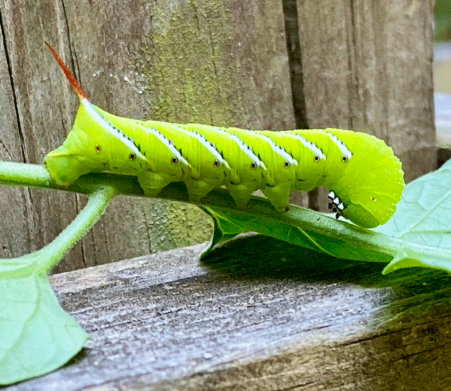
Description: The larval stage is a 3 ½ to 4-inch long pale, green caterpillar. There are five pairs of prolegs and a horn on the last segment. The tobacco hornworm has seven diagonal white stripes and usually a red horn. The tomato hornworm has V-shaped markings and a blue/black horn. The adult moth has a stout, grayish-colored body with wings that span 4 to 5 inches.
Life Cycle: In the larval stage the hornworm caterpillar passes through four or five stages before reaching full size. This process takes about one month. The caterpillar pupates in the soil giving rise to an adult moth. The adult of the tobacco hornworm is the Carolina sphinx moth. The adult of the tomato hornworm is the five-spotted hawk moth. There are two generations each year.
 
Damage: Hornworm larva are the damaging stage and are typically found on tomatoes, but feed on eggplant, peppers and potatoes as well. Caterpillars devour leaves and stems leaving behind dark green or black droppings.
 
Control: Hornworms are parasitized by several insects including the small braconid wasp which lays eggs on the larva. When the eggs hatch, the wasp larva feed on the hornworm devouring it from the inside killing the hornworm.
To avoid harming beneficial insects, handpicking hornworms is the recommended control. Hornworms camouflage themselves among the leaves making it difficult to find them.
Bt (Dipel, Thuricide), Spinosad (Conserv, Captain Jack’s Dead Bug Brew, Monterey Garden Insect Spray), cyfluthrin (BioAdvanced Vegetable & Garden Insect Spray) are a few insecticides that can be effective at controlling hornworms. Always follow label instructions and pay close attention to the harvest interval.

Lettuce Eat Local: Some Squeaks Are Not Ideal

0

Amanda Miller
Columnist
Lettuce Eat Local

Instantly I think of that incomparable sound of a mouse chirp, as it skitters along inside the wall or darts across the driveway — a rodent squeak that often elicits a human squeak in response. A similarly disconcerting squeak might be coming from an unidentified source in the vicinity of the car engine or pipes under the sink. A bicycle chain or a screen door might squeak in its plea for a good oiling, as might a rusty wagon wheel. My daughter has a pretty good squeak-squawk in response to her brother pestering her. 

Some squeaks, however, are just right. While they’re hard to categorize, lots of the squeaky sounds my kids make when they see kittens, cousins, or Daddy are the kind you want to bottle up and save forever. While the squeak I’m segueing to is technically of a less endearing nature, it is hard to hear it and not feel a tremor of happiness. 

It’s the cheese squeak! If you’ve never had squeaky cheese, you’re missing out. It literally squeaks in your mouth as you chew, which can be quite unnerving if you aren’t expecting it but equally somehow very endearing. Cheese with this audible personality is not a specific type, but rather has certain age and pH characteristics: lower in age and acidity. 

Most people probably associate squeakiness with cheese curds, which is an ambiguous category in itself, since almost all cheeses start off as curds. What’s marketed as “cheese curds” typically refers to small, nubby pieces of any type of unaged/baby cheddar — so renowned for their distinctive sound that they are also known colloquially simply as squeaky cheese. 

The sound is actually a working scientific collaboration between your teeth and the molecular structure of the cheese. According to Wisconsin Cheese, “cheese curds are made up of proteins that are bound together with calcium. When you bite into a cheese curd, this protein and calcium structure rubs against the enamel on your teeth, making a squeaking sound.” After a few days, cheese loses the ability to squeak as the protein-calcium bonds break; it tastes the same, just doesn’t sound the same. 

Other cheeses that have a similar protein structure might also provide a squeak-symphony. Fresh mozzarella, bread cheese (juustoleipӓ), panela, and halloumi are a few options from around the globe. Fortunately, “squeak” seems to be pretty relatable in any language, and we don’t even have to traverse the globe to experience it ourselves. I was catering a Mediterranean islands themed workshop recently, and may have squeaked in preemptive excitement at the excuse to make some halloumi, a Cypriot culinary all-star and “marvel of the cheese world.” One of its most distinctive qualities is its ability to withstand high heat without melting, and in fact grilling or pan-frying halloumi are some of the most common ways to enjoy it — its caramelized, crispy exterior and warm, squeaky center is wonderful. 

Halloumi has a long history, mentioned in literature from the 1500s but likely with centuries of usage before then. Authentic halloumi was traditionally made exclusively with sheep and goat milk (since those animals could traverse the island’s mountains better than bovines), and now has Protected Designation of Origin, meaning it has to be made in a certain part of Cyprus. So what I made in my kitchen in Kansas with all cow milk wasn’t “real,” but it was very tasty, and very squeaky. 

Now if I could just get Kiah to see a chicken and her grandma at the same time as she chews on some halloumi, we might have squeaky perfection. 

Halloumi Grilled Cheese-adilla

A cheese squeak has no language, so I can mix Spanish and Greek, right? Although quesadilla means “little cheese,” so I guess it is inappropriate since the cheese is not little here. Normal grilled cheeses with the cheese in between bread is good and all, but I figured if you can grill halloumi it might as well be the one to sandwich the bread! The texture of the halloumi when raw could be considered rubbery, but at least to me in a positive way; when warm and pan-fried, it might still be a bit rubber-esque, yet now with that beguiling squeak. Thyme honey is a common pairing with all sorts of cheeses in Cyprus, deliciously blending the line between savory and sweet. 

Prep tips: I can’t include the recipe for halloumi here since it is too involved, but you should be able to find either halloumi or similar “bread cheese” at a larger grocery store or Aldi. 

halloumi, sliced about ¼” thick

coarse salt

soft pita

local honey

fresh thyme

Heat a skillet over medium heat, then lay in a couple pieces of halloumi with enough space so they don’t touch. Sprinkle them with salt, and sear until they start caramelizing in spots; flip and sear the other side. Warm the pita, drizzle with honey, and sprinkle with thyme. Cut in pieces to match the halloumi if you can, then sandwich it between the pieces of fried, squeaky cheese. Eat right away.