Tuesday, January 20, 2026
Home Blog Page 137

Prairie Doc Perspective: Anatomical Variations: Connecting Physicians and Anatomists

0

Prairie Doc ®
Perspective
Ethan L. Snow, PhD

It’s remarkable how much anatomy education and medical practice overlap, yet anatomist-physician collaborations are often underutilized for improving student learning and patient care outcomes.
Becoming an anatomist or a physician requires commitment to many years of education and practical training. Both generally require four years of comparable, comprehensive baccalaureate coursework followed by four or more years of concentrated graduate/medical education and practical training. Amid both career paths, students work diligently to achieve predefined benchmarks for competency in complex human anatomy, meticulous clinical applications, and interrelated skills. Nevertheless, it is natural for anatomists to lose insight about practical clinical skills and physicians to lose insight about anatomical intricacies – most notably while the other person is keenly maintaining expert-level knowledge and knowhow of that very information. Anatomical variations offer a course of action for efficiently and effectively addressing the “use it or lose it” principle for both experts.
Human anatomy is taught and learned according to its foundational morphologic norm – that is, the typical configuration, form, and function of structures in the body. Understanding typical anatomy allows physicians to draw clinical insights from patients’ chief complaints. For example, knowing the typical arrangement of bones, muscles, nerves, and vessels in the body allows orthopedic physicians to discern differential diagnoses and establish safe and effective surgical and therapeutic treatment plans for patients with musculoskeletal issues. However, anatomical variations – structures that do not present in typical location or form – are common and can complicate both learning and medical practice.
As authorities in the granularity of human anatomy, anatomists develop and maintain expertise about the development, presentation, and impact of anatomical variations, especially as they uncover specific cases during routine cadaveric dissection. As authorities in the minutiae of patient care, physicians develop and maintain expertise about adaptive clinical practices to address anatomical variations, especially as they come across specific cases during patient examinations and surgeries. In these regards, each professional can strategically benefit from the other’s expertise to create better outcomes, and this “bench-to-bedside” collaboration is known to promote translational medical education, high-definition patient care, and exemplary interprofessional behavior.
Despite their inherent benefits, strategic anatomist-physician collaborations appear underutilized. Investigating anatomical variations cases permitted by cadaveric donors and/or living patients offers one way to encourage these collaborations. Common field interest seems to effortlessly reciprocate enthusiasm from both parties. Anatomists can leverage workload designated for research/scholarship and physicians can fulfill contractual service obligations, thus offering a manageable framework for each to strategically contribute expertise and achieve high-quality and high-impact productivity. Simultaneously involving students can further distribute workload while providing them with meaningful research experience and influential mentorship.
As indicated, cadaveric donors and living patients play a critical role in this framework by willfully permitting analysis of their associated tissues and records. Human cadaver dissection offers complete and unrestricted views of anatomical variations, and patient records (diagnostic imaging, physician summaries, etc.) convey the clinical presentation and impact of variations. Anatomists, physicians, and students remain extremely grateful to each for their incredible contributions to advancing medical education and patient care.
Ethan L. Snow, PhD is an Anatomist and currently serves as an Assistant Professor of Innovation in Anatomy at South Dakota State University in Brookings, South Dakota. Follow The Prairie Doc® at www.prairiedoc.org, Facebook, Instagram, YouTube, and Threads. Prairie Doc Programming includes On Call with the Prairie Doc®, a medical Q&A show (most Thursdays at 7pm streaming on Facebook), 2 podcasts, and a Radio program (on SDPB), providing health information based on science, built on trust.
Lettuce Eat Local: Ice Baby

0

Amanda Miller
Columnist
Lettuce Eat Local

It used to be surprising and perhaps a little unnerving, the way both of my children like to eat frozen things. It is now just a given in our household, and maybe kids having an affinity for freezer food is more commonplace than I realize, but as an adult it seems odd as well as unappealing. 

Things that are too cold hurt my teeth, and there is essentially no draw for me to chomp on icy-crunchy things (ice cream is a category unto its own). Ice is ideal for being blended into drinks, but it is not for eating and crunching; frozen fruit follows along the same lines, as it’s lovely for smoothies but just so cold to eat on its own. 

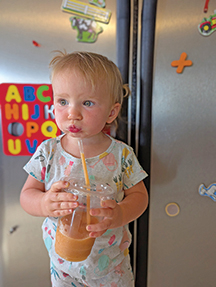
Benson and Kiah, however, could live on frozen things. The freezer shelves have been hijacked by little baggies of all sorts of nibbles for the kids — if it’s frozen, they’ll probably want it. 

For a year or two, Benson was in his frozen banana era. I would just cut bananas in half, stick a popsicle in, and pop them in the freezer. I know some moms dip the bananas in chocolate, but trust me, he didn’t need any extra incentive (or mess). Some moms also limit how many bananas they give their kids in regards to “regularity issues,” but Benson never had a problem so I just tried to keep his little body at some sort of moderation. I came home one day to his babysitter having given him five (“he kept asking for them,” she justified sheepishly — never trust a grandma), if that tells you anything about his devotion. They were a nonnegotiable staple for so long that it felt like we lost part of our family identity when he slowly transitioned to a low frequency of ingestion. 

It was bananas with Benson (that boy is bananas), yet Ki would gladly freeze all her assets. She can be remarkably articulate without many words to communicate what she desperately needs out of the freezer — and how incredibly appropriate that literally in the middle of that sentence, she woke up from a nap, inconsolable until we went to the freezer to discuss her options. 

Options like frozen peas, butter buttons, energy bites. There are “normal” popsicle-mold choices like peaches ‘n’ cream and raspberry chia, and I use a little ice cube tray to be creative/lazy with plain yogurt, bone broth, even awkward things like leftover oatmeal or mini wheat mush. The green grapes are shriveled and freezerburned; the strawberries are so hard; the okra slices feel too weird to even offer. She don’t care: if you freeze it, she will come. 

When she was teething, it made a little more sense, but I guess now it’s just part of her personality. It really doesn’t have to be anything fancy: even plain ice is plenty exciting, especially the perfect crunchy little ice spheres they steal out of Aunt Lisa’s cup whenever they see her. I just read an article about the science of picking the best ice cube for each situation, so it must not just be my kids who are obsessed with ice. 

I actually shared a recipe for a “Cup of Ice” once, in an article that I think of more often than any of my others. I wrote it the week Brian had his farming accident; we were in the SICU with his extensive injuries, at the end of ourselves (we thought — there was much more “end” to be reached) but so floored at the gift of life and the care of our community. Brian wasn’t allowed to eat or drink anything, “but he can crunch on an ice chip once every long while. He is incredibly grateful for every tiny bite, and it reminds me just to be thankful.”

I’m writing this article on Father’s Day, about Brian’s kids and their predilection for ice and icy things. I can’t help but stop and grin at God’s grace. 


Cup of Peach Icee

To be fair, it’s officially hot now and ice cold things are the ticket. While the kids would be happy with a cup of ice, a fruity icee is way more Brian’s and my style. ICEE (in all caps) is a trademark brand of frozen carbonated beverage made with sugar syrups and carbon dioxide; they began in 1967 and their website claims to be “the No. 1 frozen beverage brand worldwide.” Maybe, but my goodness, this homemade one is really fantastic, and I’d choose its natural color, flavor, and sweetness any day. Kiah got a sample taste out of the blender and almost fell apart waiting for me to pour it into her cup she was so excited. 

Prep tips: you need a powerful blender for this to work. The baking soda is to react with the acidity and create a few carbon dioxide bubbles — it won’t be fizzy per se, but you might taste a little carbonation! This amount served us four, but the kids would definitely have slurped down twice as much.

12 ounces ice cubes

12 ounces fresh peaches, roughly chopped

squeeze of lime juice

drizzle of honey, to taste

½ teaspoon baking soda

Blend for a minute or so, until completely smooth. Serve immediately. 


Reunion At The Shank Farm Was Nostalgic

0
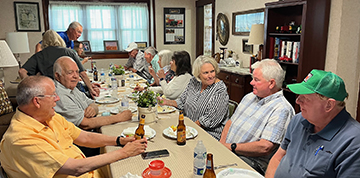
Eight retired Southwestern Bell/AT&T managers swap stories and memories over lunch at the Shank farm.

Richard Shank
Columnist

A reunion at the Shank farm near New Cambria with 11 contemporaries from days spent as a Southwestern Bell Telephone/AT&T Managers was both nostalgic and fun, which prompted preliminary plans to meet again in Topeka in December.
The combined service of this group exceeds 250 years during turbulent times in the telecommunications industry. Needless to say, there were plenty of stories to swap providing reaffirmation this group was a true team, dedicated to working together to support the fortunes of an appreciative employer.
My first day on the job, January 2, 1980, at the Southwestern Bell offices in Topeka, today seems like a time in the dark ages, although we all thought everything was high tech during that period of time.
In February 1980, Senator Ted Kennedy flew to Topeka for a speech to a group of supporters. After touching down in the capital city, Kennedy realized he had left his speech behind in Washington, D.C. A frantic aide called Ross Markwardt, my boss at the time, and asked for help. As it turns out, Southwestern Bell was one of a few that had a fax machine in those days. Ross went to the office and watched as Kennedy’s speech was transmitted over the phone line one page at a time and the story had a happy ending.
In the 1980s, there were 34 mobile phone customers in Hutchinson. Today, there are, perhaps, 15,000 cellular phone customers, so times have changed.
The origin of the telephone is a story in itself. Quite by accident, Bell invented the phone in 1876 while attempting to develop a mechanism for the deaf to better communicate. Few, at the time, thought the telephone would become a part of American life. An editorial published at the end of 1876 reported the two most significant events from that year were Custer’s last stand and the centennial of the Declaration of Independence.
The perception soon changed and Bell, who lived until 1922, never allowed the installation in his office, as he considered it a nuisance to getting work done.
Everyone at the reunion looked happy and healthy, with talk of grandchildren, foreign vacations, and golfing being the most common topics of the day.
My intro to Southwestern Bell was in a position called “Science Demonstrator,” which entailed traveling Missouri and Kansas delivering a presentation of how technology would change in coming years. During my first four- and one-half years, I spoke to civic clubs and anyone else that cared to listen. Employees jokingly called the job “the dog and pony show.”
It was a gratifying job in that I heard all the positives of the company and, on occasion, the negatives. Pulling into the Sonic Restaurant drive-in in Iola for a late lunch one afternoon, the old company Ford I was driving experienced some mechanical issues and the brakes ceased to function. Soon I was coasting up to the side of the eating establishment stopping within inches of hitting a brick wall. The manager, walked out and commented, “your brakes work about as good as our phone system.”
I was in no position to disagree and then the Sonics Manager who then laughed and offered to assist with my predicament.
In 1983, the AT&T phone system was one big happy monopoly and few were complaining. Then, Federal Judge Harold H. Greene issued an order requiring AT&T system be divided up into what was called AT&T and seven “baby bells,”
with Southwestern Bell being one of them. The term used to define this break up was “divestiture,” a word spoken daily for years to follow.
January 1, 1984, the telecommunications world was turned upside down although Southwestern Bell would be a stand-alone company.
I was off the road and sitting behind a desk on what was called “state staff.”
Early in my career, a few old-timers in the business provided some savvy advice, all of which proved accurate. One told me that in the phone business, you will be a PFC prior to being a colonel which I presume meant prepare to work your way up the ladder. Another said be nice to everybody as you never know who your next boss might be.
During my days traveling as the Science Demonstrator, I visited Joplin, Missouri, for a week of speeches to local groups. The Joplin Manager was a young man named Shawn McKenzie who looked all of 16 years old. Driving around town with Shawn, I almost wanted to ask, “when will you graduate from high school?” but did not. Actually, we really hit it off and glad we did.
Five years later, sitting at home one evening, the phone rang and the caller was Shawn. He recalled our meeting in 1984 and then said, “I will be your new boss.”
Naturally, I said great and during the 12 years to follow, would work twice for Shawn, and admire him greatly. He is one person I would like to see again, and hope to make that happen soon.
One of my favorite responsibilities while on state staff was scheduling the company’s president for his travels across Kansas. One of the presidents was a man named Ed Whitacre, a Texas born towering figure standing a six foot five inches with a deep voice. When he spoke, everyone listened.
One day Mr. Whitacre asked me to schedule a trip to Colby in the state’s northwest corner. The Colby Southwestern Bell manager decided to shake things up a little and borrowed an old Cadillac convertible to drive Mr. Whitacre around town. Mr. Whitacre, an engineer by profession with a serious demeanor probably would have preferred a pickup truck or anything but a convertible.
The following morning, by coincidence I was in the elevator with Mr. Whitacre, and he gazed at me with a stern look before saying, “you did me no favors when you sent me to Colby” and then walked around the corner to his office.
Fortunately, for all parties concerned, not a word was spoken again about the incident. Mr. Whitacre went on to serve and President and CEO of AT&T and, following retirement, revived the fortunes of General Motors as head man for that company.
In 1988, a move to Hutchinson for a position called Community Relations Manager, a name later changed to External Affairs Director, provided the opportunity for me to know and work with those attending the recent reunion.
We all traveled the highways and byways of Kansas working with the communities served by Southwestern Bell. During the winter months, we all descended on Topeka to push the company’s legislative agenda.
Some called us Governmental Affairs Representatives but most referred to us as lobbyists. A 1994 editorial in the Wichita Eagle called this contingent “an army of lobbyists” and even printed an unflattering cartoon of the group.
Then, we made trips to Washington, D.C. where we became acquainted with a new Congressman named, Jerry Moran, now the state’s Senior Senator.
A former president of Southwestern Bell/Kansas called these jobs the best in the company and that they were, which is why in part I look forward to our next gathering.


Eight retired Southwestern Bell/AT&T managers swap stories and memories over lunch at the Shank farm.

Oh! Oh! Omaha!

0

Trent Loos
Columnist

As much as Nebraskans typically like to joke about chopping Omaha off and dropping it in the Missouri River or seceding it to Iowa, there is at least one time of year that we as Nebraskans couldn’t be more proud of our largest metropolitan city – during the Men’s College World Series (MCWS)!  For the 75th consecutive year, the MCWS is being held in Omaha, Nebraska. It is one of the very few NCAA collegiate athletic championships that is continually held in the same location thanks in part to baseball fanatic and Omaha native Johnny Rosenblatt. In 1949, Municipal Stadium in Omaha, renamed Rosenblatt Stadium in 1964, was dedicated following the determination of Rosenblatt to bring a major league team to Omaha. Instead, he got a 3-year contract to host the MCWS by promising that the city would cover any financial losses.
In 2011, the MCWS moved to the newly constructed Charles Schwab Field and memorabilia from Rosenblatt can be found around Omaha including a miniature field at the Omaha Children’s Zoo. The CWS of Omaha is now a non-profit run by the offspring of several of the original founders. Their goal is to bring that same “small-town spirit” to every fan and member of the eight teams that qualify to come to Omaha every summer.
Each team is supplied with a local “host” who does everything possible to help make the trip to Omaha a magical experience. The hosts line up trips to the zoo, the Strategic Air Command or maybe even a fishing trip and they also make sure specially requested items are in team’s dugout from a specific flavor of gum to fruit and drink requests and so much more!
While teams from across the country may set their sights on traveling the “Road to Omaha” from the first fall practice, if they haven’t been there before they have some pretty interesting expectations of the city. Some players that were interviewed expected to be landing on a grass runway at the airport or seeing a ball field surrounded by corn reminiscent of a scene from “A Field of Dreams.” They expected to see cows roaming all over the place, not a hopping city full of shopping, eating and touring adventures that is home to 1million residents.
Economic indicators reported by Visit Omaha suggest that the MCWS generated $115 million in total impact in 2024, supporting more than 22,000 jobs, filling over 75,000 hotel rooms and generating over $3.5 million in local tax revenue. The stadium seats roughly 25,000 ticketed guests but thousands gather outside of the stadium to watch the games on big screens and celebrate the event at local watering holes.
Thankfully for those of us who are not attending the games in-person, there are a myriad of sports channels covering every aspect of each team, player, coach, groundskeeper, parent, umpire and everything in between. Diligent reporters have managed to find the parents of each player in the stands so they can capture the facial expressions and drama as they watch their son at the plate or see him make an impressive play in the field. You could never get all of that if you were in attendance so that is the upside of watching from the comfort of your couch in the air conditioning.
While the cameras capture the jubilation, they also share the heartbreak as only one team will end this trip to Omaha with a trophy – every other team will end their amazing season with a heartbreaking loss. They’ve poured blood, sweat, tears, injuries, ice baths, physical therapy, long hours, long days and long bus rides plus so much more into this dream. They dream of Omaha, taking their team to the top of the heap and winning “the Natty.” Only one team will do that. The rest will fist bump the men who stole their dream in a show of sportsmanship, fill their pocket with a little of the infield from “The Greatest Show on Dirt” and cry as they hug each other in the dugout. They will ponder the “what ifs” and the “if onlys” until its time to play again. For some, this will be their final at bat. For others it is a stepping stone to a career in the big leagues and for the rest it will be the most amazing player inspiration a coach could ever ask for when building for next year and figuring out how to get back on the “Road to Omaha.”

Just a Little Light: Queen Anne’s Lace

0

Dawn Phelps
Columnist

Queen Anne’s Lace graced the embankments and roadsides, standing 2-3 feet tall as my husband Tom and I headed to one of my class reunions in Tennessee.
As we drove through hills and hollows, I noticed clumps of Queen Anne’s Lace blooming profusely along the road. I asked my husband to watch for a place where he could safely pull the car off the road so I could take photos of Queen Anne’s Lace blossoms up close, and he did.
Even when I was a child, I was in awe of the intricate design of the flowers. The lacy-looking white blossoms are usually 3-4 inches across with a tiny drop of color (red or dark purple) in the very center. It is believed that the tiny bit of color attracts insects to pollinate the flowers.
Each large blossom is made up of smaller sections, and each smaller section is made up of many very teensy white flowers. I think God must have had a great time designing that beautiful weed that originated in Europe. It is of the wild carrot family, a plant that can tolerate hot, dry conditions. It is believed to be named for Queen Anne of Great Britain and her great grandmother Anne of Denmark.
I wonder if someone from Europe who migrated to the United States long ago decided to bring along a few seeds to add beauty to the New World, or maybe it was here already. No matter how Queen Anne’s lace got here, it now grows in almost all forty-eight states in the U.S., in some parts of Canada, and it is prolific in Tennessee where I grew up.
When the root is very small, it is edible but only for a short time since the roots quickly become very woody in texture. The roots are supposed to have a carrot-like taste, but I have never tasted one.
What makes Queen Anne’s Lace special to me are the memories that are connected to my mother. She and my daddy were married many years ago on May 10, a little too early in the season for Queen Anne’s Lace to be in full bloom in Tennessee. My mother used to say that she really wanted a bouquet of Queen Anne’s Lace for their wedding.
Instead of a wedding, my parents just made a visit to the preacher’s house to tie the knot—no fanfare. In fact, the story is told that while my daddy was getting “dressed up” so they could elope, my grandmother came into his room and told him that he “needed to marry that girl” from down the road that he had been courting. Not long after my grandmother’s admonition, they returned to my daddy’s house to announce that they were married.
Years later, when my mother and daddy celebrated their 50th wedding anniversary, one of my sisters from Tennessee brought a bouquet of Queen Anne’s Lace back from Tennessee to Kansas on the plane. So, my mother had a bouquet of Queen Anne’s Lace and red roses for their 50th anniversary.
Seeing Queen Anne’s Lace along the roadside is a reminder of my past, my parents, and my mother’s love of the flower (weed). In earlier years I picked some dried seeds and started a Queen Anne’s Lace patch when I lived in the country east of town, and they grew beautifully!
After marrying Tom and moving into town, I wanted to grow Queen Anne’s Lace again. So, on another trip to Tennessee, Tom patiently stopped along a narrow country road so I could pick some dried seeds. I was hoping to grow “a memory” on the east side of our house which I did, but they only lasted for a while.
Memories of a simple object or a flower can take our minds back to our younger carefree days, to those happy times with our family members who are now on the Other Side. It is funny how we attempt to “regrow” our favorite memories from our pasts, and I have tried to introduce a little of “Tennessee” into my life in Kansas.
Tom and I planted a couple of deep red crepe myrtle bushes in our back yard, but they struggle with the hot, dry weather. We also grow hollyhocks—a vivid reminder of red hollyhocks in our back yard in the country in Tennessee when I was a kid—I like the red ones the best! And this year, we planted a bit of rhubarb that resembles the kind my daddy grew—we hope it will adjust to our garden!
Sometimes the simplest thing will momentarily take my mind back to a nostalgic Tennessee memory. To a patch of poke growing by the road, a patch of wild blackberries in a field, or even a patch of blooming Queen Anne’s Lace by the roadside in Tennessee—that’s what happiness feels like!
Flowers always make people better, happier, and more helpful; they are sunshine, food and medicine to the mind.
Luther Burbank

*A correction for Ray Palmer’s 95th birthday party story. Ray worked for Kinder Morgan Natural Gas in Glasco, KS, not Northern Gas. Ray also added that a $4,000 per year insurance increase was “too much for a retired guy”—Ray retired for the second time at the age of 80! Thanks for letting me write your story, Ray!
[email protected]