Tuesday, January 20, 2026
Home Blog Page 139

Just a Little Light: Queen Anne’s Lace

0

Dawn Phelps
Columnist

Queen Anne’s Lace graced the embankments and roadsides, standing 2-3 feet tall as my husband Tom and I headed to one of my class reunions in Tennessee.  

As we drove through hills and hollows, I noticed clumps of Queen Anne’s Lace blooming profusely along the road.  I asked my husband to watch for a place where he could safely pull the car off the road so I could take photos of Queen Anne’s Lace blossoms up close, and he did.  

Even when I was a child, I was in awe of the intricate design of the flowers.  The lacy-looking white blossoms are usually 3-4 inches across with a tiny drop of color (red or dark purple) in the very center.  It is believed that the tiny bit of color attracts insects to pollinate the flowers.

Each large blossom is made up of smaller sections, and each smaller section is made up of many very teensy white flowers.  I think God must have had a great time designing that beautiful weed that originated in Europe.  It is of the wild carrot family, a plant that can tolerate hot, dry conditions.  It is believed to be named for Queen Anne of Great Britain and her great grandmother Anne of Denmark.

I wonder if someone from Europe who migrated to the United States long ago decided to bring along a few seeds to add beauty to the New World, or maybe it was here already.  No matter how Queen Anne’s lace got here, it now grows in almost all forty-eight states in the U.S., in some parts of Canada, and it is prolific in Tennessee where I grew up.

When the root is very small, it is edible but only for a short time since the roots quickly become very woody in texture.  The roots are supposed to have a carrot-like taste, but I have never tasted one.

What makes Queen Anne’s Lace special to me are the memories that are connected to my mother.  She and my daddy were married many years ago on May 10, a little too early in the season for Queen Anne’s Lace to be in full bloom in Tennessee.  My mother used to say that she really wanted a bouquet of Queen Anne’s Lace for their wedding.

Instead of a wedding, my parents just made a visit to the preacher’s house to tie the knot—no fanfare.  In fact, the story is told that while my daddy was getting “dressed up” so they could elope, my grandmother came into his room and told him that he “needed to marry that girl” from down the road that he had been courting.  Not long after my grandmother’s admonition, they returned to my daddy’s house to announce that they were married.

Years later, when my mother and daddy celebrated their 50th wedding anniversary, one of my sisters from Tennessee brought a bouquet of Queen Anne’s Lace back from Tennessee to Kansas on the plane.  So, my mother had a bouquet of Queen Anne’s Lace and red roses for their 50th anniversary.

Seeing Queen Anne’s Lace along the roadside is a reminder of my past, my parents, and my mother’s love of the flower (weed).  In earlier years I picked some dried seeds and started a Queen Anne’s Lace patch when I lived in the country east of town, and they grew beautifully!  

After marrying Tom and moving into town, I wanted to grow Queen Anne’s Lace again.  So, on another trip to Tennessee, Tom patiently stopped along a narrow country road so I could pick some dried seeds.  I was hoping to grow “a memory” on the east side of our house which I did, but they only lasted for a while.  

Memories of a simple object or a flower can take our minds back to our younger carefree days, to those happy times with our family members who are now on the Other Side.  It is funny how we attempt to “regrow” our favorite memories from our pasts, and I have tried to introduce a little of “Tennessee” into my life in Kansas. 

Tom and I planted a couple of deep red crepe myrtle bushes in our back yard, but they struggle with the hot, dry weather.  We also grow hollyhocks—a vivid reminder of red hollyhocks in our back yard in the country in Tennessee when I was a kid—I like the red ones the best!  And this year, we planted a bit of rhubarb that resembles the kind my daddy grew—we hope it will adjust to our garden!  

Sometimes the simplest thing will momentarily take my mind back to a nostalgic Tennessee memory.  To a patch of poke growing by the road, a patch of wild blackberries in a field, or even a patch of blooming Queen Anne’s Lace by the roadside in Tennessee—that’s what happiness feels like!

Flowers always make people better, happier, and more helpful;

they are sunshine, food and medicine to the mind.

Luther Burbank

*A correction for Ray Palmer’s 95th birthday party story.  Ray worked for Kinder Morgan Natural Gas in Glasco, KS, not Northern Gas.  Ray also added that a $4,000 per year insurance increase was “too much for a retired guy”—Ray retired for the second time at the age of 80!  Thanks for letting me write your story, Ray!   

 

[email protected]


Light My Fire

0
lee pitts

I was raised in the church. The Methodist Church to be precise. Mine was a church-going family right up until the time the preacher ran off with the choir director and both of them were married to other people at the time. Before that the biggest scandal in our church had been the time one of the ushers absconded with Sunday morning’s haul and blew it all on the crap tables in Vegas. After the pastor and the choir director snuck off it took great courage to admit to someone in our small town that you were a church-going Methodist. And so for awhile we became what is known in the trade as “C and E Christians” which meant the only time we went to church was on Christmas and Easter. It got so I’d rather drink Drano than go to Sunday services presided over by our new worst preacher in the business. That’s how shooting pool on Sunday morning at Grandpa’s house became a new Sunday morning ritual and how I became a good pool hustler and a terrible Christian.

Prior to the aforementioned incident my mom taught Sunday school and mimeographed the program for Sunday services, my grandma was the designated soloist and my brother and I were often the acolytes who had to wear long white robes and walk up the center aisle and light the candles that stood on either side of the beautiful cross that had been made by my great-grandfather. I had nightmares every Saturday night that the wick in my long-handled candle lighter would go out before I got my candle lit and my older brother would have to bail me out once again by lighting my candle for me in front of everyone. That’s a lot of pressure to put on a ten year old kid.

When we were church-goers the part I liked best was watching babies being baptized. I’ve always loved babies, probably because my wife and I couldn’t have any.

There are only two things I didn’t like about babies: number one, they grow up to be teenagers and number two, the ever-present puke on your shoulder. (My favorite Dave Barry line was that if you ended up with poop on your shoulder you were holding the baby upside down!) While we’re on the subject of poop I must admit that I have never changed a baby’s diaper in my life, nor do I intend to. I don’t have a clue if you have to change them twice a week or just once. Changing a baby’s diaper is definitely not on my bucket list.

Speaking of babies and church, we’ve all been there when a baby started crying in the middle of the sermon and all eyes would immediately turn to the poor mother and then one of the ushers would escort mother and baby outside because it might wake up those parishioners trying to get some sleep during the sermon.

I hate to brag but I’ve always been good at putting babies to sleep and for that matter, I’m not too bad at putting adults to sleep either, which I might be doing at this very moment. I love holding babies and because I can’t join in the holiday feasts due to my small problem that I can’t digest food, I invariably end up holding someone’s new baby so the exhausted mother can join in the festivities without worrying about her baby much. They trust me to hold their precious baby because I have a long track record of having never once dropped one on its head. That and a little whiskey in its bottle (just kidding) are how I’ve become the all-time greatest DBH (designated baby holder) in my community.

If I do get roped into going to church for a wedding or a funeral I always try to grab someone’s baby to hold because they serve as the perfect “get outta jail free” card. I’ve only ever had one mother complain about the job I did holding her baby in church. The mother asked me afterwards, “What did you do to my poor baby? After you held her she had little bruises on her baby butt?”

“You caught me,” I had to admit. “When our boring preacher wouldn’t shut up I lightly pinched your baby on her bottom hoping she’d cry and I’d have to be escorted out by the “hushers”.


Lettuce Eat Local: All That Jas-mine

0

Amanda Miller
Columnist
Lettuce Eat Local

“Rice is great if you’re hungry and want 2000 of something.”
This quip from a comedian is printed in one of the cookbooks on my shelf, and it has printed itself in my brain as well. It’s not like screamingly hilarious, but I guess it’s just the right amount of funny.
This caused me to wonder if 2000 was also just the right amount of “rices.” Apparently I am not the first one to be curious about how many grains of rice are in a cup, and thanks to the internet I don’t even have to do my own computations. If I wanted to watch a youtube video of someone else counting individual grains of rice, I could do that — or at least that’s what it looks like, but I didn’t watch, because I have over 2000 better things to do with my time.
Fortunately some people were really smart and went with basic math instead. They took the weight of either a grain of rice in milligrams, or how many grains of rice were in a gram, and calculated it out from there. Thus, an approximate value of a cup of dry rice is around 8500 grains, and so 2000 would be slightly under one-fourth cup; rice increases in volume by about 2 ½ times when cooked, so that equals a strong half-cup of cooked rice.
So okay, you can’t be starving, but if you’re moderately hungry and have plenty of other food to put on it, then 2000 grains is great.
This comes with a few disclaimers. As with many foods and like I discussed with lettuce a few weeks ago, we often oversimplify culinary categories. Rice is rice, yes, but also: short grain, long grain, jasmine, basmati, brown in any of those types, arborio, carolina gold, etc. Types all share similarities, of course, but also have their own inherent distinctions in texture and flavor — plus also are often more common in different regions, so are frequently more associated with particular usages and cooking styles. Since rice is eaten all over the globe, there is literally a worldful of possibilities.
That also means there is a planet of things I could talk about in regards to rice. Considering it’s J week, though, my choice for jasmine rice is obvious.
My other disclaimer is that even if I were hungry for 2000 of something, it wouldn’t be rice. I could probably handle that many popcorns? I tend to get bored with actually eating rice itself, although I love making it, since it is so globally versatile and I tend to love the foods that are paired with it, from South American to African to Asian.
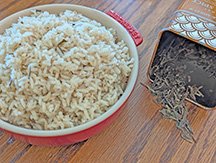
Jasmine rice, with its long grain and fragrant aroma, was developed in Thailand in the 1950s and remains the rice of choice in much of Southeast Asia. Its name is because the white rice grains reminded people of the white petals of jasmine flowers; even just cooked plain, it tends to have more “rice-y” flavor, and the texture is very appealing — a little sticky and chewy, with a distinct aroma. I was struck by how much it smelled like popcorn when I was cooking it, before knowing that that is what everyone else also says it smells like.
Rice that smells like popcorn…that means jasmine rice might be the right thing after for when I’m hungry for a couple thousand of something.

KU News: Podcast from KU’s FLITE Center helps teachers navigate classroom AI tools

0

From the Office of Public Affairs | https://www.news.ku.edu

Headlines

Contact: Chance Dibben, Achievement & Assessment Institute, [email protected]
Podcast from KU’s FLITE Center helps teachers navigate classroom AI tools

LAWRENCE — With the number of artificial intelligence tools growing and changing by the day, Lisa Dieker, director of the Center for Flexible Learning through Innovations in Technology & Education (FLITE), and Maggie Mosher, assistant research professor and global keynote speaker in AI, wanted to provide an up-to-date, accessible and reliable resource for teachers who may feel overwhelmed by the amount of information and tools offered. To this end, Dieker and Mosher created a free podcast series called “AI Advocates” to inform teachers about artificial intelligence tools for the classroom.

“We’ve been in schools working with teachers in different districts to transform education using AI, and the thing we hear the most frequently is, ‘I don’t know what’s out there to help my students,’” Mosher said. “We wanted to provide something to help educators start a little at a time without feeling overwhelmed. AI changes so quickly. Often, by the time an episode comes out, the tool has already gone through multiple reiterations. That’s how quickly AI progresses.”

FLITE, a center within KU’s Achievement & Assessment Institute, introduces and creates new technologies in education to improve learning and performance outcomes. As AI tools become more available and accessible to the public, FLITE researchers are looking at how AI can help teachers and students in the classroom.

In each podcast episode, Dieker and Mosher explore a different AI tool and its benefits, drawbacks, safety, privacy considerations and classroom uses. The episodes include only the necessary information so that teachers can get the information quickly, keeping in mind their busy schedules.

“We’ve really tried to make it digestible. In five minutes or less, we tell you about a tool we’ve used and what we like about it,” Dieker said. “We’ve also really tried to focus on tools that are free or at least tools that you can try out for free and then make your decision from there.”

Dieker said that AI is not meant to replace teaching and human connections between educators and students; rather, the tools are meant to make their jobs easier by facilitating some of the behind-the-scenes administrative work teachers must do, such as creating visuals, condensing information and creating presentations.

“A lot of people worry that transforming and integrating technology is going to take more time, but what we’ve found is it gives teachers back the time that they would have spent on administrative tasks,” Dieker said. “AI gives teachers back that time so that they can then spend their time building relationships with students, which is where we know powerful education happens.”

Dieker and Mosher also hope to see some of the highlighted AI tools benefit students with disabilities and make learning more accessible by helping teachers better serve all students.

“Students with disabilities shouldn’t be singled out because they have a disability. Using a team-teaching approach with AI in the general education classroom can ensure every student’s needs are met without causing teacher burnout. AI provides the possibility for students to individualize their own education,” Mosher said. “When teachers need additional support to quickly individualize content, they can consult AI tools to ensure timely access to content on ideas to effectively teach specific skills to individual students all within the same classroom.”

An “AI Advocates” journal to accompany each podcast episode is also in the works. It will feature a step-by-step process for using the tool covered in that episode. The journal and the video version of each podcast episode, currently available on YouTube, will give listeners various ways to receive the information.

“AI Advocates” is available on KU ScholarWorks and numerous podcast platforms, including Spotify, Apple Podcasts and Amazon Music.

Dieker will be exploring more about AI’s use in special education in her Fall 2025 SPED 598 course, Artificial Intelligence for ALL: Educational Applications, and Mosher will continue training teachers in K-12 schools throughout Kansas in partnership with the Center for Reimagining Education (CRE), which assists Kansas educators in exploring AI tools to begin thinking about how to reimagine teaching and learning.

-30-

————————————————————————


KU News Service

1450 Jayhawk Blvd.

Lawrence KS 66045

[email protected]

https://www.news.ku.edu


Erinn Barcomb-Peterson, director of news and media relations, [email protected]


Today’s News is a free service from the Office of Public Affairs