Thursday, January 22, 2026
Home Blog Page 161

Lawn mowers have sure been buzzing as of late!

0

Lawn mowers have sure been buzzing as of late! Mowing is a fundamental practice in maintaining a good lawn. Correct mowing produces a neat, even, well-groomed appearance that is a source of personal pride and satisfaction. A lawn’s density, vigor, water consumption, weed infestation and resistance to weather stress is largely affected by how it is mowed. The effectiveness of all other lawn maintenance — fertilizing, watering and weed control — depends on proper mowing.


Mowing at the proper height is critical to the development of a healthy lawn. Grass species have different growth habits. Set the mower at the right height for the species of grass you are mowing.


Cool-season grasses such as bluegrass, tall fescue, and perennial ryegrass are mowed higher than warm-season grasses because of their erect growth habit. Because hot weather is stressful for cool-season grasses, they should be cut at the higher end of their tolerance range during the summer. The additional height helps insulate the ground against heat, furnishes more food-producing area, and encourages roots to penetrate more deeply into the soil. Stay within the tolerance range or the grass may become coarse, stemmy, and may lodge.

Mowing too low during hot weather places cool-season grasses under stress and leads to excessive watering. If done repeatedly, infrequent, short mowing produces thin, weak turf that is highly susceptible to weeds. Avoid a drastic or sudden reduction in cutting height (scalping), which seriously diminishes root growth.


Recommended mowing heights for lawns:

Bermudagrass 1–2 inches

Bluegrass 2–3 1/2 inches

Buffalograss 2–3 inches

Perennial ryegrass 2–3 inches

Tall fescue 2 1/2–3 1/2 inches

Zoysiagrass 1–2 inches


If you would like to learn more about care of your tall fescue lawn join us on May 6 at 6:30 PM to learn about how to really take care of your tall fescue lawn at the Newton Public Library. This program is free but you must register by calling (316) 284-6930 or emailing [email protected].

“The Golden Rules of Dementia”

0

Dementia is a progressive condition that results in decline in cognitive function. People with dementia have increasing difficulties with short term memory, thinking, and reasoning. For family members it can be hard to watch the decline in a loved one who is struggling with dementia. Interacting when someone has dementia can be difficult. Following these three Golden Rules can help.

Rule number 1: Do not ask direct questions. Asking someone with dementia if they remember your name or remember what they had for breakfast can be distressing. Someone with dementia may not be able to find the answer you are looking for and can feel put on the spot to come up with an answer.

Rule number 2: Listen to the person with dementia and learn from them. When someone is suffering from dementia, their feelings are more important than facts. My grandmother had dementia for the last 20 years of her life. She was very upset that my aunt had not come to visit her. My aunt had passed away a few years prior. At first, we thought the best thing was to tell her the truth, that my aunt had died. We saw that this was new information each time we told her. She grieved deeply each time she heard that news. It was kinder to tell her that my aunt was away at school and would be home at the next holiday to visit. There was no reason to keep inflicting that trauma on her. We were able to ease her mind. She was worried she had done something wrong to cause my aunt to not visit.

Rule number 3: Do not contradict. The part of the brain that is able to reason is no longer functioning in dementia. Trying to win an argument with logic is not beneficial. Another time visiting my grandmother, she was very anxious that she had not taken lunch out to her husband. She believed he was out working in the field on the family farm. My grandfather had died the year I was born. Rather than contradicting her, I said that I would make sure that he got lunch and would take it out for her. This made her feel better.

These three golden rules can help give the family member with dementia a sense of security and safety. It can also be helpful for family members to interact with the person they love in a new and meaningful way. Meet the person with dementia where they are, instead of trying to force them to be where you are. If you allow them to take the lead, you may learn some beautiful stories from the past and have fond memories for your future.

Jill Kruse, D.O. is part of The Prairie Doc® team of physicians and currently practices as a hospitalist in Brookings, South Dakota. Follow The Prairie Doc® at www.prairiedoc.org and on Facebook, Instagram, and Threads featuring On Call with the Prairie Doc®, a medical Q&A show, 2 podcasts, and a Radio program, providing health information based on science, built on trust, streaming live on Facebook most Thursdays at 7 p.m. central and wherever podcast can be found.

Just a Little Light: Journey Home

0

Dawn Phelps
Columnist


From Dawn
.  On April 27, I received an email from Sherry LaBrie from Lakeland Florida, a granddaughter of Mable and Archie Belisle who lived in the Miltonvale community many years ago.  Sherry wrote to me after several of their family members had visited Miltonvale to honor the wishes of three of their family members to be buried in the Miltonvale Cemetery.  

Here’s a little Belisle family history.  Archie and Mable were integral members of our community and the UMC Church for many years.  Archie was born in 1902 and died in 1979.  Mable was born in 1905 and died in 1997.  Many in our community still remember them.  

My husband Tom told me a story about Archie.  He said Archie flew a small airplane and taught a Sunday School class for young boys.  Tom was in his class.  He said that if the boys attended Archie’s class, Archie would take them up in his airplane.  So, Archie’s Sunday School class was well attended!

Mable and Archie were parents of Virginia (Ginny) who married Walter Brannon and Margaret Ann (Ann) who married Leroy Henry.  Walter, Sherry’s father, died March 29, 1999, and her mother Virginia died September 9, 2022, and their ashes were held for future burials.  Walter and Virginia were teachers.

Margaret Ann lived in New York State for many years where she worked as a nurse.  She was living near her daughter Kara in Massachusetts when she died on April 8, 2025.  After her death, the family traveled to Miltonvale to bury Ann and the ashes of Walter and Virginia.

On April 23, they were buried in our country cemetery south of town.  During their limited time in Miltonvale, the family fulfilled the final burial wishes for three people and briefly connected with several in our community.


Letter written by Sherry LaBrie 

Hello Dawn, I was looking for you this past Wednesday because Harry Lee (my husband Tom’s youngest brother) suggested I drop in on you.  We were there (6 cousins) to bury the last of the Belisle Miltonvale family out at the cemetery.

My name is Sherry Brannon LaBrie.  My sister Beth Brannon Eifert, my brother Carl Brannon, and I were there to bury the ashes of our parents, Walter and Virginia Belisle Brannon.  My daughter, Becky Fellows, and my husband Tom LaBrie came with us.

My cousins, Lisa Henry Payton, Matthew Henry, and Kara Henry were there to bury their mother, Margaret Ann Henry.  

Virginia and Margaret Ann were the daughters of Archie and Mable Belisle who lived there most of their lives.  Archie worked for Kansas Power and Light.  Mable was multi-talented and served her family, church, and community in many ways.

All the cousins have many beloved memories of Miltonvale and visiting our grandparents. We took a walk down “memory lane” while there for about 24 hours.

I believe Margaret Ann was about the same age as your husband, Tom.  My mom, Virginia, was about 10 years older.

It was fun to run into Harry and Richard Shultz at the cafe as they shared some stories that they remembered from times past.

I think I contacted you once about the Record on behalf of my mother when she needed to contact Virgil Vesterberg.  Virgil was a cousin of hers and Ann’s.  She received a copy of the Record every week until she passed away 9-9-2022.  I’m glad they were still publishing until then.

I guess I just wanted to share one last visit to Miltonvale for us all together.  In the past Grandma would be sure something about her visitors was in the Record.  I’m sorry I missed meeting you face to face.

Greetings to all the Phelps family.  Mrs. Phelps (Grandma Emma Phelps) often had me as a visitor when I was little.  I have fond memories of that time.


Blessings, 

Sherry LaBrie 


From Dawn.  Thank you, Sherry, for allowing me to share your letter with our local paper one more time.  That would make Mable happy!  And thanks for reminding us of our own memories or Archie and Mable.

Since your visit, Tom and I drove out to the cemetery to look for their final resting places.  We found where they are now—on the north side of the cemetery, not far from Mable and Archie.  Your loved ones lived their lives well.

They have completed that circle of life—from their births in our little town and back home again.  Their final earthly journey “home” to Miltonvale is complete.  May they rest in peace until we all meet again.  Blessings to you all!  Dawn

A Plow With Crank Levers Survives On Shank Farm

1

Richard Shank
Columnist

1950, the dawn of the second half of the 20th century, all seemed well on the Shank farm near New Cambria, Kansas, where Ray Shank (my father) was planning to update his farm equipment, including the purchase of an Oliver four-bottom plow with radydex shares and crank levers.
Times were good on the farm during those years following World War II and, perhaps, no one could visualize what was on the horizon in 1951, that being the worst recorded flood in Kansas history, a record that remains to this day.
My dad who entered adulthood in 1929, the start of a time in American history which has come to be known as the “Great Depression” was not one to waste or discard anything, including purchase orders for farm equipment. Recently, Kent Shank, a nephew, was pursuing some of dad’s farm records and came across the purchase order for the plow.
The plow was purchased February 27, 1950, for the hefty sum of $253. Included in the file was a loan document stating dad agreed to pay the full amount plus $7.78 in interest on or before July 15, 1950 or shortly after that year’s wheat harvest. Dad must have kept his end of the bargain as the plow is still in family hands, three quarters of a century later.
In those days, the Shanks lived on a farmstead within 1,000 feet of the Solomon River. On Friday the 13th of July 1951, the worst recorded flood in history, crossed the farmstead and the current was so strong that it took everything not tied down with it. My brother, Ed, a 10-year-old then, remembers the plow which was sitting outside and being washed 150 feet south of the buildings before stopping. When the water receded, Dad retrieved the plow and it was soon back in action.
In those pre-hydraulic days, dad called his new piece of equipment a “trip plow.” In other words, we tied a rope to the back of the frame of the tractor which was then attached to a piece of iron sticking up from the front of the plow.
If all went as planned, the tractor driver would pull the rope and the moldboards of the plow would fall into the ground. To get the plow out of the ground, we just pulled the rope with the tractor going forward and it jumped up in the air. To establish depth, we gave the levers a few turns to the left and then we were ready to plow. From what I remember, it was a lot easier than cranking a tractor to get it started.
Sometimes following harvest, particularly when it did not rain, the soil was hardened making it difficult to get the plow in the ground, no matter how much you cranked the levers. Old-timers, like my dad, could improvise practically any situation and this time he placed a piece of iron weighing approximately 100 pounds atop the plow to help get the plow in the ground. That worked too.
Sometimes the plow became plugged due to intake of heavy straw, which could be a daily occurrence considering the heavy stubble produced by those fertile fields in Ottawa and Saline County. My dad said backing the plow was not an option. His preference for unplugging the plow was to pull the rope and get it out of the ground, and then pull the straw out, one clump at a time. That process ranks as my least favorable memory of plowing the fields of north central Kansas.
Five months after purchasing the plow, Dad splurged and purchased an Oliver 99 tractor, which could take the plow sailing across a field. The 99, still on the farm and running, came with an electric starter, lights and 18 mile per hour road gear and is ranked as one of the greatest tractors from that era.
I fondly remember days while growing up and plowing early in the morning until evening going round and round the fields driving the Oliver 99 and turning over the sod leaving behind what looked like a perfectly manicured field. At the end of the day, this tractor driver went home with the impression that something big time had been accomplished. For this teenage farm boy, life was as good as it gets, considering my mother showed up in the middle of the afternoon with a Pepsi and one of her homemade peanut butter cookies.
Longevity ruled the day for the plow, and with all of Dad’s equipment purchases. His goal was to always “get his money’s worth out of all purchases.”
The plow would go on to turn over wheat stubbles for the next 25 years, until 1976, when it was replaced by a four-bottom, semi mounted plow. Not much monetary value remained on the four-bottom, but dad decided it should remain on the farm and in the family, and it was pulled into a machinery lot where it remained for the next 27 years.
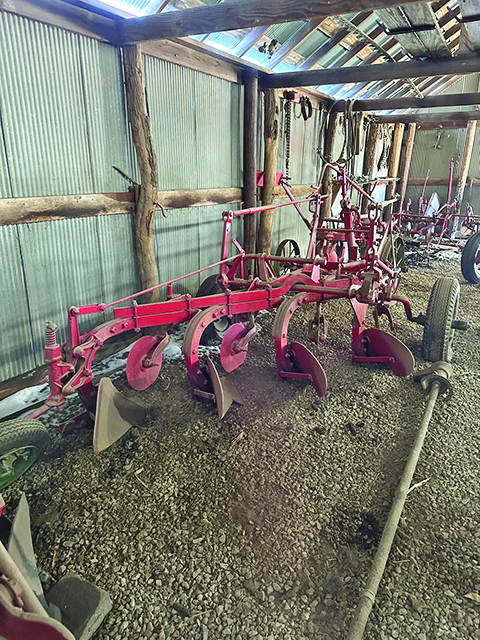
Upon Dad’s death in 2003, I had the opportunity to purchase the homeplace and most of the machinery remaining on the farmstead, including the four-bottom plow. Other than a few trees that had grown up between the moldboards, the old plow still looked pretty darn good. A good clean up and paint job followed and the plow looked like it was ready for an encore performance. Next, we stored it in a machine shed where it remains today.
Recently, on a cold winter day following a blizzard, I opened the doors of a 93-year-old machine shed and peered at a sea of antique implements, a majority of which were Oliver. There is nothing young these days at the Shank farm, including the owner.
The old plow, now 75 years of age, parked inside the shed looked as if it was in repose. A quick check determined the crank levers still turned. The plow is in good company in the old machine shed, which includes an Oliver hay rake with steel wheels, and a spring-tooth harrow purchased near the same time as the plow. Twenty years ago, I was able to purchase a 1930s two-bottom plow that was previously owned by Louie Royal, a neighbor three miles to the south of the Shank farm, and it is parked in the shed too.
All the above-mentioned implements looked as though they could do a day’s work today if called to action. All implements are proof that in Oliver’s heyday, this company manufactured the finest in farm machinery.


Summer is coming: Remember your sunscreen

0

Summer is knocking on the door, which for many folks means picnics and swimming and gardening and other outdoor activities.

That also means sun. Lots and lots of sun.

Ashley Svaty, a family and consumer sciences specialist at K-State’s Northwest Research-Extension Center in Colby, said it’s “critically important that we think about protecting our skin’s health.”

“There is a statistic (from the American Academy of Dermatology) that it only takes one blistering sunburn during childhood or adolescence to nearly double a person’s chance of developing melanoma,” Svaty said. “So even when we’re younger, we have to be mindful of the sun’s rays, and as adults, we have to be role models and help protect those kids and babies.”

Researchers say that a little sun is good for the body and mind: 20 minutes of sunshine helps in producing vitamin D, supports bone health, relieves blood pressure and promotes good mental health.

But too much sun can lead to longer-term, negative health effects.

“We need to protect ourselves when outside,” Svaty said. “I understand if we work in a field, or those that have outdoor jobs. Seek shade as much as you can, but if you can’t find shade, wear a white brim hat and sunglasses to protect those eyes, and wear UPF (Ultraviolet Protection Factor) protective clothing.”

Another common term associated with sunscreen for the skin – SPF – stands for Sun Protection Factor. Sunscreens are sold with varying levels of SPF, but Svaty said the level that one buys – as long as it is 30 SPF or higher – is less important than routinely re-applying protection every two hours while outdoors.

“The big thing to remember is that you can get as high of an SPF as you want, but remembering to re-apply that every two hours is critically important,” Svaty said. “The majority of people don’t put enough sunscreen on the first time, and then they don’t re-apply later. SPF 30 or higher is fine, but remember to re-apply every two hours.”

Svaty noted a few extra things to keep in mind:

  • The type of sunscreen one uses – spray, lotion or other – doesn’t matter. It’s a personal preference.
  • Cover as much skin as possible when outside. SPF clothing is one good way to do this, while remaining comfortable.
  • Use sunscreen all year round. The sun’s reflection off snow in the winter can be equally damaging to skin.
  • Remember vulnerable spots when applying sunscreen, touch as top of head, tips of ears and back of neck.
  • Discard expired sunscreen and keep a fresh tube year-round.

More information on sun protection is available online from the American Academy of Dermatology and the American Cancer Society, or speak to a board certified dermatologist.