Thursday, January 22, 2026
Home Blog Page 165

Horticulture 2025 Newsletter No. 07

0
KSU horticulture

1712 Claflin, 2021 Throckmorton Plant Science Center
Manhattan, KS 66506 (785) 532-6173

PDF Version

VIDEO OF THE WEEK:
Drought Tolerant Plants for a Challenging Kansas Landscape
(Archived K-State Garden Hour)
You might not be thinking about drought right now with the spring weather, but it inevitably affects our landscapes at some point during the summer.

April GARDEN CALENDAR
Find out what to plant in the garden this spring.

VEGETABLES
Planting Warm Season Veggies
Most of our warm-season vegetables can be planted in early May, however, winter squash and pumpkins should be delayed until mid to late June. The first generation of squash bugs is active in July. Delaying the planting date for squash will result in younger plants that can escape this round of squash bug damage. Plants will need protection from the second generation of squash bugs which is present in August.

To read more about squash bugs visit our KSRE publication: Squash Bugs

Protecting New Vegetable Transplants from the Wind
Wind is an important environmental feature for the plant world. Many plants rely on the wind to disperse seeds and transfer pollen from one plant to another. Young plants strengthen their stems as a result of nudging from the wind. As you move seedlings into the garden remember to harden them off by exposing them to the elements gradually. Without preparing the plants for the wind through increased exposure they are more susceptible to breaking under this force. In small scale gardens, you can also create a wind break to further protect young transplants from the wind, but this is not practical on a large scale.

Soil Temperature and Warm Season Veggies
Tomatoes can be transplanted when the soil temperature is 55 degrees F. For peppers, cucumbers, melons and squash the soil should be at least 60 degrees. Our soil temperature is high enough now that it is safe to plant most warm season crops.

Remember to check out the Kansas Mesonet resource. You can access current and historic soil temperatures to help you plan your garden calendar.

FRUIT
Integrated Approach to Fruit Tree Care
Success in the landscape begins with good cultural care. For fruit trees this means cleaning up debris, proper pruning, minimizing weeds, planting in the right location and providing supplemental water as needed. Even with the best cultural care there are times where spray treatments are necessary, but healthy trees are better able to stand up to the stress from diseases and pests.

At this time of year, you can do all the cultural care right and still have problems with disease and pests on fruit trees. Starting a spray schedule in April and May is often necessary to prevent problems such as cedar apple rust. The fungicide you use will change from spring into summer and organic options are available. Check in with your local Extension agent for a recommended spray schedule.

TURF
Spring Fertilizer Application for Cool Season Turf
Lawns should typically be fertilized when they are actively growing. Cool-season grasses such as Kentucky bluegrass, tall fescue and perennial ryegrass benefit from being fertilized in fall and late spring. The fall application is important as it helps the turf build up food reserves enabling it to green up earlier in the spring. Cool-season grasses usually have a flush of growth in mid-spring using up much of the stored energy. By applying fertilizer shortly after this growth, the turf is able to replenish the depleted nutrients ensuring the plants are strong heading into the stress of summer. A slow-release nitrogen fertilizer is best for the May application. Liquid or dry fertilizer are fine, though dry tends to be easier for homeowners to apply.

Warm-season grasses such as bermudagrass, buffalograss and zoysiagrass should be fertilized in late spring and/or summer. https://bookstore.ksre.ksu.edu/pubs/mf2324.pdf

Always read the fertilizer label for the correct rate and specific instructions.
Sweep dry fertilizers off hard surfaces and back onto the lawn to prevent it from washing into storm drains polluting our waterways.
Water after applying fertilizer if rain is not in immediate forecast.
PESTS
Bagworms – Too early to spray!
Mid to late June is typically the best time to treat for bagworms but if you had bagworms last year, you’re likely antsy to prevent their return. If there are empty bags on trees and shrubs in your landscape, it is likely you will have bagworms this year as well. Treatments for bagworms should not be done until most or all of the larvae have hatched. For now, if you see young bagworms, you can manually remove and destroy them. Treatments will be largely ineffective right now.

Cucumber Beetles and Bacterial Wilt
Description: Cucumber beetles can either be striped or spotted. Striped cucumber beetles are more common with ¼-inch long bodies, black head and antennae, straw-yellow thorax and yellowish wing covers. There are three parallel longitudinal black stripes down the body. Spotted cucumber beetles have 12 black spots on the wing covers with yellow on the underside of the abdomen.

Life Cycle: There are two generations of cucumber beetles each year. They overwinter as adults. After mating the females lay eggs in the soil at the base of cucurbit plants making it easy for larvae to feed on roots when they emerge. Two to three weeks later the larvae pupate in the soil giving rise to the second generation later in the growing season. It takes about four to six weeks for a single generation to go from egg to adult.

Damage: Cucurbit plants are targeted by cucumber beetles whose feeding reduces growth and can cause plant death. Young pumpkin and squash plants are common targets. Holes in leaves, stems, flower and fruits caused by feeding can affect yield. Cucumber beetles also transmit the disease, bacterial wilt, which causes sudden browning and death of cucumbers and muskmelons. Once infected the plant cannot be cured making prevention key.

Control: Protect young plants now by using row covers, cones or another physical barrier. Seal the edges of the barrier to prevent beetles from entering. Use transplants which can stand up to bacterial wilt better than seedlings. Mulch with straw around plants to create a habitat for predators such as wolf spiders. Remove crop debris after each growing season and manage weeds. Monitor plants regularly and manually remove cucumber beetles. Sticky cards can be used to help monitor for pests present in the garden.

Insecticides with permethrin (Bonide Eight Vegetable, Fruit & Flower Concentrate and Hi Yield Garden and Farm Insect Control) can be used when pollinators are not present. Always follow all label instructions and only use insecticides in combination with proper cultural controls.

Read more at our KSRE Publication: Striped and Spotted Cucumber Beetle

Eastern Tent Caterpillar
Description: Native to North America, Eastern tent caterpillars are hairy and black with a white stripe down the back and yellow/brown stripes on the sides along with blue, oval-shaped spots. Caterpillars create a tent-like nest that can be a foot or more in length. Full-grown caterpillars can be 2 to 2 ½ inches long. The adult moths have reddish-brown wings with two whitish bands across the forewing. The eggs, laid in masses, are covered with a shiny, black material enclosing the eggs. Cocoons are one-inch in length and white or yellowish in color.

Life Cycle: Caterpillars emerge in early March when buds begin to break. They create a silk tent in a tree crotch with many other caterpillars to create a colony. Mature caterpillars leave their nest to seek a safe place to pupate. About three weeks later the adult moth emerges. Upon mating, females lay masses of 150 to 400 eggs on branches to overwinter and hatch the following spring. There is one generation per year.

Damage: Caterpillars emerge from their tents when it is not too hot or raining, usually early morning and evening to feed on leaves. Defoliation may not kill trees and shrubs directly, but does put the plants under stress as photosynthesis is reduced. The silky nests in the trees are unsightly.

Control: Scout for egg masses during winter to remove and destroy. Dispose of tents as they appear in spring. Exposing young caterpillars makes them susceptible to predators such as birds though mature caterpillars are less appetizing due to the hairs present. Bt (Bacillus thuringiensis subsp. kurstaki) or Spinosad can be used to kill young caterpillars. Mature caterpillars can be treated with pyrethroid-cyhalothrin or permethrin insecticides, but be aware these will harm beneficials as well. Do not use these products when pollinators are active. When inside the tents, caterpillars are protected so insecticides applied at this time are much less effective.

TREES
Suckers on Trees
In spring some trees send up growth, known as suckers, from the base of the tree or roots. Suckers can develop several inches to several feet from the trunk of the tree and can be an indication the tree is under stress. However, some species are just more prone to sucker growth regardless of the health of the tree.

Not only are suckers unattractive but they deplete energy from the tree so removal is recommended. Use pruners to clip suckers at the base where they are attached to the main tree. If the cut is not made at the point of origin and a stub is left intact it will likely cause branching and exacerbate the problem. If there are minimal suckers present, removal can be delayed until early summer when regrowth is less likely. Herbicides should NOT be used to treat suckers.

Storm-Damaged Trees
Much of Kansas experienced heavy winds and rain over the past week or will at some point this season. Here are recommendations for managing storm-damaged trees.
Not all trees should be salvaged. Trees with bark that has split and exposed the cambium or those where the main trunk has split are not likely to survive. Trees with so many broken limbs that the structure is altered may best be replaced. Though these trees may produce new growth, they are under such extreme stress they are much more susceptible to diseases/pests and can be dangerous due to increased risk for further breaks.
Prune broken branches to the next larger branch or the trunk. Do not cut flush with the trunk, but rather to the collar area between the branch and the trunk. Cutting flush to the trunk creates a larger wound that takes longer to heal.
Cut back large limbs progressively. The first cut should be made on the underside of the branch about 15 inches away from the trunk. Cut up about one-third of the way through the limb. The second cut should be made on top of the branch but about two inches further away from the trunk creating an angle when joined with the first cut. This will cause the branch to break away. The third cut should be made at the collar to remove the resulting stub.
MISCELLANEOUS
What to do about a hard crust layer on the soil surface
Heavy downpours of rain often lead to soil crusting. Intense rainfall can disperse soil into small particles. When the soil dries quickly it seals the particles together creating a concrete-like layer. Young seedlings struggle to break through the crust and consequently die. The crust layer also creates a problem for drainage since water is no longer able to penetrate.

To prevent soil crusting, keep the soil covered. During the off-season grow a cover crop for the nutrient benefits as well as to protect the surface from the impacts of heavy rain. Increase organic matter content and till as little as possible or not at all. Organic matter improves the texture making the soil less susceptible to crusting because the particles of soil are not easily displaced.

To remediate soil that has a crusty layer, cultivate lightly to break up the hard surface. While there is a risk of damaging existing plants if done carefully, it is much less harmful than the effects of crusted soil.

Useful Resource: K-State Extension Wildlife Management Website
May is Gardening for Wildlife month and we have a wonderful resource available through K-State Extension Wildlife Management. Find research-based information for gardening with wildlife by creating habitats to meet their needs. Check out the podcast “Fins, Fur and Feathers” hosted by Extension specialists, Drew Ricketts and Joe Gerken, YouTube guides and more at
KSRE Wildlife Management.

QUESTION of the WEEK
“I was at the park yesterday and saw these little bugs crawling all over the place. What are they?”
These are the larvae of ladybird beetles, more often referred to as “ladybugs”.

Adult and larvae of the ladybird beetle are beneficial insects. They feed on pests such as aphids, mealybugs, whiteflies and scale and do not harm garden plants. The larvae may look menacing, with the orange and black markings on their bodies but they are effective at managing garden pests.

Contributors:
Cynthia Domenghini, Instructor and Horticulture Extension Specialist
Kansas Garden Guide

Division of Horticulture
1712 Claflin, 2021 Throckmorton
Manhattan, KS 66506
(785) 532-6173

For questions or further information, contact your local extension agency.
This newsletter is also available on the World Wide Web at:
http://hnr.k-state.edu/extension/info-center/newsletters/index.html

The web version includes color images that illustrate subjects discussed. To subscribe to this newsletter electronically, send an e-mail message to [email protected] listing your e-mail address in the message.
Brand names appearing in this newsletter are for product identification purposes only. No endorsement is intended, nor is criticism implied of similar products not mentioned.
K-State Research and Extension is committed to making its services, activities and programs accessible to all participants. If you have special requirements due to a physical, vision or hearing disability, or a dietary restriction please contact Extension Horticulture at (785) 532-6173.


Cynthia Domenghini, Ph.D.
Instructor; Horticulture Extension Specialist
Department of Horticulture and Natural Resources
Kansas State University
1712 Claflin Rd.
Manhattan, KS 66503
785-340-3013
[email protected]
Turtle Market

0
Thayne Cozart
Milo Yield

On occasion I’ve written about unusual ways that me and my early school friends spent our time playing.

One such story wuz about having gram weight lifting contests with land terrapins (turtles) used as the power source. The way we did it wuz to drill a painless hole in the rear edge of the turtle’s shell and tie a string to the shell, then thread the string through a tiny pulley fastened above the turtle, then fasten the other end of the string to gram weights made to be used on a balance scale.

The “winner” wuz the turtle that could heft the heaviest gram weight the highest into the air. The owner of the winner captured bragging rights.

***

Well, that story prompted a faithful reader from nearby Green, Kansas, to stop by our morning Old Geezers’ Gabfest and Coffee Klatch, to tell me about another funny turtle story that he recalled.

This story originated decades ago on one of the big ranches in the southernmost Sandhills of Nebraska. The son of the owner, while making his regular rounds on the ranch checking to make sure all the windmills were pumping water for the cattle, noticed an abundance of flat-shelled land turtles near the water tanks.

So, out of curiosity and just for fun, he started collecting the turtles in a long cattle trailer. As his “turtle herd” grew he kept it well fed and watered. Eventually, he had so many turtles that he wuz faced with a problem of what to do with them all.

According to the story, somehow the young rancher came up with an idea on how to cash in on his hoard of turtles. One weekend, he hooked up to the turtle trailer and headed for Denver. Once there, he found a big urban farmer’s market and got permission to sell his country wares.

It turns out that the flat-shelled turtle market in Denver wuz booming. Every turtle carried a hefty price tag, and it didn’t take the Nebraskan long to sell out his inventory.

You might wonder what the big appeal of turtles wuz to up-scale, yuppie Denver urbanites. The surprising answer wuz they wanted to use the turtle shells — with the turtles still alive inside — as paint pallets for personal messages or scenes.

Who would have guessed? The young rancher turned a handsome profit from an activity that would assuredly be illegal in today’s highly sensitive woke world.

***

The creative ways to have fun and waste time among rural youth seems to have no bounds. Another youth-prank story that wuz told at the Geezer’s Gabfest is this one.

Some rural teenagers in the northern Flint Hills of Kansas caused quite a stir with a prank they pulled many years back. At the time of their prank, the annual spring ritual of burning off the tallgrass prairie wuz in full swing and the local volunteer fire fighting brigade was on high alert for wildfires.

Here’s what the ornery teens did. They had saved up a bunch of smoke bombs from the previous Fourth of July celebration. Then they went to a secluded vacant old farmstead with an abandoned tile upright silo. One by one they climbed to the top of the silo and dropped smoke bombs into the silo.

Rather quickly a satisfying plume of smoke emerged from the top of the silo and could be seen from any direction for miles around. The sight of smoke immediately started a chain of phone calls to the volunteer fire fighters and they gathered a team and rushed to the origin of the smoke.

Of course, the pranksters were long gone by the time the fire fighters arrived. But it didn’t take the firemen long to realize they’d been bamboozled and they vowed to find the perpetrators.

The story teller said the pranksters kept mum long enuf for the furor to die down and they got away scot-free. However, he did wonder why he and his buddies needlessly climbed to the top of the silo to drop the smoke bombs in. He said the prank would have worked just as well by tossing the smoke bombs through an open window at the bottom of the silo.

***

Writing about rural youth getting creative in having fun and passing time conjured up a way I used to entertain myself when I wuz a kid growing up on a farm in the 1940s-50s.

I used to sneak a serving spoon out of the kitchen and find a wet spot in the ground in the shade. Then I’d dig a bottle-shaped hole in the ground about 4-5 inches deep. Then I’d capture either a half-inch long black carpenter ant climbing on a tree trunk of a big pincher beetle that I’d find under a board. I’d drop the critter into the hole.

My goal wuz to dig the hole well enuf that the ant or the beetle couldn’t climb out of it. Sometimes if the bugs were nimble enuf to climb out, I’d find some fine dust and put a ring of dust around the top of the hole. That would make the bugs fall back into the hole every time.

***

I’ve mentioned many times about my mechanical ineptness and unluckiness. I proved that again this week. I wuz working on my new raised garden beds using a skill saw. To power the saw, I connected two heavy-duty extension cords. I wuz busily sawing away when Nevah yelled “fire,” and I looked around to see a fire blazing where the two extension cords were fitted together. To make matters worse, the fire wuz squarely on top of a rubber garden hose. So, I damaged two extension cords and a garden hose at the same time.

***

Words of wisdom for the week: “‘On time” is when you get there.” Have a good ‘un.

Just a Little Light: Mothers

0

Dawn Phelps
Columnist


Mother’s Day is almost here, and I found an article which is similar in structure to Paul Harvey’s 1978 speech on his “Rest of the Story” radio show entitled “So God Made a Farmer.”  But this one is about mothers.

I am unsure who the original author is, but one source gives credit to the Imperfect Women Team.  This article has a bit of a modern twist to it.

And on the 6th day, God looked down on Adam in his planned paradise and said, “I need a nurturer.”  So God made a mother.

God said, “I need someone who feels deeply and loves fiercely, whose tears flow just as abundantly as their laughter, whose heart is warm, and their ability to guide and set limits is strong. I need someone whose influence on those that they nurture is eternal.”  So God made a mother.

God said,  “I need someone who can hear a sneeze through closed doors, in the middle of the night, 3 bedrooms away,  while daddy snores next to her, who could kiss the ‘boo boos,’  scare away the monsters under the bed, clean up the middle-of-the-night accidents, and live off of 4 hours of interrupted sleep.”  So God made a mother.

God said, “I need someone who can ride the roller-coaster of anxiety, hope, fear, and pride with an outward appearance of calm assurance as she sends her child off to his first day of school. 

“I need someone who will buy the school supplies, drive for the field trips, help study for the history tests, fill out the permission forms, clap from the back row of the spring musical, and help coach a sport she’s never played.

“I need someone to teach a child to tie her shoes, make new friends, handle disappointments, shop for a prom dress, and drive a stick shift. 

“And when that child is 18, I need someone to ride that roller coaster of anxiety, hope, fear, and pride again as she sends her child away to college with the same calm confident outside exterior.”  So God made a mother.

God said, “I need someone who is willing to jump in a car and drive children to school, soccer games, and piano lessons on a daily basis.  I need someone who can run to the grocery store twice in a day, because someone forgot to add something to the list.

 “I need someone who can take the animals to the vet, drop off the dry cleaning and pick up prescriptions and still make sure dinner in on the table for the family to eat.”  So God created a mother.

“Somebody who realizes that children need to be allowed to grow, gain confidence in themselves and be encouraged to be independent individuals and accept the path they choose. 

“Somebody who realizes that their job is one where the better they are the more surely they won’t be needed in the long run.

“Somebody whose breath will be taken away when they visit their first newborn grandchild in the hospital and their daughter looks at them with loving eyes and says “I hope I can be the kind of mom you are, Mom.”  So God made a mother.

No matter how old your children are, mothers are special people who never stop loving and caring for their children.  So for all mothers out there, I wish you a Happy Mother’s Day! 

[email protected]

A Tax-Advantaged Road to First-time Home Ownership

0

Topeka, Kan. – It is often joked that there is a “national day of” calendar event for everything imaginable. March 7 is national Sock Puppet Day. August 3 is a celebration of big foreheads. November 14 is national Spicy Guacamole Day. The ever-growing list of National day of events can be a fun excuse to celebrate a unique tradition. They can be a pleasurable justification to eat something sweet or savory. But, best of all, they have become a good reason to educate.

May 1st is celebrated as National New Homeowners Day. A day dedicated to drawing attention to the excitement around new homeownership. The purchase of a first home is a life achievement that, for many, comes with a great sense of pride. The road to first-time homeownership can be long and often come with a detour or two. In an effort to help Kansans ease the path to the purchase of their first home, the Kansas Legislature passed a bill to allow for the establishment of First-time Home Buyer (FTHB) Savings Accounts. These FTHB Savings Accounts are a great way for Kansas residents to save money for
the purchase of a first home for themselves or a designated beneficiary.

• Who is eligible for a First-Time Home Buyer Savings Account?
A qualified Kansas First-Time Home Buyer is a person who has never owned or purchased under contract for deed, either individually or jointly, a single-family, owner-occupied primary residence including, but not limited to, a condominium unit or a manufactured or mobile home that was assessed and taxed as real property; or as a result of the individual’s dissolution of marriage, has not been listed on a property title for at least three consecutive years.

• How do Kansans open and register an account?
Potential account owners can establish a First-Time Home Buyer Savings Account at any qualified financial institution. Financial institution means any state bank, state trust company, savings and loan association, federally chartered credit union doing business in this state, credit union chartered by the state of Kansas, national bank, broker-dealer, mutual fund, insurance company or other similar financial entity qualified to do business in Kansas. Financial institutions are not required to classify money saved in these accounts as funds intended for the purchase of a first-time home. After establishing an account with a qualifying financial institution, an account owner designates the account as a First-Time Home Buyer Savings Account by reporting the account and its funds to the Kansas Department of Revenue on Schedule FHBS when filing their Kansas Income Tax Return.

• What are the tax advantages to opening a First-Time Home Buyer Savings Account?
Contributions made by Kansas state income taxpayers to a First-Time Home Buyer Account
during the tax year may qualify for a state income tax deduction for the account holder. Up to $3,000 can be deducted for individual filers, and up to $6,000 can be deducted for joint filers.

“Kansans looking to have a leg up in their savings efforts towards the purchase of a first home should consider the tax-advantages associated with the First-Time Home Buyer Savings Account,” said State Treasurer Steven Johnson.

As the State Treasurer’s Office continues its educational efforts around FTHB Savings Accounts, the state is relying on partnerships with local financial institutions to help Kansans better understand how these tax-advantaged savings accounts can offer individuals a great savings option in the pursuit of homeownership. Some financial institutions, like nbkc bank, have committed resources to help Kansans in their pursuit of homeownership. Visit Treasurer.ks.gov to learn more about First-Time Home Buyer Savings Accounts and visit your preferred financial partner to begin your tax-advantaged road to first-time homeownership.

Long waiting lists and kidneys wasted: The state of organ transplants and how it affects Missouri and Kansas

0

When Carthesa Hutson’s son, Chris, finally got around to getting his driver’s license he was almost 19.

She remembers being at the DMV with him when he paused on the application question about becoming an organ donor and looked to her. She told him to follow his heart.

“He said, ‘Well, if I’m not here, I would like somebody else to have the opportunity to live,’” Hutson said.

Neither of them knew that in just a few weeks Chris’ family would have to fulfill that wish.

Eight years ago this May, only a couple months after Chris checked the box to be an organ donor, he was murdered in a road-rage shooting in south Kansas City. Chris’ organs went to seven people on waiting lists.

Gary Dixon of Independence, who was in the hospital being kept alive by a cardiac pump, got Chris’ heart. He often talks about the young man who gave it to him.

“I want to make sure that nobody forgets who little Chris is,” Dixon said. “He saved seven people that day. … What happened to him should not have happened, but look what he did.”

There are many more stories about organ donations that saved lives. But critics of the country’s sluggish organ transplantation system say there should be many more.

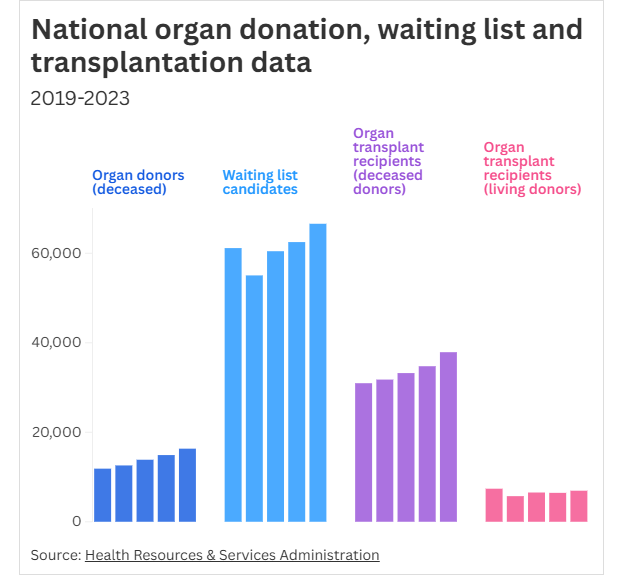
Last year, surgeons in the United States transplanted 48,000 organs , more than ever before. But 105,000 people remain on organ waiting lists nationwide, including 1,998 at transplant hospitals in Missouri and 502 at hospitals in Kansas. The majority — 87% — are waiting for kidneys.

Critics point to the large gap between supply and demand as evidence that the system is broken. They argue that inefficiencies and misaligned incentives mean some potential donors are never considered, while other organs are recovered from deceased donors, yet not used.

Changes in recent years — including a 2023 federal law that ended monopoly control of the transplant system — are aimed at fixing problems . But the fact remains that people are still waiting for months or years for kidneys, hearts, livers and other organs.

And every day, an average of 17 people die while on a transplant waiting list .

Struggle for equity

Since doctors in Boston completed the first successful kidney transplant in 1954, there has always been a greater need for organs than can be met with available donations. And the system has constantly struggled to develop equitable allocation protocols that fairly prioritize potential organ recipients.

In 1984, the federal government stepped in to oversee the system. Legislation established the Organ Procurement and Transplantation Network . It serves as the framework around the country’s 251 transplant hospitals, 138 laboratories and 55 organ procurement organizations (OPOs).

Under that system, every transplant hospital has waiting lists of patients who need organs, and every donated organ is assigned a list of possible recipients. Organs are allocated based on factors like how good a match the patient is for the organ, how sick they are and how far they are from the donated organ.

That 1984 law established a national computer database to match patients to donated organs based on an objective algorithm. And every transplant center has its own waiting lists and criteria for adding patients.

Since there aren’t enough organs to go around, organ allocation is one of the few areas of medicine where doctors have to choose which patients are more worthy of treatment.

“If you’re going to give an organ and save a person who’s going to live for one year,” said Ryan Pferdehirt, an ethicist with the Center for Practical Bioethics in Kansas City, “or — everything being equal — give an organ to a patient who’s going to live for 20 years, you would probably want to go with a 20-year option.”

Over the years, however, the organ allocation system has developed obstacles that make it less than objective.

Bias keeps some people off transplant lists. Black patients, for example, are three times more likely than white patients to have kidney failure, but much less likely to be placed on kidney transplant waiting lists. And women, according to some studies , are less likely than men to receive a liver transplant.

Access is another issue. In rural areas, for instance, getting to a transplant center can be difficult. And sometimes a patient is in a part of the country where fewer organs are donated, or they go to a transplant center with strict standards about which organs to accept. Both scenarios could mean fewer organs to go around.

Finally, for a patient without insurance, the cost of a transplant operation alone could be a barrier. According to the American Transplant Foundation, which offers financial assistance and other support to people who need transplants, a heart transplant could cost more than $1.6 million, a liver $878,000 and a kidney transplant more than $442,000.

Reforming the system

Critics believe that access to organs has also been limited in part by the way the transplantation system was set up four decades ago. Until recently, a single nonprofit — the United Network for Organ Sharing (UNOS) — held the sole government contract to manage all aspects of the system.

But criticism that transplant waiting lists were only continuing to grow under UNOS led Congress to pass legislation in 2023 to break the single government contract into pieces. Last fall, the Health Resources and Services Administration began awarding those contracts to a list of new vendors for various duties related to operating the network.

In a statement announcing the new contracts, then-Health and Human Services Secretary Xavier Becerra said the transplant network had been “mired in monopoly.”

“With the life of more than 100,000 Americans at stake,” the statement said, “no organ donated for transplantation should go to waste.”

According to government data , almost 28% of kidneys recovered from deceased donors in 2023 were not transplanted. That’s up from a rate of 26.6% in 2022 and 18.7% in 2012.

UNOS, which has a contract with the federal government that is set to expire in June but could be renewed, has defended its work. It also is calling for changes to improve the system, including allowing kidneys shipped on commercial flights to travel in the passenger cabin.

That trend of kidneys — the most in-demand organ for transplants — going unused is another reason there has been so much attention in recent years on changing the system.

Ongoing reforms include federal regulators taking aim at how OPOs — the nonprofits charged with accepting donated organs and shepherding them to transplant patients — are evaluated.

Each region of the country has one OPO — there are more than 50. When someone dies under circumstances that might make their organs suitable for donation, it’s the OPO’s job to decide whether an organ is worth pursuing and talk to the donor’s relatives if it is.

OPOs also find appropriate recipients for the organs, make offers to transplant hospitals and see that accepted organs make it to the patients who are waiting.

Although it is increasingly common for people to agree to donate their organs after death, most deaths don’t lend themselves to organ donation. Organs might be diseased, a donor might be too old or their organs might have been damaged in the dying process.

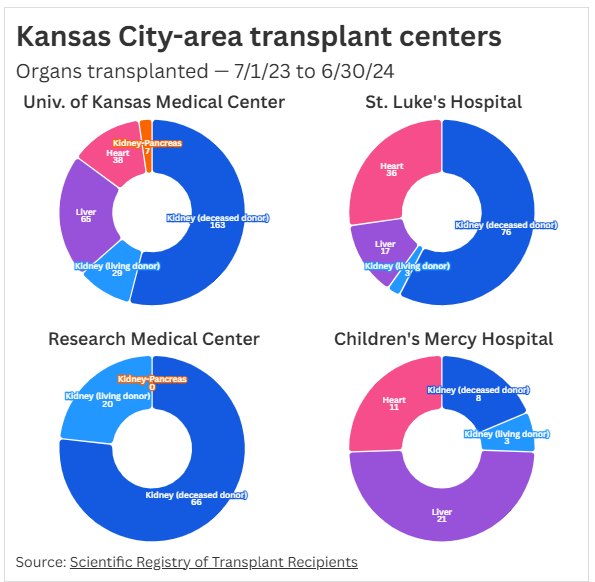
In the year beginning July 1, 2023, 19,187 hospital deaths were referred to the Midwest Transplant Network , the OPO that serves Kansas and western Missouri. Of those, 365 became donors, resulting in 482 kidney transplants, 221 liver transplants, 150 lung transplants and 100 heart transplants. There were 24 pancreas transplants during the period, while intestines were transplanted twice.

Midwest Transplant Network’s procurement rates are among the best in the country. For the first time last year, the organization facilitated more than 1,000 annual transplants.

But overall, OPOs have faced criticism for not getting more organs into the system. Some people argue they were leaving too many potential donor organs behind, not even exploring whether they might be usable.

That’s why the Centers for Medicare and Medicaid Services, the government agency that certifies OPOs, in 2022 changed the measures it uses to rate them. Now OPOs are judged not only on the number of organs they procure, but also on the number that are actually transplanted.

The Association of Organ Procurement Organizations (AOPO) believes that the new rating system unfairly holds OPOs accountable for something they have no control over. Ultimately, it’s up to the transplant hospital to decide which organs they will accept.

The association argues that the new metrics are adding to the number of donated organs going unused because OPOs now feel pressure to procure organs that are less likely to be accepted. According to the AOPO, 11,000 of the 54,000 organs recovered for donation in 2023 were not used . Most of those that ended up being thrown out were kidneys.

In 2024, 9,266 kidneys — an 83% increase in five years — were not used, the group said.

Midwest Transplant Network, which reported $82.9 million in 2023 revenue, is in the top 25% of OPOs for both donation and transplant rates, meaning it falls in the top category and is not in danger of decertification. But the AOPO estimates that 42% of the nation’s OPOs are in danger of losing certification in 2026 when CMS applies the new metrics.

No plans have been announced for how those OPOs’ functions would be handled if they are decertified. Shutting them down could negatively affect organ procurement numbers. Dorrie Dils, AOPO president, said she wants regulators to remember the people relying on the work that OPOs are doing.

“It’s not just about numbers and measures and all of those things,” Dils said, “but there are real humans on both sides.”

OPOs say they face strong headwinds in getting transplant centers to accept more organs. That’s in part because hospitals have very different incentives than OPOs. The Centers for Medicare and Medicaid Services rates hospitals based at least in part on patient outcomes, so they have every incentive to be selective in the organs they accept.

“We’re pushing over here and we’re asking the transplant centers to pull,” said Jan Finn, Midwest Transplant Network’s president and CEO. “We’re saying, ‘Take these organs. We’ve got them available. We have donor families that have allowed them to be transplanted in someone else.”

But the hospitals are more likely to proceed cautiously.

Better than they are now

Kansas City only has four hospitals that do transplants: the University of Kansas Medical Center, St. Luke’s Hospital of Kansas City, Research Medical Center and Children’s Mercy Hospital, where kidney and liver programs have been on pause since March “due to surgical staffing issues,” according to the hospital’s website. None of Kansas City’s transplant centers have lung programs.

The relatively small number of transplant centers in the area combined with changes in the distance organs can be allocated mean that about 80% of the organs Midwest Transplant Network receives are sent to other parts of the country. Before 2019, only about 20% of organs donated left the region, Finn said.

“That’s a lot more players that we are working with,” she said, “that we have to understand and know how to provide the information to them.”

Kidneys can go almost anywhere in the country because they can survive outside the body longer. Hearts and livers need to be transplanted more quickly.

The coordination and timing are critical when a donor heart comes through, said Dr. Jessica Heimes, a cardiothoracic surgeon who does heart transplants at St. Luke’s Hospital.

“Once we have a donor (operating room),” she said, “we actually plan things and time things so that when we walk back into this hospital with that organ, we are ready to sew that in … meaning the patient is asleep on the table.”

Typically hospitals have transplant teams, with doctors, social workers, nutritionists and coordinators, that decide which patients should be placed on their organ waiting lists.

St. Luke’s transplant team meets weekly to consider new patients and keep tabs on existing ones.

“We look at pretty much every facet of their life to make sure that they are an appropriate candidate,” Heimes said.

When an organ becomes available, the transplant surgeon makes the call about whether it’s a good match for their patient.

Dr. Timothy Schmitt, director of transplantation at the University of Kansas Health System, the Kansas City area’s largest transplant hospital, said doctors need patients to be healthy enough to survive a transplant surgery. And want organs to be the best match and the healthiest they can get.

“You want that organ to make (the patient) better than what they are now,” Schmitt said.

Although transplant hospitals have jurisdiction over their patients’ care, they are not immune from feeling the effects of changes to the transplant system.

Since rules about organ allocation were amended a few years ago to prioritize sicker patients further away rather than finding recipients nearby, Schmitt said his patients have had to wait longer and often are sicker by the time they finally get a transplant.

Treating sicker patients increases costs. So does traveling greater distances to get organs, he said.

“We had to fly an organ in from Colorado — I think it costs like $30,000 just to fly the organ in,” Schmitt said. “If it was in our own neighborhood, it would be a lot easier to drive an ambulance over to grab it.”

Dr. Alice Crane, an abdominal transplant surgeon at Research Medical Center, said she’s already seen the effects of the new OPO-rating system. In an effort to get more transplants to hospitals, she said, she’s noticed some OPOs are more often bypassing the ranked list of eligible recipients when making organ offers.

The New York Times published an investigation in February that highlighted the trend, finding that out-of-sequence offers are happening 20% of the time, much more than just a few years earlier.

Crane said she hasn’t seen the practice locally, but it has happened when patients have been on the list for organs coming from OPOs in other parts of the country.

“It’s a very complicated process and it undergoes constant revision,” Crane said. “And every time … we tried to correct it, sometimes it goes in a direction we don’t expect.”

Crane said she holds out hope that new transplant technology and techniques will make more organs available for patients on waiting lists. She encourages her patients in need of kidneys to reach out on social media and through other networks to try to find a living donor. In 2024, 7,030 people became living donors , meaning they donated a whole kidney, a segment of their liver or a uterus.

But in truth, Crane said, real progress will finally come when preventive health care can help patients avoid organ failure in the first place. Diabetes is the most common reason people end up in kidney failure, she said, and that can be prevented or treated early.

“As much as I love doing (transplants), I wish I didn’t have to,” Crane said. “We all want out of a job. That would be a very good thing for society.”

The post Long waiting lists and kidneys wasted: The state of organ transplants and how it affects Missouri and Kansas appeared first on The Beacon .

As reported in the Wichita Eagle