
Ideally, potatoes should be stored in a cool garage or basement where the relative humidity is 90% and the temperature is between 40- and 45-degrees F. Although they can be stored for long periods of time in temperatures below 40-degrees F, the starches begin converting to sugars which alters the flavor of the potatoes. If this happens in your storage area,
keep the potatoes at room temperature for two to three days prior to consuming and the desired flavor should return. If stored above 45-degrees F for prolonged periods of time, the potatoes will begin to sprout. Potatoes will become soft and shriveled if the relative humidity is too low. Storing potatoes in perforated plastic bags will help maintain higher humidity levels.
Storing Potatoes in Cold Temperatures

Using Old Garden Seed

Seeds typically remain viable for about 3 years if kept in cool, dark, dry conditions though there are exceptions. For example, members of the carrot family (carrots, parsnips and parsley) have short-lived seeds which are usually good for only 1 to 2 years. Colorado State University has a publication with more detailed information about the longevity of specific species. (Storing Vegetable and Flower Seeds)
If you are unsure of your seed viability you can
test it by placing 10 seeds on a paper towel moistened with warm water. Cover the
seeds with a second moistened towel. Roll up the towels and place inside a plastic bag
with several holes. Keep the bag in a warm location such as the top of a refrigerator.
Remoisten the towels with warm water as needed. After the first week, check for
germination. Remove sprouted seeds and check again after another week. The percent
of seeds that sprout indicates the germination rate. You can decide if this rate is acceptable or if purchasing new seed is warranted.
Hidden Below A Kansas Town Is An Underrated, One-Of-A-Kind Museum

Over 60 stories beneath the ground in Hutchinson, Kansas is Strataca, a super unique museum within a working salt mine. Hutchinson is a little over three hours from Kansas City, once known as the “Paris of the Plains,” and Strataca is one of its top attractions. There are few other working salt mines in the world that allow people to visit, so it’s a pretty special experience.
The salt deposits here were discovered in the 1880s, and they’re used primarily for rock salt. They were formed around 275 million years ago, and to help give a sense of the grand scale of this massive geologic formation, it’s got 37,000 square miles of salt, according to the Kansas Geological Survey. And Strataca itself has 150 miles worth of tunnels.
Of course, you won’t be able to explore all of them during your visit to the mine, but there are different options to see some of the coolest parts of the mine. You’ll start by checking in at the above ground lobby, and you’ll get your hard hat, a rebreather (just in case), and watch the required safety video — one of the rules is to not lick the walls. From there, you’ll take a double-decker elevator down 650 feet into the darkness.
Strataca has exhibits on mining history and Hollywood film memorabilia
After a 90-second ride, the elevator opens up into Strataca’s mining gallery, a large, lighted cavern with exhibits on the history of the mine and the salt itself. When you visit, you’re not actually in the part of the mine where the salt is being actively mined, but there’s plenty of evidence that the glittering caverns were once active work sites. Once a piece of equipment was brought into the mine, it didn’t come out, so you can see some of the historic machinery throughout the museum. They also have some of the trash that was left behind by workers over the decades, like empty soda cans, and even half a sandwich, which look like they were just dropped there yesterday. 
It’s 68 degrees Fahrenheit in the mine all the time, so it can be a particularly nice place to visit during summer, when temperatures outside can get well into the 90s. With its temperature combined with its steady humidity of around 48% and protected location deep underground, the salt mine makes for the perfect place to safely store and preserve all kinds of documents and artifacts. That includes film reels, costumes, and props from hit Hollywood movies, some of which are on display. You can see one of George Clooney’s “Batman & Robin” costumes, one of Matt Damon’s “Monument Men” costumes, props from “The Matrix,” “Men In Black,” “Twister,” and more.
What to know about visiting Strataca
Strataca is closed on Mondays and Thursdays, and the base package is their Salt Blast Pass ($25 for adults, $18 for kids). It’s a self-guided experience that takes about 2.5 hours and includes access to the Hollywood displays, mining gallery, and two different rides. One of those rides is the Salt Mine Express, a 15-minute narrated train ride into a part of the mine that was last used in the 1950s. The other is the Dark Ride, a guided 30-minute tram ride, which takes you deeper into the mine, and includes a moment of complete darkness. You’ve never known true darkness until you’re deep underground. You also get a chance to mine some salt for yourself.
They have a couple of add-on options for more time underground. The Salt Safari adds on an hour, and it takes you on a guided ride deeper into the mine. On weekends, you can go on the Lantern Tour, where you’ll get to explore a part of the raw mine on foot. They hold special events throughout the year. Ever wanted to run a 5k 650 feet under the ground? You can do that here. At the holidays, they put up miles of twinkling lights for their aptly named Season of Lights celebration. They’ve also got an event center underground where they host their popular “Murder in the Mine” dinner theater nights. These themed, interactive events are for adults only.
After you check out Strataca, if you’re looking for more unique Kansas destinations, visit Lindsborg, which is America’s Little Sweden. And there’s the fun folk art in the small town of Lucas.
Read More: https://www.islands.com/1720754/strataca-kansas-underground-salt-museum-situated-below-small-town-unique-underrated/
IRS, Security Summit partners urge people to watch out for bad tax advice on social media

The Internal Revenue Service and the Security Summit partners issued a consumer alert today about the growing threat of bad tax advice on social media that continues to dupe people into filing inaccurate tax returns.
On day two of the ninth annual National Tax Security Awareness Week, the IRS and the Security Summit partners are spotlighting the wildly inaccurate tax claims that continuing building across social media. These scams take many different forms and make outlandish promises to inflate refunds.
“The growth of bad tax advice on social media continues to grow, luring unsuspecting taxpayers into filing bad tax returns,” said IRS Commissioner Danny Werfel. “We urge people to do some research before falling for these scams. Finding a trusted tax professional or visiting IRS.gov is a better way to research a tax issue than relying on someone talking in their car or their kitchen about a non-existent tax hack.”
For years, members of the Security Summit – representing state tax agencies, tax professionals, tax software companies and the financial industry – have worked to raise awareness about tax-related identity theft and related tax scams. To counter this growing threat of tax scams, many of the Summit members have joined together to launch a related group, the Coalition Against Scam and Scheme Threats (CASST).
Throughout the past year, the IRS and the Summit partners saw an escalation of new scams and bad advice surface on social media that promise to magically enrich taxpayers. This year, the public has seen the emergence and rapid spread of financial scams ranging from the Fuel Tax Credit on federal tax returns to “pig-butchering” scams that involve investments in fake cryptocurrencies that ultimately leave the victims penniless.
The newly formed CASST alliance, comprising dozens of public and private sector organizations, is working cooperatively to combat these growing scams and protect taxpayers against filing of inaccurate tax returns fueled by social media advice. Increasing awareness of new and emerging tax schemes on social media is one part of a multi-pronged effort by the CASST coalition to combat tax scams and fraud.
Scams that promise easy money through claiming inaccurate credits or other schemes are seen in social media and in other places. Some producers of misleading content on social media are driven by a criminal profit motive, while others are simply trying to gain attention and clicks, with little regard for the risks it poses to their followers.
“Common wisdom dictates that if it sounds too good to be true, it often is, and that’s especially with some of the crazy ideas about taxes being spread on social media,” Werfel said. “Social media platforms are rife with influencers making claims about tax credits or deductions that stretch the truth or are outright lies, aimed at gaining themselves clout or pushing up their views. At the same time, this puts their audience’s tax returns and personal finances at risk. If people want good tax information on social media, they should follow options like a trusted tax professional or the IRS social media platforms.”
What to watch out for on social media
The IRS is aware of various filing season hashtags and social media topics leading to inaccurate and potentially fraudulent information. A common theme among many of these examples involves people trying to use legitimate tax forms for the wrong reason.
The IRS has seen a spike this year in the following types of scams on social media:
“Self Employment Tax Credit”: Promoters on social media have made misleading claims that taxpayers – particularly self-employed individuals and gig economy workers — can get up to $32,000 through the so-called “Self Employment Tax Credit.”
In reality, there is no “Self Employment Tax Credit”; rather, scammers are advising taxpayers to incorrectly use Form 7202, Credits for Sick Leave and Family Leave for Certain Self-Employed Individuals, to improperly claim the specialized and very limited Sick Leave and Family Leave Credit on their income.
People who were self-employed could claim credits for Sick and Family Leave only for limited COVID-19 related circumstances in 2020 and 2021; the credit is not available for 2023 or 2024 tax returns. The IRS has a detailed set of FAQs describing the very technical requirements for meeting this provision of the law.
Household employment taxes: In a variation on the “Self Employment Tax Credit” scheme, taxpayers are being advised to “invent” fictional household employees and then file Schedule H (Form 1040), Household Employment Taxes, to claim a refund based on false sick and family medical leave wages they never paid.
Fuel Tax Credit: This specialized credit is designed for off-highway business and farming use. Taxpayers need a business purpose and a qualifying business activity such as running a farm or purchasing aviation gasoline to be eligible for the credit.
The vast majority of individual taxpayers do not qualify for the Fuel Tax Credit. It is only for businesses that use certain types of fuel (not for the gas people put in their car). Yet promoters increasingly advise ineligible taxpayers to claim it, and then the promoters line their own pockets by charging the individual a hefty fee.
Inflated income and withholding: This scheme encourages people to use tax software to manually fill out Form W-2, Wage and Tax Statement, and include false income information. Scam artists suggest people make up large income and withholding figures, as well as the employer from which it’s coming. They then instruct people to file the bogus tax return electronically in hopes of getting a substantial refund – sometimes as much as five figures – due to the large amount of withholding.
Claim of Right: In this long-seen scheme, taxpayers are advised to file tax returns and attempt to take a deduction equal to the entire amount of their wages. Promoters advise them to label the deduction as “a necessary expense for the production of income” or “compensation for personal services actually rendered.” The deduction is based on a complete misinterpretation of the Internal Revenue Code and has no basis in law.
The IRS has seen hundreds of thousands of dubious claims like these, leading to refunds being delayed and the need for taxpayers to show legitimate documentation to support their claims – which they often don’t have. Many of these scams were highlighted during this spring’s annual Dirty Dozen series. The IRS is on the lookout for each of these types of false tax claims as well as others.
The IRS and Summit partners urge taxpayers to exercise caution when filing their tax returns and ensure they only claim credits to which they’re entitled. Taxpayers who did fall victim need to follow steps to verify their eligibility for the claim. Otherwise, they could face audits and expensive fines; in some cases, they could be subject to federal criminal prosecution and imprisonment.
If individuals have doubts about the legitimacy of a particular tax credit, they should review the many resources available on IRS.gov or seek advice from a qualified tax professional and, in some cases, file an amended return to remove claims for which they’re ineligible to avoid potential penalties.
‘Tis the season
These threats are present year-round, but the approach of the 2025 tax filing season means that misinformed influencers and outright scammers will intensify efforts to persuade the public to take their bad advice.
Instead of looking to shady or ill-informed influencers on social media, a better option for taxpayers to learn how to properly use tax forms and claim credits is to go to IRS.gov and follow IRS social media channels.
- IRS.gov has a forms repository with legitimate and detailed instructions for taxpayers on how to fill out the forms properly.
- Use IRS.gov to find the official IRS social media accounts, or other government sites, to fact check information.
Taxpayers should also consider consulting a tax pro if they’re thinking of applying tax advice seen on social media to their own tax situations.
Pass it on
The IRS encourages the public to report improper and abusive tax schemes, as well as tax return preparers who knowingly prepare improper returns, including “ghost preparers.”
To report an abusive tax scheme or a tax return preparer, people should mail or fax a completed Form 14242, Report Suspected Abusive Tax Promotions or Preparers, and any supporting material to the IRS Lead Development Center in the Office of Promoter Investigations.
Mail:
Internal Revenue Service Lead Development Center MS7900
1973 N. Rulon White Blvd
Ogden, UT 84404
Fax: 877-477-9135
Alternatively, taxpayers and tax professionals may report the information to the IRS Whistleblower Office for possible monetary award.
Taxpayers can also report scams to the Treasury Inspector General for Tax Administration or the Internet Crime Complaint Center. The Report Phishing and Online Scams page at IRS.gov provides complete details.
Why scientists say every new infection puts you at risk of getting long COVID

Salam Kabbani wears a smile, and many of her sentences trail into laughter.
That tends to mask the fact that she got COVID-19 three years ago — and never got better.
The 34-year-old Overland Park pharmacist is one of 17 million Americans battling long COVID, an amorphous constellation of symptoms that scientists are only beginning to understand and most doctors are struggling to treat.
Kabbani faced months unable to work. For days at a time, she could barely get out of bed. Just taking a shower exhausts her. She gets dizzy with no notice. Her brain gets foggy. And if she pushes herself even a tiny bit too far, her body simply wilts and she is forced to climb into bed.
“The number of people that are like, ‘Oh, but you look fine,’” Kabbani said, a laugh bubbling to the surface. “Well, yeah, you know, I’m not hemorrhaging from my eyeballs. But I am very much disabled.”
With only 13.5% of adults opting to get the most recent COVID vaccine, a growing number of health care experts and patient advocates are sounding an alarm. The only sure way to avoid getting long COVID, which is believed to affect a third of people infected with the SARS-CoV-2 virus, is to avoid getting COVID.
An up-to-date vaccine, which some people skipped last year, too, is the best way to do that. But public health officials said they face strong headwinds in their efforts to share that message.
Pandemic fatigue and “anti-vax propaganda,” said George Turabelidze, Missouri’s state epidemiologist, stand in the way. Now Robert F. Kennedy Jr., a known vaccine skeptic, is expected to get a substantial role in Donald Trump’s new administration.
But people shouldn’t be lulled into thinking that COVID will be just like a cold, Turabelidze said.
“Some people — even with mild COVID,” he said, “develop long COVID.”
And long COVID, said Jenna Hopkins, an occupational therapist at University Health, “is ruining people’s lives.”
The U.S. Census Bureau’s most recent household pulse survey found 18.6% of Missouri adults and 16.5% of Kansas adults said they have experienced long-COVID symptoms. Nationally, close to 45 million of the country’s 250 million adults said they have had long COVID at some point.
The illness can take hold of anyone who comes down with COVID, no matter their age, gender or overall health. It can linger for months or years. It can be relatively mild or completely disabling.
And while the severity of an initial COVID infection doesn’t seem to influence whether someone gets long COVID, the number of times a person comes down with COVID could be a factor. In other words, every time you get the virus is another chance to end up with stubborn health problems.
“It gets really ugly very quickly,” said Arijit Chakravarty, a COVID researcher in Massachusetts, “because what it means is that if you wait long enough, everyone is at risk of getting it.”
Marathon runner had to be in bed for a year
If Kelly Meiners could scream from the rooftops to warn people to protect themselves against the virus, she would. 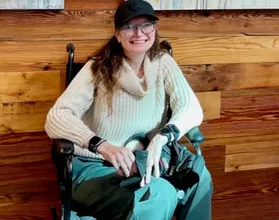
The 49-year-old college professor and marathon runner came down with a relatively minor case of COVID in 2021. She stayed home from the office, even though her symptoms felt like nothing more than a bad cold.
That quickly changed in the weeks after her initial infection cleared up.
“Over the next year, I lay in bed,” said Meiners, who chaired the physical therapy department at Rockhurst University. “I had no idea what was going on with me. I felt I was severely drugged and drunk. I couldn’t make sense of anything. I couldn’t think straight.”
In an effort to fend off debilitating migraines and persistent seizures, Meiners spent most of her time in a dark room, wearing noise-canceling headphones and dark glasses. She couldn’t hold a pen or a fork. She could no longer read or walk.
And when she went to a doctor in Kansas City, she was told that it was all in her head, that she should exercise. As an athlete, Meiners wanted nothing more. So her husband bought a recumbent bike. She strapped herself in and pushed herself until the seizures began.
She was told exercise would make her better. Now she understands it only made her worse.
Finally, a year after falling ill, a friend of a friend got Meiners an appointment at Mayo Clinic in Minnesota. The doctor there immediately knew what was wrong.
“I just cried,” she said. “It wasn’t because there were so many things wrong with me. It was because they finally believed me.”
Finding someone to help
Unfortunately, long-COVID patients often have a difficult time finding someone who can help them. And someone who will believe they are sick.
Doctors didn’t learn about COVID in medical school — let alone long COVID. And they work in a system where they need to document their care for insurance purposes. Long COVID is so new and varied in the ways it shows up, it barely has an agreed-upon clinical definition.
So it’s no wonder some doctors are sending patients away without care or telling them their symptoms are in their heads.
“I don’t think it’s coming from a place of malice,” Kabbani said. “It’s truly just a lack of awareness and understanding and being burned out.”
Now that Kabbani’s health is improved, she spends the extra energy trying to help educate the world about the disease. She has written a book about her own journey, and she and Hopkins, the University Health occupational therapist, are creating a podcast.
Kabbani, who works as an infectious disease pharmacist at Olathe Health, is speaking at continuing medical education events, trying to bring information about long COVID directly to doctors and nurses.
“What I hope to drive home to these providers,” she said, “is that the symptoms are very strange, and they fluctuate. That’s why it may seem like it’s absolutely in their heads. But it’s absolutely not.”
Research theories about long COVID
This summer, long COVID earned a consensus case definition from the National Academies of Sciences, Engineering and Medicine. Someone has the chronic condition, according to the new definition, when health problems are present for at least three months after a COVID infection.
Those problems can affect one or more organ systems, according to the definition, as “a continuous, relapsing and remitting or progressive disease state.” And a person can meet the definition by having just one or multiple symptoms, from the list of 200 included in the definition.
“If people just had lung problems,” said Adnan I. Qureshi, a professor of neurology in the University of Missouri School of Medicine, “it would be much easier to study.”
The National Institutes of Health launched a nationwide research program in 2021 with a $1.15 billion investment. In February, the agency announced it would spend another $515 million over the next four years.
The program includes dozens of studies and drug trials across the country, including studies at the University of Kansas Health System and Children’s Mercy Hospital.
U.S. Sen. Bernie Sanders, I-Vermont, has introduced legislation that would invest another $1 billion a year for a decade in research, provider education and public education.
Scientists have several theories about how long COVID strikes, and they are starting to believe that there may be more than one answer.
For example, in some cases, the immune system, which has been activated by the initial viral infection, simply doesn’t turn off once the virus is gone. That means a person’s own immune system can damage the body.
Another theory is that when someone has long COVID it could be because they still have traces of the virus in their body.
Another possibility, scientists said, is that the virus damages the circulatory system, which could explain why symptoms are so varied and in so many organs.
Pacing to survive
Doctors are finding that some patients get better over time without treatment. But others need to manage symptoms.
When patients come to see him at University Health’s Center for COVID Recovery, Wesley Strouts, a nurse practitioner who specializes in internal medicine, looks for the symptoms he can treat that will provide some relief. Sometimes he finds different diagnoses to explain what’s happening. Often, he refers patients to Hopkins, the occupational therapist who has built a specialty out of helping patients manage symptoms.
For many patients, Hopkins said, the best approach is to follow “pacing protocols.”
“Sometimes the treatment is the cure,” she said. “When people are able to manage their symptoms … sometimes their symptoms will start to dissipate as long as they are continuing to be very careful to avoid triggering activities.”
For Amanda Finley, 47, who first came down with long COVID after a 2020 bout with the virus, pacing looks like this: Work. Uber home. Straight to bed. Often her weekends must be entirely devoted to sleeping so she can face another work week.
It’s better than the alternative Finley knew in 2021 when she was living in a tent at Weston Bend State Park because she couldn’t work and had no money for rent. The Independence woman couldn’t see her 11-year-old son for months.
But even when Finley had energy for nothing else, she stayed connected with other people dealing with the illness. Early in her diagnosis, she formed a Facebook group for COVID long haulers that today has 16,000 members around the world.
It helps her know she’s not alone. And it could be a tool in science’s effort to solve mysteries surrounding the illness. Finley tries to put researchers in touch with the people in the group.
“The patients are the experts with long COVID,” she said. “We’re the ones going through the jungle with a machete making the path.”
Telling her story
Since her long-COVID symptoms began, Meiners has missed graduations, kids heading off to college, holidays, family vacations and almost every other part of her life.
She just passed the third anniversary of her initial COVID infection, and she still spends 90% of her day on the sofa or in bed. Meiners needs an electric wheelchair to navigate her Leawood home, but with the help of more than 20 prescriptions and pacing strategies to avoid flare-ups, she can have moments with her husband and three kids.
And Meiners has found a small amount of peace in making art, something she’d never tried before this. Her paintings, which tell her long-COVID story, are on display at the Lenexa City Center Library. They have been shown in galleries around the city.
It may not be screaming from the rooftops, Meiners said. But, right now, it’s the best she can do.
Suzanne King is The Beacon’s health reporter in Kansas City
