Thursday, January 29, 2026
Home Blog Page 260

Giving thanks for God’s blessings—including fresh ponhoss and sausage

0

Lovina’s Amish Kitchen
Lovina Eitcher,
Old Order Amish
Cook, Wife &
Mother of Eight

It is already mid-forenoon and I feel like I’m running behind. I have so much to do before Joe and I leave tomorrow.

Joe’s workplace is taking their employees and their spouses and children under age 16 to Gatlinburg, Tennessee, over Thanksgiving Day. Two Crossroad buses will take all of us. There will be 56 people on our bus. It is an eight-and-a-half-hour drive from the start-out point to Gatlinburg. Joe and I have never been to the Smoky Mountains, so it will be nice to see them. 

It was our turn to host Thanksgiving dinner this year for our Michigan family, but we will be gone over that time. It wouldn’t have worked out for sister Emma’s family either, with Steven still pretty weak from his surgery. 

Nephew Steven, 17, spent last week in the hospital after having spinal fusion surgery for scoliosis. This is a major surgery, and with Steven also having muscular dystrophy, it takes the muscles longer to recuperate. He will have some long days, and so does sister Emma with being his caregiver. He needs to be turned over every hour or so. 

Sunday afternoon, Joe and I went to visit him. Emma’s family were all there as well, and so was sister Verena. Then Dustin and daughter Loretta and sons and daughter Verena and her special friend Daniel Ray also came to visit Steven.

Saturday evening, son Joseph and Grace, daughter Lovina and Daniel, and son Benjamin spent the evening there as well. Nephew Benjamin was excited to shoot his first deer—an 8-point buck. So of course the men all stood around telling “deer” stories!

Our Friday night and Saturday were busy butchering two pigs. One was for Daniel and Lovina and the other one for us. Son-in-laws Dustin and Daniel dressed the two pigs on Thursday evening since they had to work on Friday. Then on Friday night, all the meat was cut from the bones. The bacon, pork loins, hams, and so on were cut out. 

Saturday morning they started a fire under the big kettle to cook meat from the bones so we could make ponhoss. Ponhoss, also known as scrapple, is a mush made from pork, flour or cornmeal, and spices. We pick the cooked meat off the bones and put it through the grinder. The water the bones were cooked in is then measured and poured back into the kettle along with the ground meat. The mixture is then thickened with flour and seasoned with black pepper and salt. 

Daniel and Lovina used flour and cornmeal and different seasonings for their ponhoss. It turned out a little too spicy for my taste. Everyone has their different tastes and opinions on how to make ponhoss, but I prefer seasoning with good old salt and pepper. 

The sausage was also ground, seasoned, and bagged. My husband Joe sliced the meat, and it was all bagged and put in the freezer. Daniel has their bacon and ours soaking in a brine he mixed up for a few days before we slice it up. The lard was also rendered and turned out really nice and white. 

I am so thankful to have sausage in the freezer again. We were out of it, though I still had canned sausage. We are enjoying ponhoss and fresh sausage again. 

Dustin and Loretta, Joseph and Grace, and Daniel Ray also helped with the butchering of the pigs. We were glad once the last piece was washed up and we could call it a day. 

As Thanksgiving Day draws near, let us thank God for the many blessings we have. Thank God every day, not only on Thanksgiving Day. Wishing all of you God’s blessings as well!

Ponhoss

For more information on ponhoss, see the story “Busy Butchering Days” in my most recent cookbook, The Cherished Table.


Pork bones

Water
Flour
Salt
Black pepper

Place pork bones in a large kettle and add enough water to cover. Cook until the meat comes off the bones. Remove bones and skim fat from broth. Measure the quantity of broth remaining. Return meat to broth. (We grind the meat before returning it to the broth.) 


Then add 4 cups of flour for every gallon of broth, sifting in the flour, as well as 2 tablespoons salt and 1 tablespoon black pepper per gallon of broth. Cook, stirring constantly, until thickened, then pour into pans. Let cool, then slice loaves as desired. Fry slices on each side until golden brown.

Lovina’s Amish Kitchen is written by Lovina Eicher, Old Order Amish writer, cook, wife, and mother of eight. Her three cookbooks, The Cherished Table, The Essential Amish Cookbook, and Amish Family Recipes, are available wherever books are sold. Readers can write to Eicher at Lovina’s Amish Kitchen, PO Box 234, Sturgis, MI 49091 (please include a self-addressed stamped envelope for a reply); or email [email protected] and your message will be passed on to her to read. She does not personally respond to emails.

Sorghum Connection Series plans December field days in three Kansas locations

0
Events aim to help producers improve profitability

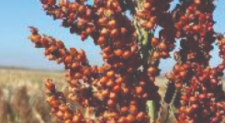
Kansas’ sorghum harvest may be winding down, but a group of state and university groups are just getting started with efforts to help the state’s producers.

The Sorghum Connection Series – consisting of officials from the Kansas Grain Sorghum Commission and Kansas State University – will hold three field days in early December aimed at supporting the state’s producers, which grow more grain sorghum than any other state in the nation.

The free events include:

  • Dec. 4 – Salina.
  • Dec. 5 – Hays.
  • Dec. 6 – Garden City.

Each event begins at 8 a.m. and concludes at approximately 3 p.m. To register and for exact location of each field day, visit www.ksgrainsorghum.org.

The agenda at each meeting includes:

  • Managing Chinch Bug Populations, presented by K-State entomology Anthony Zukoff.
  • Effective Weed Management Strategies, presented by K-State weed management specialist Sarah Lancaster.
  • Unleasing the Potential of Sorghum in the Pet Food Industry, presented by K-State’s Julia Pezzali.
  • Navigating the Sorghum Market Outlook, presented by K-State agricultural economist Dan O’Brien.

Each year, Kansas producers grow approximately 46% of total acres of grain sorghum in the United States, or approximately 185 million bushels.

Thus, says Kansas Grain Sorghum Commission director of communications and outreach Maddy Meier, “the Sorghum Connection is more than just a series of events; it’s an investment in the future of sorghum production in Kansas.”

“By providing producers with access to the latest research and information, we’re empowering them to make informed decisions and drive innovation in the heart of sorghum country.”

Several factors could be behind few numbers of deer in Central Kansas

0

Weather continues to have an impact on one of Central Kansas’ major hobbies: hunting. Opening day of pheasant season on Nov. 9 coincided with nearly two inches of rain in the Golden Belt. Cheyenne Bottoms Wildlife Manager Jason Wagner said that was enough to keep many hunters off of dirt roads and out of fields. As rifle season begins for deer on Dec. 4, dry conditions may also be playing a role with fewer deer in the area.

“Out at the Bottoms I’ve seen it, the numbers just aren’t there,” Wagner said. “They’ve crashed. They’ve dropped off pretty significantly, especially over the last two years.”

Wagner said viral disease epizootic hemorrhagic disease (EHD), and chronic wasting disease (CWD), also known as zombie deer disease, may be factors in the decline. CWD has been reported in more than half of Kansas counties, including most counties in the western two-thirds of the state.

“Lack of habitat is probably hurting some of the deer numbers, too,” Wagner said. “You don’t think about that so much, but the drought we’ve had the last couple of years, with a lot of the CRP being hayed and grazed or just expiring and put back into production, there’s less deer habitat out there.”

Hunting allotments can also impact deer populations. The Kansas Department of Wildlife and Parks takes several factors into consideration each year when determining allotments, including deer-vehicle accident reports, surveys from land owners and hunters, and crop damage reports.

As reported in the Great Bend Post

Hot Pink fits for regenerative farming firm

0

Huge jugs of liquid fertilizer stacked at Win Biologics are far from exclusive to the company specializing in regenerative agriculture.

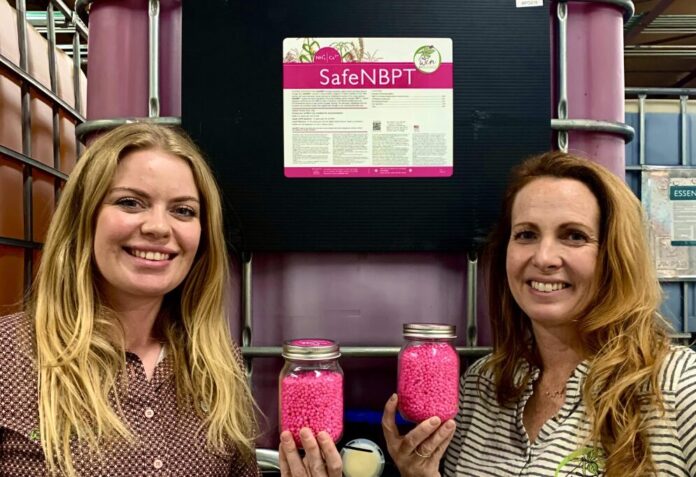
But owner Carolyn Wingate isn’t above using the “hot pink” nitrogen stabilizer—nicknamed Barbie Juice‑to promote her female-owned firm.

It’s an amusing coincidence to the entrepreneur, whose dedicated staff of six has only one male. Yet they compete for business in an industry packed with Y chromosomes. (In the above photo) Win Biologics sales representative Raeann Magill, left, and company owner Carolyn Wingate pose with the hot pink urea they sell to farmers. (Journal photo by Tim Unruh.)

“We’d like to hire more men, but we just happened to collect female unicorns instead,” Wingate said. “It’s difficult to gain ground on big agriculture, regardless of gender.”

She referred to the likes of Koch, Verdesian, CHS, Nutrien, Winfield United, and other Goliath companies that sponsor academic research.

Win Biologics is focused on bringing life to soils through fertility, feeding microbes and using soil health principles and other earthy necessities, such as cover crops. They keep green foliage on the land throughout the year and provide a conduit for water infiltration, rather than watching it drain into ditches and streams.

“Win Biologics is all about growing native life in the soil. We’re not a bug-in-a-jug company,” Wingate said. “We sell food sources for natural biological systems.”

The company started small and sells products to rural retailers.

While it has taken some time to snare attention, Win Biologics is using results to earn favor, one farmer at a time, through small suppliers.

Wingate sells products in Kansas, Oklahoma, Texas, Colorado, Nebraska and Missouri, just to name a few.

In North Carolina, Win Biologics played a role in farmer Russell Hedrick’s dry land corn yield record in 2022, Wingate said, binning 459.91 bushels to the acre.

Win Biologics is posting sales on farms tiny to huge, she said, relying on end results and word-of-mouth advertising to collect customers.

Wingate’s forces “have had to earn their seat at the table of the good ol’ boy network of big ag. When a woman walks into an ag retailer, you have to prove that you’re not just a pretty face. I feel like we have to be twice as smart as any guy walking through the door,” she said.

Win Biologics staff offer education in rural America by bringing in speakers on cover crops, small water cycles, fungal and biological systems in soil and other areas of regenerative agriculture.

“There are other companies who do similar things. Our business has doubled every year for the past three years because we make products that have an ROI and provide the education and customer service from highly knowledgeable agronomists,” Wingate said. “We don’t want to see anybody go broke. We’re not trying to be cocky, but we are confident in regenerative agriculture solutions on big acres and small.”

Like the natural wonders contained in healthy soils, which are the building blocks to feeding the world, she insists balance is necessary in most endeavors.

“Guys are natural born protectors and killers. They have been trained by big ag to hit the easy button with anything that ends in ,cide’ or death. Women are made to be nurturers, and we grow things as God intended, and we can easily soften the approach to agriculture,” Wingate said. “Sometimes you need a handshake, and sometimes you need a hug.”

The fledgling firm, based in south Wichita, enjoys a history hinged to regenerative agriculture. That’s how Win Biologics got its start. Its evolution, however, has branched out to meld old farming methods with new.

“The whole point of the company is to try to build a ladder or bridge to conventional agriculture, big ag, big chem and big pharma, with hard chemistry,” she said, “and start educating on how you can have better nutrient cycling through carbon products and cover crops.”

It’s all about adapting to a “systems approach.”

“You can’t just buy something in a jug and expect it to work,” Wingate said. “It’s about increasing your biology, understanding how to get from dead to alive. Most farmers’ soils are dead and propped up on synthetic inputs, and they’re trying to keep their crops alive long enough to get them to harvest.”

While Wingate’s company is relatively meek in size, she’s not afraid to take on the establishment with a “two-step distribution process (selling directly to small independent retailers) rather than a three-step process. We skip the distributors, making it a better value on the farm.”

She relies on farmer research (customers) and independent companies, such as Performance Crop Research in Hoxie, Great Bend and Manhattan.

“(Carolyn) is a very driven lady. We enjoy working with her,” said Melissa Nelson, Performance Crop Research’s owner.

“My job is to provide unbiased data collection to Win Biologic,” she said. “I love what I do, helping companies move the industry forward.”

C4 Ag Solutions, of Great Bend, with a store between Pawnee Rock and Dundee, carries Win Biologics additives.

“We’ve got a niche in our area for certain products from (Wingate),” said Lance Crosby, C4 Ag Solutions owner.

Wingate said, “Rather than sending money to universities, we support other local companies, such as Performance Crop Research. Trials make all the difference. We make and manufacter everything and go directly to the retailer, bring products close to the customers and facilitate a lot of conversations with them.”

Wingate started her company in early 2021 — with the help of some farmers who believed in her mission and gave her cash in hand before her first products were even produced.

“We are able to go toe-to-toe with these giant corporations,” she said, but it’s not the intention to match the competitors in size or sales.

The “family-owned independent business sells regenerative agriculture products primarily to small family-owned retailers or farms” in the High Plains and Midwest, according to a company biography.

Win Biologics’ main drivers are the legion of ladies who work out front as sales representatives who are educated in agronomy, she said, with college degrees and experience from some of the above-named major organizations.

The small company is glued by solid friendships of folks who hold tightly to Win Biologics’ mantra.

“We’re on a mission for healthy soils, healthy crops and healthy people, all the way through the cycle,” Wingate said. “Our slogan is ‘We Wet Our Plants,’ and we have many other catchy product names such as Soy Sauce or HotMeth (methylated seed oil). We try to have fun and edutain (educate and entertain) as much as possible.”

They are proud members of the “Soil Sisters,” an unofficial club dedicated to improving soil biology to aid in food production. The tag originated in 2016 at High Plains Journal’s yearly Soil Health U gatherings in Salina, Kansas.

“We are all girls (in the field), and we sell hot pink urea,” Wingate said, “but this is not a feminist operation.”

Urea can be changed to other colors, she said, but hot pink is preferred because it stands out.

Win Biologics stages yearly “Soil Health Events” where they focus on education and entertainment on Todd Tobin’s farm near Iuka, north of Pratt, Kansas. They aim to solve problems for all, in a fun way, with generous portions of food and music.

“Sometimes, agronomy’s boring. We try to host fun events such as Farmer Daycare (at the Win Biologics warehouse, 2028 E. Northern Street, in south Wichita). On Dec. 6 this year, while wives come Christmas shopping in Wichita, we will feed the guys snacks and play agronomy yard games with prizes,” Wingate said.

It helps when farmers like Tobin and others back up Win Biologics’ results.

“Todd uses almost everything we make, and he’s been the research person for almost everything we make. He’s proving it can be done on a large scale,” she said. (See sidebar.)

Win Biologics’ platform is built on solutions.

“We’re just trying to sell products,” said Raeann Magill, sales representative. “We’re trying to make lasting change. If we can introduce ideas that lead to change, that’s great.”

Jesse Blasi, who also farms near Iuka, received help from Wingate for a non-farm problem some eight years ago.

“I have a daughter who was diagnosed with arthritis, and Carolyn reaches out to help us out with dietary. She sent a random stranger cookbooks,” Blasi recalled.

He later discovered Win Biologics carried “a highly refined fulvic acid, a food source for microbes in the soil that breaks down naturally occurring fertilizer like phosphorus and potassium, and man-made fertilizers. It makes a healthier plant that will hang on longer in stressful conditions.”

Win Biologics isn’t hell-bent on creating converts. This is not a religion, Wingate said, just another idea billed to trim the cost of inputs, save water, help the environment and put more money into the pockets of farmers.

“If they just want to stabilize their nitrogen with our Barbie Juice, just that is a step in the right direction,” Wingate said. “I think we have a lot of respect, but there is a split between the regenerative focus and the conventional approach, and we work in either vein.”

That’s perfect at the Blasi farm. His father, David Blasi, uses conventional practices on his portion of the operation.

“I sold all of my tillage equipment and a four-wheel-drive tractor. We used to have four of everything,” Jesse Blasi said. “It didn’t take much convincing on fulvic and humic acids. There’s definitely some yield pickup there.”

Father and son support each other, but engage in friendly competition “about who out-yielded who, or more importantly, who had the highest revenue,” he said. “The only places that high yields matter are the Domino table at the co-op or the coffee shop.”

Not every farmer is an easy sell, Wingate said. It took some time to convince eastern Pratt County farmer Brandon Bortz when they met some four years ago.

With any new technology, the integrated farmer, rancher and feedlot owner is a show-me operator who demands proof that products fit on his operation.

He calls it his Facebook or MySpace test. Only one of those survived the early days of social media.

“MySpace didn’t last. There are a lot of companies that make a big splash, and they don’t last,” Bortz said. “(Wingate) was still relatively new, just starting to get into the game. A lot of salesmen will pitch you a lot of different stuff. The question is, do you really want to invest in certain technology if it’s going to be gone in a year? We challenged Carolyn on her sales pitch and got into the technical stuff pretty deep to back up what she was trying to sell.”

He didn’t take an immediate plunge, but stayed in touch.

“That first year, we bought a little bit of her products to try them out,” Bortz said. “She’s done a very good job. We would ask her a question, and she would either find the answer or find a person who knew it. We’re very diligent and made her prove her stuff, and she doesn’t take it personal.”

This past year, the Bortz operation purchased more products from Win Biologics, and just as in the beginning, continues to challenge the technology.

“I think we have a good relationship,” he said. “There are places and times that regenerative farming practices are a good thing, and at other places, you have to see it work. Carolyn is proving to be more than a salesman. She’s helping us learn, and we’re helping her learn along the way, too. She’s part of our farm now.”

Wingate and staff are addicted to the satisfaction of seeing producers succeed, no matter how they do it.

“I one thousand percent support conventional farmers, but I don’t support conventional agriculture because it robs profits from farmers,” she said. “I do believe agriculture is broken, but the tools to fix it are right in front of your face.”

Reducing input costs takes pressure off of yield, Wingate said.

“When farmers are able to back down by a gallon (per acre) on fertilizer, when soil health starts improving, and you see a yield bump over conventional fertilizer planning, people start talking,” she said. “Farmers are our best salespeople.”

Wingate knows who pays her bills.

“Keeping farmers profitable is how we keep our nation happy and fed,” she said. “The mental health of farmers is a massive problem. They work way harder than I do in a day, and I believe they should be paid for that work.”


Young Aggie Learnin’

0
Thayne Cozart
Milo Yield

One beautiful fall morning at dawn, a Missouri rancher and young son set out for a peaceful day of working the calves in their small beef herd. As they gathered the herd, the son’s eyes drift to the sun peeking over the horizon. He squints a bit, then asks his dad, “Dad, why does the sun always rise in the east?”

His dad ain’t ready for such a question and he, too, squints into the new day and replies, “Don’t rightly know, son. I’ve never really thought about it.”
His son nods, but his curiosity isn’t satisfied. He continues to look into the sky and he sees a red-tailed hawk soaring about his head. So, he asked, “Dad, how does that hawk stay in the sky, and why is it’s tail red?”
His father, more stumped then before, scratches his head and replies, “Don’t rightly know the answer to that one either, son.”
When they get their herd to the working chute and start running calves through, the inquisitive son asks ol’ Dad, “Why are some of our calves heifers and some of them steers?”

Without even looking up, the father gives a familiar answer: “Don’t rightly know, son. It’s a mystery. Pay attention to the cattle.”

But, the kid’s persistent, if nothing else, and poses another thorny question. “Dad,” he says. “Why do some of our cattle have horns and some don’t?”

His patient father answers, “Can’t rightly say, son. The answer’s not on the tip of my tongue.”
His son falls silent for a moment and has an inner feeling like he might be annoying his father with all his questions.
But, after some time, he turns to Dad again, a bit more hesitant this time, and asks a final question.
“Dad, do you mind me asking you all these questions?”
His father, watching the last calf’s heels leave the chute, glances over at his son with a smile and says, “Course not, son… If you don’t ask questions, you never learn nothin’.”

***

Sometimes the random conversation at our morning Old Geezer Coffee Klatch yields a good humorous story for my column. Here’s a story, true as told, from ol’ Howie Didditt.

Howie said back in the days of his callow teen youth — when farm kids pretty much lived their lives without helicopter parents constantly worrying about their kids’ safety — he and a buddy gained access to some dynamite sticks and fuses being used locally to fracture limestone for fence post holes. This wuz in north-central Kansas.

They decided it would be fun and interesting to try out some partial dynamite sticks in various ways. So, they tried quarter sticks around tree stumps, under rubbish piles, etc. The dynamite always gave off a satisfying and resounding blast, but did little real damage.

So, Howie and his buddy decided to up the ante. They found a critter hole in the dam of a family farm pond and agreed it would be fun to dynamite the hole and find out what kind of critter wuz inside. And, they decided it would take an entire stick of dynamite to do the deed.

So, they pushed the dynamite stick way back into the hole, carefully unrolled the fuse and lit it — then ran for cover. It’s a good thing they did because Howie said the ensuing blast blew a gash clear through the pond dam, threw dirt and rocks over a wide area, and the water gushed out of the pond and headed downstream.

Howie said that’s when he got a sinking feeling in his gut and knew he wuz in big trouble. And, he wuz correct. His dad was not a tiny bit amused by his son’s dynamite experiment. And, he was less amused that summer wuz coming and the pasture pond had been reduced to nuthin’ but a puddle. And, fixing the dam would be expensive.

In short, Howie’ teen dynamiting days were over. And, he never found out what kind of critter had made the hole in the pond dam.

***

By now readers probably know that president-elect Trump has selected Brooke Rollins to be the Secretary of Agriculture in his new administration. Curious about her, I found this pre-politics information about her on Wikipedia:

Rollins was raised in Glen Rose, Texas, and attended Texas A&M University, where she graduated cum laude with a B.S. degree in agricultural development in 1994. While at Texas A&M, Rollins was the first female to be elected student body president. She also served as the speaker pro tempore of the Student Senate, the chair of the Texas A&M Judicial Court, and was a Cotton Bowl Classic queen. She went on to earn a Juris Doctor from the University of Texas School of Law, graduating with honors.

As a youth, Rollins was a leader in her Future Farmers of America Chapter and in her 4-H Club. Her family is a generational farming family. As a parent, she guided her four kids in their show cattle careers.

Only time will tell about her tenure as ag secretary, but at least she has a direct farm/ranch background and an ag development education. That’s more than can be said about most of the recent USDA secretaries

***

Here are words of wisdom for the week — from bumper snickers:

“America is the only nation great enough that even her haters won’t leave.”

And, “The richest person is not the one who still has the first dollar he/she ever made, but it is the person who still his/her first friend.”

I hope your Thanksgiving Day wuz a good ‘un — with lots of family, friends, food and fun.