

Veterans Day
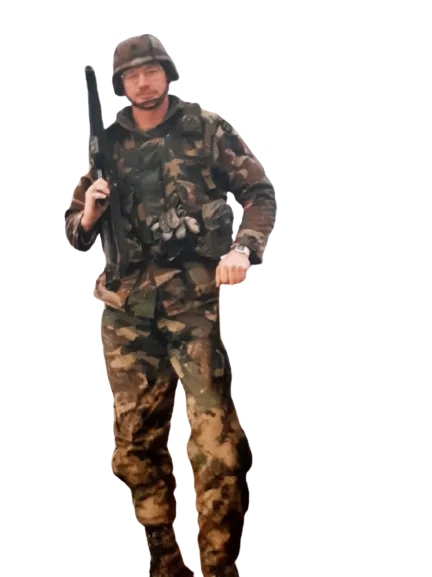
While I realize Veterans Day has come-and-gone for 2024, I feel this column, even though a week late, is still applicable. I come from a family where many have served in the military in one way, shape or form. My dad was an infantryman in the Army during WW II and served in Italy for a time. His older brother served as Flight Engineer on a B-24, flying 13 missions over Germany during WWII. I was a Field Artillery Meteorologist, collecting atmospheric data for the artillery for 20 years in the Army National Guard, and was in Bosnia for 6 months. My wife Joyce spent 8 years in the Air National Guard as a photographer and as a plane cargo loader. Three of her uncles, all from Mennonite families, served in the army and navy during WWII and the Korean Conflict. Two of my cousins were in the Air Force, one of my nephews was a marine and another nephew is currently in the navy. When asked by her siblings, (all who are also Conscientious Objectors,) why she joined the military, my wife Joyce replied “Cause daddy never told me not to.” I say all this not to brag, but to say that we are a family who believes in and supports maintaining a strong military in the United States.
The person who suggested I write this column a couple years ago, told me of an office conversation discussing whether or not to do anything special that year for Veterans Day in their paper. One coworker replied “Yes, absolutely. Patriotism has to be taught.” That got me thinking about ways we can teach our kids and new citizens to be proud of our country and of our military, both current members and veterans.
First of all, by example, teach your kids respect for our flag, for the pledge of allegiance to our flag and for our National Anthem. When reciting the pledge of allegiance, honoring our flag as it is displayed or paraded past you or when singing the Star-Spangled Banner, stand, come to attention and face the flag with your right hand over your heart. Now, some will say the flag is only a piece of cloth, the pledge of allegiance only something we recite and the national anthem only a song. While those statements are true, these things are symbols of our freedom and of our country. Teaching our youth respect for these things will help teach them appreciation for God’s allowing us to live in a free country like the United States, appreciation for the soldiers that currently serve, soldiers that have served in the past and soldiers that have died protecting that freedom.
Most places you go, be it Walmart, the mall, a fast-food restaurant or some large event, you will see men and women wearing a hat or another item of clothing giving the appearance that they are military veterans. Ask those people if they are veterans, and if so, offer your hand and thank them for their service, and urge your kids to do the same. This is also a great gesture toward law enforcement personnel, firefighters and all manner of first responders, for they, like soldiers are the ones who run toward dangerous situations, allowing the rest of us run to safety.
I agree with the assessment that “Patriotism has to be taught,” and we as parents and grandparents must be the teachers. Be creative with other ways to honor our veterans; offer to pay for their Big Mac and fries, their morning coffee at Scooters or at the local café, let them go ahead of you in line at Dillons, etc. Also, take your kids and grandkids to church and be the example of wholeheartedly thanking God for these freedoms we have. As Lee Greenwood so eloquently sang, “God Bless the USA”
Steve can be contacted by email at [email protected].
Our Abbreviated Lives

In these modern times, anyone with a pulse knows that communication amongst ourselves has changed. With the advent of the internet, emails, and a plethora of social media platforms too many to keep track of, it seems a natural spinoff is that folks wanting to save time and effort communicating have invented abbreviations (acronyms).
I think the use of these communications shortcuts was started by the computerized younger generation in their effort to squeeze more “stuff” into their always-in-a-hurry lives. Quickly, other age groups jumped on the abbreviation bandwagon.
Soon, we began seeing and interpreting such acronyms as ASAP (As Soon As Possible), BOLO (Be On Lookout), LMAO (Laughing My Arse Off), YOLO (You Only Live Once), IDK (I Don’t Know), BTW (By The Way), IMHO (In My Humble Opinion), NOYB (None Of Your Business), FUBAR (Fouled Up Beyond All Recognition), KISS (Keep It Simple Stupid), and EG (Evil Grin).
***
That got me to thinking that folks in agriculture are squeezed for time, too. They’ve no time to waste trying to make a living and grow food, fiber, and fuels for everyone. And, they need easy ways to vent their frustrations.
So, I’ve tried to think of useful “Aggie Acronyms” that will streamline aggie communications. Here’s a few that I’ve thought of off the top of my head.
• NLITC — Need Lift Into Tractor Cab
• BDIF — Broke Down In Field.
• FDCO — Fence Down Cows Out
• HGTT — Hauling Grain To Town
• FFT — Fixing Flat Tire
• MADT — Markets Are Down Today
• MAUT — Markets Are Up Today
• BSIWF — Big Storm in Weather Forecast
• BLFS — Be Late For Supper
• FWG — Fixing Water Gaps
• WCT — Working Cattle Today
• SGST — Son Got Speeding Ticket
• ROOS — Ran Out Of Seed
• CGTS — Calf Got The Scours
• VKAC — Varmint Killed A Chicken
• CGM — Cow Got Mastitis
• CGCE — Cow Got Cancer Eye
• HHUIF — Horse Hung Up In Fence
• SBBST — Selling Black Baldy Steers Today
• BINPWH — Bull In Neighbor’s Pasture With Heifers
• BETD — Bulls Expensive These Days
• TSFF — Treating Sheep For Footrot
• GTTFP — Going To Town For Parts
• SIMWP — Stuck In Mud With Pickup
• CICGOA — Crop Insurance Cost Going Up Again
• WCEPFB — Will Congress Ever Pass Farm Bill
• DD — Danged Drought
• NVB — Need Vacation Badly
***
Now, I got to thinking about old folks like me. Time is really important to us, too. The actuarial tables tell the tale. Therefore, we can use the following “Aging Acronyms” to save us precious time.
• ATD — At The Doctors
• BFF — Best Friend’s Funeral
• BTW — Bring The Wheelchair
• BYOT — Bring Your Own Teeth
• FWIW — Forgot Where I Was,
• GGPBL — Gotta Go Pacemaker Battery Low
• GHA — Got Heartburn Again
• ETAT — Every Thing Aches Today
• AAUA — Arthritis Acting Up Again
• TFT — Texting From Toilet
• GBMT — Good Bowel Movement Today
***
An obnoxious cattleman was attending his association convention. After one contentious meeting, he got into the hotel elevator and vented to another rider, “I’ve been insulted. I just overheard our president say he’s offer me $100 if I’d resign from the board of directors. I’m trying to decide what to do next.”
His companion replied, “I’d hold out for $200.”
***
My words of wisdom for the week are: “The easiest search in the world is your search to find someone to blame.”
Have a good ‘un.
Wheat Scoop: Kansas Wheat launches campaign conveying the benefits of wheat beyond the value of grain

For audio version, visit kswheat.com.
Kansas Wheat, in collaboration with Kansas State University researchers, has officially kicked off a new educational campaign aimed at farmers, landowners, financial institutions and policymakers. “Wheat: Beyond the Value of the Grain” emphasizes the wide-ranging advantages of including winter wheat in a cropping system, extending far beyond the grain’s market price.
“The role that wheat plays in global food security is unquestioned,” said Aaron Harries, Kansas Wheat vice president of research and operations. “But what about wheat’s role in a sustainable cropping system? There is more value to winter wheat than the price received for the grain. And now a study has been done to analyze wheat beyond the value of the grain.”
To further explain the campaign and the research behind it, Harries sat down with Romulo Lollato, K-State associate professor of wheat and forage production, for an episode of the “Wheat’s On Your Mind” podcast. The duo discussed the well-documented, multifaceted role of winter wheat in a sustainable cropping system, including its economic and environmental advantages.
“Wheat as a crop brings many benefits to the cropping system,” Lollato said. “In areas such as Kansas, where wheat historically has been an important crop, by excluding it from rotations, we may be missing out on some of those benefits that have made our cropping systems here successful.”
The idea behind the “Wheat: Beyond the Value of the Grain” campaign kicked off just before the 2020 pandemic after the pair investigated a continued reduction in winter wheat planted acres, particularly in Kansas. The project started with a review of the multitude of studies that have been published over the years, not only looking at grain production, but also at the other benefits wheat provides as part of a cropping system. That initial review yielded more than 60 pages of benefits cited from more than 300 studies, highlighting the incredible versatility of winter wheat.
“For us, the versatility and the flexibility of winter wheat gives options to the wheat farmer,” Harries said.
From the very first steps in the growing season, winter wheat offers a significant advantage to producers through its broad planting window, providing much-needed flexibility in managing farm operations. This adaptability also extends to its dual-purpose nature, allowing for both grain and high-quality forage production, ultimately increasing potential economic returns.
Research has also consistently demonstrated the positive impact of incorporating winter wheat into crop rotations. Studies conducted globally, including long-term projects in Kansas, Illinois and Wisconsin, show that including wheat in a cropping rotation significantly boosts yields of other crops like corn and soybeans, compared to monoculture systems. A long-term Kansas study reported a 12-bushel-per-acre increase in soybean yields when rotated with winter wheat, regardless of the tillage system used, compared to continuous soybean cultivation. Similarly, western Kansas corn yields were 14.7 bushels per acre higher after wheat than after grain sorghum.
Furthermore, wheat helps improve soil structure, organic matter content and nutrient cycling, enhancing soil health. Wheat’s presence also helps control pests and diseases, reducing the need for chemical pesticides.
The research is clear — integrating winter wheat into cropping systems represents a strategic approach to maximizing crop yields and productivity. By leveraging winter wheat’s diverse benefits and addressing associated challenges through informed management practices, farmers can achieve sustainable agricultural practices that support long-term profitability and environmental stewardship.
These quantified benefits of winter wheat and more are now a research paper, but the campaign’s goal is to disseminate more digestible, two-page extension-style publications that focus on each benefit separately.
Read the full publication and keep watch for additional added resources as they are released this winter at kswheat.com/wheatrx. Listen to the full conversation between Harries and Lollato and all other episodes of the “Wheat’s on Your Mind” podcast at wheatsonyourmind.com.
###
Written by Julia Debes for Kansas Wheat
Four Seasons

We are finally getting some much needed rain in Harvey County! I enjoy rain especially after the long dry spell we’ve had and I like living where we have four seasons each year. I love the fall and spring the best and I know that I have to adjust my clothing as well. Plants have to adjust also and houseplants are not exception.
Newly bought houseplants or those brought in from outside often lose their leaves. In order to understand why this occurs, we need to look at how these plants are grown and what the plant needs to do to adapt to its new environment. Houseplants are normally produced either under shade outdoors in southern states or in greenhouses. Also, many homeowners move their houseplants outside during the summer. Regardless, the plants receive much more sunlight than they do in an indoor environment. Research done in Florida in the late 1970s revealed that tropical plants grown under high light conditions produce “sun leaves” while those grown under low light conditions have “shade leaves.” These leaf types differ structurally in that sun leaves have less chlorophyll (the substance that plants use to convert sunlight to energy) and the chlorophyll that is present is located deeper inside the leaf. Sun leaves also tend to be thick, small and numerous while shade leaves are more thin, larger, and fewer in number. When plants are moved from one light condition to another they need time to adjust. This process is known as acclimatization. If they are forced to acclimatize too quickly, they will drop their sun leaves and produce a new set of shade leaves. If the acclimatization process is slower and less drastic, the plant can convert their sun leaves to the shade leaves that do better under low light. If going from shade to sun, this process is reversed.
Some houseplants are acclimatized before they are sold but many are not. So how do we help our new houseplants or those moved inside acclimatize to their new home environment? Houseplants should start out in an area of the home that receives plenty of light and then gradually moved to their permanent, darker location. This process should take 4 to 8 weeks depending on the degree of difference in light levels between the initial and final location of the plant. Remember, plants need to be acclimatized whether they are moved from a sunny location to one that receives less light or from shade to sun. Understanding plant processes allows us to anticipate potential problems. Acclimatization gives our houseplants a greater chance of retaining leaves and avoiding the stress of completely replacing them.
