Thursday, January 29, 2026
Home Blog Page 271

Fall leaf drop is here!

0

This is always a sad time of year. After leafing out and shining in the summer sun and waving in the wind they all eventually turn brilliant fall colors and fall to the ground. Fall leaf drop is here!

For a light covering of leaves in your lawn, they can be mowed. Mow leaves when they are dry, so they don’t clump together and make it more difficult. When mowing leaves, make sure you can see the grass beneath the cut-up leaves. If the leaf layer is too thick, it can smother and kill the grass.

By mowing the leaves and chopping them into small pieces, they will drop between the blades of grass to the soil surface. Once there, microbes can begin to break them down. As the leaves are broken down, they will contribute to the organic matter in soils and nutrients will be released for turf to utilize.

If you’ve ever done any composting, you know how valuable leaves can be as a ‘brown’ material. Compost is a dark, crumbly, and earthy-smelling form of organic matter that has gone through a natural decomposition process. If you have a garden, lawn, trees, shrubs, or even planter boxes or houseplants, you have a use for compost.

While we often dread the appearance of leaves in our yards, they are a valuable and free resource for our landscapes.

Leaves can also be used as a mulch in vegetable gardens, flower beds, and around trees and shrubs.

A layer of mulch can be beneficial in our landscapes. It can help:

· Conserve soil moisture

· Moderate soil temperatures

· Prevent soil crusting and erosion

· Control weeds

· Contribute nutrients and organic matters to soils

When using leaves as mulch, it’s a good idea to shred them first because leaves may clump together, forming a mat that can prevent moisture from reaching the soil. Shredded leaves are more likely to stay in place compared to unshredded leaves.

Leaves can be used to help insulate plants too. By using leaves as insulation, we can keep the soil uniformly cold and prevent freezing and thawing cycles that can damage marginally hardy plants, such as some hybrid tea roses, lavender, etc. This can be done by placing shredded leaves around the crowns of these plants, or wire frames can be built and filled with leaves. If using leaves as insulation, don’t put them on plants until temperatures are consistently below freezing.

Wheat Scoop: Kansas Wheat Set to Share Expertise at USW Global Crop Quality Seminars

0
Kansas Wheat

For audio version, visit kswheat.com.

The official results are in for quality testing for the U.S. hard red winter (HRW) crop, and Kansas Wheat is set to share the story of this past year’s growing season with global buyers by participating in the annual Crop Quality Seminars organized by U.S. Wheat Associates (USW).


“The Kansas HRW crop this year is performing very well with solid milling and baking quality despite the challenges of consecutive growing seasons,” said Justin Gilpin, Kansas Wheat CEO. “The analysis in the 2024 U.S. Crop Quality Report contains good news for us to share with global customers looking to produce high-quality wheat foods.”


USW is the export market development organization for the U.S. wheat industry, helping promote HRW and the other five U.S. wheat classes to wheat buyers, millers, bakers, food processors and government officials in more than 100 countries around the world. As part of that work and a commitment to transparency, USW produces an annual U.S. Crop Quality Report that includes grade, flour, dough, and baking data for five of six U.S. wheat classes. The report provides essential, objective information to help buyers get the wheat they need at the best value possible.


To produce the annual report, USW compiles comprehensive data from analyzing hundreds of samples conducted during and after harvest by partner organizations and laboratories. USW also shares more detailed, regional reports for all six U.S. wheat classes and Desert Durum® on its website, as well as additional information on sample and collection methods, solvent retention capacity (SRC) recommendations, standard deviation tables and more.


For this year’s report, 575 HRW samples were collected from grain elevators in 40 reporting areas. According to the report, the Gulf-exportable crop experienced variable conditions, including persistent early dryness that resulted in slightly smaller kernels and mid-season moisture that boosted yields and test weights.


This year’s data showed the crop is greatly improved over previous years, including a balance of protein, strong grade characteristics and good milling properties. According to the report, “Overall, this crop meets or exceeds typical HRW contract specifications and should provide high value to customers.”


Now that the analysis is complete and the report is published, the focus shifts to the annual series of Crop Quality Seminars, during which USW and teams of farmers and wheat quality experts present the results and have conversations directly with customers in their home markets. Gilpin is set to attend presentations in South and Southeast Asia. Aaron Harries, Kansas Wheat vice president of research and operations, and Mike McClellan, a Rooks County farmer who serves on the Kansas Wheat Commission, will participate in seminars in South America.


“USW’s annual crop quality seminars are essential for building trust and strengthening relationships with our global customers,” Gilpin said. “By providing timely and accurate information during these face-to-face meetings, we emphasize the reliability of Kansas wheat for their needs through an open market they can count on.”


Learn more about the quality of this year’s HRW crop and the USW crop quality seminars at uswheat.org/crop-quality.


###


Written by Julia Debes for Kansas Wheat

“HPV causes cancer, and can be prevented”

0

What do warts, pap smears, cervical cancer, head and neck cancer, and a vaccine all have in common? Three letters: HPV

Human papillomavirus ( HPV) is a common virus that can cause growths on skin and mucous membranes. There are over one hundred different types of HPV, and while some cause common warts, others can cause cancer.

HPV may be spread by skin to skin contact. The virus can enter your body through even the smallest tear in your skin. Warts caused by HPV can be contagious, either through direct contact with a wart or when someone touches something already touched by a wart. Genital or oral HPV infections can spread through sexual contact or through skin to skin contact in the genital region, anus, mouth, or back of the throat.

Unfortunately it can be difficult to prevent HPV infections that cause common warts. It is helpful to avoid picking at a wart to avoid spreading it. Plantar warts located on the bottom of your feet can be prevented by wearing shoes or sandals in public pools and locker rooms.

The treatment of common warts can be difficult as well. Some warts go away on their own, while others may grow despite attempts at treatment. No treatment is perfect. Persistence, however, is a key for success. Whether you treat a wart with an over-the-counter method such as salicylic acid, or go to the doctor to have it frozen, be prepared to treat the wart several times in consecutive months for full resolution.

Genital warts can be prevented by abstinence, and limited by being in a mutually monogamous relationship, limiting your sexual partners, and using a condom, which can form a barrier for HPV and other sexually transmitted diseases.

Thankfully, there is a vaccine which is very effective at decreasing the risk of cancers caused by HPV such as cervical cancer and some cancers in the mouth and back of the throat. It can also decrease the risk of genital warts and genital cancers. The HPV vaccine is recommended for girls and boys often at ages 11 or 12 and can be given as early as age 9 and up to age 45. It is most effective before exposure to HPV. The immune response is better at a younger age, so when given before age 15, only two shots are recommended in the series, while three shots are recommended if started after age 15.

For decades, women have undergone pap smears to help catch cervical cancer in the early stages for better detection and treatment. The HPV vaccine can prevent the underlying cause of cervical cancer, can decrease the need for pap smears, and has been effective in decreasing rates of cervical cancer.

Once one of the most common causes of death for American women, cervical cancer death rates were cut in half starting in the mid 1970’s with better detection and screening from pap smears. Now, a recent study in Scotland detected ZERO cases of cervical cancer in women born between 1988-1996 who were fully vaccinated against HPV before age 14. This highlights the effectiveness and benefit of the HPV vaccine.

Andrew Ellsworth, MD. is part of The Prairie Doc® team of physicians and currently practices Family Medicine at Avera Medical Group in Brookings, South Dakota. Follow The Prairie Doc® at www.prairiedoc.org, Facebook, Instagram, Youtube and Threads. Prairie Doc Programming includes On Call with the Prairie Doc®, a medical Q&A show (most Thursdays at 7pm streaming on Facebook), 2 podcasts, and a Radio program (on SDPB), providing health information based on science, built on trust.

Lovina Recalls Earlier Days—and Chores—Before the Family Moved to Michigan

0

Lovina’s Amish Kitchen
Lovina Eitcher,
Old Order Amish
Cook, Wife &
Mother of Eight


It is Tuesday morning, and the sun is trying to peep through. Hopefully we will see the sun today. We have had a few days of not much sun, so our battery pack hooked up to our solar panels is draining fast. During the night the water quit working, as the pump couldn’t kick in with the battery so low. And of course our gas jugs were all empty. 

When my husband Joe’s driver came to take him to work, Joe went to the gas station and brought home a jug of gas. He filled the generator and hooked it up to charge the battery. Since it was so low I’m waiting to wash dishes until the battery has charged a little more. 

We get so dependent on an easier lifestyle than we lived over 20 years ago before our move to Michigan. Flushable toilets and running water weren’t anything we had to worry about. Our freezers and refrigerators also run off solar, and we didn’t have that either. I must admit that I would miss not having these “extras.” I will never forget all those years of going out to the well to pump water for drinking. We had a cistern under our breezeway floor! At first we didn’t have a cistern pump, so Joe would use a five-gallon bucket to dip water up and fill several clean garbage cans with water to bathe and to wash laundry. This was softer water than the hard water from the well. All this water had to be heated first. I would really miss my hot and cold running water and our tubs and showers. We have lived here for over 20 years, and with Elizabeth (our oldest) being 9 years old at the time of our move, not many of our children remember “those times.” The three oldest remember the most. 

Sunday morning Joe and I were debating whether we should take our pony Stormy and the open pony buggy to church since it wasn’t that far. It was raining lightly, and I told Joe that years ago we wouldn’t have had a choice to take a covered buggy. We used an umbrella and braved all kinds of weather. We did take Stormy, and it turned out to be nice with no rain after all for our ride there and back. 

Grandson Denzel, 2, drove home from church with us. There is something about a pony ride that he loves!

Daughter Loretta and Dustin and son Byron and daughter Elizabeth, Tim, and four children and Daniel Ray (daughter Verena’s special friend) were our afternoon guests. Elizabeth and Tim went to church in another church district and decided to stop in on their way home. Daniel Ray popped popcorn for all of us. 

Abigail, 8, and Timothy (T.J.), 5, wanted me to play a game of Uno with them. They thought it was funny to try to play the “Skip” card on Grandma.

Sons Benjamin and Kevin left Friday night for Indiana and spent the weekend at a friend’s house. I was thinking the house would really seem empty, but not for long. Son Joseph and Grace and daughter Lovina and Daniel showed up for supper. Also Daniel Ray. Joseph grilled chicken while I made a noodle soup. Along with sliced cheese, crackers, and chocolate chip cookies, it completed our meal. 

Earlier in the day I had baked over 125 chocolate chip cookies, as I had to take some to church on Sunday. It is so nice to be able to bake in my house again. 

Joseph and Grace and Daniel and Lovina ended up staying for the night. They could sleep in their “old” bedrooms. It felt good to have them sleeping under “our roof” again. 

The next morning I made breakfast for them before they left. I made our usual Saturday breakfast of fried eggs and potatoes, bacon, cheese, toast, and hot peppers. And of course coffee and chocolate chip cookies. 

Until next week . . . God bless!

Sour Cream Noodle Bake

For the filling mixture:

1 pound ground beef

1 small sweet onion, diced

2 cloves garlic, minced

1 (15-ounce) can tomato sauce

1/2 teaspoon salt

1/2 teaspoon black pepper


For the noodle mixture:

12 ounces egg noodles

1 1/2 cups small curd cottage cheese

3/4 cup sour cream

1/2 teaspoon salt

1/2 teaspoon black pepper

1/2 teaspoon garlic powder

1/2 teaspoon onion powder

8 ounces shredded Colby Jack cheese, divided

Preheat oven to 350 degrees Fahrenheit. Spray a 9 x 13-inch baking dish with cooking spray and set aside. 

In a large skillet over medium-high heat, add the ground beef and onion, breaking up the beef into crumbles, and cook until there is no pink left and the onion has softened, 8–10 minutes. Add the garlic and stir until fragrant, 30 seconds. Stir in the tomato sauce, salt, and pepper. Bring to a simmer, turn the heat down to low, and simmer, uncovered, for 15 minutes. Stir occasionally. 

While the filling is simmering, cook and drain the egg noodles per the package directions. In a large bowl, stir together the cottage cheese, sour cream, salt, pepper, garlic powder, and onion powder until well combined. Add the noodles to the bowl and stir so the noodles are coated. Place half the noodles in the bottom of the prepared baking dish. Top with half of the filling. Top with half of the cheese. Repeat with the remaining noodles, filling, and cheese. Place in the oven for 20 minutes until it is warmed through and the cheese has melted. 

Lovina’s Amish Kitchen is written by Lovina Eicher, Old Order Amish writer, cook, wife, and mother of eight. Her three cookbooks, The Cherished Table, The Essential Amish Cookbook, and Amish Family Recipes, are available wherever books are sold. Readers can write to Eicher at Lovina’s Amish Kitchen, PO Box 234, Sturgis, MI 49091 (please include a self-addressed stamped envelope for a reply); or email [email protected] and your message will be passed on to her to read. She does not personally respond to emails.


 

The Unique And Unsung Kansas Destination Called One Of America’s Best Small Art Towns Read More: https://www.islands.com/1701694/known-america-best-small-art-towns-unsung-kansas-lucas-gem-unique-must-see/

0

When you think of Kansas, you might picture its tall grass prairies, Old West heritage, civil rights history, or famous barbecued smoked meats. However, there’s another side to the Sunflower State, which is often overlooked by travelers drawn to metropolitan areas. Kansas is brimming with charming small towns that, unlike many other parts of the U.S., are less frequented by tourists, offering visitors an authentic old-town experience. One such place is Lucas, which is perfect for a vacation filled with intriguing sights. This town offers something truly weird and wonderful for anyone seeking an off-the-beaten-path experience where you can unleash your creative side. Found at the end of the Post Rock Scenic Highway, it’s a fantastic stop-off on your perfect U.S. road trip itinerary.

Few small towns on your Midwest road trip are as eccentric and colorful as Lucas. Repeatedly hailed as having one of the best small-town arts scenes by USA Today, Lucas is a whimsical artsy wonderland that’s sure to capture your imagination. Aptly named the Grassroots Art Capital of Kansas, this little-known spot is an uncrowded alternative to more traditional vacation destinations, boasting world record-breaking monuments, wacky museums, and sculpture gardens, with colorful creations that even spill out onto the telephone poles on Main Street. What began as a passion project by retired teacher and veteran Samuel P. Dinsmoor in 1907 to entice passing visitors into town has since inspired hundreds of artists to contribute their work. As a result, this underrated and artsy town with a population of under 400 people (as of 2024) has become a must-visit piece of Americana.

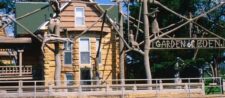
No trip to Lucas is complete without visiting S. P. Dinsmoor’s Garden of Eden, the outdoor sculpture exhibit that sparked the town’s quirky art obsession. The Garden of Eden features many creative structures, including a concrete log cabin, sculptures that reflect populist ideas and biblical imagery (such as Adam and Eve, serpents, and angels), and even a mausoleum where Dinsmoor and his wife are buried. Visitors can take a self-guided tour or opt for a guided one depending on the time of year you’re visiting. Entry fees are reasonably priced, and free street parking is available outside of the house. There is even a gift shop where visitors can pick up a funky souvenir while also supporting this important piece of Kansas heritage.

Lucas is also home to the World’s Largest Souvenir Plate, according to the World Record Academy. The plate, created by local artist Erika Nelson, is 14 inches wide and intricately depicts scenes of Lucas’ life and history. Nelson is also the creator of The World’s Largest Collection of the World’s Smallest Versions of the World’s Largest Things, which is located just off the town’s main street. Here, she showcases small-scale models of famous oversized American tourist attractions, such as the world’s largest rocking chair, ketchup bottle, and ball of twine. Kitschy and playful, her mobile exhibit is on display from April and October and celebrates the humor and larger-than-life culture of America.

The Grassroots Art Center is another fascinating stop in Lucas, offering insights into the town’s obsession with outsider art — art created by untrained artists while working outside of the cultural norms. One visitor to the center shared their review on TripAdvisor, saying, “I loved the wide variety of unique and unusual art!… I could see how that part might not be to everyone’s taste, but I was mesmerized! The rest of the center had so many different things there was something for everyone. It’s amazing to see what people can do with all different types of mediums.”

Lucas is a town where just about anything goes and freedom of expression is celebrated. You’ll find interesting art in the most unlikely places along Main Street — even the telephone poles feature artistic installations. But one of the town’s most unique attractions is Bowl Plaza, a public restroom created by Mri-Pilar and Eric Abraham and assembled with the help of a team of local volunteers. This characterful wheelchair-accessible bathroom is embellished with mirrors, mosaics, and a menagerie of upcycled materials. The giant oval toilet lid at the entrance and a sculpture resembling a giant toilet paper roll complete the look, adding a playful touch to the restroom theme.