Saturday, January 31, 2026
Home Blog Page 299

Kansas is covered in farms but isn’t growing enough local produce for school lunches

0
Despite being surrounded by farmland, school districts in western Kansas struggle to source local food options to feed kids. But farm tours given by the state’s Child Nutrition and Wellness program can establish new pathways to keep kids healthy.

GARDEN CITY, Kansas — Deep into western Kansas, there’s an abundance of corn and cattle. But there aren’t as many juicy tomatoes, crisp apples or fresh squash.

That has left residents in vast pockets of the state without access to nutritious foods. For these communities, finding produce may be inconvenient at best, despite being surrounded by farms.

And schools are no exception in the search for healthy food. That’s why staff from the Kansas Department of Education are trying to find solutions by connecting school districts to local farms to benefit both parties.

As part of that effort, a busload of school district nutrition directors recently drove out to western Kansas farms so that schools could have more options to access local food.

But Eryn Davis, the state’s Farm to Plate program coordinator, said in this part of Kansas, finding food for humans rather than livestock is a challenge.

“From my research, it was limited on what I could find in western Kansas, both in Garden City, and even north in Colby,” Davis said.

Feeding kids locally

Even though rural Kansas has direct access to agriculture, most farms in Kansas grow commodity crops such as soybeans, wheat and corn. That limits the access rural Kansans could have to other healthy foods.

The 2008 farm bill encouraged institutions operating child nutrition programs to purchase unprocessed locally grown and locally raised agricultural products.

This in theory would benefit the health of rural children and boost the ag economy of local farmers, lawmakers said.

As a result, the Farm to School program was established in Kansas to provide grants, materials and connections to local producers and gardening education for schools.

Davis said locally sourced food not only provides more nutrient-dense options, but it also has economic benefits.

“It’s supporting the economy of our Kansas communities that we have here, keeping our dollars. Repurchasing from Kansas producers is a big push for local foods,” Davis said.

Most school district leaders on the tour said they rely on trucking in their food from eastern Kansas, although they each had the same locally sourced foods in common: beef, dairy and tortillas.

But the need for vegetables and fruit in southwest Kansas remains.

Connecting farms and schools

The first stop on the tour was connecting districts from Dodge City, Garden City and Sublette to a poultry farm outside of Lakin.

As soon as everyone made their way off the bus, the chickens timidly surrounded the group of outsiders.

The Diamond W Farm and Ranch is a family operation specializing in egg production, owned by Samantha Williams with her husband and three sons.

“I started with 15 chicks, and I said, ‘It’s just as much work (with) 15 chicks as 100 chicks,’ so I got 100, then 200, and now we have anywhere from 300 to 500 chickens laying eggs at a given time,” Williams said.

The Williams family are one of the largest egg producers in southwest Kansas, and they deliver to nearby towns.

Williams initially got her egg license to provide eggs to the day care her boys attended. The operation grew so they could provide eggs to feed more children in the surrounding towns.

“I love getting up and seeing the chickens’ fluffy butts every morning; it’s like my form of therapy,” Williams said.

After seeing what the Williams family could offer school districts, everyone filed back onto the bus and started brainstorming ways they would like to use local eggs.

The bus then traveled back to Garden City to the only produce farm in town, Prairie Wind Produce.

Steven Michel runs the produce farm with his wife. One thing about Michel – he’s passionate about produce.

“Me and the wife had a seniors meal the other day. It had two cherry tomatoes; they were mushy and had no flavor. People come try our tomatoes and they’re back three days later,” Michel said.

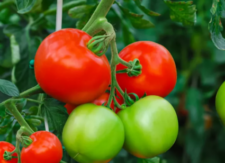
Standing in a greenhouse forest of tomatoes, school district leaders in Garden City said they hadn’t known about this produce farm in their own town. They passed around fruits and vegetables, marveling at each one.

Limitations to local foods

The Michels are the exception rather than the rule in western Kansas. Michel serves as the vice president for the Kansas Specialty Crop Growers Association.

“We are the only ones that grow more than two or three vegetables in at least a 60-mile radius – it’s just us,” Michel said.

That’s part of the limitation to a Farm to School program like the one in Kansas. For some school districts, there just is not a lot of local produce to source.

Michel said some of this is a lack of growers and education. Western Kansas no longer has horticulture expertise from Kansas State University, which Michel believes has discouraged the growth of gardens.

Most of the produce consumed by Kansans – 95% – is grown outside of the state. Schools are the only place for some kids to get nutritious meals from local sources. Those living in the breadbasket have significantly higher rates of diabetes, colon cancer and heart disease, according to the University of Kansas Medical Center.

Experts say for the Farm to School program to be successful in a place like western Kansas, there will need to be more produce growers.

But specialty crops aren’t covered as well by crop insurance that guarantees against drought or hail storms, which have become staples of western Kansas’ climate.

Plus, growing produce is labor intensive, Michel said. And rural Kansas has made its claim to fame being able to grow more with fewer workers thanks to technology advancements and large-scale grain.

But Davis, the coordinator of the Farm to Plate program, is optimistic that these farm tours help make the connections both farmers and school districts need. By giving producers a wholesale market, and schoolchildren fresh produce grown down the road, she thinks that this is a program that can chip away at both problems.

“It’s a good way to bring nutritious local foods to the community, and that partnership with the producer is important, too, to support their business,” Davis said.

Calen Moore covers western Kansas for High Plains Public Radio and the Kansas News Service. You can email him at [email protected].

The Kansas News Service, ksnewsservice.org.

Taking Inventory (Best Of)

0
lee pitts

Whenever I am having difficulty making a decision I always do what any reasonable person would do. I grab a yellow legal pad and make two lists. One list is the good points and the other is the bad. Here’s an example:

I Like Ranching Because…

* Cows are punched… not a time clock.

* You meet some interesting people including veterinarians, neighbors, truck drivers and marriage counselors.

* Every year is a rebirth.

* Old things are respected giving hope to all of us in our old age.

* There is no commute to work. You just wake up and there it is.

* Cows don’t talk a lot.

* Many humorous things happen on a ranch. Whether it is a banker attempting to open a tight gate or a calf attacking the flank of a cow, a day never passes without something funny happening.

* You never know when you’ll spot some form of wildlife. Thankfully most of the time it isn’t human.

* Ranching is never boring. If you get tired of building fence you can always change to digging post holes and stringing barbed wire.

* Dog food qualifies as a business expense.

* More time is spent in the saddle than the seat of a tractor.

* No necktie is required.

* Despite the best efforts of AT & T and Apple there are no telephones on horses. (At least not on my horse).

* There hasn’t been a perfume invented that smells as good as early morning dew on sagebrush.

* A rancher can get plenty of daily exercise without having to join a fancy club or wear those skin-tight purple leotards. How embarrassing!

* The feeling you get inside when you are out checking cows in the pasture next to the road and a car goes by and the kids inside are waving furiously because they like cowboys and there you are pretending to be one.

* 90% of the time is spent with cows and 10% with people, which is just about right.

* Hanging out at the auction market qualifies as work.

* You get to spend a lot of time with two of God’s greatest creatures…your horse and your wife. Not necessarily in that order.

* Feeding cows is fun.

* You usually don’t have to pay a lot of income tax.

Things I Don’t Like About Ranching…..

* Feeding cows for six months isn’t that much fun.

* You don’t get to pay a lot of income tax.

* Litter that blows on to the ranch thrown by passing motorists. Inside the fast food bags are empty containers for chicken nuggets and other decomposed poultry products.

• The boss is never far away. But usually she’ll feed you breakfast before she tells you everything she wants done that day.

* External parasites that sometimes pop up in the cattle business such as environmental lawyers, grubs and government bureaucrats.

* Media people who say things about us that aren’t true.

* Truck drivers who knock over your antique loading chute.

• Personally, I don’t care for landlords, calf scours, environmental impact reports, heavy panels, barbed wire, water gaps, trespassers, cockleburs or calves that have to die.

You can see my list of things I like about ranching is much longer than the list of things I don’t like about it.

I guess that means I’m doing what I ought to.

But I have to tell you, it doesn’t matter what the lists say… I’d be doing it anyway.

Shoebox recipient to speak at local events

0

It may be only October, but area Operation Christmas Child volunteers are already gearing up for several events in the area featuring speaker, Anabel Rosario. Anabel’s Father was a pastor who worked multiple jobs in order to provide for the church as well as his family of five. Through this meager existence they were constantly reminded that God is faithful. One Sunday Anabel’s church celebrated “El dia del Nino.” At this special gathering for children she received an Operation Christmas Child shoebox gift. When she opened it, she was ecstatic to find stuffed animals, personal care items and school supplies – all items that she needed at the time. Mesmerized by the contents of her box, she wondered who sent her this beautiful gift. She saw the letter that was included in her shoebox along with the photograph of the ones who packed it. Even though she couldn’t understand English at the time, she understood the word love in the letter and knew that her shoebox was packed with love.
Anabel many times questioned why God allowed her family to suffer in poverty. Her simple shoebox gift reassured her that God is faithful.
Ten years after receiving her shoebox gift, Anabel suddenly lost her father, mother and older sister in a tragic accident. Amidst tears and sadness, she felt the Lord remind her of the lesson her father had taught her throughout childhood, the lesson that her shoebox reassured – God is faithful.
Anabel will be in the area to share her story at south central Kansas schools, churches and the following Project Leader Workshops. Everyone is invited to hear her share, and to receive free resources, ideas & inspiration for packing shoebox gifts for children in need around the world.
Wednesday, October 2, First Southern Baptist Church, 1201 E 23rd St. Hutchinson 6:30 – 8:00 pm.
Thursday, October 3, First Missionary Church, 1310 Avenue C, Dodge City 6:30 – 8:00 pm
Saturday, October 5, Mead United Methodist Church, 204 N Park St., Meade 10:30 – 12:00 pm
Sunday, October 6, Ridgepoint Church, 8000 W 21st. St. Wichita. 6:30 – 8:00 pm.
Operation Christmas Child is a project of Samaritan’s Purse that delivers gift-filled shoeboxes to children around the world in Jesus’ name. Individuals, families, churches & groups pack shoeboxes with school supplies, personal care items & fun toys and bring them to drop-off locations during National Collection Week, November 18-25. Last year south central Kansas collected over 29,000 shoebox gifts, and hope to this year reach their goal of 32,000. Each a tangible expression of hope and God’s love. For information on how you can get involved visit samaritanspurse.org/occ.

Lettuce Eat Local: Goodness gracious it’s garlic

0

Amanda Miller
Columnist
Lettuce Eat Local


“Look out, here comes the vampire!” the clerk called out in fake terror as I walked in the door. 

While I’ve had what I consider a standard amount of descriptors attached to me over my life, this particular one was a first. Fortunately, there was only one character trait that had landed me that label; and no, it wasn’t a thirst for blood, a hypersensitivity to sunlight, or an ability for telekinesis. It was my superhuman strength — no wait, it wasn’t that either — it was my avoidance of garlic. 

For various internet-researchable reasons that I won’t go into detail here, vampires and garlic just don’t mix. Garlic repels them, and garlic repels me, so the logical inference is that I am a vampire.

For the record, I do not believe in vampires. I learned more about them in a single page read of my google search “traits of vampires” than my sum total of knowledge up to this point. My only other experiences comprise seeing the Count in a few of my son’s Sesame Street books, and a strange season in college involving a unit-mate obsessed with the Twilight series. 

The fact remains, however obfuscated by silly/creepy vampire lore, that garlic does repel me. It hasn’t always been this way, and who knows if it will always be, but it’s definitely my current reality. I don’t know the cause or the exact time of incidence, but it seems my sensitivity to garlic (and all alliums) occurred sometime in concurrence with the bacterial infection, parasite, and amoeba I came home from Kenya with ten years ago. I spent a few years feeling sick and not being able to figure out why, until I finally stumbled onto cutting out the certain food group containing fructans…and suddenly/slowly my stomach didn’t feel like it was rotting anymore. Enough details: I try not to eat garlic in any form or onions that have not been well cooked, and I feel good. 

I’ve mentioned this unusual food sensitivity in an article before, and you may or may not have noticed the dearth of garlic in my recipes. It’s good I like to cook, because garlic is one of the most ubiquitously used ingredients. You tell me what savory dish doesn’t start with sauteing an onion with some garlic. 

I’ve had friends tell me they’ve tried to cook without garlic…and just couldn’t even logicize their way out of tossing in those minced garlic cloves or that teaspoon of garlic powder. The vast majority of premade spice mixes also include garlic, so accidental use is also extremely common. Fortunately, I’m not actually allergic, so I don’t have a reaction besides feeling sick for a while, and it seems my symptoms have lessened over the years of healing my gut.

Often people lament my life’s loss of garlic, but honestly, it’s okay — it’s annoying, but I don’t miss it; and in fact, it even smells bad to me now as my body associates feeling bad with its aroma. My poor family has a low threshold for eating it now too as they rarely get any at home. 

I’m just so grateful I’m not sensitive to dairy. Now that would be a travesty. 


G is for Roasted Garlic Butter Biscuits

This is honestly one of the only times something garlicky has smelled good to me: it reminded me of the special garlic biscuits my mom used to make for some Sunday lunches. They were the only time I remember eating tube biscuits; they were baked in a buttery garlic sauce and they were incredible. I didn’t set out to recreate my childhood memories, but when I pulled these biscuits out of the oven, it instantly brought me back to the family table of years past. I just thought it would be a fun idea to have the garlic butter infused into the biscuits instead of spreading them with it.

Prep tips: Brian turned these into epic-looking little sandwiches with bacon, mayo, and fresh tomato slices, but they’d be great on their own or with some scrambled eggs.

1 head of garlic (yes I mean the whole head)

1 tablespoon olive oil

8 tablespoons butter, room temp

½ teaspoon salt

your favorite buttermilk biscuit recipe

Cut off the tip of the unpeeled/unseparated head of garlic, exposing the top of the cloves. Set on a piece of foil, drizzle with the oil and sprinkle with some salt, and wrap tightly. Roast at 400° for 45-60 minutes (I usually bake something else at the same time — but not desserts….), or until the cloves are soft and golden. Let cool, then literally take the whole head and squeeze out the garlic cloves. They should be smushy, but if not, mash with a fork. Stir into the butter with the salt, and chill. Use as the butter in your biscuit recipe (and if you need one, email me). 

“Children’s Dental Health: Key Points for Parents”

0

Good dental health in children is crucial for overall well-being. Healthy teeth enable proper chewing, speech development, and contribute to self-esteem. Prioritizing dental health through education, preventive care, and regular check-ups lays the foundation for a lifetime of healthy smiles. The following topics are common discussion points of children’s dental health.

First Dental Visit

Children should visit the dentist by their first birthday or within six months after their first tooth erupts. Early visits help establish a dental home and allow the dental care team to monitor oral development and provide guidance on proper care. Regular dental visits every six months are essential for monitoring dental health and catching potential issues early.

Fluoride Treatments

Fluoride is a naturally occurring mineral that helps prevent tooth decay. Fluoride treatments can help strengthen tooth enamel, making it more resistant to acids produced by bacteria in the mouth. This in turn helps to significantly reduce the risk of cavities and promote stronger, healthier teeth. Dentists often recommend fluoride treatments for children and may also suggest fluoride toothpaste for at home use.

Dental Sealants

Dental sealants are thin coatings applied to the chewing surfaces of molars (back teeth) to protect them from cavities. Sealants act as a barrier against food particles and bacteria. They are typically recommended for children once their permanent molars emerge, usually around age six.

Visiting An Orthodontist

Children should have their first evaluation with an orthodontist by age seven. At this age, an orthodontist can identify potential issues with tooth alignment and bite. Early intervention may prevent more severe problems later and can help guide the growth of the jaw.

Thumb Sucking

Thumb sucking is common in infants and toddlers and usually doesn’t cause issues if stopped by age four. Prolonged thumb sucking can lead to dental problems, such as misalignment of teeth or changes in the roof of the mouth. If a child continues thumb sucking beyond this age, parents should consult a dentist for advice.

Baby Bottle Tooth Decay

Baby bottle tooth decay occurs when sugary liquids like milk or juice cling to a child’s teeth, leading to decay. To prevent this, avoid putting a baby to bed with a bottle and ensure regular cleaning of the child’s teeth and gums. Water can be used as a nighttime beverage.


Teeth Grinding (Bruxism)

Teeth grinding, or bruxism, is common in children, especially during sleep. It can be caused by stress, misaligned teeth, or other factors. If grinding is frequent, it can wear down teeth and lead to discomfort. Parents should discuss the issue with their child’s dentist, who may recommend monitoring, relaxation techniques, or In some cases, a custom mouth guard.

Dental Anxiety

Dental anxiety is a common issue among children, characterized by fear or apprehension about visiting the dentist. This anxiety can stem from various factors, including fear of pain, unfamiliar environments, or negative past experiences. Prepare children by discussing what to expect at their visit, using positive reinforcement, and visiting the office beforehand to familiarize them with the environment.

Regular dental checkups and good oral hygiene practices are vital for children’s dental health. Parents and caretakers should stay informed about common issues and consult their dentist for personalized advice to ensure the health of their child’s smile.

John Bisson, DDS is a dentist and owns Bisson Dental in Brookings, SD. Dr. Bisson is originally from Sturgis, SD but moved to Brookings in 2015 and opened Bisson Dental in 2018. For more information about Bisson Dental head here, https://www.bisson-dental.com/. Follow The Prairie Doc®.www.prairiedoc.org and on Facebook featuring On Call with the Prairie Doc a medical Q&A show providing health information based on science, built on trust, streaming live on Facebook most Thursdays at 7 pm central.