

Monday, February 2, 2026
Home Blog Page 321

KU media advisory: KU experts can comment on 2024 elections, related topics

0

From the Office of Public Affairs | http://www.news.ku.edu

Media advisory

Contact: KU News Service staff, [email protected], @KUNews

KU experts can comment on 2024 elections, related topics


LAWRENCE — As a contentious U.S. election season heads toward November, University of Kansas experts are available to discuss with media the candidates, key issues, procedures and narratives of the 2024 races.

Read on for experts by topic; some experts appear under multiple categories.


Artificial intelligence

John Symons, professor of philosophy, can discuss artificial intelligence, including large languages models such as ChatGPT. His research explores the social, technological and existential concerns inherent to AI. Symons also is director of KU’s Center for Cyber Social Dynamics, home for the interdisciplinary and cross-cultural study of the relationship between internet and data-driven technologies and society, politics and culture. (Media contact: Jon Niccum, 785-864-7633)


Children and politics

Meagan Patterson, professor of educational psychology, can discuss how parents can talk about the election, candidates, politics, civic processes such as voting and difficult topics with children. Patterson has conducted research on children’s opinions on race, how picture books can introduce young readers to politics, political and civic engagement, intergroup attitudes as well as gender and race in child development. (Media contact: Mike Krings, 785-864-8860)


China, international trade

Raj Bhala, Brenneisen Distinguished Professor of Law, can discuss the international trade policies of the respective candidates and parties, the trade war with China, free trade agreements (including NAFTA/USMCA), the World Trade Organization, U.S. relations with India and Iran, labor rights and forced labor, and other international legal, economic, political and national security matters. With over three decades of experience, Bhala is the author of 100 law review articles and 13 books, including the brand new “International Trade Law: A Comprehensive E-Textbook, Sixth Edition,” which is freely available Open Access on KU ScholarWorks. (Media contact: Mike Krings, 785-864-8860)


Jack Zhang, assistant professor of political science, can discuss the political and economic relationship between the U.S and China. Zhang is also the founder and director of the KU Trade War Lab. His research explores the political economy of trade and conflict in East Asia with a focus on explaining why interdependent countries use military versus economic coercion in foreign policy disputes. (Media contact: Jon Niccum, 785-864-7633)


Conservatism, social movements

David Farber, Roy A. Roberts Distinguished Professor in the Department of History, can discuss the history of modern conservatism, capitalism in 20th-century U.S. history, democratic practices and social change movements, particularly how those of the 1960s and 1970s relate to events of today. Farber is the author of more than a dozen books, including “The War on Drugs: a History,” “The Rise and Fall of Modern American Conservatism” and “The Age of Great Dreams: America in the 1960s.” (Media contact: Jon Niccum, 785-864-7633)


Rachel Schwaller, multiterm lecturer in the departments of History and of Women, Gender & Sexuality Studies, can speak about the history of white, conservative Christians in America. Her research builds on the field of anthropology of scriptures, scripturalization and biblicism. (Media contact: Jon Niccum, 785-864-7633)


Debates and speeches

Brett Bricker is a Department of Communication Studies faculty member and assistant coach for KU’s nationally ranked debate team. He co-wrote a chapter in the 2016 book “Debating the Donald,” which analyzed Trump’s performances in the intraparty debates that led up to him winning the GOP nomination. Bricker is available to comment upon any candidate’s debate preparation and/or performance. As a scholar, Bricker has examined how hyperpartisanship has affected the “political apology.” (Media contact: Rick Hellman, 785-864-8852)


Robert Rowland, professor of communication studies, is available to journalists to comment upon the speeches, campaign rhetoric and debating styles used by candidates seeking the presidency and vice presidency. Rowland is a leading expert on presidential rhetoric and author of the 2021 book “The Rhetoric of Donald Trump: Nationalist Populism and American Democracy.” The KU researcher has specialized in the rhetorical legacies of presidents, calling Ronald Reagan and Barack Obama “once in a generation” communicators who raised the sights of their fellow citizens to lofty national ideals. Trump, he has called “a master at creating fear and hatred of others,” while he assesses President Joe Biden’s performance in his June 27 faceoff with Trump as the worst in the history of televised presidential debates. (Media contact: Rick Hellman, 785-864-8852)


Election administration and election workers

Zach Mohr, associate professor of public affairs & administration, can speak about the business of elections, including the cost of holding elections on federal, state and local levels, public accounting of government spending, election administration and the role of election workers. Mohr studies public budgeting, accounting and financial management and is the author of the book “Cost Accounting in Government: Theory and Applications” and is writing a book on the cost of elections on a local level. Mohr has also testified before the Congressional Committee on House Administration and was a city administrator before entering academia. (Media contact: Mike Krings, 785-864-8860)


Energy policy

Christopher Koliba, Edwin O. Stene Distinguished Professor of Public Affairs and Administration, can speak about issues including governance; accountability in governance; government employees at federal, state and local levels; sustainability in policy and communities; critical infrastructure; natural disaster mitigation and energy policy. He is author of the book “Governance Network in Public Administration and Public Policy” and dozens of book chapters and journal articles on governance, government networks, sustainability, policy and related topics. Koliba will also be director of KU’s Center for Democratic Governance, which will open this fall. Editors: Koliba can also discuss government accountability and the labor force. (Media contact: Mike Krings, 785-864-8860)


Extremism

Don Haider-Markel, professor of political science, can speak about political extremism, national political trends and potential policy implications. His research includes American politics and public policy that deals with a wide number of issues, including Christian nationalism, gun ownership, military service controversies and LGBTQ politics. Editors: Haider-Markel can also discuss gun ownership and LGBTQ politics. (Media contact: Jon Niccum, 785-864-7633)


Gun ownership

Margaret Kelley, professor of American studies, examines the relationship between women, guns and modern culture. Using her comprehensive Guns in American Life Survey, she has explored topics involving how this is intersects with gun ownership, racism, religion and veterans. (Media contact: Jon Niccum, 785-864-7633)


Mark Joslyn, professor of political science, can discuss issues of partisanship and political attitudes. He is co-author of several studies on what influences voter attitudes, including level of education, gun rights and understanding of genetics. His book “The Gun Gap” captures the differences between gun owners and non-gun owners and shows how this gap improves conventional behavioral and attitudinal models. Joslyn can also discuss partisanship. (Media contact: Jon Niccum, 785-864-7633)


Editors: Don Haider-Markel can also discuss gun ownership.


Housing

Kirk McClure, professor emeritus of public affairs & administration, can speak to issues of housing, housing policy, affordability of housing and government housing programs, as well as homelessness. McClure has conducted research in housing markets, examined federal affordable housing programs and was a scholar in residence in the Department of Housing and Urban Development’s Department of Policy Development and Research. (Media contact: Mike Krings, 785-864-8860)


Labor force

Misty Heggeness, associate professor of public affairs and administration and associate research scientist at the Institute for Policy & Social Research, can discuss women in the American workforce, economics, the care economy, working mothers and how government policy influences women’s economic well-being. Heggeness has published research on “girly economics,” or how care work influences the economy; “Swiftynomics,” how Taylor Swift is both an economic engine and representative of women’s influence in the larger economy; and she is leading research on the role of young adults in the workforce. Editors: Heggeness can also discuss women and politics. (Media contact: Mike Krings, 785-864-8860)


Editors: Koliba can also discuss the labor force.


Latino American politics

Tiffany Gonzalez, assistant professor of history, can speak about U.S. politics, Chicano-Latino history, women’s history and social movements. Her upcoming book is titled “Representation of Change: How Chicanas Reshaped the American Political Process in the Late Twentieth Century.” Editors: Gonzalez can also discuss women and politics. (Media contact: Rick Hellman, 785-864-8852)


Alcides Velasquez, associate professor of communication studies, has researched several topics relating to the use of social media by the Latino community and how that relates to their political participation like his 2018 study. (Media contact: Rick Hellman, 785-864-8852)


LGBTQ politics

Editors: Haider-Markel can discuss this topic.


Partisanship

Kevin Mullinix, associate professor of political science, examines the extent to which political parties and elected officials shape the public’s attitudes toward various policies. His past articles include studies of police use of excessive force, wrongful convictions and racial disparities in traffic stops. He is author of the book “The Politics of Innocence: How Wrongful Convictions Shape Public Opinion.” (Media contact: Jon Niccum, 785-864-7633)


Editors: Joslyn also can discuss partisanship.


Women and politics

Mary Banwart, professor of communication studies, is available to comment on topics that relate to women in American politics, from suffrage to today. Banwart has co-written the book “Gender and Politics: Changing the Face of Civic Life,” coming out later this summer. The book analyzes the latest research — including results from the 2022 midterms — on the role that gender plays in political campaigns, from media coverage to social attitudes. (Media contact: Rick Hellman, 785-864-8852)


Hannah Britton, professor in the departments of Political Science and of Women, Gender & Sexuality Studies, can discuss women and politics and the prevention of gender-based violence. She is also the director of KU’s Center for the Study of Injustice at the Institute of Policy & Social Research. (Media contact: Jon Niccum, 785-864-7633)


Teri Finneman, associate professor of journalism, can discuss media representations of women candidates, coverage of presidential and other candidates, political coverage outside of major media markets and media portrayals of first ladies throughout U.S. history. Finneman is the author of the books “Reviving Rural News: Transforming the Business Model of Community Journalism in the U.S. and Beyond” and “Press Portrayals of Women Politicians, 1870s-2000s” and is creator and host of “The First Ladies” podcast. (Media contact: Mike Krings, 785-864-8860)


Editors: Gonzalez and Heggeness can also discuss women and politics.


-30-

————————————————————————


KU News Service

1450 Jayhawk Blvd.

Lawrence KS 66045

Phone: 785-864-3256

Fax: 785-864-3339

[email protected]

http://www.news.ku.edu


Erinn Barcomb-Peterson, director of news and media relations, [email protected]


Today’s News is a free service from the Office of Public Affairs

 

KU News: Lawrence AUMI Group will receive award from Kansas Commission on Disability Concerns

0

From the Office of Public Affairs | http://www.news.ku.edu


Headlines


Contact: Sherrie Tucker, Department of American Studies, [email protected]

Lawrence AUMI Group will receive award from Kansas Commission on Disability Concerns


LAWRENCE — On Aug. 2, the Kansas Commission on Disability Concerns (KCDC) will present a Michael Lechner Advocacy Award to the Pre-Pandemic Ensemble (PPE), a Lawrence-based mixed-ability improvising band that uses an instrument called AUMI, or Adaptive Use Musical Instrument, to improvise across abilities.


According to the KCDC, the award is given to those who have advocated for people with disabilities in their community. The Pre-Pandemic Ensemble demonstrates to the public that people with disabilities have talent, hope, inclusion and passion for music.


The Pre-Pandemic Ensemble came together through monthly all-ability jam sessions using the AUMI at the Lawrence Public Library and continued over Zoom during the pandemic isolation period. The ensemble includes Sherrie Tucker and Ray Mizumura-Pence, both University of Kansas faculty members in the Department of American Studies. Tucker has published extensively on the AUMI, most recently as co-author of a 2024 book about its origins.


The PPE plays AUMI on iPads, which need to be charged and updated regularly. AUMI comes preloaded with hundreds of sounds, but PPE members enjoy gathering their own sounds, such as the sound of member Drew White’s favorite bowling alley, Royal Crest Lanes in Lawrence. A musical piece might include such an array of sounds as a bowling ball smashing into pins, a loop of someone playing recorder, kitchen percussion and kalimba.


“You have to put hard work into it, and you can’t do it without other people. We all have to work together,” White said.


As important as the PPE’s work is to its members, and as enjoyable as it has been to foster rare opportunities of all-ability music-making in the Lawrence community, winning an award came as a surprise to the musicians. For local poet and ensemble member Julie Unruh, the recognition from the KCDC “left me in awe. I was shocked I didn’t think anything like would happen to us.”


The PPE has performed at the Society for American Music (virtually), the Lied Center Pavilion and the Lawrence Public Library Auditorium. Monthly jams will resume in September at the library’s Sound+Vision Studio for people of all ages and abilities, with no experience necessary.


-30-


————————————————————————


KU News Service

1450 Jayhawk Blvd.

Lawrence KS 66045

Phone: 785-864-3256

Fax: 785-864-3339

[email protected]

http://www.news.ku.edu


Erinn Barcomb-Peterson, director of news and media relations, [email protected]


Today’s News is a free service from the Office of Public Affairs
 

KU media advisory: KU experts on women candidates can discuss historic shift in 2024 presidential campaign

0

From the Office of Public Affairs | http://www.news.ku.edu

Media advisory

Contact: Mike Krings, KU News Service, 785-864-8860, [email protected], @MikeKrings; Erinn Barcomb-Peterson, KU News Service, 785-864-8858, [email protected], @ebpkansas

KU experts on women candidates can discuss historic shift in 2024 presidential campaign


LAWRENCE — President Joe Biden announced he would drop out of the presidential race this weekend and endorsed Vice President Kamala Harris to be the new Democratic nominee. The late, dramatic change in the race gives Harris the chance to become the first woman president, as well as the first African American and Asian American woman president. University of Kansas researchers are available to speak with media about the historic shift, media portrayals of women candidates and related topics.

Teri Finneman has conducted research and written extensively on the history of journalism, women in politics, first ladies and mass media. She can discuss the evolution of political coverage, especially of women candidates and how those portrayals can influence an election.

“The fact that the United States will now have two women who will be on the ballot for president in the last decade is a monumental shift in political history,” Finneman said. “Yet make no mistake, sexist and delegitimization tactics remain strong after centuries of trying to discredit women in power.”

Finneman is the author of the books “Press Portrayals of Women Politicians, 1870s –2000s” and “Reviving Rural News: Transforming the Business Model of Community Journalism in the U.S. and Beyond.” She is also creator and host of the podcasts “The First Ladies” and “Journalism History.”

To schedule an interview with Finneman, contact Mike Krings at 785-864-8860 or by email.

Mary Banwart, professor of communication studies, is available to comment on topics that relate to women in American politics, from suffrage to today. Banwart has co-written the book “Gender and Politics: Changing the Face of Civic Life,” coming out later this summer. The book analyzes the latest research — including results from the 2022 midterms — on the role that gender plays in political campaigns, from media coverage to social attitudes.

To schedule an interview with Banwart, contact Erinn Barcomb-Peterson at 785-864-8858 or by email.


-30-

————————————————————————


KU News Service

1450 Jayhawk Blvd.

Lawrence KS 66045

Phone: 785-864-3256

Fax: 785-864-3339

[email protected]

http://www.news.ku.edu


Erinn Barcomb-Peterson, director of news and media relations, [email protected]


Today’s News is a free service from the Office of Public Affairs

Lettuce Eat Local: Blueberries for Sal and Kiah

0

Amanda Miller
Columnist
Lettuce Eat Local

“I’m so blue-hoo-hoo, blue-hoo-hoo, blue-hoo-hoo-hooooo, I’m so blue I don’t know what to do!” If you are in the right demographic, you might know exactly how to sing those silly lines — proper French accent and falsetto included. It’s Madame Blueberry singing her operatic lament, of course, from a turn-of-the-century eponymous episode of VeggieTales. 

I haven’t seen that animated show of my childhood in probably 20 years, but the tune immediately pops right back into my head. [Side note, I always wondered if the greedy berry was based off of something, but never bothered to look it up until right now: Madame Bovary from a realist 1857 novel of the same name. Something new to add to my neverending reading list.] It’s a song my nine-month-old daughter could sing often these days; fortunately not in the emotional sense, although her teeth and allergies have been really bothering her this week. 

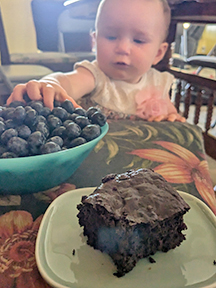
I actually mean in the physical sense — and clearly, she’s not cold in this weather. Just blue, so blue, thanks to her obsession with blueberries. 

She does well eating almost all foods so far, but a lot of B foods are at the top of her preferred list. Bananas, beef, beets, and most of all, blueberries. (Although she is not undiscerningly affirmative of foods that start with b, as the butternut squash and frozen cubes of bone broth I tried to feed her this morning did not go over as well.) I’m not quite sure how far babies are supposed to be able to see at this developmental stage, but I’m guessing I could find out some with accuracy if I just set a bowl of blueberries down at various distances from Kiah. 

I decided to be so smart the other day, and instead of cutting so many blueberries in half — okay, let’s be honest, I just eat half of each berry and give her the rest, she didn’t get her love of fruit out of nowhere — I figured I would just cook some berries down into a simple sauce to stir into yogurt. 

I did achieve my goal of not having to chase down and clean up all the dropped, thrown, and smacked berry halves. But I forgot how cooked blueberries take on an almost incandescent shade of deep dazzling blue that permeates and stains anything it touches. 

And, incidentally, it touches a lot of things when there’s a baby involved. 

Oh well, I had to do laundry anyway. And that vibrant blue color is not only an indication of rich blueberry flavor, but also of the presence of anthocyanins, powerful antioxidants found primarily in blue, purple, black, and red foods. Berries have the highest concentrations of anthocyanins, which may have significant health benefits, including reducing heart disease, lowering blood pressure, and improving brain function. All sorts of things that I as her mother care deeply about Kiah getting as she grows, and all sorts of things that she couldn’t care less about, as long as whatever she’s eating tastes like blueberries. 

So I’ll keep giving her blueberries in whatever format, and she’ll keep eating them, and the floor and our clothes will keep singing, “I’m so blue….”


Magical Blueberry Brownies 

I was going to share a recipe for some iteration of vibrantly colored blueberry-beet yogurt parfait, but then I remembered the brownies a friend had made and their secret ingredient — blueberries! While I didn’t actually follow the recipe, I kept the surprisingly strong ratio of blueberries to cocoa powder the same, as they are the backbone of the brownies. All the anthocyanins are still present even though the blue color disappears, but don’t worry, a rich staining brown takes its place.

Prep tips: you can use fresh or thawed frozen blueberries. Also these are clearly not normal brownies so don’t expect that; just expect tasty.

1 ½ cups blueberries

1 ¼ cups cocoa powder

½ cup almond butter

sugar or maple syrup to taste 

1 tablespoon baking powder

½ teaspoon salt

2 eggs

Process all ingredients in a blender until smooth. Pour into a greased loaf pan and bake at 325° for about 30 minutes, or until brownies have formed a crust on top and are firmed. Let cool in the pan for at least a little while before digging into — they will be crumbly, but oh so chocolatey. Store leftovers in the fridge. 


Lettuce Eat Local: Good stuff, Maynard

0

Amanda Miller
Columnist
Lettuce Eat Local

“Good stuff, Maynard!”

Some of you might get that reference immediately, while the rest of you have no idea what I’m doing. Our household is young enough that we wouldn’t quite as naturally spout off that tagline from a 1983 Malt-O-Meal commercial, yet you’ll hear it rolling off Brian’s and my tongues like cream of wheat off a spoon. Benson has even been heard saying it to himself in his silly little voice. Although I’m not sure of the conversation context, I first learned about this Maynard from a group of ladies in one of my cooking classes; their age demographic is above mine by a good margin, so they were all in the know while I had to be educated. 

Since then, I’ve educated several others with an easy-to-reference YouTube clip of the breakfast bear. It gets me every time — I don’t know if it’s the haircuts, the speaking patterns, or the dry humor, but I know it’s not the product advertised.

I know lots of people are fans of Malt-O-Meal. Or rather, I assume there are at least enough people that purchase this kind of product to keep it on the market since its invention in 1919. Cooked milled wheat middlings had been served as a breakfast porridge for at least a couple decades before then; Cream of Wheat debuted in Chicago at the World’s Columbian Exposition of 1893. Cream of Wheat was a marketing innovation in response to a reduced demand for flour, and it was clearly met with more accolade than I give it: the initial product testers telegrammed back, “Forget the flour. Send us a car of Cream of Wheat.”

Before this article, I thought those two products were the same thing under different brand names, but Malt-O-Meal added malted barley to a slightly coarser ground wheat than the smoother, “creamier”-cooking Cream of Wheat. Farina is the general term for this particular style of ground wheat kernels, that falls somewhere on the spectrum between cracked wheat berries and flour; think grits made from wheat instead of corn. 

I’m obviously not a major connoisseur of the porridge. I’ve had one or the other before, but I’m generationally biased against it; my parents tell of their season as recently-married poor young college students when Cream of Wheat was their breakfast staple for far too many mornings. My mom got desperate enough for some variety in their budget breakfast that she tried adding food coloring — it seems it didn’t help matters much. 

On the other hand, my mother-in-law has instant Cream of Wheat for breakfast often, as a perfect easy breakfast after finishing the early morning milking. (She makes it with milk, of course, and tops it with a little brown sugar.)

All I can say for farina porridge is that it’s a good blank canvas for adding flavors, whether the pre-added packaged varieties or your own in-home additions. But God made oatmeal for a reason, so if I want a hot breakfast porridge, and one that has better taste, texture, and nutrition, oatmeal is where I’m headed. 

All that said, we did just have wheat harvest. And if there ever was a time to try making my own cream of wheat, it’s when I have a bucket of fresh-from-our-field wheat berries sitting in my kitchen…i.e., now. 

And you know, it wasn’t bad. It’s not going to become a staple, but I surprised myself with how enthusiastically I kept going in for another bite. I can truthfully say, “Good stuff, Maynard.”


Homemade Malt of Wheat

I wanted the creaminess of Cream of Wheat and the malt of Malt-O-Meal, so good news, I can do both. This breakfast isn’t quite as quick as the minute or two in the microwave the instant varieties require, yet it’s still fast and easy, and a good bit more nutritious since this uses the whole wheat berry instead of degermed. My Vitamix high-powered blender can do a whole range of different grind textures, and you should be able to find something that gets a coarse grind for you (try a food processor or coffee grinder if you don’t have a blender). 

Prep tips: if a bucket of fresh wheat didn’t appear in your house, you can find wheat berries at Glenn’s Bulk Food, another bulk food store, or sometimes even a “regular” grocery.

½ cup wheat kernels, ground to a medium-fine texture

2 cups milk 

¼ teaspoon salt

2 tablespoons browned butter 

2 tablespoons malted milk powder

sweetener and/or toppings of choice

Add wheat, milk, and salt to a saucepan, and simmer over medium-high heat until thickened, 5-10 minutes depending on the grind. Remove from heat and whisk in butter and malted milk, as well as honey/maple syrup/brown sugar/whatever you want. Top with toasted nuts, chocolate chips, coconut, bananas, again whatever you want — or really just another pat of butter.