Wednesday, February 4, 2026
Home Blog Page 350

Farm Pond Olympics

0

When I was a kid, I owned a big ole’ jumbo prehistoric aluminum canoe that looked like it would have been more at home on four big tires and pushing a snowplow. Its saving grace was that it was also extra stable on the water. One particular evening my brother-in-law and I were anchored in the middle of dad’s farm pond, fishing. A boat anchor on one end and a big steel ball for an anchor on the other kept the thing from twirling around in the wind. We had multiple tackle boxes open on the seats, I guess to give the appearance that we were big-time contenders on the professional farm-pond bluegill circuit. Anyway, as it was getting dark, we pulled anchor to paddle toward shore. My anchor came up with no problems, but the steel ball on his end was stuck in the black, oozy mud bottom of the pond. Wrapping the rope around his hands a couple times, he leaned backwards to dislodge the steel ball. He was built like a dump truck and when the ball came free, he hit the other side of the canoe like a rodeo bull out of the chute, causing ole’ jumbo to do the unthinkable and dump us both into the drink. There we were, bobbing around in the middle of an absolute flotilla of fishing lures; some floating and some sinking slowly toward the bottom, but all sporting at least three razor-sharp hooks. Now, Katie Ledecky could swim the length of dad’s pond as easily as the rest of us could walk across the kitchen, but how about swimming it through a scum of floating fishing lures.

Welcome to the first event in the 2024 Farm Pond Olympics, the freestyle lure swim. The swimmers can choose their stroke, but they have to stay on top of the water. We’ll divide the pond into lanes with bailer twine tied to electric fence posts on each side of the pond. All shapes and sizes of floating fishing lures will be scattered over each lane beforehand, and at the crack of the starter’s pistol, the swimmers simply swim to the other side of the pond as quickly as possible. The event can be scored a variety of ways; most lures on their body, fewest lures on their body or certain lures could be given a point value and the winner would be the swimmer with the most points when the point value of the lures clinging to their body is tallied. The event could be made even more life-like by unceremoniously flinging each swimmer from a sinking canoe to start the race.

The diving board at dad’s pond was an old steel frame with a big old barn plank for a board. We welded the frame from stuff dug out of the usual farmer’s scrap pile and carried it to the pond with the tractor and loader. It was on the dam, so the frame was made to be as tall as the dam. One end of the old barn plank lay across the steel frame and hung out over the water and the other end rested on top of the dam and was held there with a huge rock. It did little good to bounce on the board when diving because the old plank had zero spring to it. I remember going to a nice swimming pool once with the church youth group and running out onto the diving board and pouncing on it like I did at the pond. The thing flung me so high I had a nose bleed when I hit the water! I once watched my buddy Ralph bounce off the end of the board as usual,

then looked-on as the plank followed him end-over-end into the pond cause’ the rock had somehow gotten moved. Anyway, the next event in the Farm Pond Olympics would be farm pond diving. The degree of difficulty will always be high no matter what dive they choose, and the chunkier divers will have a definite advantage in the event. We’ll probably have to employ an extra person at the judges table to keep an eye on the rock.

Dads pond was chock full of pesky little bluegills and each tiny one we caught found its way into the nearby fencerow as a way to weed them out of the pond. We found out that smacking them with a canoe paddle was a pretty novel and effective way to get them to the fencerow, so the third event in the Farm Pond Olympics would be bluegill batting. The event will be divided into two categories; land batting in which each contestant will bat his or her bluegill from the bank, and water batting where the batting will take place from a canoe. The batters can choose to have their bluegills pitched to them or they can choose the freestyle delivery where they throw it up in the air themselves before whacking it. Winners will be chosen for both longest distance and for highest flight, and naturally canoe paddles will be provided so that no one has an unfair advantage.

I’ve made my pitch to the International Olympic Committee, but I’m not yet sure if this Farm Pond Olympic thing will catch on. I figure we have ranch rodeos so why not Farm Pond Olympics. Any way, if the 2024 Farm Pond Olympics become a reality, I’ll be available to coach bluegill batting…Continue to Explore Kansas Outdoors!

Steve can be contacted by email at [email protected].

KU News: Research will establish best ‘managed retreat’ practices for communities faced with climate change disaster

0

From the Office of Public Affairs | http://www.news.ku.edu

Headlines

Contact: Brendan Lynch, KU News Service, 785-864-8855, [email protected], @BrendanMLynch

Research will establish best ‘managed retreat’ practices for communities faced with climate change disaster

LAWRENCE — Around the globe, communities at risk from repeated flooding due to climate change face stark decisions. Some communities in peril of flooding may resolve, or be urged, to relocate to a safer location — something known as “managed retreat.” In the United States, flood-prone communities in coastal states like Louisiana and Alaska already have commenced managed retreat inland.

“It’s retreating from risk, and we hope to provide decision support for the equitable implementation of retreat to build climate resilience,” said Elaina Sutley, associate professor of civil, environmental & architectural engineering at the University of Kansas.

Sutley is leading a three-year, $650,000 multidisciplinary study of managed retreat as part of a collaboration funded by the National Science Foundation and Canada’s New Frontiers in Research Fund via the 2023 International Joint Initiative for Research on Climate Change Adaptation and Mitigation Competition. Each agency funds the scientists at institutions in their respective countries.

The KU-headed partnership is dubbed “Retreating from risk (RFR): Decision-supports for the equitable implementation of retreat to build climate resilience.” Beyond KU, the effort involves Stony Brook and Texas Tech universities as well as researchers abroad.

“This is multidisciplinary collaboration between partners in the United States, Canada and Indonesia, who are all faced with flood disasters, whether that’s coastal flooding associated with a hurricane or not,” Sutley said. “Inland flooding, seasonal flooding and repeated nuisance flooding — all three of these countries are facing it. Managed retreat has become a somewhat common adaptation strategy, particularly for flooding. The U.S. team will also consider retreating from wildfire disasters.”

While the study of managed retreat will focus on communities suffering from floods and wildfires, Sutley said the work could guide decision making for communities faced with different kinds of repeating natural disasters.

“Floods aren’t the only hazard this work is applicable to,” she said. “In many ways, flooding isn’t much different from a lot of hazards. How can we best move out of a place that is going to be hit repeatedly by disaster and has a record of being hit repeatedly?”

The KU researcher said the goal is to understand how managed-retreat approaches are being considered across many geographies, nations and cultures, then identify any key strategies that are shared, as well as understand where there are necessary differences.

“There are many different strategies,” Sutley said. “In the U.S., one of the most common ways we see managed retreat executed is with the buyout program from FEMA. This project, through our international collaboration, is trying to understand how different cities and governments — faced with different types of hazards, with different political, social and cultural contexts — have considered managed retreat. Did they successfully adopt it or one of its strategies? What challenges or barriers did they run into that prevented them from adopting it? What challenges came up when they went through this process? What can we learn within countries across geographies, and then across countries and geographies?”

Sutley said the team would take care to seek and incorporate Indigenous knowledge and practices where applicable, partnering with communities that may already have faced relocation or exploitation historically.

“The new Frontiers Research Fund of Canada require that you consider and include Indigenous communities,” Sutley said. “That’s part of some of their equity legislation. It’s key to work with people who have relationships and experience doing this — taking time to build trust that’s needed. Those are going to be key tenets. While the locations we’ve identified in the United States to partner with aren’t on reservations, for example, they certainly do have people who’ve been disproportionately impacted by historical and modern-day policies and practices that our team is very sensitive to.”

From these studies, the collaborating researchers will document political, financial, social, cultural and policy barriers to adopting managed retreat. The study will include data collection via surveys, interviews, focus groups and roundtable discussions, ensuring the work incorporates viewpoints from people involved in the decision-making process at all levels.

“How can we use all of that information to guide future communities who may consider managed retreat as an option?” Sutley said. “What are the pros? What are the things that make this a really great option in these different areas? Really, I think we’re going to hear very different things from one community to the next but also from one kind of stakeholder in that decision process to the next. So, we’re taking more of an open-ended approach.”

The results will help guide policymakers, community leaders and future research efforts. The researchers plan to produce “contextually relevant decision-support tools,” such as a training module, best-practices guidebook or conversation toolkits, to guide community leaders in engaging constituents on managed retreat.

Sutley said managed retreat is an urgent issue and the work would yield tools at the end of its three-year span.

“Any research that can offer guidance is needed as soon as possible,” she said. “We’re really trying to learn from communities at different stages of dealing with this question — those who are over and done with it, those at the beginning and those in the middle. We’re studying communities at all these different stages so we can understand how the process unfolds in these different contexts. The findings are meant to be relevant both immediately and long term.”

-30-


————————————————————————


KU News Service

1450 Jayhawk Blvd.

Lawrence KS 66045

Phone: 785-864-3256

Fax: 785-864-3339

[email protected]

http://www.news.ku.edu


Erinn Barcomb-Peterson, director of news and media relations, [email protected]


Today’s News is a free service from the Office of Public Affairs

Pretenders and children

1
john marshal

Our national psyche now seems to begin and end with the downside: Criminal trials for prominent legislators and a former president; beastly heat or rain or both nearly everywhere; famine and war on three continents; the tragedy of Israel and Palestine. Elections in Europe, political conventions in America. An old and enfeebled Biden, a lawless and insolent Trump.

There’s the drift. If America is depressed, its leadership is leading the way.

Consider our collapse of foreign policy, an item that stands out in an assessment of our mood. Over two decades our approach has been whipsaw in pressing matters of climate change, Russian aggression, Chinese cunning, the Middle East hell-trap and more.

To hear it from the world’s leaders, America gives the world the jitters; from Bush through Biden, we have seemed vague, tentative or clumsy. Canada’s Trudeau, France’s Macron, Germany’s Scholz, even China’s Xi, are among the perplexed.

Each time a president or a top legislator is asked whether the administration or the Congress is confused, the answer is no. Then we are treated to their special brand of consistency in energy, the environment, foreign affairs, even inflation.

This is not convincing. Even the press is confused as it bends over to be “objective,” attempts at balance that often falsify the moment. There is no other side to the invasion of Ukraine, or polluted air and water, massacre by famine in Africa, or decades of tragic misstep in the Middle East.

The Democrats have lost control of their own. Republicans have surrendered control to one man. In the process, we have gone thrashing about the Middle East, poked around Europe’s Balkans, feuded with China, replaced bridges with walls along our own borders. All the while a basic fact is ignored or forgotten, that the first purpose of a foreign policy is the preservation of our values and society at home.

If just one leader in the Congress or executive branch would face an audience and say, “we blew it,” we would be one our way. Instead we are scolded for insisting that they end the excuses and charades.

*

Richard Nixon once identified the American people as children, to be treated that way. Recent presidents and congressional leaders are close to that mark, not because we are really childlike, but because their service became so frenetic that they were like parents who are everywhere around us, telling us what to do and what to believe and shouting at us or spanking our hands when we don’t do it or believe it.

Our “leaders,” if we can call them that today, talk and talk, and it is impossible to realize that it is us and our lives they are talking about. Their language is scripted and abstract, designed to appeal to a certain cult or tribe or focus group. There are no ideas today, only motives and strategies.

Barbara Tuchman, the late historian, once described the leadership of the Nixon and Ford years as “The Great Pretenders.” Today when we demand that their heirs quit pretending, they turn on us and chide us for daring to question their lies.

The sum of it is that politics has become the ugliest game in America. It has compounded a sense of frustration. It is no longer possible to believe an individual – even a president – can beat the game. The game has become too unwieldy to play with much hope of winning.

That game may come down a peg with the next election, but don’t bet on it.

Stuga Vodka creators find way back ‘home’ to make Kansas corn-based spirit

0

LINDSBORG — Meaning small house or cottage in Swedish, the word “Stuga” is all about home.

Now the word has taken on a new meaning, as a brand of homegrown and crafted, corn-based Kansas vodka.

The idea for a corn-based vodka came from husband and wife Hilary and Erin Condren after finding themselves back “home” to the family farm in Lindsborg during the height of the COVID pandemic.

“The world’s falling apart, we’re in California … and we decided to go home to Lindsborg, Kansas, embrace our roots and figure out what in the world is happening before we make any next decisions,” Erin Condren said.

Where do the roots of the Stuga Vodka brand come from?

Condren is the fifth-generation owner of the farm after her family left Sweden in 1869 and found themselves staking claim in Lindsborg under the Homestead Act.

The Condrens decided that if they were going to take over and steward the family farm, they wanted to find a unique way to make use of the crops that helped her ancestors flourish.

At the same time, the Condrens also partnered with Dani Greene to take over the Öl Stuga bar in Lindsborg, and things started aligning to begin this new adventure into distilling.

“It all sort of came together where we took over the bar, took over the farm, took over the crops,” Condren said, “and we thought let’s do something cool.”

Lovers of vodka, the Condrens realized that Tito’s was really the only brand that was using 100% corn, and decided it could be something they could do to add to the market, using Kansas ingredients.

“We knew we wanted to be Kansas-made,” Condren said. “We knew that we had Kansas corn (to use) and even if our farm didn’t produce enough Kansas corn we wanted to align ourselves with others who had Kansas corn.”

They also wanted to make sure Stuga would be made in Kansas, so they looked around the state and eventually partnered with Boot Hill Distillery in Dodge City to house the operations.

“We felt immediately a connection to Hayes Kelman and his team at Boot Hill,” Condren said. “We walked through, legally, how we were going to create an alternating proprietorship.”

She said the two are distinct companies, but Boot Hill and Stuga share facilities and teams.

“We worked through renditions and formulas until we came up with what we wanted to put out into the world that Kansas could be proud of,” she said.

After refining the product, she said they wanted to find a Kansas distributor to get their vodka on shelves and they found that with Lenexa-based Worldwide Beverage Group, and the product launched in May 2024.

Find Stuga Vodka in Kansas liquor stores now.

Though they have a distributor, Erin Condren said she and her husband still make the time for personal interactions, calling and walking into stores to pitch the vodka themselves, with the product now in 132 stores across the state.

“There has not been one store that has said no to the product,” she said.

In addition to the straight 80 proof, six-times distilled, corn vodka, Stuga also sells canned vodka soda cocktails, with five different cocktails; Rain, an unflavored vodka soda with sparkling water; Farm, which uses grapefruit juice; Harvest, which uses blood orange; Lake, lime flavored; and Sun, using lemon juice.

“We’re coming out with a sixth (canned cocktail) in fall called ‘Hunt’ that’s cranberry,” Erin said. “That’ll be out in October or November.”

For more information about the company, visit its website at www.stugaspirits.com. Stuga also regular posts information and updates on its Facebook and Instagram pages.

Grasshoppers

0

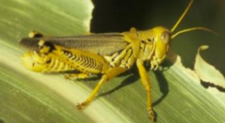
Raise your hand if you’re feeding grasshoppers in your garden right now. You’re not alone. You are likely hosting several grasshopper varieties which increase in size as they molt and
mature. Full-sized adults are the most problematic as they have wings and can cover more ground. They also have a tougher skin making insecticides less effective.

As with many problems in the garden, early action is important. Nets/floating row covers
can be effective protection for small areas, though grasshoppers have been known to
chew through netting. Gardeners who want to avoid synthetic treatments have to decide
the amount of damage they can tolerate. In suburban areas, it is important for
gardeners to work together to control grasshoppers and limit the destruction.

Insecticides are usually effective when the spray comes in direct contact with the
grasshopper. Most have to be reapplied to eliminate new arrivals. Immature
grasshoppers are limited in their range since they travel by foot. They are easiest to
control at this stage.

Gardeners who choose to use insecticides will likely select one of the following options
labeled for the widest variety of crops:

• permethrin (Hi-Yield Garden & Farm Insect Control, Eight Vegetable, Bonide
Eight Vegetable, Fruit & Flower Concentrate, Bonide Eight Garden Dust),
• cyfluthrin (BioAdvanced Tomato & Vegetable Insect Killer),
• gamma-cyhalothrin (Spectracide Triazicide.