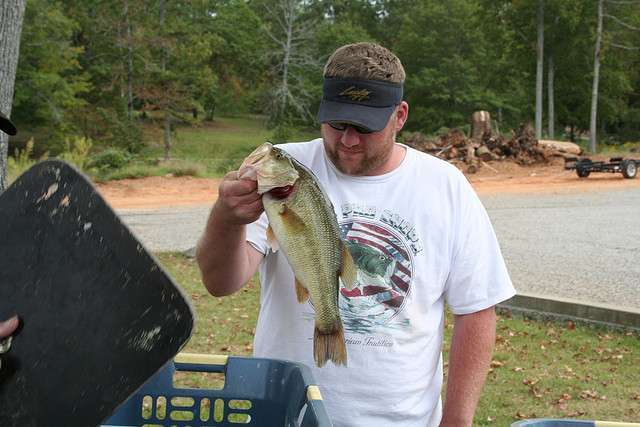
All KDWPT fisheries districts are offering a fishing newsletter that can be sent out to all that want it. The newsletters are aimed at keeping anglers informed about fishing opportunities and information in their areas of interest. The first few editions of the Cheney Fisheries District have been completed and are ready for distribution.
Zebra mussels can be found attached to rocks lakewide. Zebra mussel veligers are too small to be seen with the unaided eye and they can be found in boat livewells, minnow buckets, boat bilges, water toys, and anything else that is capable of holding even a small amount of water. Be sure to drain all equipment before leaving the lake to avoid moving veligers to other waters. THIS INCLUDES MINNOW BUCKETS, BOAT LIVEWELLS, AND BILGES!!! Zebra mussel numbers have decreased at Cheney; however, anglers and boaters should still use caution to avoid moving adults and veligers from the lake.
Click HERE to learn how to prevent the spread of zebra mussels.
Drifting cut shad has produced some good catches. More blue catfish are also showing up in angler catches in the last couple years. Be sure of your fish identification as the minimum length limit on blue catfish is 35″.
White Perch
Netting results this fall indicate that white perch numbers increased this year; however, there are many catchable-size white perch (10+”) in the lake.White perch cannot be used as live bait, but they do make good cut bait. For tips on identifying a white perch from a white bass, wiper or striped bass click HERE.
All white perch in your possession must be dead. It is illegal to posses live white perch.
The longer I live on this earth, the more I appreciate the freedoms we enjoyed in the days of attending the country school. Oh, I know, some of you younger ones may say “Oh no, that is ancient history!”
That was, however, the liberty of living that has made our country great, in spite of what some political parties may rant about.
It was refreshing to wake up to the sound of the crows cawing in the shelterbelt behind the house on a beautiful Autumn morning. To put your bare feet on the cold linoleum of the floor as you made your way to the succulent smell of breakfast in the big farm kitchen, was an eye opener, to say the least.
Later, breakfast eaten, books and dinner bucket in hand, I started out across the wheat field to take a short cut to the country school of Sunrise. The windmill was cranking its usual blustery wheels as I walked beside the barn, the chickens were pecking away at their morning repast. I could barely hear the pigs, off a little ways in their pen, grunting around their troughs in typical hog fashion.
Our two farm dogs, Shep and Spot, ran around excitedly as they followed me across the wheat field with just a bit of green wheat beginning to crop up through the little fall furrows of black loam soil.
I swung my dinner bucket back and forth as I took long strides across the field. The clouds across the sky skimmed across the horizon in a lazy fashion and I could imagine new horizons. I always looked forward to a day at the country school. Life was good!
After tramping across the field, I reached the country road and started up the hill where the school of Sunrise was located. The bright American flag was waving lustily in the Kansas breeze as I walked up the cement porch steps. I walked in through the outside hall, past the sink that even had a pump, and into the girl’s hall where I put up my dinner bucket.
As I walked back outside, I joined my friend Ruth at the swings and we sat on them and chatted about the happenings of our day. After awhile we made our way to the merry-go-round and one of the boys decided to give us a fast twirl. Two of the younger kids were on the teeter-totter, enjoying some bumps along the way.
The large bell on top of the school began to ring as we saw the teacher standing by the door and we hurriedly made our way to the front of the school to march in.
We stood by our desks, the little first grade ones on one side of the room and the larger ones on the other. We stood straight and tall and proud as we did our flag salute. After that we sang “God bless America” with all the gusto we possessed. It was then, we closed our eyes and listened to the teacher make the opening prayer.
All through the opening of school two famous patriots scrutinized our faces from the wall…George Washington and Abraham Lincoln, Americans we were proud to know.
“You may be seated!” the teacher announced, and we each sat down at our desk. Then started the schedule of the period. “First Grade Reading!” she announced and two little children went to the front and sat on their seats. After about ten minutes they went back to their places and she called the next class forward. This went on through the whole period until all eight classes had been up and their assignments given.
It was interesting to listen in on each class and I dare say, we learned a lot.
Finally it was time for recess. If you were one of the younger ones you probably played on the swings, teeter-totters and merry-go-round. If you were a little older and could bounce the ball, you got to play basketball on our dirt-packed court. It was totally fun and even the teacher got into the thick of it. Sometimes we even went a little longer, consequently, we came back in very sweaty. But oh, what fun we had!
For our lunch break at noon, we all went to get our dinner buckets from the boys or girls hall. Then we found a place to sit and enjoyed our banter back and forth. Sometimes we would trade part of our lunch with someone else. It was a real treat when we had a sandwich with “store” bread, even though it was white and gummy. Usually we had home-made bread cut in thick slices with ham.
On cold days the teacher also had to keep the coal stove burning to heat up the school. If it was really cold, we all sat by the big pot-bellied stove to keep warm. Sometimes in winter, it got dark and we could barely see. The teacher couldn’t light the lamps from the ceiling since that was quite a job.
The teacher must have breathed a sigh of relief when school was over at four p.m. Some of the kids’ fathers would be waiting for them in their cars outside. Mine never did because he was still at his job in Hutch. Several of us kids would walk down the hill of the country road on our way home. Sometimes we would stop at a little creek at the bottom of the hill. We would sit around a few minutes and play “make believe” about what life would be like someday. No matter the weather the school day would have been a “good day!” There was a certain peace about the simple life and it did feel that “God was in his heaven and all was right with the world!”
Doris welcomes your comments and can be reached at [email protected].
The National 4-H Hall of Fame celebration involved many people from Kansas, including Marilyn Pence Galle, inductee, and Daryl Buchholz, who attended as the associate director for K-State Research and Extension.
Marilyn Pence Galle was one of 14 inductees from across the country recognized by the National 4-H Hall of Fame this year.
WASHINGTON, D.C. – A point where five trails converge at Rock Springs 4-H Center near Junction City, Kansas, was once an area where many young people could get lost, turned around and need direction. A Kansas couple devoted to the 4-H program decided to make a change to help these young people find their way, which led to the creation of the Galle-Pence Trail Plaza.
“It’s an area in the middle of Rock Springs with directional signs for the boys, girls and others who use the facility to know which direction to go,” said Marilyn Pence Galle, who with her husband, Nelson, made the trail plaza possible.
Providing direction and maps to show the way at Rock Springs isn’t the only way Marilyn Pence Galle has assisted 4-H youth. She’s a lifelong supporter of 4-H who has witnessed the program as a member, club and project leader, county extension council member and trustee of the Kansas 4-H Foundation. Perhaps most importantly, she’s served as a volunteer in every aspect of her involvement and is Kansas’ first volunteer to be inducted into the National 4-H Hall of Fame.
Galle, who currently resides in Manhattan, was one of 14 people inducted during the ceremony at the National 4-H Youth Conference Center in Chevy Chase, Maryland, on Oct. 10. The National 4-H Hall of Fame honorees are nominated by their home states, National 4-H Council, the National Association of Extension 4-H Agents or 4-H National Headquarters based upon their exceptional leadership at the local, state, national and international levels.
“The class this year only had 14 delegates, which is probably one of the smallest classes we’ve had,” said Pam Van Horn, Kansas 4-H youth development specialist. “The National 4-H Hall of Fame started in 2002 to honor the national centennial of 4-H. Kansas has done quite well. We have a tremendous depth in our program, and we are so proud Marilyn is being honored as a volunteer this year.”
Marilyn Pence Galle delivers her award acceptance speech as one of 14 inductees to the 2014 National 4-H Hall of Fame. She is the first volunteer from Kansas to be awarded this honor.
A lifelong 4-H advocate
Galle was a Kansas 4-H member for 11 years in the Bethel 4-H Club in Shawnee County. The club no longer exists, but it was a club that meant a lot to Galle, as her father helped start it many years before she joined.
She continued her love for 4-H in college, where she was active in Collegiate 4-H at Kansas State University. While at K-State, she met Nelson, a fellow 4-H member, at Kansas 4-H Roundup. The couple married and had three boys—Russell, Randy and Ron—who were all 11-year 4-H members also.
Galle, a 19-year 4-H community club leader and project leader, said her favorite aspect of 4-H was volunteering with her boys and others in the local club.
“One of the most fun things was way down at the local level and in my kitchen, having a boys’ food class,” she said. “We had sixth grade boys come and learn mainly how to read directions and do simple cooking. They were a lot of fun and knew they had to clean up before they could go outside and play football.”
The simple life skills 4-H provides to young people are invaluable, Galle said. The organization helps them become better leaders, public speakers and more organized individuals.
Galle herself was active on the poultry judging team as a 4-H member. She was on the K-State Poultry Judging Team in the 1950s and the only young lady at the time to participate in the national poultry judging contests. It made sense for her to encourage 4-H members to take advantage of the judging programs that encompass many different areas, such as dairy, horse, livestock, meat and poultry.
“Judging participation is wonderful, too,” she said. “Judging helps them make decisions all through life.”
In addition to volunteering as a club and project leader, Galle served 11 years on the McPherson County Extension Council with two years as chair, 11 years as a 4-H Program Committee Leader and was chair of the McPherson County 4-H Advisory Committee.
In 1984, she joined the Kansas 4-H Foundation Board of Trustees and served as chair from 2000 to 2004. She continues to provide counsel to the Rock Springs 4-H Center Advisory Committee—a role she’s taken on for the past three decades.
Galle is among the top lifetime donors to the Kansas 4-H Foundation that currently has nearly $20 million in assets. She served as the special gifts co-chair to the Growing Kansas Leaders campaign that ended in 2013 with $12.8 million in funds for Kansas 4-H.
As if being involved in 4-H on the local, county and state levels weren’t enough, Galle has also supported 4-H on the national and international levels. Exchange programs have benefited from the Galle family hosting 4-H visitors from various areas of the United States, Japan and Germany.
The Galles were named the Kansas 4-H Family of the Year in 1980, and in 2008, Marilyn received the 4-H Distinguished Service Award. The Galles are members of the Heritage Council, which means they’ve publically declared that Kansas 4-H is in their estate plans in hopes of encouraging others to do the same.
Rolling with the changes
Galle said when she first got involved in 4-H, it was more of a rural organization, but she’s glad to see it become an organization that includes youth from rural and urban areas. The 4-H program has gone through changes and added projects geared to help all young people become better adults.
“It’s sometimes hard to make changes, but a lot have been made,” Galle said. “The main thing is (4-H) has to be for the youth and give them what they need to develop.”
She added that despite changes necessary to keep up with the times and get more young people involved, the core values of 4-H have remained the same. Head, hands, heart and health continue to remind members how to think, care, give and live for themselves and others.
Galle is an example of someone who has benefited personally from 4-H and knows the importance of giving back on many different levels so others can experience the same benefit. She said it’s great that the National 4-H Hall of Fame recognizes volunteers, and she’s proud to be among the many people with Kansas ties to earn the honor.
“I’m proud of Kansas having recognition, because we have an excellent program in the state,” she said.
In addition to serving as a 4-H volunteer, Galle has been a lifelong educator who worked in the public school system 30 years. Galle is serving or has served on boards and committees for many other organizations, including Alpha Chi Omega Sorority, Christian Education Committee, Moundridge Pride Program, Moundridge Tree Board, P.E.O. and trustee of the Dyck Arboretum of the Plains in Hesston.
At Kansas State, she is a member of the Presidents Club at the KSU Foundation, and she currently serves or has served on boards for the KSU Gardens and Marianna Kistler Beach Museum of Art.
Upson Lecture Series for Fall 2014
MANHATTAN, Kan.– Bruce Vincent will speak at K-State’s Forum Hall Monday Nov. 10 at 7 p.m. for Food for Thought’s Upson Lecture Series. Vincent’s presentation is titled “With Vision There Is Hope – How NOT to be the career of last choice.”
Vincent will discuss the importance of careers that involve “getting your hands dirty,” and the thought process and attitude behind producing goods that stimulate the economy and create a healthy environment.
A third-generation logger from Montana, Vincent will bring his thoughts on how an intelligent work force is needed to raise and produce the products that feed, clothe and shelter humanity.
Through his many endeavors, which include testifying on natural resource issues before Congress, appearing on news programs such as “60 Minutes” and giving motivational speeches across the country, Vincent brings a perspective on how to lead, not fight, the discussion over our nation’s environmental health.
The event is open to the K-State and local community. Admission is free.
Food For Thought, a group of current and former Kansas State University students, is a grassroots organization with the mission of bridging the information gap between the two percent of the American population who produce food and the everyday consumer.
For more information about Food for Thought, visit:
MCPHERSON, OCTOBER 29 – Dr. Brian Faris will lead the “Hands on Herd Health for Small Ruminants” workshop at the new state-of-the-art K-State Sheep and Meat Goat Center, 2117 Denison Avenue, Manhattan, from 9:00 AM – 3:00 PM, Saturday, November 22.
The new facility, designed with animal care and handler safety in mind, contains design features and handling procedures that can be adapted to a producer’s current facilities. Workshop participants will experience the luxury of the new facility, and be allowed hands on experience like trimming hooves, FAMACHA evaluations, and perform sonograms on pregnant ewes.
Classroom time will cover herd health, vaccinations, body condition scoring, fecal egg counts, and how to create safe working facilities with what producers currently have on their operation. The workshop will also cover the FAMACHA practice, which helps producers evaluate the lower eyelid to check for anemia determining individual animals in need of parasite treatment to help reduce animal resistance to dewormer products.
Dr. Faris, who grew up in Texas, has spent his entire life in the sheep and goat industry, and has extremely valuable information to share with producers. Faris received his undergraduate degree from Texas A&M and received his doctorate in Animal Science at New Mexico State. Prior to moving to Kansas, he served as a 4-H Youth Livestock Specialist in North Carolina.
There is no charge for the workshop. FAMACHA evaluation cards will be available for purchase at the workshop for $15.00. Please indicate on the registration form whether you would like to purchase a set of cards at the workshop. Attendees are asked to RSVP by November 15 to help in planning for handouts, cinnamon rolls, and other refreshments. Lunch will not be provided. Online registration can be found at www.AmazingGrazingKansas.com, or you may contact Mary at 785-562-8726 or [email protected].