Tuesday, January 27, 2026
Home Blog Page 219

Just a Little Light: Moments and Murmurations

0

Dawn Phelps
Columnist

The Rural Messenger is happy to introduce a new columnist from Kansas. Dawn Phelps is a wife, mother, and grandmother from Miltonvale, Kansas. She grew up on a farm in Tennessee but has lived in Kansas for many years.
In 2007 she began writing for hospice after her husband Ralph Thorn died of kidney cancer. In 2008 she added a weekly newspaper column “Just a Little Light” to her writing schedule. Each story includes a tidbit of light or a nugget of truth on a variety of topics.
Dawn has worked for many years as a registered nurse and social worker and continues to write for Meadowlark Hospice.
She has published two books—Tales from Tootleville and (Continued on page 12)
(PHELPS Continued from page 1) Finding Your Clover after a Loss as well as three booklets, and a series of mailers. She is currently writing a book about her life with her first husband entitled Country Girl, City Boy—Our Story Our Song.

It was a February morning, 2021, and I was driving to work. The pastures were dry and brown. Few cars were on the road. The sky was blue, and the sun was shining. Some high whimsical, white “horsetail” clouds made a beautiful contrast with the blue sky.
On such a sunny day it was hard to believe that our area of Kansas was under a winter storm watch that would begin that night and potentially leave behind a few inches of snow. But I put that thought aside and decided to enjoy the moment as I drove to work.
I thought how blessed I was to still have a job. I also thought about a lady on the Topeka news the previous evening and how the announcer told about a food giveaway at a parking lot . The announcer said they had given away bacon for the first time ever that day.
And the lady being interviewed had been very happy to get the bacon and stated, “It’s the first meat I’ve had in months.” The lady’s remarks on the news brought tears to my eyes, and my husband Tom and I talked about how blessed we were to have more than enough food.
Then Tom and I reminisced about our childhood years. I told Tom that our gardens were crucial for our family’s survival with our large family of seven kids. Like the lady on the Topeka news, as children, we had little meat, but we were never hungry, and we were blessed and healthy.
As I drove, I listened to music of “the Masters” on the radio—Beethoven, Liszt, and Vivaldi—a mandolin concerto in C and beautiful violin music. Then something moving high in the sky on the south side of the highway caught my eye.
What a sight to see thousands of black birds flying in mass, majestically twisting, turning, swirling, and swooping in synchrony! Their aerial show was a bonus that morning as I drove to work. As a child I remember seeing such flocks, and I was fascinated with how they seemed to know what they were supposed to do, thousands of birds flying inches apart, twisting and turning in synch.
I had recently heard the word murmuration that described what I was watching. The word refers to an enormous flock of birds, either on the ground or in the air. While on the ground the birds seem to be murmuring in low, continuous utterances—probably where the word murmuration came from. But grumbling sounds on the ground were a stark contrast to the joyous air performances I watched that day—they seemed to be celebrating!
Scientists have studied the flocks as they perform in the air. They have observed them, photographed, videotaped them, and are now using computers to try to figure out how the thousands of birds gracefully fly only inches apart without bumping into one another.
How do they know when to turn, how to reverse their course, or fly up or down? Have they mastered the art of choreography or are they just flying for the fun of it?
I slowed my car as I watched the flock of birds disappear from my sight. Even after I could no longer see them, the memory of their dance remained. As I drove the last few miles to work, I thought about how I used to drive to visit clients as a part of my previous jobs.
And I still recalled the sense of awe that I felt on some of those days—when springtime was bursting out all over, when the sun was shining and the sky was blue, when there were hints of color in the trees in the fall, when flocks of geese honked their way south, or when there was a glorious sunset!
But I rarely saw black birds putting on a show like that February morning—a morning that reminded me I was so blessed. I had nothing to murmur about! I was not hungry like many. I could hear the music of the masters. I had eyesight to see the beautiful blue sky and the birds’ aerial performance, and I had witnessed a murmuration which seemed more like a celebration!
Even if a winter storm should come that night, I knew life would go on. After all, storms and sunny days are both a part of life. Maybe my lesson was to look, listen, and enjoy every beautiful moment that presents itself.
Recently, about a week ago, I was again blessed to witness a massive flock of black birds majestically flying in synch! It was the longest, widest murmuration I had ever seen!
Then I remembered that special morning in 2021. This time the flock seemed to be headed on a southwesterly route. Since it was so early in the month, I wondered if we might be witnessing a migratory flight, but I will never know for sure. Anyway, it was a captivating moment!
So, keep your eyes open for those special “murmuration moments,” Pause and soak them in. Someday those moments may become your special memories!


11 Highly Valuable Treasures Hidden In Kansas You Can Find

0

Have you ever wondered what treasures might be hiding in Kansas? From tales of outlaw loot to buried caches of gold, the state has its fair share of legendary lost fortunes.

The idea that millions of dollars could be hidden beneath the prairie is enough to spark anyone’s imagination. Every story comes with mystery, adventure, and a little bit of hope. And if you’re feeling bold, the thought of hunting for these riches is a thrill like no other.

Kansas may not be the first place you think of when it comes to treasure, but it’s home to some incredible stories. Who knows what secrets might be buried near an old homestead or lost along a dusty trail? It’s time to dig into the past and see what you might uncover.

The Incredible Treasures Of Kansas That Are Waiting To Be Discovered

These valuable and mysterious treasures remain out of reach, yet fascinating:

The Deadly Legacy of the Fleagle Brothers – $3,870,000+

The Fleagle brothers, Ralph and Jake, led a gang that terrorized Kansas, California, and nearby states in the 1920s. Their biggest heist was the 1928 robbery of the First National Bank in Lamar, Colorado, where they took $220,000.

The gang fled back to their ranch in western Kansas, where they buried a portion of the stolen money. After capturing a doctor to treat a wounded gang member, they murdered him, leading to an intense manhunt.

Jake was eventually tracked down and killed, while Ralph and the others were arrested and hanged. Over the years, some of their buried loot has been recovered in Nebraska, Kansas, and California.

How much the treasure would be worth today

If the Fleagle brothers’ hidden money were found, it would now be worth around $3.87 million.

Lost Silver of the Santa Fe Trail – $3,390,000+

In 1853, a trader named Jesus Martinez led a wagon train from Santa Fe to Independence, Missouri. Just four miles west of present-day Dodge City, the group was attacked by a large band of warriors.

After five days of fighting, the camp was overrun, and all the drivers except Martinez were killed. The attackers looted the wagons, set them on fire, and took the remaining stock.

Once the area was clear, Martinez uncovered 21 bags of silver coins, each worth $1,000, and buried them before escaping.

Years later, before his death, he told his son about the hidden silver, leading to a search in 1876. If the treasure were valued now, it would be worth over $3.39 million.

How much the treasure would be worth today

The 21 bags of silver coins buried by Jesus Martinez would be worth an estimated $3.39 million.

The Buried Fortune of Felix Goldman – $13,000,000+

Felix Goldman ran a stage station between Medway and Syracuse, Kansas, along the Arkansas River. When a suspicious stranger visited for three days straight, Goldman feared a robbery was coming.

He took no chances, burying his savings along with $17,000 in gold and silver coins from the station’s funds. Not long after, he was found dead, and authorities arrested a man named Tolliver.

The suspect swore he had not taken any money, leaving many to wonder what had happened to the hidden stash. Hamilton County, near the Colorado border, holds the history of this old stage station.

How much the treasure would be worth today

Over time, the value of Goldman’s buried fortune has grown to over $13 million.

The Untold Riches of Pawnee Rock – $773,000,000

For centuries, Pawnee Rock was an important gathering place for Native American tribes and a key landmark on the Santa Fe Trail. Travelers often stopped here to rest, resupply, and take advantage of the nearby Arkansas River.

As ambushes and robberies became common, many wagon train members buried their gold and silver before settling in for the night.

Some were killed in an ambush before they could retrieve their valuables, leaving countless hidden caches in the surrounding area.

Spanish expeditions, pioneers, and merchants traveling between Missouri and New Mexico are all believed to have left treasure behind.

Over time, the site was quarried for building materials, and its height was greatly reduced.

How much the treasure would be worth today

If recovered, this lost fortune could be worth about $773 million.

The Cherokee Badman’s Secret Stash – $3,000,000+

Henry Starr, known as the “Cherokee Bad Boy,” was a notorious outlaw who led a gang of bank robbers across Arkansas, Oklahoma, and Kansas. His crime spree began in 1892, and within a year, most of his gang had been killed or captured.

Starr himself was caught in Colorado while on vacation, but after multiple prison sentences, he continued robbing banks. Over his 32-year career, he claimed to have robbed 21 banks, stealing nearly $60,000.

He once said that the money from his early robberies was hidden “near the border in a place nobody could find it in a million years.” Many believe this stash is buried somewhere along the Cimarron River in Stevens County.

How much the treasure would be worth today

Henry Starr’s hidden loot would be worth over $3 million.

The Hidden Gold of Offerle – $15,000,000+

In 1851, a group of gold miners and their families were traveling back from California when they were attacked near present-day Offerle. As the ambush unfolded, they buried $90,000 worth of gold dust in a Dutch oven at the site.

The only survivor was an eight-year-old girl who was taken captive but later lived to tell the story. Years passed, and the tale of the hidden gold was passed down through generations.

In 1918, a woman claiming to be related to a survivor arrived in Kinsley with a map, hoping to recover the buried fortune. Despite her efforts, the exact location remained a mystery.

How much the treasure would be worth today

The fortune left behind by the ill-fated group of miners is estimated to be worth over $15 million.

Forgotten Riches of the Nemaha River – $3,000,000+

Two miners returning from the California gold fields in 1854 made camp near a ford in the Nemaha River. Before heading into Richmond for supplies, they buried two buckskin bags full of gold nuggets inside an empty powder can.

While in town, one of the miners was shot and killed, and the other barely escaped with his life. Fleeing toward St. Joseph, Missouri, he left the gold behind in his rush to get away.

Before joining the Union Army years later, he gave his wife a rough map of the hiding place, promising to retrieve the treasure after the war.

He never returned, dying early in the conflict, but his sons traveled to Seneca in 1889 to find the gold. However, they failed to locate the buried cache.

How much the treasure would be worth today

The estimated value of the two buckskin bags full of gold nuggets is over $3 million.

Chouteau’s Island’s Lost Silver – $8,000,000+

Chouteau’s Island, once a landmark along the Santa Fe Trail, was the site where $24,000 in silver coins was buried in 1828. The island sat in the Arkansas River, providing a stopping point for traders and travelers heading west.

Over time, however, the river’s shifting course caused the island to erode and eventually disappear.

Despite the changes, the hidden silver remained buried beneath what was once an important trading site. Lakin, Kansas, now lies just five miles northeast of where Chouteau’s Island once stood.

How much the treasure would be worth today

The lost Chouteau’s Island treasure would hold an estimated value of over $8 million.

The Stolen Army Paymaster’s Treasure – $24,000,000+

An army paymaster traveling from Lawrence to Denver was robbed of $195,000 in gold and silver coins around 1862. The stolen fortune was hidden between two sycamore trees near the Wakarusa River, just south of Lawrence.

This area in Douglas County was a well-known travel route during the Civil War era. Soldiers, settlers, and traders frequently passed through, making it a prime location for bandits looking for easy targets.

The paymaster’s stolen coins remained where they were buried, tucked away in a quiet stretch of land.

How much the treasure would be worth today

The lost treasure buried south of Lawrence would likely be valued at over $24 million.

The Lost Gold of the Solomon River – $309,000,000+

A group of Spaniards or California gold miners was traveling near Morland when they were attacked.

To keep their fortune safe, they threw a treasure chest into the Solomon River before fleeing. Over time, the river changed course, leaving the chest buried beneath dry ground.

Some believe the hidden fortune contained gold bars worth $400,000 at the time.

How much the treasure would be worth today

The gold bars thrown into the Solomon River could be valued at over $309 million.

The Stolen Wells Fargo Payroll – $4,000,000

A Wells Fargo office in Ellis was robbed of a $22,000 railroad payroll in 1870. The thieves made their getaway and stashed the stolen money near the limestone banks of Big Creek just outside of town.

This location provided plenty of cover, making it an ideal hiding spot for the stolen loot. Wells Fargo agents and local lawmen searched for the missing payroll, but the thieves had hidden it a little too well.

How much the treasure would be worth today

If recovered, the missing money from the Ellis robbery would be worth around $4 million.


How did the Kansas City Chiefs get their name? A fake tribe, a fan contest and Lamar Hunt.

0
Kansas City Chiefs’ third consecutive Super Bowl appearance, the team name, logo, and some problematic fan customs like the “tomahawk chop” are once again being broadcast worldwide. But where did it all start, and how did the team avoid becoming the Kansas City Texans?

If things had gone differently, Kansas City football fans could have been rooting for the Kansas City Texans.

Other ideas on the table? The Kansas City Mules, the Kansas City Stars or — how about the Kansas City Royals, only as a football team?

As the Chiefs have entered dynasty status with more presence on the international stage, local apparel companies have made products featuring made-up mascot names like the Villains or the Chefs.

The origin of the Kansas City Chiefs moniker goes back to 1963, a decision connected to the region’s Native American heritage, a boisterous mayor, a fan-driven newspaper contest, and Lamar Hunt — the man also credited with naming the Super Bowl.

“He loved everything about sports: the competition, the pageantry,” says writer Michael MacCambridge, author of “America’s Game: The Epic Story of How Pro Football Captured a Nation” and “’69 Chiefs: A Team, a Season and the Birth of Modern Kansas City.”

Hunt was the son of a very rich oil man and played football himself.

“He was shy by nature. The place where he found refuge was sport,” says MacCambridge.

In 1960, Hunt started the American Football League and ran the Dallas Texans, one of three pro football teams in the state at the time. Within two years, he realized this was too much competition, and he began casting a net for places to relocate.

Many city leaders saw this as a huge opportunity, and heard Hunt was scouting in places like New Orleans.

“At one point the mayor of Kansas City, H. Roe Bartle, learned that Lamar had been in Atlanta, scouting that out,” says MacCambridge. “He flew directly to Dallas and sat down with Lamar in his office and said, ‘Please consider Kansas City.’”

Mayor Bartle made a compelling case to Hunt: There were no other pro football teams in the area, and the business community would support the team by promising to sell a certain number of tickets.

So Hunt announced he’d move the team to Kansas City.

What’s in a nickname?

Bartle was as big as a linebacker and loved cigars. He was also a lawyer, philanthropist, and had been a leader for the Boy Scouts, where he landed his nickname “the Chief.” Bartle was not Native, but claimed to be inducted into an Arapaho tribe and said he was given the name “Chief Lone Bear.”

It’s just one of the many things Gaylene Crouser takes issue with about him.

“He was the founder of the Tribe of Mic-O-Say, which is not an actual federally-recognized tribe of American Indians,” says Crouser, executive director of the Kansas City Indian Center. “It’s a made up tribe.”

Crouser is a citizen of the Standing Rock Sioux Tribe, Hunkpapa and Oglala, and also a member of the group Not In Our Honor, which has called for decades for the Chiefs to change their name.

The Mic-O-Say group, which still exists in Missouri today, claims on their website they blend aspects of American Indian heritage with the ideals of scouting.

The state of Missouri’s history with Native American tribes is another point of pain for Crouser. The state violently discriminated against tribal people, forced them to relocate, and did not allow them to speak their languages or practice their customs.

“It adds insult,” says Crouser. “The whole fact that not only are you bastardizing our culture, you are doing it in a state that didn’t want us to be here.”

It’s not clear if, at the time, concerns like Crouser’s ever made it to owner Lamar Hunt, the ultimate decision maker. At first, Hunt was set on keeping the name the Texans.

“He felt it was intrinsic to the team’s identity,” says MacCambridge.

Hunt was eventually swayed, and announced a “Rename the Dallas Texans contest” in the Kansas City Star, which received more than 4,000 submissions and more than 1,000 ideas.

If Hunt had gone with the most popular entry, Kansas City fans would be cheering for the Mules.

Instead, he landed on the Chiefs for a few reasons, according to the Kansas City Call: to honor the region’s Native American heritage, because of Bartle’s nickname, and because it was classy, short and would look good in a headline.

Hunt was also the idea-man behind the Chiefs’ red and gold team colors, which were his second choice. (His first choice was Columbia blue and white.) Inspired by the look of the San Francisco 49ers helmets, Hunt created the arrowhead logo with the intertwined letters K and C.

Moving forward and scaling back

Another, more problematic, early Chiefs logo showed a cartoon Native American character in full headdress running across a map of the Kansas City region. The team eventually got rid of that one and, over the decades, have scaled back on other offensive logos and imagery.

But fan practices like the “tomahawk chop,” which started in the 1990s, continue to be a point of frustration for activists calling for change.

The chop and chant got started at Florida State University football games, then the Atlanta Braves baseball team adopted it. Eventually, it was performed at a Chiefs game by a Northwest Missouri State University marching band, and it caught on with fans.

“It’s just unacceptable in this day and age,” says Crouser. “And frankly, Kansas City deserves better than that.”

Twenty years ago, the American Psychological Association released a recommendation that all Native American imagery and mascots in sports should be changed. As a response, sports organizations and teams at all levels have scaled back or completely changed their mascots and logos.

In 2020, the Chiefs organization announced they would ban headdresses and face paint inside Arrowhead Stadium. In 2021, they retired Warpaint, a horse mascot that would run around the field after touchdowns.

Team leaders have said they want to honor Native American heritage of the region, and they formed an American Indian Community Working Group to “promote an awareness and understanding of Native cultures and tribes,” according to their website.

While no real plans for a name change are on the docket, MacCambridge, a lifelong fan, has an idea to throw in the hat.

“I would have no problem being the Kansas City Wolves,” he says.

Crouser offers a different thought, which plays into the original history of the naming of the team.

“Maybe they should, again, do a contest and see where people are with it,” she suggests.

A few years back, the alt-weekly magazine The Pitch asked Kansas Citians for their ideas — from Kansas City Crowns to the Reds.

And who doesn’t get inspired by some of the spin-off schwag fans have taken upon themselves to create — especially those “Chefs” shirts, which are an homage to that original Snickers commercial of the ‘90s.

If there’s one thing to learn from the past, it’s that things like names and trends aren’t set in stone. They can evolve and change.

This episode of A People’s History of Kansas City was reported by Suzanne Hogan, and produced by Suzanne Hogan and Olivia Hewitt, with editing by Luke X. Martin and Mackenzie Martin. 


Can Pine Needles Cause Abortions in Cows?

0

Can pine needles cause abortions in cows?  The short answer is “yes.”

Pine needle abortion can cause significant losses for producers, but simple strategies can reduce the risk. Check and repair fences around ponderosa pine trees to prevent losses in your herd, especially during the second and third trimesters.  By excluding pregnant cows, you can avoid devastating losses.

Here are two real-life examples of producers who experienced premature calf losses.

Example 1: The Prairie Blizzard. The four lone pine trees were all that remained from the pioneers who tried to settle on the prairie.  During a recent blizzard that dropped over a foot of snow, it took several days for ranchers to reach their pregnant cows with hay.  With drifts underfoot, the cows were tall enough to reach up and eat the pine needles out of the trees during the blizzard.  A week later, half the cows prematurely lost their calves.

Example 2: The Old Farmstead. A neighbor purchased an old farmstead, which included a pasture where a shelterbelt of trees surrounded the buildings- pine and cottonwood trees.  The buildings and wire fence that kept the cows out of the old shelterbelt had fallen down in disrepair, so the neighbor pulled the fence.  His bred heifers ran there that winter, and more out of curiosity, nibbled on the pine needles.  Several heifers aborted that winter.

Both producers lost calves to pine needle abortions, as the cows and heifers “slinked” or calved too early, and the fetuses died.

Why do pine needles cause abortions in cows?

Since the 1920’s, cattlemen wondered if ponderosa pine needles were causing abortions in their herds. In the 1980’s to 1990’s, researchers were able to determine that ponderosa pine needles did indeed cause abortions in pregnant beef cows.

Compounds in the Pinus ponderosa (or ponderosa pine tree) needles interferes with blood flow to the uterus and fetus, leading to premature births or fetal death.

Both green or dried needles from ponderosa pine trees, if ingested by pregnant cows, can be harmful. Cows would need to eat 3-5 pounds of needles for several days to trigger an abortion.  The later the trimester, the more susceptible cows are to “pine needle abortions.”  The third trimester, especially the last 30-60 days, can cause more abortions than early in the pregnancy.  Low temperatures also seemed to increase pine needle consumption.

What animals are not affected by eating pine needles?

Cows that are not pregnant, steers, and bulls are not affected if needles are ingested, as well as pregnant elk, sheep, or goats.

How to prevent pine needle abortions

What are solutions to avoid pine needle abortion?  The simplest solution is to fence out ponderosa pine trees so that cattle cannot reach the needles to ingest them.

Another strategy is to adjust the calving season, so cows are calving in the summer or late fall, when they are less likely to eat pine needles in their second or third trimester.

Kansas’ Water Problem: Changing minds, changing practices

0

All the snow this winter has helped improve the drought conditions across Kansas. But it’s just the proverbial drop in the bucket of what we need to make sure we’ll still have drinking water for our kids and grandkids, especially in parts of Western Kansas.

The governor and leading Republicans have said securing the state’s water future is a top priority this year. But some say there’s one practice holding up the process.

Drought Conditions

Miller Drilling has stayed busy this last year. One could almost say, too busy. KAKE News caught up with them one day as they were drilling a new well in Hutchinson.

“Basically, they don’t have any water,” said Adam Miller.

It’s a refrain this Central Kansas company has been hearing for years.

“We had a major drought back in 2011 and ’12, and the groundwater never really recovered from that,” he said.

It’s only gotten louder and more persistent recently.

“I think probably since about August, probably a third of our wells have been emergency jobs here. People are flat running out of water,” said Ez Miller. “Forty-nine years since I started drilling, it’s probably about as bad as I’ve ever seen it.”

Retired farmer and current state lawmaker, Joe Seiwert of Pretty Prairie knows exactly what the Millers are talking about. He’s had to re-drill the well for his home multiple times, deeper every time.

“If you can’t get water, what’s your house going to be worth? Who’s going to buy it?” Seiwert asked.

It’s just one of many concerns he has about the falling water levels in Reno County, where his home is.

“Some places, we might have been able to get by with a 30 or 40-foot well, and some of those now we’re going down close to 200 feet,” Adam Miller said.

A recent survey in Wichita showed the top priority Wichitans want the City Council to work on this next year is drinking water.

“We’re still in drought, and obviously worried about going into Phase 3 of drought which could have a huge impact on our economy and our community,” Councilwoman Becky Tuttle said during a recent council workshop.

So it might surprise you to learn, that drinking water isn’t the biggest use of water in Kansas, a state where agriculture runs so much.

Agriculture and Irrigation

“About 83-84% of the water use in the state of Kansas is for irrigation,” said Earl Lewis, director of the Department of Agriculture’s Division of Water Resources. “It is by far our biggest user, and it is primarily the reason that we’re seeing water levels decline in some of those areas.”

It’s an effect Seiwert says he’s seen on his land.

“That river was a huge river,” he said, pointing to what’s now a nearly dry river bed that leads through his land to Cheney Reservoir. “When I was a kid. Grew up in our backyard. You could hardly walk across it, because it was 16-18 inches deep. Now it’s three or four inches deep.”

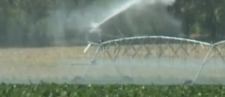
When asked what he thinks has changed, he said, “The 1200 and some irrigation circles in Reno County along the rivers, you know, pulling out a million gallons a day.”

The State’s Fault

He says it’s not the irrigators who are at fault, though, but the State of Kansas.

“It’s not the farmer’s fault. He cannot pump that water without that permit. I can’t put in a well without a permit,” Seiwert said.

Then he repeated himself, “It’s not the farmer’s fault. He is doing what he has to do to keep his water permit. You know? He’s kind of between a rock and a hard spot, too.”

Use it or Lose it

It’s a policy Seiwert refers to as “Use it or Lose it.” If an irrigator doesn’t use all the water their permit allows in a given year, they lose their permit.

It’s a policy Lewis says doesn’t really exist anymore.

“That’s always out there, but it’s really more most, for the most part, myth, in fact,” Lewis said.

That’s because of a 2012 change in the law that allows irrigators to get what’s called a Multi-Year Flex Account, where they get a five-year allocation of water with no limits on what they can use in any one particular year, as long as they don’t exceed the five year total.

“People tend to save about 15% just by having that flexibility,” said Rep. Jim Minnix, R Scott City.

Minnix is the Chair of the Kansas House Committee on Water and a farmer who uses irrigation wells.

“From an economic standpoint, it makes all kinds of sense. If we’re in an extreme drought and someone has already planted corn and invested thousands of dollars an acre in their crop out there…and you want to save your crop, it’d be nice to be able to water it. And then given the next year, if you have more rainfall, higher than average, be able to save some.”

Minnix says his committee is working on adding more flexibility to those accounts. He adds there are also fines in place for people who over-irrigate or wastewater.

“Those have been on the books for many, many years. There’s a mentality of irrigators out there, a small percentage of them, want to pump as much as possible in a given year, whether they need to or not, just to have a high historical pumping usage rate in case they get a 25% cut…from the State of Kansas. That mentality is antiquated,” he said.

Seiwert, who also serves on the Water Committee, says the accounts are a step in the right direction, but not enough. Not yet.

“(When irrigators turn the water on,) we’re pumping a third of the Mississippi every day,” he said. “When they’re using it.”

The Governor’s Take

So while KAKE News was at the Statehouse in January, Senior Political Reporter Pilar Pedraza asked the governor if there was any talk of dropping the water allocations entirely from the permitting process.

“There is talk particularly, use it and lose it. That’s such a dumb thing, so dumb, wherever it is,” Gov. Laura Kelly, D Kansas, said. “That whole use it or lose it has always been bad policy, so we are having conversations with that.”

Lewis pointed out a lot of the issues surrounding water use today came from decisions made generations ago.

“These decisions that led us to this point where we have a declining water situation really were public policy decisions going clear back to the 1950s,” he said.

The question is, will a Republican supermajority get along well enough with a Democratic governor to make changes that could upset some Kansans?

“You have a lot of people who have a lot of skin in that game,” Kelly said. “So it’s sensitive.”

Politics at the Door

But it’s something lawmakers say they’re making progress on.

Minnix said the state has made great advances since 2021, adding that last year the Water Committee got lawmakers to increase funding to water programs in Kansas, programs like loans to small cities that need financial help to upgrade their water systems.

“You heard earlier, $350 million in requests for a… $19 million fund,” said Minnix. “There’s that much demand, even in our small municipals out there to upgrade their water systems, drinking water or wastewater.”

As he spoke to committee members during their first meeting of the 2025 Legislative Session, he asked them to leave their political differences at the committee room door.

“‘I’m asking you, as committee members, to come in this door, leave the Republican/Democrat stuff outside, leave the…rural and urban, everything,” Minnix said. “When we come in here, we’re…working on policy to improve the water situation here in the State of Kansas.”

After the meeting, Minnix said part of the challenge in the committee is educating people with antiquated ideas about water usage.

“The people that are still practicing (use it or lose it) don’t realize what has happened in the last 20 years,” he said. “It’s an antiquated thought pattern and we need to educate them that they’re not helping themselves as much as they think they are.”

“It’s a cultural shift as much as anything,” Lewis agreed, “Getting people to understand they can use less water and still be productive in their farm.”

As reported on KAKE News