Tuesday, January 27, 2026
Home Blog Page 224

Substitutes for recently banned cherry dye are limited, says food scientist

0

K-State’s Blakeslee says food bans are based on best available science

The U.S. Food and Drug Administration’s recent ban on the use of a popular food dye will create a new challenge for home bakers aiming for a signature cherry red color in candy, cakes, icings and other food products.

Kansas State University food scientist Karen Blakeslee said there are foods that can substitute for FD&C Red No. 3 – such as beets, cranberries, raspberries and more – “but these may also add flavors to food that may not be wanted.”

She added that food manufacturers and researchers will look at how these new colors react with other ingredients or temperature changes.

The FDA announced on Jan. 15 that it is banning the use of FD&C Red No. 3 in any food product or drugs that are ingested. The government agency cited two studies indicating cancer in laboratory male rats that were exposed to high levels of the dye, due to a rat-specific hormonal mechanism.

To date, there are no scientific studies that have shown a connection between consuming FD&C Red No. 3 and cancer in humans, but a provision within the U.S. Food, Drug and Cosmetic Act (called the Delaney Clause) prohibits the use of food or color additives if they are proven to cause cancer in humans or animals.

The FDA will require manufacturers using FD&C Red No. 3 to reformulate their products by Jan. 15, 2027 or Jan. 18, 2028, depending on the size of the business. Imported foods may not contain this ingredient.

If shopping for food colors, consumers can avoid products containing FD&C Red No. 3 by reading the ingredient statement on the packaging, according to Blakeslee.

“Look for FD&C Red No. 3, Red 3, or if the product is imported, it may be called erythrosine,” she said. “FD&C Red No. 3 is a certified color additive and it must be specified in the ingredient statement if it is included in the product.”

Other examples of color substitutes for FD&C Red No. 3 include red beet extract or paprika extract. Blakeslee said future decisions on food additives by the FDA will be based on the best science available. The agency shares information regarding recalls, outbreaks and more on its website.

More food safety tips are available online from K-State’s Rapid Response Center for Food Science. Blakeslee publishes a monthly newsletter, called You Asked It!, with timely tips for safe food in and out of the home.

More information is also available at local extension offices in Kansas.

Bird watchers are traveling to Kansas for a look at this ‘mega-rarity’

0

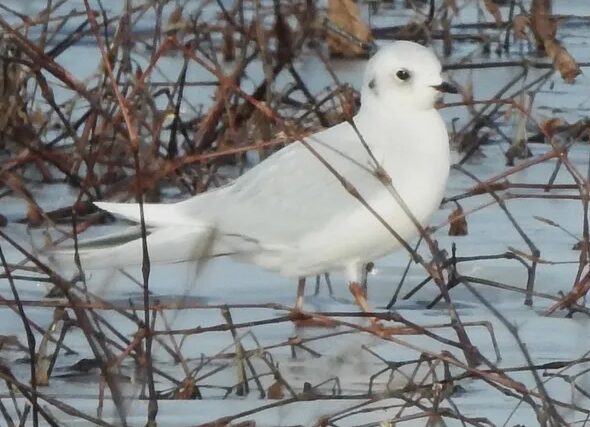
Bird watchers are flocking to southwest Kansas after the appearance there of a Ross’s gull, a rare species generally found only in Siberia, Greenland, Canada and northern Alaska.

“This is a really big deal to birders, not only to Kansans but to birders across the United States,” said Carol Morgan, president of the Topeka Audubon Society.

At least 100 people had journeyed to Ford County to enjoy a “once-in-a-lifetime opportunity” to see the lone Ross’s gull, which was first spotted Friday in a rural area about 20 miles south of Dodge City, Morgan said.

The bird remained in that area Tuesday morning, she said.

“Confirmed by experts, this small, pale gray gull has caused a stampede of birders to the location for the chance to see a mega-rarity,” Morgan said.

Bird expert says this is one of 11 reported sightings ever in lower 48 states

Morgan said she learned online Friday from fellow bird watchers that the Ross’s gull had been spotted in Ford County. The bird’s gender is unknown, she said.

“There have been only 10 other reported sightings of Ross’s gull on eBird in the lower 48 states ever,” Morgan said. “Most of those sightings were on the northern east or west coasts.”

Morgan said she and two friends drove nearly 300 miles Saturday to the area involved, where they spent about 30 minutes watching the Ross’s gull fly around and scavenge in the area of a playa, which is a “seasonal wet spot” that provides a good habitat for migrating birds.

Morgan said of the experience, “It was fantastic.”

Gull’s appearance in Kansas as rare as a ‘three-peat Super Bowl victory’

Chuck Otte, a past president of the Kansas Ornithological Society who lives near Milford in Geary County, said he drove out to see the Ross’s gull Sunday.

Otte has been watching birds since he was 4 and is about to turn 69, he said.

A Kansas City Chiefs fan, he said he found it difficult to explain to people “what a rarity” the bird’s appearance here is.

“It’s the bird watcher’s equivalent of a three-peat Super Bowl victory,” he said.

What is the Ross’s gull?

The global population of the Ross’s gull has been estimated at less than 10,000, according to the website of the National Audubon Society.

The bird is named after the British explorer James Clark Ross. Its breeding grounds were first discovered in 1905 in northeast Siberia.

Ross’s gulls are generally 11.4 to 12.2 inches long, weigh 4.9 to 8.8 ounces and have a wingspan of 35.4 to 39.4 inches, according to www.allaboutbirds.org.

During its breeding season, the Ross’s gull has a remarkable appearance, with a dark collar circling its head, Morgan said.

“It is pale gray and brilliant white, sometimes with a pink wash on the breast and belly, a small black beak, bright orange legs and a wedge-shaped tail,” she said. “In non-breeding season (now), the circle around the head is almost invisible, with only a dark ear spot remaining, and the legs are dull orange.”

The species is protected in the U.S. by the Migratory Bird Treaty Act.

Ross’s gulls feed mostly on insects during the breeding season and mostly on small fish and marine invertebrates during migration and in the winter, Morgan said.

“It may also feed on dead animals, which is what it is doing at the playa in Ford County,” she said. “I observed it consuming parts of a dead snow goose that was lying on ice.”

Topeka Audubon Society president: ‘This is a birder’s dream’

Morgan said she and her friends began their journey to southwest Kansas about 5 a.m. Saturday, arriving about 9:30 a.m.

“It was a long drive, but it was worth it,” she said.

Morgan said she and her friends watched the rare bird accompanied by about a dozen other people, including one from Texas.

The Ross’s gull was often within about 40 feet of the dirt road from which the birders watched using binoculars and telescopes on tripods, though it sometimes flew out to areas that were more distant, Morgan said.

Ross’s gull is ‘a delicate little gull’

Otte said he is accustomed, when showing up at a place where a bird from a rare species has been sighted, to having to scan through hundreds of other birds before finding the one rare bird.

That was not the case Sunday, he said.

“It was the only gull there,” Otte said, adding that none of the other types of gulls he expected to see in the area were present.

The Ross’s gull is “a delicate little gull, one of our small gulls, and because of its rarity that makes it even more striking,” Otte said.

Gull’s presence brought tourism dollars to southwest Kansas

Bird watchers from Oklahoma, New Mexico, Colorado, Nebraska, Missouri, Wisconsin and South Carolina have also traveled to Ford County to see the Ross’s gull, Morgan said.

“This is a birder’s dream, to be able to see an incredibly rare species somewhere within driving distance, or within flying distance if you’re coming from someplace like South Carolina,” she said.

She said she was pleased the presence of the rare bird was generating tourism dollars for the state of Kansas, with visitors paying “considerable” amounts to cover costs that include food, gasoline and lodging.

As reported in the Topeka Capital Journal

 

Register of Deeds Office Closed Temporarily for Software Training

0

From February 10–14, 2025, the Reno County Register of Deeds Office will be temporarily closed to the public as staff receive training on the county’s new land records management system, Tyler Enterprise Records Management. The Register of Deeds Office is located in the Courthouse Annex building, 125 West First Avenue in Hutchinson.

To ensure a smooth transition to this updated system, the following adjustments will be made:
• eRecording Submissions: The eRecording system will be temporarily closed to submitters
starting Thursday, February 6, 2025, at 4:30 PM.
• Phone Calls & Messages: Calls during the temporary closure will be forwarded to voicemail but will be checked twice daily between 8:00 AM – 8:30 AM and 4:30 PM – 5:00 PM. Please leave a message at (620) 694-2942 if assistance is needed.
• Front Counter Services: The front counter will be closed to walk-in customers and document drop-offs during the closure period.
• Urgent Inquiries: If immediate assistance is required, please contact Michelle Updegrove at [email protected].

The office will resume normal operations on Monday, February 17, 2025, coinciding with the official launch of the Tyler Enterprise Records Management system. This transition will enhance efficiency and provide improved services to the public.

“We appreciate the community’s patience and understanding as we implement these upgrades to better serve Reno County residents,” said Michelle Updegrove, Reno County Register of Deeds.

Time to rethink deworming the beef herd

0

The use of commercial livestock dewormers has paid off in terms of animal health and productivity, but it has also resulted in resistance among parasite populations.

“As dewormers lose effectiveness, producers need to develop a broader strategy for managing internal parasites in their livestock,” said Eric Meusch, University of Missouri Extension livestock specialist.

Resistance to deworming products

A recent study funded by Merck Animal Health and led by Eric Bailey of the University of Missouri conducted fecal egg count reduction tests in beef herds across the state, finding resistance to macrocyclic lactone dewormers (avermectin-type dewormers). The benzimidazole class of dewormer (“white” dewormer) still showed efficacy above the threshold for effective deworming, which is 90%. The results of the Missouri study are consistent with a larger data set compiled by Merck Animal Health.

The dewormers losing efficacy are products commonly used in pour-on and injectable forms and have become popular due to cost and ease of administration.

“The popularity and frequency of use of these products has likely led to resistance,” said Meusch.

Understanding the enemy

To manage parasites, it is important to understand their life cycle, said Meusch. Stomach worms must complete several life-cycle stages both inside the gastrointestinal tract of cattle and on the pasture. The cows can only be infected by consuming grass from infected pastures, and pastures can only be infected by cows carrying adult stomach worms.

Worms that are resistant to a dewormer (less than 90% are killed by the treatment) survive and lay eggs that are deposited in the pasture. Over time, the percentage of resistant larvae increases in the pasture until the animals are infected with worms that can no longer be controlled with the product.

Manage the problem strategically

Better grazing and pasture management can limit the exposure of cows to parasites on pasture, Meusch said. Rotational grazing can allow cows to avoid times when the most larvae are emerging on the grass. Because the larvae remain lower in the grass surface layer to keep from drying out, leaving a higher residual when grazing can help avoid exposure to the larvae as well.

Strategic deworming is another concept that can help avoid exposure to parasite larvae on pasture. This is basically timing deworming treatments to take advantage of when the worms on the pasture are dormant and not reinfecting animals. When temperatures drop to 28 degrees Fahrenheit a few times, typically in the late fall, it can be a good time to deworm because it isn’t likely that cattle will be reinfected from the pasture after that point. This allows them to go through the winter without stomach worms, ensuring they benefit the most from supplemental feeding. It also ensures cattle aren’t depositing more eggs on the pasture over the winter.

The parasites infecting pastures will become active again in the spring when temperatures regularly exceed 50 degrees. As the eggs emerge into larvae and advance to the third stage, the cows will be infected again. The next strategic time to deworm is about six weeks after the springtime temperatures exceed 50 degrees. At this time, the cows will have been reinfected but are not yet depositing eggs in the pasture. This extends the time that eggs aren’t being deposited and helps reduce the parasite burden on the pasture.

It isn’t always possible to visually identify which cows are carrying the heaviest worm loads, but culling cows that chronically show symptoms of a heavy parasite infection can also benefit overall herd health.

“By managing grazing and strategically deworming cattle to avoid further pasture contamination, producers can keep their animals healthy and productive, as well as help ensure the long-term efficacy of deworming products,” said Meusch.

For more information about deworming strategies or assessing the worm load in your cow herd, contact your local MU Extension center, or email Eric Meusch at [email protected].

Grandchildren share their thoughts

0

Lovina’s Amish Kitchen
Lovina Eitcher,
Old Order Amish
Cook, Wife &
Mother of Eight


Following are what the children told daughter Verena to write in the column last week. Space did not permit us to add this so we will put it in this week’s column. Daughter Verena stayed with daughter Susan and Ervin’s five children while they went to Florida to spend a week with his parents.

  Kaitlyn, 8,-  I do the chicken chores! I check if the water is frozen or not. My favorite chore is sweeping the floors. Abigail and Marianna are my friends at school. Dad and Mom went to Florida and I miss them. Verena is watching me and Anna is here too.

   Jennifer, 7,- I like washing dishes and I like when Verena is here. I like helping Kaitlyn with chicken chores. My favorite food is pizza and my favorite colors are pink and red. I went to Dustin and Loretta and saw their baby. Their baby Kylie smells good. I saw Denzel and Byron too. They gave me hugs and kisses. I was holding the tiny baby. Kaitlyn and I built a snowman and we named it ‘Unicorn’. My Mom and Dad went to Florida.  Anna is here and she gives us piggy back rides.

   Isaiah, 6, – I want to go to town to the pizza place. I like to lead our pony ‘Penny’. When I get bigger, I want to cut down trees. I want to clean out the barn and make a new barn. I miss my Mom and Dad and I want to see an alligator like they did. My favorite chore is giving my ponies ‘Penny’ and ‘Peanut’ hay. I like when my Dad takes us out on the pond when it is frozen.

   Ryan, 5,-  My favorite colors are blue and red. My mommy and daddy went to Florida and I miss them and my little baby Jr.  Verena is staying with us. I am missing my two front teeth.   I like all my friends. My favorite food is pizza and chicken. When I am big, I want to be a fisherman. 

   Curtis,5,- My favorite colors are green and red. I like Christmas colors. The horses are out in the field. Alligators are scary and they eat people. My Grandpa Joe is my favorite person. He goes to bed when it’s dark. A dog came here and bit our rooster and made it died. The Mom chickens were quacking because the rooster died.  My mom and dad are in Florida with alligators. My Mommy (Ervin’s Mom) is there too. (A lot of the Amish grandchildren call their grandma ‘Mommy’)

  On Thursday we had baby Kylie, Byron, 1, and Denzel, 2, here while Dustin went with Loretta to her appointment. Her leg had been bothering her and the doctor confirmed that she has a big blood clot that needs surgery. Her surgery is scheduled for Friday. Until then, Loretta needs to take it easy which is hard to do with three little ones. Dustin is great at getting meals and helping with the little ones. May God keep his protecting hands over Loretta.

  Baby Kylie is 4 weeks old and weighs 7 pounds. Daughter Verena gave her a bath while she was here and she was so relaxed.  Denzel is being potty trained and he does very well. He loved it when we cheered for him every time he “went potty”. His big grin is so sweet. Byron runs towards the potty every time after he already messed his diaper but he is getting the idea. Hopefully by this summer he will follow Denzel’s example and be easy to train. It was never one of my favorite parenting things when I potty trained my children. Some were so easy and others seemed to take forever. 

  Saturday we had daughter Susan and Ervin’s six children here. They brought them at 7:45 A.M. on their way to town. I made them all breakfast which was biscuits, sausage gravy, and scrambled eggs. I also made them each a cup of hot chocolate and the smiles appeared on their faces when they saw the dab of whipped cream in their cup. After driving in the buggy through the cold brisk morning it helped warm them up. Ervin Jr., 1, is so easy to care for. Joe rocked him to sleep for his nap. I think I might have broken a record and gave him his first taste of hot chocolate.  He emptied his cup in no time. His little grin is so precious and he has five older siblings that adore him. 

  May God always protect these sweet little angels as they travel into the unknown future. Our grandchildren have brought us much joy and happiness. God’s blessings to all!

 BUTTERMILK DRESSING

1 cup mayonnaise             

1 cup buttermilk 

¼ teaspoon onion powder 

½ teaspoon garlic powder

¼ teaspoon black pepper

¼ teaspoon salt

1 tablespoon parsley 


 In a mixing bowl combine all ingredients and mix well. Refrigerate for 2 hours to blend flavors. If dressing is too thick, add more buttermilk.  


Lovina’s Amish Kitchen is written by Lovina Eicher, Old Order Amish writer, cook, wife, and mother of eight. Her three cookbooks, The Cherished Table, The Essential Amish Cookbook, and Amish Family Recipes, are available wherever books are sold. Readers can write to Eicher at Lovina’s Amish Kitchen, PO Box 234, Sturgis, MI 49091 (please include a self-addressed stamped envelope for a reply); or email Questionsforlovina@gmail.com and your message will be passed on to her to read. She does not personally respond to emails.