Friday, January 30, 2026
Home Blog Page 268

Meteor showers ramp up in fall and winter. Here’s how spot them in central Kansas

0

With four current meteor showers happening right now, there is a good chance for people in north-central Kansas to catch a glimpse of “shooting stars” streaking across the sky.

Here’s a look at how, when and maybe where to see meteors in the next few weeks and into the end of 2024 in central Kansas.

What are meteors and why do they appear?

Meteors are the light emitted from meteoroids as they enter the Earth’s atmosphere.

According to the American Meteor Society, (AMS) a meteoroid can be up to 1 meter in size and typically come from fragments of larger asteroids or, more likely, comets.

While they can be larger, the society said most visible meteors are caused by particles that are around the size of a small pebble to a grain of sand.

“When the meteoroid collides with air molecules, its high level of kinetic energy rapidly ionizes and excites a long, thin column of atmospheric atoms along the meteoroid’s path, creating a flash of light visible from the ground below,” the society said.

Which meteor showers are happening and coming up?

According to the AMS, there are four active meteor showers right now and two still to come before the end of 2024.

The Orionids, which are the result of particles from Halley’s Comet, will remain active until Nov. 22. As the name suggests, they radiate from the constellation Orion.

Both the Northern and Southern Taurids come from Comet Encke and will remain active until Dec. 2 and Dec. 8, respectively, radiating from just above Taurus with the Northern shower radiating close to the Pleiades cluster.

The Leonids, coming from Comet Tempel-Tuttle, will stay active until Dec. 2. Although the peak of this shower, which radiates from Leo, will take place on the night of Nov. 16 into 17, the moon will be 98%, which may prevent some of the best views of it at that time.

In December, two showers will take place, including what AMS said is usually the strongest meteor shower of the year, the Geminids, which will be active between Dec. 2 and Dec. 21.

This shower, which comes from an asteroid rather than a comet and radiates from the Gemini constellation, is expected to peak on the night of Dec. 12 and 13.

“The Geminids are often bright and intensely colored. Due to their medium-slow velocity, persistent trains are not usually seen,” AMS said.

Finally, the Ursids, which comes from the Comet Tuttle and radiates between Ursa Major and Ursa Minor, or the Big and Little Dipper, will peak on the night of Dec. 21 and 22.

What is the best time and where is the best place to look for meteors?

Having some knowledge of the night sky is always recommended before going out and looking for meteors, particularly as most are associated with the position of a constellation.

There are several phone apps available that will give users the ability to find the specific constellation. The Salina Astronomy Club‘s website recommends Stellarium, which has apps for desktop, tablets, phones or even on a web browser.

While meteors can be seen at anytime of night, AMS said it is more likely that meteors will be seen in the hours before sunrise as opposed to the hours after sunset.

“This is due to the motion of the Earth as it revolves around the sun, with the leading edge (morning side) of the Earth encountering more meteoroids than the trailing edge (evening side),” AMS said. “Many meteor shower radiants do not rise before midnight, making most meteor showers best between midnight and morning twilight.”

When going out to look for meteors, it is recommended to move away from light pollution. For those in north-central Kansas, this means typically traveling north or west to more remote areas with less population and way from city lights.

After finding a place to observe the shower, AMS said to allow time for eyes to adjust to dark conditions.

It is best to observe meteors from a reclining position, such as in a lawn chair or sleeping bag with eyes directed about 45 degrees above the horizon in the general direction of the shower radiant.

“The use of all lights should be minimized, with only dim, red pen-lights or flash-lights used sparingly,” AMS said.

Finally, AMS said the most important thing about observing meteors is practicing patience.

“Most meteor showers will not produce a spectacular display, but will instead produce a steady, reliable show — sometimes with a few surprises,” AMS said. “Meteor watching is like watching a graceful, natural fireworks display, and you never know when or how bright the next ‘shot’ will be.”

As reported in the Salina Journal
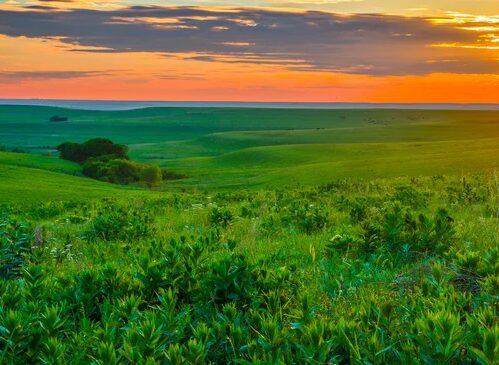
 

One Of The World’s Last Remaining Tallgrass Prairies Is A Rare Breathtaking Hilly Region In Kansas

0

Located on the edge of the Midwest and bordering the national-park-rich western state of Colorado, Kansas often gets unfairly overlooked when it comes to travel. However, Kansas is a great travel destination and has lots of interesting and unique things to do and see, from Jerusalem State Park and its Badlands-like topography to the artsy small town of Lucas and the vibrant nightlight of Kansas City which was historically called the “Paris of the Plains.” On top of this, Kansas is also filled with diverse and vibrant natural ecosystems; however, they come in a form you may not expect — rolling hills of native grasslands. In fact, the Sunflower State is home to one of the world’s last remaining tallgrass prairie: the Flint Hills.

Located in eastern Kansas, the Flint Hills are practically all that remains of the tallgrass prairies which once covered the Midwest like an ocean expanding from the Rocky Mountains to the Mississippi River and from Canada to Texas. Although originally considered barren land by settlers, we know today that tallgrass prairies are one of the most diverse ecosystems on Earth, only beaten by the Amazon Rainforest. On top of being ecologically important, the Flint Hills are also breathtakingly beautiful, especially on a windy day when the native grasses roll and dance in the breeze. So, how can you best enjoy the beauty of Kansas’ tallgrass prairies?

How to get the most out of your time in the Flint Hills

The Flint Hills of Kansas cover a large area of the eastern part of the state, from almost the northern border all the way down into Oklahoma. As such, one of the best ways to see as much of the area as possible is to drive through it on the Flint Hills National Scenic Byway. This 47-mile-long road offers great views of the rolling prairie-covered hills all while following the historic Santa Fe Trail — a wagon route that acted as an important trade and travel passageway between America and Mexico. As you take in the views of the rolling hills and prairie on the drive, you can stop at viewpoints and historic spots along the way like the Schrumpf Hill Overlook, Cottonwood River Bridge, Madonna of the Trail Statue, and Kaw Guardian of the Grove sculpture.

While much of the land in the Flint Hills is privately owned by ranchers, there are a few nature reserves that you can also stop at to get out and stretch your legs on a trail. The Flint Hills National Wildlife Refuge is a little out of the way but is great option for those who want to explore the marshland aspects of the prairie. You can also visit the Tallgrass Prairie National Reserve which is located just outside of Strong City and contains plenty of hiking paths. If you are lucky enough, you may even spot a herd of bison from the Scenic Overlook Trail.

Best places to stay and eat in the Flint Hills

The best thing about exploring the Flint Hills via car is that there are plenty of cute small towns to stop at along the way with unique and interesting things to do and places to stay. At the north end of the scenic byway, the town of Council Grove contains a few charming hotels like the Cottage House Hotel and Motel as well as the Lark Inn on Main. Council Grove also has plenty of shopping and fun things to do like wandering around Flint Hills Books or brushing up on the history of the area at the Kaw Mission State Historic Site and Museum or the Last Chance Store, where once upon a time travelers would stop purchase supplies before heading into Native American lands. Other great small towns that have plenty of places to stay and cute shops to check out include Cottonwood Falls, Cassoday, Matfield Green, and Strong City.

However, if you are looking for some good eats, Council Grove is where it’s at with fun and historic restaurants like Hays House 1857 Restaurant and Tavern and Trail Days Cafe and Museum. You can also find more food options in Manhattan, which is also in the Flint Hills a little to the north and contains great modern restaurants like Tallgrass Tap House, So Long Saloon, and Bourbon and Baker.


Veterans Day

0

While I realize Veterans Day has come-and-gone for 2024, I feel this column, even though a week late, is still applicable. I come from a family where many have served in the military in one way, shape or form. My dad was an infantryman in the Army during WW II and served in Italy for a time. His older brother served as Flight Engineer on a B-24, flying 13 missions over Germany during WWII. I was a Field Artillery Meteorologist, collecting atmospheric data for the artillery for 20 years in the Army National Guard, and was in Bosnia for 6 months. My wife Joyce spent 8 years in the Air National Guard as a photographer and as a plane cargo loader. Three of her uncles, all from Mennonite families, served in the army and navy during WWII and the Korean Conflict. Two of my cousins were in the Air Force, one of my nephews was a marine and another nephew is currently in the navy. When asked by her siblings, (all who are also Conscientious Objectors,) why she joined the military, my wife Joyce replied “Cause daddy never told me not to.” I say all this not to brag, but to say that we are a family who believes in and supports maintaining a strong military in the United States.

The person who suggested I write this column a couple years ago, told me of an office conversation discussing whether or not to do anything special that year for Veterans Day in their paper. One coworker replied “Yes, absolutely. Patriotism has to be taught.” That got me thinking about ways we can teach our kids and new citizens to be proud of our country and of our military, both current members and veterans.

First of all, by example, teach your kids respect for our flag, for the pledge of allegiance to our flag and for our National Anthem. When reciting the pledge of allegiance, honoring our flag as it is displayed or paraded past you or when singing the Star-Spangled Banner, stand, come to attention and face the flag with your right hand over your heart. Now, some will say the flag is only a piece of cloth, the pledge of allegiance only something we recite and the national anthem only a song. While those statements are true, these things are symbols of our freedom and of our country. Teaching our youth respect for these things will help teach them appreciation for God’s allowing us to live in a free country like the United States, appreciation for the soldiers that currently serve, soldiers that have served in the past and soldiers that have died protecting that freedom.

Most places you go, be it Walmart, the mall, a fast-food restaurant or some large event, you will see men and women wearing a hat or another item of clothing giving the appearance that they are military veterans. Ask those people if they are veterans, and if so, offer your hand and thank them for their service, and urge your kids to do the same. This is also a great gesture toward law enforcement personnel, firefighters and all manner of first responders, for they, like soldiers are the ones who run toward dangerous situations, allowing the rest of us run to safety.

I agree with the assessment that “Patriotism has to be taught,” and we as parents and grandparents must be the teachers. Be creative with other ways to honor our veterans; offer to pay for their Big Mac and fries, their morning coffee at Scooters or at the local café, let them go ahead of you in line at Dillons, etc. Also, take your kids and grandkids to church and be the example of wholeheartedly thanking God for these freedoms we have. As Lee Greenwood so eloquently sang, “God Bless the USA”

Steve can be contacted by email at [email protected].

Our Abbreviated Lives

0
Thayne Cozart
Milo Yield

In these modern times, anyone with a pulse knows that communication amongst ourselves has changed. With the advent of the internet, emails, and a plethora of social media platforms too many to keep track of, it seems a natural spinoff is that folks wanting to save time and effort communicating have invented abbreviations (acronyms).

I think the use of these communications shortcuts was started by the computerized younger generation in their effort to squeeze more “stuff” into their always-in-a-hurry lives. Quickly, other age groups jumped on the abbreviation bandwagon.

Soon, we began seeing and interpreting such acronyms as ASAP (As Soon As Possible), BOLO (Be On Lookout), LMAO (Laughing My Arse Off), YOLO (You Only Live Once), IDK (I Don’t Know), BTW (By The Way), IMHO (In My Humble Opinion), NOYB (None Of Your Business), FUBAR (Fouled Up Beyond All Recognition), KISS (Keep It Simple Stupid), and EG (Evil Grin).

***

That got me to thinking that folks in agriculture are squeezed for time, too. They’ve no time to waste trying to make a living and grow food, fiber, and fuels for everyone. And, they need easy ways to vent their frustrations.

So, I’ve tried to think of useful “Aggie Acronyms” that will streamline aggie communications. Here’s a few that I’ve thought of off the top of my head.

• NLITC — Need Lift Into Tractor Cab

• BDIF — Broke Down In Field.

• FDCO — Fence Down Cows Out

• HGTT — Hauling Grain To Town

• FFT — Fixing Flat Tire

• MADT — Markets Are Down Today

• MAUT — Markets Are Up Today

• BSIWF — Big Storm in Weather Forecast

• BLFS — Be Late For Supper

• FWG — Fixing Water Gaps

• WCT — Working Cattle Today

• SGST — Son Got Speeding Ticket

• ROOS — Ran Out Of Seed

• CGTS — Calf Got The Scours

• VKAC — Varmint Killed A Chicken

• CGM — Cow Got Mastitis

• CGCE — Cow Got Cancer Eye

• HHUIF — Horse Hung Up In Fence

• SBBST — Selling Black Baldy Steers Today

• BINPWH — Bull In Neighbor’s Pasture With Heifers

• BETD — Bulls Expensive These Days

• TSFF — Treating Sheep For Footrot

• GTTFP — Going To Town For Parts

• SIMWP — Stuck In Mud With Pickup

• CICGOA — Crop Insurance Cost Going Up Again

• WCEPFB — Will Congress Ever Pass Farm Bill

• DD — Danged Drought

• NVB — Need Vacation Badly

***

Now, I got to thinking about old folks like me. Time is really important to us, too. The actuarial tables tell the tale. Therefore, we can use the following “Aging Acronyms” to save us precious time.

• ATD — At The Doctors

• BFF — Best Friend’s Funeral

• BTW — Bring The Wheelchair

• BYOT — Bring Your Own Teeth

• FWIW — Forgot Where I Was,

• GGPBL — Gotta Go Pacemaker Battery Low

• GHA — Got Heartburn Again

• ETAT — Every Thing Aches Today

• AAUA — Arthritis Acting Up Again

• TFT — Texting From Toilet

• GBMT — Good Bowel Movement Today

***

An obnoxious cattleman was attending his association convention. After one contentious meeting, he got into the hotel elevator and vented to another rider, “I’ve been insulted. I just overheard our president say he’s offer me $100 if I’d resign from the board of directors. I’m trying to decide what to do next.”

His companion replied, “I’d hold out for $200.”

***

My words of wisdom for the week are: “The easiest search in the world is your search to find someone to blame.”

Have a good ‘un.