Monday, February 2, 2026
Home Blog Page 296

Historic military convoy to travel through Southeast Kansas

0
A convoy of historic military vehicles is less than a week from traveling through Southeast Kansas. The Military Vehicle Preservation Association: History In Motion convoy is traveling old Jefferson Highway from the Canadian line to New Orleans. The route mostly follows US-69 through Kansas. The convoy will be in Fort Scott on October 13, then will come through the Arma-Pittsburg-West Mineral area October 14-15. It will continue on to Joplin from there.
These vehicles will be on display at multiple locations.
On Monday, October 14, there will be a public viewing at the Franklin Community Park in Franklin from around 11 a.m. to 2:30 p.m. This viewing is hosted by Miners Hall Museum.
Also on Monday, October 14, there will be a public viewing at the Crawford County Historical Museum in Pittsburg from around 3 p.m. to 5:30 p.m.
Then, on Tuesday, October 15, a public viewing will be held at Big Brutus near West Mineral from around 3 p.m. until 5 p.m. Please note, due to the convoy Big Brutus is allowing free admission beginning at 3 p.m.
You can follow the progress of the convoy at Facebook.com/MVPAConvoy.

FROM THE GRAVEL CROSSROADS OF AMERICA’S HEARTLAND, ACROSS 5-STATES, TO BACK HOME TO KANSAS

0

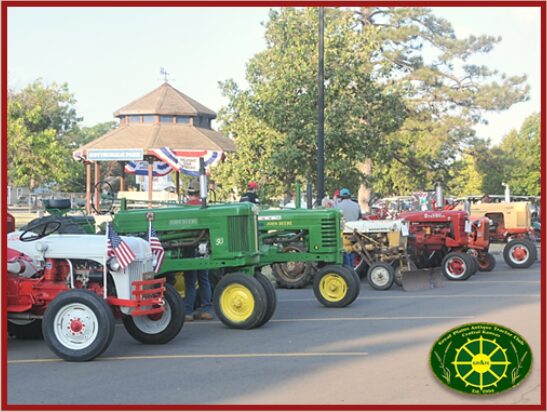
– Michael Hinton, Owner | CEO of TalkingTractors.com, along with an accomplished
group of Kansas businesses, organizations, and individuals, were honored Thursday, October 03, 2024, during the Kansas Department of Commerce’s 2024 To The Stars: Kansas Business Awards ceremony at the Great Bend Convention and Visitors
Bureau. The event recognized the outstanding contributions to the state’s economy and communities.
Hinton was bestowed a Merit Award in the category of Welcome Back – Entrepreneurs and businesspeople who once left Kansas but have returned home to make a mark in the Sunflower State. Born in Newton, KS, and growing up in rural Harvey County; Hinton and his family had relocated to 5-U.S. States over the span of the last 25-years for his career, before moving back home to Kansas (briefly in 2015 and permanently in 2020). TalkingTractors.com was launched in January 2024 and has quickly become Nationally recognized for Antique Tractor Preservation Day, an Ag Heritage celebration that Hinton founded.
A record 346 businesses, organizations, and individuals were nominated in nine categories for this year’s To the Stars: Kansas Business Awards. A total of 53 Merit Awards and 45 Regional Awards were presented at the event. In an October 03, 2024,
Kansas Office of the Governor Media Release, Governor Laura Kelly said, “By honoring and showcasing their accomplishments, we aim to inspire other businesses to keep reaching for new opportunities across our state.”
Lieutenant Governor and Secretary of Commerce David Toland added, “Each of the nominees play a critical role in the new era of Kansas we are creating —they are truly the pillars of our success and more than worthy of being celebrated.”
“I cannot imagine a better life than being born a Kansan, raised a Kansan, and calling Kansas home, stated Michael Hinton, adding, “This award further speaks to my passion for preserving America’s heritage farm machinery for future generations, and bringing continued awareness to our state’s renowned agricultural heritage.”

Lettuce Eat Local: As sweet as honey…because it is honey

0

Amanda Miller
Columnist
Lettuce Eat Local

Though honeybees are very small insects, the numbers in facts about them seem impossibly large. For example, there can be 50,000 bees in an average beehive; bees’ wings beat around 11,400 times a minute; a queen bee can lay upwards of 1500 eggs in a day. The USDA says that honeybees pollinate over 130 types of vegetables, fruits, and nuts, facilitating the production of about $15 billion worth of crops every single year. 

Another mindblowing fact is that it takes approximately 1200 bees flying a total of 60,000 miles and visiting over two million flowers to get enough nectar to make a pound of honey. A corollary trivia tidbit is that worker bees live about 6 weeks, and each one will only produce somewhere between 1/12 and ½ teaspoon of honey in its lifetime. (I keep finding different actual numbers for some of these stats, but the points remain: it’s a lot, or a very little.)  

Suddenly it makes a lot of sense why honey isn’t the cheapest sweetener on the market. I often buy local honey by the gallon, since by another amazing reality it doesn’t go bad, and that purchase can come with a little sticker shock — until I think of the millions of bees whose lives’ work went into our consumption. 

Not because of price, but because of our desire to be semi-self-sustainable, Brian and I would love to have our own honeybee hives. But since we are both allergic to beestings, and we don’t want our sting:life ratio to match bees’ 1:1, it seems like a hobby better left to others. Brian has found several hives in various fields and alerted beekeeper friends of ours, so we are not unintroduced to hyperlocal honey. Local raw honey is supposed to help with seasonal allergies (as well as a whole smorgasbord of other potential health benefits), helping your body acclimate to the area pollens, so I’ll consider our consumption of it a medical practice. 

Fortunately, we know that Benson isn’t similarly allergic to bees, since last year he had no reaction when he got stung by one that was also (wisely) investigating our waste chocolate feedpile. My favorite part of that story is that, in his two-year-old diction, he would tell us how Papa and Eeyore were with him. We figured out he meant Leroy, but the nickname may forever stick. 

And perhaps it’s partially our fault since we play an audio storytelling of Winnie the Pooh for Benson every night — “My favorite thing is me coming to visit you, and then you ask, ‘How about a small smackerel of honey?’ ” — but I think Benson would brave the odds even if he were allergic. That boy can sense the honey jar being pulled out of the cupboard from anywhere in the house. (He literally grabbed the honey and ran away with it while I was trying to take the picture.) “I just need a yittle yick on my finger!” 

To be fair, is there much that isn’t improved with a smidgen of honey? Even just add the word and it instantly sounds better: honey whipped cream, honey mustard, honey glazed salmon, honey grahams, honey bread, honey barbeque, honey roasted carrots…basically everything except honey badger. Drizzle it on everything from oatmeal to cheese to avocado toast, and your life will be better. 

Like Proverbs 16:34 says, “Kind words are like honey — sweet to the soul and healthy for the body,” so let’s have lots of both. 

There are so many honey-focused recipes we do that I could share for this H is for Honey article, and I was stuck between this and a hot honey chile butter I also just made. But that one was too easy (you can see the ingredients in the name…) and this dressing is an awesome addition to autumn salads. It’s thick, creamy, sweet but not too sweet, and pairs beautifully with all the fall things like butternut squash, apples, kale, etc, although it’s also getting used around here as a dunk for our cherry tomatoes that are finally ripening. 

Prep tips: I’m not typically a brand follower, but I’m getting to be a big fan of Duke’s mayonnaise. Maybe it’s just because I’m a Southerner at heart, or maybe it is better. 

2 cups mayo

1 ¼ cup dijon

⅓ – ½ cup local honey

¼ cup apple cider vinegar

dash cayenne

salt to taste

Blend or whisk all ingredients until smooth. Season to your tastes. 

Wheat Scoop: No Small Factor: Producers should consider coleoptile length when deciding when and how deep to plant wheat

0
Kansas Wheat

For audio version, visit kswheat.com.

Producers have a lot to consider when deciding when to start planting wheat — moisture, soil temperature, Hessian fly-free dates and more. Based on research from Kansas State University, another one of these considerations may appear small, at least physically, but could have a big impact come harvest — coleoptile length.


When a wheat seed germinates, one of the first structures to emerge from the seed after the seminal roots is the coleoptile. This plant part is a rigid protective structure that covers the emerging shoot of a wheat plant. As the wheat plant develops, this covering continues to elongate as the young seedling pushes through the soil until it breaks the surface and reaches sunlight. Then, the coleoptile stops growing and the first true leaf emerges through it.


However, if a wheat seed is planted too deep or into the wrong soil conditions, the coleoptile may not be able to break through the soil, leading to a variety of compounding issues for wheat stand establishment. In this case, when the coleoptile is unable to emerge, the first true leaf may emerge underneath the soil’s surface. Then, the leaf takes on an accordion-like appearance, the wheat plant typically becomes yellow and eventually the plant dies. Even if the plant survives, it has limited access to nutrients and sunlight and will result in lower yields.


So how do producers prevent this situation? First, according to a recent Wheat Rx publication by K-State Research and Extension, wheat should never be planted deeper than the coleoptile length of the wheat variety. In dryland environments like western Kansas, producers often “dust in” their wheat or plant into dry soil and rely on deeper subsoil moisture, requiring deeper planting depths. To succeed in this common scenario, farmers should select wheat varieties with longer coleoptile lengths that will help the wheat plant make it from the deeper planting to the soil surface.


An additional consideration is soil temperature. Planting wheat too early into warm soil temperatures can further reduce the coleoptile length. Some varieties will not germinate when soil temperatures are greater than 85°F and coleoptile length can be reduced by as much as 60 percent in higher temperatures. K-State recommends that if producers choose to plant in warmer soil temperatures, plant at a shallower depth (3/4 to 1 inch deep), even if moisture is absent in the top layers of soil. Planting wheat deep (greater than 2 inches) increases the risk of poor emergence and unacceptable stands.


By understanding the temperature sensitivity and coleoptile length of their selected wheat varieties, producers have one more tool to help them decide when to plant and how deep to promote better wheat stand establishment.


View the full list of ratings for coleoptile length for Kansas wheat varieties and find other recommendations based on the latest K-State research at kswheat.com/wheatrx. Wheat Rx is a series of Extension publications and other educational outreach materials designed to address key management areas of hard winter wheat. These publications contain recent data based on novel research funded in part by wheat farmers through the Kansas Wheat Commission’s two-cent wheat assessment.


###


Written by Julia Debes for Kansas Wheat