Sherry F. Nelson, LCSW, Human Development Specialist, Marion County, University of Missouri Extension
Each year more than 4,000 Americans lose their life to fire and approximately 25,000 are injured. At least 80 percent of fires in the U.S. occur in the home; however, there are many things we can do to prevent these fire tragedies and injuries. Testing our smoke alarms is one of the most critical things we can do to protect ourselves and our loved ones. All homes should have smoke alarms, an escape route and fire extinguishers on hand.
Smoke alarms: There should be a smoke alarm in every bedroom. Additionally having a smoke alarm on every level of your home is a must and you should test your smoke alarms monthly. Experts recommend that you change your batteries twice a year, in the fall and spring when we change our clocks for daylight saving time.
Escape plans: Having an escape plan and practicing the plan has been shown to save lives because you and your family will know exactly what to do in the event of an emergency. Practice the plan twice a year with the whole family. Be sure to know two ways out of your home and have a designated meeting place outside. Remember that once you are out of the home, have a neighbor call 911, and DO NOT go back inside. Be sure to educate babysitters/caregivers of your escape plan so they are familiar with it as well.
Fire extinguishers: Having fire extinguishers on each level of the home is a must for every homeowner or renter. An ABC type extinguisher is best because it can be used on most types of fires…
4-H members, volunteers and alumni to participate in two-day statewide community service project
MANHATTAN, Kan. – When members recite the 4-H pledge, they vow to use their hands for larger service to better their club, their community, their country and their world.
This year, Kansas 4-H members, volunteers and alumni are uniting to prove their commitment to the pledge by participating in 48 Hours of 4-H, a statewide community service project showcasing the positive impact 4-Hers can make in just one weekend.
On Oct. 11 and 12, the weekend immediately following National 4-H Week, an estimated 3,000 people from at least 58 counties are expected to participate in more than 130 different community service projects.
These numbers shouldn’t be too surprising, considering a recent study on positive youth development showing that 4-H members, grades 7-12, are four times more likely to make contributions to their communities than their peers. They are also estimated to be twice as civically active.
Blake Foraker, Kansas 4-H youth leadership council president, said that when the state council met last spring, community service was something they felt they needed to emphasize more as a way to connect back with those founders of the organization who wrote things such as the 4-H motto, “To Make the Best Better.”
“We were looking for a way to unite 4-H across the state at the local level,” Foraker said. “We pledge our hands to larger service, and that’s a big part of what 4-H was centered around when it was created more than 100 years ago. As we move forward, we see 48 Hours of 4-H becoming a unique challenge and something we can watch grow over the next few years.”
For more information about how you can get involved, contact your local extension office or check out the details for 48 Hours of 4-H at www.Kansas4-H.org/484H.
LINCOLN, Neb. — Learning the life sciences in the 21st century and beyond is about much more than memorizing information for a test and then moving on to the next subject. Students must learn in a more dynamic environment that ties the threads of science together into a whole from the start of their undergraduate experience, say University of Nebraska-Lincoln professors who are leading an effort to develop new teaching methods that meet these demands.
The University of Nebraska-Lincoln has received a four-year, $2,321,012 grant from the National Science Foundation.
Currently, life sciences teaching works like this, said Joe Dauer, assistant professor in the School of Natural Resources: “You start cramming as much knowledge as you can into a student’s head their freshman year, in pieces, and you hope students over time figure out how to connect things.”
Tomas Helikar, assistant professor in the Department of Biochemistry and principal investigator for the grant, said the new approach will be in contrast to “the way I learned – rote memorization from textbooks, static pictures, and so on. We need to be more dynamic.”
The Bureau of Labor Statistics says that over half of the 30 fastest growing careers in this nation require familiarity with the life sciences, a discipline that is rapidly shifting to a more systems-level, large database driven approach to understanding ourselves and the world we live in.
The UNL initiative brings together life sciences educators and computational biologists to develop innovative methods to meet the challenges posed by this new approach within the life sciences.
Currently, it isn’t until they’re upperclassman and graduate students that students are immersed in this advanced thinking. “We want students connecting those pieces earlier,” Dauer said.
Life sciences students will be much more challenged from the start of their college experience. Some will find that more engaging and fun, but Dauer said he expects some resistance too.
“Students have this expectation they’re going to be told what’s on the exam and what they need to memorize and if they do that, they’re going to get an A,” he said.
“The U.S. is realizing that as life sciences have evolved as a research field, education also needs to change the way we teach,” Helikar added.
“This project has the potential to significantly transform the learning of biology by providing a complete learning environment that enables students to learn by constructing, simulating, analyzing, and interrogating the dynamic and systems properties of living organisms,” the project team said in its summary.
The proposal was developed in response to “Vision and Change: a Call to Action in Undergraduate Biology Education,” a document produced by The American Association for the Advancement of Science, based on the findings of a large number of biologists. That document emphasizes the importance of systems thinking, learning about the dynamics of biology, and integration of computer simulations into undergraduate biology education.
Dauer and Helikar said they expect by the end of the grant’s four years, Life Sciences 120 and 121 will be taught very differently. Less “stand and deliver” by lecturers in auditoriums, and a more fluid classroom, with groups working together and more interaction between instructors and students. Labs for these classes also will be taught differently, with more simulations and immersion into systems thinking.
Helikar said the project will produce web-based modules that can be adapted for use in universities across the country.
It will use the Cell Collective, a web-based computer simulation platform developed in Helikar’s lab that has been successfully used in computational biology research, as a tool for learning about complex biological processes in a broad set of university life sciences courses. The technology has been successfully piloted as an educational tool in immunology and microbiology courses and has been included as part of an inquiry-based cancer biology textbook.
The educational research planned in this grant aims to extend this platform, and develop a comprehensive and easily accessible learning environment that will provide university students and instructors with computer models and learning content for topics taught in both introductory and specialized biology courses. It will enable students to learn about the dynamics of living systems in real-time through interactive simulations, while providing instant feedback with simulation and assessment results.
In addition, the web-based nature of the resource will enable students and their teachers to participate in learning activities on both a local and global scale.
Developed resources will be made available to researchers and teachers interested in incorporating this approach into their own learning technologies and methodologies. A design-based research and development approach is being used to learn about how student conceptual change can be supported by this intervention. Data from the students’ conceptual models and biology evaluation assessment and from exploratory interviews aimed at perceptions of difficulty, language barriers, and areas of greater clarification will be analyzed to refine the software technology.
This project is funded jointly by the Directorate for Biological Sciences and the Directorate of Education and Human Resources, Division of Undergraduate Education in support of efforts to address the challenges posed in Vision and Change in Undergraduate Education: A Call to Action http://visionandchange.org/finalreport/
Even during tight supplies and high retail prices, consumer demand for pork is the highest it’s been in 10 years, said K-State livestock economist Glynn Tonsor. A recent report, however, shows herd expansion could lead to lower pork prices for consumers next year.
Even during tight supplies and high retail prices, consumer demand for pork is the highest it’s been in 10 years, said K-State livestock economist Glynn Tonsor. A recent report, however, shows herd expansion could lead to lower pork prices for consumers next year.
Herd expansion could mean lower pork prices for consumers by the middle of next year.
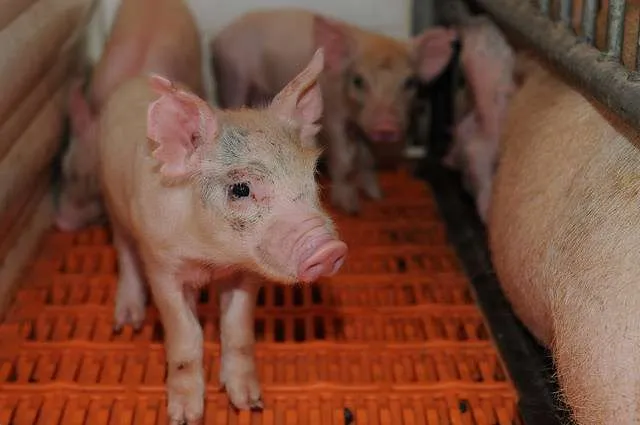
MANHATTAN, Kan. – The U.S. pork industry today is small by historic standards. But, signs of producers holding back more females to increase the breeding herd mean the industry is in the process of expanding, which could put more pounds of pork in grocery stores by the middle of next year.
“We continue to have historically high hog prices, as well as retail pork prices,” said Glynn Tonsor, livestock economist for K-State Research and Extension. “We also have improving production costs as grain prices are coming down. That’s sending a signal, an economic incentive, for pork producers to expand so they can sell more pigs at a positive dollar per head margin than they did last year.”
Information about the state of the U.S. pork industry was included in the quarterly Hogs and Pigs Report, released by the U.S. Department of Agriculture’s National Agricultural Statistics Service on Sept. 26. Tonsor said the report provides the best estimate of the current size of the industry and how large it will be in the future.
According to the report, the inventory of all hogs and pigs on Sept. 1, 2014 was 65.4 million head, which was 2 percent lower than a year ago but up 6 percent from June of this year. The breeding inventory was at 5.92 million head, up 2 percent from last year and up 1 percent from June. The market hog inventory was at 59.4 million head, down 3 percent from last year but 7 percent higher than it was in June.
Further, U.S. hog producers intend to have 2.89 million sows farrow, or have pigs, during the September through November 2014 quarter, which is up 4 percent from the actual farrowings during the same period in 2013 and up slightly from 2012. A projected 2.87 million sows will farrow December through February 2015, up 4 percent from 2014 and up 3 percent from 2013.
A consumer focus
What does this expansion outlook mean for pork consumers? Tonsor said most likely around the middle of next year, retailers will see an increase in pork supplies coming from this expansion. An increase in supplies likely means cheaper pork prices for consumers.
“None of this is guaranteed, but our current estimate is that we’re going to have more sows, and therefore more pigs and more pork pounds that show up starting around April 2015,” he said. “There will be some relief in high prices (consumers) have been seeing for some time now. Most of these adjustments take a long time, not quite as long of a biological lag that we have in the cattle industry, but they still take time.”
Specifically, it would take in excess of eight months from starting the process of holding back females, to breeding them, to farrowing them, to weaning their pigs and feeding them to a finished market weight.
“The reason I highlight that is the tight pork supply situation we have today is here for the rest of 2014,” Tonsor said. “Couple that with strong meat demand in general, strong pork demand in particular, we’re probably going to have historically high pork prices the rest of 2014.”
One of the greatest challenges the U.S. pork industry has faced recently is PEDv, or porcine epidemic diarrhea virus. Discovered in the United States for the first time in 2013, PEDv is a disease caused by a porcine coronavirus and can lead to vomiting and occasional diarrhea in sows and gilts and severe diarrhea and vomiting in nursing and recently weaned pigs, according to Kansas State University’s College of Veterinary Medicine (http://www.vet.k-state.edu/depts/dmp/service/news/KSVDL_PEDV_fact_sheet.pdf).
PEDv spreads quickly and can lead to severe sickness and death in pigs, although it is not a threat to food safety or humans. A Pork Checkoff report (www.pork.org/News/4678/PEDVsImapct.aspx#.VC7IH3i9Kc0) estimates the disease caused a loss of 7 million to 8 million pigs from June 2013 to April 2014.
“To the extent we have additional concerns about PEDv, that could mute some of this increase in pork production,” Tonsor said.
PEDv has reduced the amount of pigs weaned per litter, he said, and the net effect is fewer market hogs in the United States, therefore fewer pork pounds produced. In the past, the virus has hit swine herds worse from November through April. Although vaccines have been developed recently, it’s unknown if producers can battle the virus more effectively through the coming winter with use of the new vaccines.
Pork demand still high
Despite the recent and current tight supply situation caused in a large part by PEDv, Tonsor said retail pork demand has been strong. Given the pounds produced and consumed in the United States recently, the retail price realized was higher than most expected.
“The second quarter of 2014 was actually the best quarter for retail pork demand, the way I estimate it, in more than 10 years,” he said. “It’s important to recognize that’s a positive signal for the entire pork industry, because the public was willing to pay more for those reduced pork pounds than we expected.”
“The U.S. public sees more value in those (pork) products,” he continued. “Maybe the products are more convenient. Maybe the consumers were less sensitive to the price or had improving incomes. Probably some of all of the above is actually truth, which led to this positive demand story.”