Wednesday, January 28, 2026
Home Blog Page 219

KU News: Community donations at heart of Radical Jewelry Makeover Exhibition at KU

0

From the Office of Public Affairs | http://www.news.ku.edu

Headlines

Community donations at heart of Radical Jewelry Makeover Exhibition at KU

LAWRENCE — A fall 2024 class project to repurpose unwanted jewelry into new pieces will culminate in an exhibition later this month at the University of Kansas. Radical Jewelry Makeover: KU, led by Sunyoung Cheong, assistant professor of metalsmithing and jewelry, sought donations —and stories — from Lawrence and Topeka residents for the project. The exhibition will take place Jan. 21-31 at the Edgar Heap of Birds Family Gallery in Chalmers Hall, with a closing reception and sale from 5 to 8 p.m. Jan. 30.

KU strengthening national defense partnership with new office

LAWRENCE — The University of Kansas is reinforcing its commitment to national security and strengthening its partnership with the Department of Defense by launching a new Office of National Defense Initiatives. ONDI combines the expertise of the former Office of Graduate Military Programs with KU’s three Reserve Officers’ Training Corps (ROTC) programs. Mike Denning, who has served as the director of the Office of Graduate Military Programs since 2011, will lead ONDI as the assistant vice chancellor for national defense initiatives.

KU senior DaNae Estabine named a Schwarzman Scholar

LAWRENCE — DaNae Estabine, a University of Kansas senior from Olathe, is among the select students who have been named to the 11th class of Schwarzman Scholars. The program is a fully funded, one-year master’s degree in global affairs and leadership program at Tsinghua University in Beijing.

Authors unearth layers of meaning in ‘West Side Story’

LAWRENCE — For Paul Laird, University of Kansas professor emeritus of music, “West Side Story” is not just the quintessential Broadway musical. It’s like the Bible or Shakespeare — an inexhaustible source of inspiration, interpretation, analysis and commentary. “The Cambridge Companion to ‘West Side Story,’” just out from Cambridge University Press, is Laird’s third scholarly book about the musical.

Full stories below.

————————————————————————

Contact: Sunyoung Cheong, Department of Visual Art, [email protected]

Community donations at heart of Radical Jewelry Makeover Exhibition at KU


LAWRENCE — A fall 2024 class project to repurpose unwanted jewelry into new pieces will culminate in an exhibition later this month at the University of Kansas.

Since 2007, Ethical Metalsmiths has facilitated semester-long projects around the world through the Radical Jewelry Makeover initiative. Metals and gemstones are often mined in some of the poorest countries, on sacred lands and in disputed territories, resulting in significant costs to both human lives and the environment.

RJM: KU, led by Sunyoung Cheong, assistant professor of metalsmithing and jewelry, sought donations —and stories — from Lawrence and Topeka residents for the project. Participating students, along with regional artists from the Lawrence and Kansas City area, spent the semester collecting donations, sorting through them and creating new pieces of jewelry that honor their origins and the environment.

Many donations were from older residents and had sentimental value, Cheong said. Some pieces were vintage jewelry from the 1960s to ’70s, including a Charles Revson/Aldo Cipullo 18 karat gold-plated love bracelet.

“After Cartier released the love bracelet in 1968, Aldo Cipullo — who designed it — decided to make a more affordable version for mass marketing in collaboration with Charles Revson of Revlon Cosmetics. Students and I learned so much about historical jewelry and materials used then and how to identify materials for the first time,” Cheong said.

She said some students pushed themselves to create unique pieces, trying new techniques and processes and learning how to embrace imperfections and repurpose materials into something creative. Among them:

Charlie Gelhausen created a skull pendant that used recycled silver and beads from donations. Gelhausen began with a CAD design, followed by 3D printing, casting and flocking on the backside.
Soobeen Lee designed yellow earrings made from metal beads and wire. She disassembled the beads, powder-coated each one individually, then reassembled them using wire.
Grace Billman’s fake pearl necklace features pearls of various sizes and is finished with ribbons.

“As a teacher, I have learned how important it is to make a positive impact on students, especially after collaborating with our community and nonprofit organizations like Ethical Metalsmith,” Cheong said. “This was the first time my students and I worked on a project outside of school, and it was fascinating to see how the students challenged themselves and grew as artists.”

The Radical Jewelry Makeover Exhibition will take place Jan. 21-31 at the Edgar Heap of Birds Family Gallery in Chalmers Hall, with a closing reception and sale from 5 to 8 p.m. Jan. 30.

Gallery hours are 9 a.m. to 5 p.m. weekdays and 9 a.m. to 1 p.m. Jan 31.

Any leftover materials will be returned to Ethical Metalsmith after the show.

-30-

————————————————————————

KU News Service is now on BlueSky.

Follow for KU News Service stories, discoveries and experts.


https://bsky.app/profile/kunewsservice.bsky.social

————————————————————————


Contact: Mike Denning, Office of National Defense Initiatives, 785-864-1684, [email protected]

KU strengthening national defense partnership with new office


LAWRENCE — The University of Kansas is reinforcing its commitment to national security and strengthening its partnership with the Department of Defense (DoD) by launching a new Office of National Defense Initiatives (ONDI).

The new office will serve as KU’s central hub for DoD engagement to focus KU capabilities to better serve the state of Kansas and the nation. ONDI combines the expertise of the former Office of Graduate Military Programs with KU’s three Reserve Officers’ Training Corps (ROTC) programs. Organizationally the new office resides within the Office of Academic Affairs.

This restructuring recognizes the DoD as an academic partner and emphasizes the importance of national security research and education as core components of the university’s strategic plan. By centralizing these efforts, KU enhances both current and future contributions to the nation’s national defense.

“The creation of ONDI amplifies the message that national security research and education are not just important, but vital to our academic mission,” said Jen Roberts, senior vice provost for academic affairs. “With the recent hiring of Dr. Kurt Preston, a former senior leader within the DoD research enterprise, and the promotion of Trent Williams to director of National Defense Education Initiatives, we are demonstrating our commitment to bridging KU’s expertise with real-world security needs.

“This restructuring, which includes bringing KU ROTC programs under ONDI, creates a powerful synergy and a single point of contact for the DoD.”

Mike Denning, who has served as the director of the Office of Graduate Military Programs since 2011, will lead ONDI as the assistant vice chancellor for national defense initiatives. His leadership ensures continuity and deep institutional knowledge of both KU and the DoD.

“This restructuring represents a significant step forward in KU’s steadfast commitment to supporting the DoD and national security,” Denning said. “In a time of rapid technological advancement and evolving global threats, ONDI will place KU’s exceptional faculty, talented students and cutting-edge research at the forefront of numerous DoD opportunities.”

-30-

————————————————————————

Don’t miss new episodes of “When Experts Attack!,”

a KU News Service podcast hosted by Kansas Public Radio.


https://kansaspublicradio.org/podcast/when-experts-attack

————————————————————————


Contact: Erinn Barcomb-Peterson, KU News Service, 785-864-8858, [email protected], @ebpkansas

KU senior DaNae Estabine named a Schwarzman Scholar


LAWRENCE — DaNae Estabine, a University of Kansas senior from Olathe, is among the select scholars who have been named to the 11th class of Schwarzman Scholars, which provides for a year of graduate study in China.

Schwarzman Scholars is a fully funded, one-year master’s degree and leadership program at Tsinghua University in Beijing. Scholars earn a master’s degree in global affairs.

Estabine is majoring in psychology with minors in business and philosophy. She was among around 5,000 applicants for the award.

Scholars chosen for this highly selective program will live in Beijing for a year of study and cultural immersion, attending lectures, traveling and developing a better understanding of China.

After completing the Schwarzman Scholars program, Estabine plans to attend law school and pursue a career as a prosecutor in Kansas.

“One of my key interests is prison reform — a global issue that often goes unnoticed but affects every nation and its citizens,” Estabine said.

The Schwarzman Scholars program, she said, will prepare her with a global perspective and the leadership skills needed to tackle complex challenges like prison reform, both in Kansas and around the world.

“Through my experience in China, I hope to gain insights into their prison system and its impact, as understanding what works — along with what doesn’t — is crucial to shaping effective policies,” Estabine said.

During her KU career, Estabine has also been named a Newman Civic Fellow and a finalist for the Truman Scholarship. Moreover, she serves as the student body president, having been elected by her peers in March 2024.

“It has been such a pleasure working with and getting to know DaNae over the past two years. Her passion for prison reform is inspiring, and I am certain her experience as a Schwarzman Scholar will expand her leadership skills and global knowledge, enhancing her work as a future prosecuting attorney,” said Erin Wolfram, director of the Center for Undergraduate Research & Fellowships. “I look forward to seeing the impact she makes in the state of Kansas and beyond over the course of her career.”

Named for Blackstone co-founder Stephen Schwarzman, the scholarship program was inspired by the Rhodes Scholarship — founded in 1902 to promote international understanding and peace — and is designed to meet the challenges of the 21st century and beyond.

Admissions opened in fall 2015, with the first class of students in residence in 2016. Estabine is the second Jayhawk to receive the honor. KU graduate Ashlie Koehn was among that first class of Schwarzman Scholars.

-30-

————————————————————

The official university account for X (formerly Twitter) is @UnivOfKansas.

Follow @KUnews for KU News Service stories, discoveries and experts.


————————————————————————


Contact: Rick Hellman, KU News Service, 785-864-8852, [email protected], @RickHellman

Authors unearth layers of meaning in ‘West Side Story’


LAWRENCE — For Paul Laird, University of Kansas professor emeritus of music, “West Side Story” is not just the quintessential Broadway musical. It’s like the Bible or Shakespeare — an inexhaustible source of inspiration, interpretation, analysis and commentary.

“The Cambridge Companion to ‘West Side Story,’” just out from Cambridge University Press, is Laird’s third scholarly book about the musical. Laird and Elizabeth Wells of Mount Allison University in Canada co-edited the new work, and Laird wrote or co-wrote two of its 16 essays. The contributors analyze everything from the show’s adaptation of “Romeo and Juliet” right up to the 2021 Steven Spielberg film version.

“There were some perspectives that came out of this book that surprised me,” said Laird, who has written an additional five books on composer Leonard Bernstein alone. “I certainly learned things. We were asking people from various backgrounds and generations to write about it, and they did so in very different ways. That was instructive for me. I don’t agree with everything in the book, but as an editor, that’s not my job. My job is to bring together an interesting volume, and I love the different perspectives we have.”

Jane Barnette, KU professor of theatre, and Martin Nedbal, KU professor of musicology, also contribute chapters that look at “West Side Story” from the perspective of their specialties — adaptation dramaturgy and Viennese musical history, respectively.

Laird’s solo chapter deals partly with the compositional methods Bernstein used to unify the show.

“Bernstein is a composer in the classical tradition,” Laird said, “and most Broadway composers are not. There are very few who have also written symphonies and ballets and operas. This is how Bernstein wanted to work, and in his previous musicals he’d already done this.”

Laird said Bernstein foreshadows certain actions with musical snippets, then recalls them later.

“There are intervals and themes that he uses to tie the thing together,” Laird said. “It’s a musical way of enhancing the drama.”

The Broadway musical premiered in 1957, but Laird says it was the 1961 movie version, which won 10 Academy Awards, that made “West Side Story” a global hit.

The 2021 film version was a box office failure, which the editors acknowledge in their foreword, but Laird said “West Side Story” remains relevant.

“Clearly, we still have issues of race and prejudice and bias in our culture,” he said. “That’s what brings about the hatred that makes this show work and makes it so visceral. It’s about human beings who just can’t get outside themselves and think with empathy about other people.

“Because of that, and because we’re human beings, I think it’s always potentially relevant. I thought the new movie was very good, but clearly it wasn’t what America wanted to watch in 2021. But as we said in the preface, at least it shows the work is still current. But you don’t even need to show that, because, as the world turns, ‘West Side Story’ has been put on somewhere virtually every week. This show is not going away, like ‘Romeo and Juliet’ doesn’t go away.

“We love to watch people fall in love. We love to hear them sing about it. That’s why musicals and operas exist. I think that’s a basic human desire, and it’s going to stick around with us.”

-30-

————————————————————————


KU News Service

1450 Jayhawk Blvd.

Lawrence KS 66045

[email protected]

http://www.news.ku.edu


Erinn Barcomb-Peterson, director of news and media relations, [email protected]


Today’s News is a free service from the Office of Public Affairs

KU News: Dole Institute spring programming season opens with former Kansas governors, bestselling author Sharon McMahon

0

From the Office of Public Affairs | http://www.news.ku.edu

Headlines

Contact: Jackson DeAndrea, Dole Institute of Politics, 785-864-4900, [email protected], @DoleInstitute

Dole Institute spring programming season opens with former Kansas governors, bestselling author Sharon McMahon


LAWRENCE — The Robert J. Dole Institute of Politics at the University of Kansas today announced its early spring 2025 programming, featuring the Elizabeth Dole Women in Leadership Lecture recognizing “America’s Government Teacher” Sharon McMahon; a discussion on the evolution of Kansas politics over the last half-century with former Kansas governors Kathleen Sebelius and Mike Hayden; program series analyzing changes in presidential power, and technology and innovation in wartime; and a special temporary exhibit honoring the late former President Jimmy Carter.

“This spring, we feature timely discussions of both historical and contemporary shifts in politics, governance and civic life,” said Audrey Coleman, director of the Dole Institute. “This perspective helps us move through new challenges and build new relationships to address those challenges.”


Special exhibit

Members of the public are invited to visit the Dole Institute’s museum and galleries to view a special memorial exhibit honoring the life and legacy of former President Jimmy Carter and his relationship with former U.S. Sen. Bob Dole. Carter, 100, died Dec. 29, 2024, at his home in Plains, Georgia. The special exhibit, developed by archivists from the institute, features original manuscripts and photographs that highlight the relationship and areas of cooperation between Dole and Carter. The exhibit will be on display through Feb. 2. Visitors will have an opportunity to sign a guest book that will later be presented to the Carter family.


Public programming

Former Kansas governors Kathleen Sebelius (D, 2003-2009) and Mike Hayden (R, 1987-1991) will join Philadelphia Inquirer journalist and KU graduate Katie Bernard for a discussion on the evolution of Kansas politics over the last half-century. The conversation is inspired by Michael Smith and H. Edward Flentje’s recent book published by the University Press of Kansas, “Reform & Reaction: The Arc of Kansas Politics,” which features contributions from late KU professor and political scientist Burdett Loomis. The program will take place at 7 p.m. Jan. 23 at the Dole Institute and is presented in partnership with the University Press of Kansas.

New York Times bestselling author and educator Sharon McMahon will be honored at the Elizabeth Dole Women in Leadership Lecture at 7 p.m. Feb. 6. Named after former U.S. Sen. Elizabeth Hanford Dole, the series honors her long-lasting career in public service by featuring women who break barriers, make significant contributions in their field and reach positions of leadership. This program will be held in partnership with the Lawrence Public Library and will include a book signing opportunity for guests. A free ticket is required to attend the program; tickets will be available online beginning 10 a.m. Jan. 28.

McMahon, a former high school government and law teacher, became known as “America’s Government Teacher” during the 2020 election for her viral efforts to combat political misinformation through her social media platforms. Since then, she’s continued to provide historical context and nonpartisan insights into present-day issues through a variety of mediums, including her newsletter The Preamble, which is one of Substack’s largest publications; her chart-topping podcast “Here’s Where It Gets Interesting”; and her book “The Small and the Mighty,” which highlights the unsung heroes who shaped America. She’s earned national communications awards for her efforts and leads philanthropic initiatives to address critical needs in communities nationwide.


Program series

Public educator Matt Beat will serve as the Spring 2025 Dole Fellow. His series, “Exactly How Much Power Does an American President Have?,” will examine how the exercise of presidential power has evolved since the ratification of the Constitution and how it is shared with each branch of government, the states and citizens themselves.

A former middle and high school educator, Beat has taught history and civics across various grade levels. His in-depth lessons inspired him to launch his YouTube channels, Mr. Beat and The Beat Goes On, which have accumulated over 1 million subscribers and nearly 300 million views from around the world. He has also published two books, including “The Power of Our Supreme Court,” that highlight the powers and dynamics of governmental institutions. Programs will take place at 4 p.m. Wednesdays this spring starting Feb. 19.

The Dole Institute will continue its partnership with the Command and General Staff College’s Department of Military History at Fort Leavenworth to host the Fort Leavenworth Series throughout the year. The series provides free historical lectures to the public facilitated by world-class military history professors. This year’s series, “Technology and Innovation in War,” will explore the technological advances and innovative reforms that have altered warfare from the 19th century to the present. Lectures are scheduled for the first Wednesday of each month at 3 p.m. beginning Feb. 5.


Additional programming

Save the date for the institute’s annual Easter Egg Roll with Dole from 10 a.m. to 1 p.m. April 19. The Lawrence family favorite will feature an egg-rolling race inspired by the White House Easter Egg Roll, egg hunt, bunny corral, live music, story time, crafts and more.

Finally, Dole Institute Visiting Fellows Ed Duckers and Pedro Irigonegaray will be joined by members of the Dole Institute Student Advisory Board and Washburn University School of Law students for the spring edition of The Counselors. The program, presented in partnership with the Washburn University School of Law, contains qualities of both a mock trial and debate — featuring expert witnesses, cross-examination and student-led research. The program will take place at 6:30 p.m. April 24.

More programs, including the annual Dole Lecture, will be announced at a later date.

Detailed information on all of this season’s programs, special events and exhibits can be found at the Dole Institute website. All programs will take place in person at the Dole Institute and will be available to watch live on the institute’s website and YouTube channel.


-30-

————————————————————————


KU News Service

1450 Jayhawk Blvd.

Lawrence KS 66045

[email protected]

http://www.news.ku.edu


Erinn Barcomb-Peterson, director of news and media relations, [email protected]


Today’s News is a free service from the Office of Public Affairs

Just a Little Light: Moments and Murmurations

0

Dawn Phelps
Columnist

The Rural Messenger is happy to introduce a new columnist from Kansas. Dawn Phelps is a wife, mother, and grandmother from Miltonvale, Kansas. She grew up on a farm in Tennessee but has lived in Kansas for many years.
In 2007 she began writing for hospice after her husband Ralph Thorn died of kidney cancer. In 2008 she added a weekly newspaper column “Just a Little Light” to her writing schedule. Each story includes a tidbit of light or a nugget of truth on a variety of topics.
Dawn has worked for many years as a registered nurse and social worker and continues to write for Meadowlark Hospice.
She has published two books—Tales from Tootleville and (Continued on page 12)
(PHELPS Continued from page 1) Finding Your Clover after a Loss as well as three booklets, and a series of mailers. She is currently writing a book about her life with her first husband entitled Country Girl, City Boy—Our Story Our Song.

It was a February morning, 2021, and I was driving to work. The pastures were dry and brown. Few cars were on the road. The sky was blue, and the sun was shining. Some high whimsical, white “horsetail” clouds made a beautiful contrast with the blue sky.
On such a sunny day it was hard to believe that our area of Kansas was under a winter storm watch that would begin that night and potentially leave behind a few inches of snow. But I put that thought aside and decided to enjoy the moment as I drove to work.
I thought how blessed I was to still have a job. I also thought about a lady on the Topeka news the previous evening and how the announcer told about a food giveaway at a parking lot . The announcer said they had given away bacon for the first time ever that day.
And the lady being interviewed had been very happy to get the bacon and stated, “It’s the first meat I’ve had in months.” The lady’s remarks on the news brought tears to my eyes, and my husband Tom and I talked about how blessed we were to have more than enough food.
Then Tom and I reminisced about our childhood years. I told Tom that our gardens were crucial for our family’s survival with our large family of seven kids. Like the lady on the Topeka news, as children, we had little meat, but we were never hungry, and we were blessed and healthy.
As I drove, I listened to music of “the Masters” on the radio—Beethoven, Liszt, and Vivaldi—a mandolin concerto in C and beautiful violin music. Then something moving high in the sky on the south side of the highway caught my eye.
What a sight to see thousands of black birds flying in mass, majestically twisting, turning, swirling, and swooping in synchrony! Their aerial show was a bonus that morning as I drove to work. As a child I remember seeing such flocks, and I was fascinated with how they seemed to know what they were supposed to do, thousands of birds flying inches apart, twisting and turning in synch.
I had recently heard the word murmuration that described what I was watching. The word refers to an enormous flock of birds, either on the ground or in the air. While on the ground the birds seem to be murmuring in low, continuous utterances—probably where the word murmuration came from. But grumbling sounds on the ground were a stark contrast to the joyous air performances I watched that day—they seemed to be celebrating!
Scientists have studied the flocks as they perform in the air. They have observed them, photographed, videotaped them, and are now using computers to try to figure out how the thousands of birds gracefully fly only inches apart without bumping into one another.
How do they know when to turn, how to reverse their course, or fly up or down? Have they mastered the art of choreography or are they just flying for the fun of it?
I slowed my car as I watched the flock of birds disappear from my sight. Even after I could no longer see them, the memory of their dance remained. As I drove the last few miles to work, I thought about how I used to drive to visit clients as a part of my previous jobs.
And I still recalled the sense of awe that I felt on some of those days—when springtime was bursting out all over, when the sun was shining and the sky was blue, when there were hints of color in the trees in the fall, when flocks of geese honked their way south, or when there was a glorious sunset!
But I rarely saw black birds putting on a show like that February morning—a morning that reminded me I was so blessed. I had nothing to murmur about! I was not hungry like many. I could hear the music of the masters. I had eyesight to see the beautiful blue sky and the birds’ aerial performance, and I had witnessed a murmuration which seemed more like a celebration!
Even if a winter storm should come that night, I knew life would go on. After all, storms and sunny days are both a part of life. Maybe my lesson was to look, listen, and enjoy every beautiful moment that presents itself.
Recently, about a week ago, I was again blessed to witness a massive flock of black birds majestically flying in synch! It was the longest, widest murmuration I had ever seen!
Then I remembered that special morning in 2021. This time the flock seemed to be headed on a southwesterly route. Since it was so early in the month, I wondered if we might be witnessing a migratory flight, but I will never know for sure. Anyway, it was a captivating moment!
So, keep your eyes open for those special “murmuration moments,” Pause and soak them in. Someday those moments may become your special memories!

11 Highly Valuable Treasures Hidden In Kansas You Can Find

0

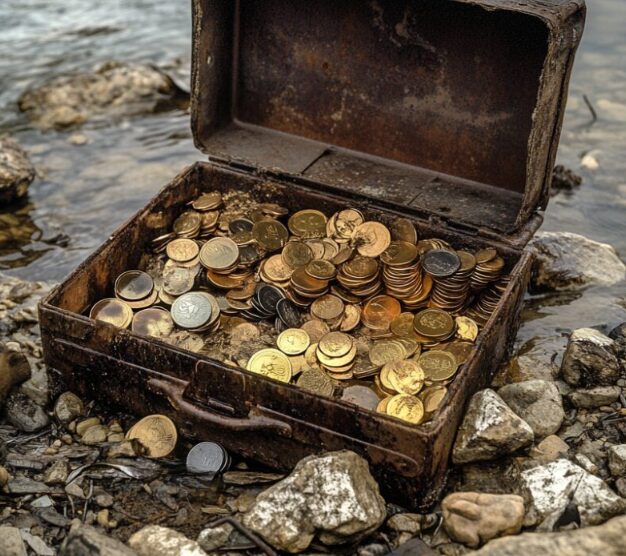
Have you ever wondered what treasures might be hiding in Kansas? From tales of outlaw loot to buried caches of gold, the state has its fair share of legendary lost fortunes.

The idea that millions of dollars could be hidden beneath the prairie is enough to spark anyone’s imagination. Every story comes with mystery, adventure, and a little bit of hope. And if you’re feeling bold, the thought of hunting for these riches is a thrill like no other.

Kansas may not be the first place you think of when it comes to treasure, but it’s home to some incredible stories. Who knows what secrets might be buried near an old homestead or lost along a dusty trail? It’s time to dig into the past and see what you might uncover.

The Incredible Treasures Of Kansas That Are Waiting To Be Discovered

These valuable and mysterious treasures remain out of reach, yet fascinating:

The Deadly Legacy of the Fleagle Brothers – $3,870,000+

The Fleagle brothers, Ralph and Jake, led a gang that terrorized Kansas, California, and nearby states in the 1920s. Their biggest heist was the 1928 robbery of the First National Bank in Lamar, Colorado, where they took $220,000.

The gang fled back to their ranch in western Kansas, where they buried a portion of the stolen money. After capturing a doctor to treat a wounded gang member, they murdered him, leading to an intense manhunt.

Jake was eventually tracked down and killed, while Ralph and the others were arrested and hanged. Over the years, some of their buried loot has been recovered in Nebraska, Kansas, and California.

How much the treasure would be worth today

If the Fleagle brothers’ hidden money were found, it would now be worth around $3.87 million.

Lost Silver of the Santa Fe Trail – $3,390,000+

In 1853, a trader named Jesus Martinez led a wagon train from Santa Fe to Independence, Missouri. Just four miles west of present-day Dodge City, the group was attacked by a large band of warriors.

After five days of fighting, the camp was overrun, and all the drivers except Martinez were killed. The attackers looted the wagons, set them on fire, and took the remaining stock.

Once the area was clear, Martinez uncovered 21 bags of silver coins, each worth $1,000, and buried them before escaping.

Years later, before his death, he told his son about the hidden silver, leading to a search in 1876. If the treasure were valued now, it would be worth over $3.39 million.

How much the treasure would be worth today

The 21 bags of silver coins buried by Jesus Martinez would be worth an estimated $3.39 million.

The Buried Fortune of Felix Goldman – $13,000,000+

Felix Goldman ran a stage station between Medway and Syracuse, Kansas, along the Arkansas River. When a suspicious stranger visited for three days straight, Goldman feared a robbery was coming.

He took no chances, burying his savings along with $17,000 in gold and silver coins from the station’s funds. Not long after, he was found dead, and authorities arrested a man named Tolliver.

The suspect swore he had not taken any money, leaving many to wonder what had happened to the hidden stash. Hamilton County, near the Colorado border, holds the history of this old stage station.

How much the treasure would be worth today

Over time, the value of Goldman’s buried fortune has grown to over $13 million.

The Untold Riches of Pawnee Rock – $773,000,000

For centuries, Pawnee Rock was an important gathering place for Native American tribes and a key landmark on the Santa Fe Trail. Travelers often stopped here to rest, resupply, and take advantage of the nearby Arkansas River.

As ambushes and robberies became common, many wagon train members buried their gold and silver before settling in for the night.

Some were killed in an ambush before they could retrieve their valuables, leaving countless hidden caches in the surrounding area.

Spanish expeditions, pioneers, and merchants traveling between Missouri and New Mexico are all believed to have left treasure behind.

Over time, the site was quarried for building materials, and its height was greatly reduced.

How much the treasure would be worth today

If recovered, this lost fortune could be worth about $773 million.

The Cherokee Badman’s Secret Stash – $3,000,000+

Henry Starr, known as the “Cherokee Bad Boy,” was a notorious outlaw who led a gang of bank robbers across Arkansas, Oklahoma, and Kansas. His crime spree began in 1892, and within a year, most of his gang had been killed or captured.

Starr himself was caught in Colorado while on vacation, but after multiple prison sentences, he continued robbing banks. Over his 32-year career, he claimed to have robbed 21 banks, stealing nearly $60,000.

He once said that the money from his early robberies was hidden “near the border in a place nobody could find it in a million years.” Many believe this stash is buried somewhere along the Cimarron River in Stevens County.

How much the treasure would be worth today

Henry Starr’s hidden loot would be worth over $3 million.

The Hidden Gold of Offerle – $15,000,000+

In 1851, a group of gold miners and their families were traveling back from California when they were attacked near present-day Offerle. As the ambush unfolded, they buried $90,000 worth of gold dust in a Dutch oven at the site.

The only survivor was an eight-year-old girl who was taken captive but later lived to tell the story. Years passed, and the tale of the hidden gold was passed down through generations.

In 1918, a woman claiming to be related to a survivor arrived in Kinsley with a map, hoping to recover the buried fortune. Despite her efforts, the exact location remained a mystery.

How much the treasure would be worth today

The fortune left behind by the ill-fated group of miners is estimated to be worth over $15 million.

Forgotten Riches of the Nemaha River – $3,000,000+

Two miners returning from the California gold fields in 1854 made camp near a ford in the Nemaha River. Before heading into Richmond for supplies, they buried two buckskin bags full of gold nuggets inside an empty powder can.

While in town, one of the miners was shot and killed, and the other barely escaped with his life. Fleeing toward St. Joseph, Missouri, he left the gold behind in his rush to get away.

Before joining the Union Army years later, he gave his wife a rough map of the hiding place, promising to retrieve the treasure after the war.

He never returned, dying early in the conflict, but his sons traveled to Seneca in 1889 to find the gold. However, they failed to locate the buried cache.

How much the treasure would be worth today

The estimated value of the two buckskin bags full of gold nuggets is over $3 million.

Chouteau’s Island’s Lost Silver – $8,000,000+

Chouteau’s Island, once a landmark along the Santa Fe Trail, was the site where $24,000 in silver coins was buried in 1828. The island sat in the Arkansas River, providing a stopping point for traders and travelers heading west.

Over time, however, the river’s shifting course caused the island to erode and eventually disappear.

Despite the changes, the hidden silver remained buried beneath what was once an important trading site. Lakin, Kansas, now lies just five miles northeast of where Chouteau’s Island once stood.

How much the treasure would be worth today

The lost Chouteau’s Island treasure would hold an estimated value of over $8 million.

The Stolen Army Paymaster’s Treasure – $24,000,000+

An army paymaster traveling from Lawrence to Denver was robbed of $195,000 in gold and silver coins around 1862. The stolen fortune was hidden between two sycamore trees near the Wakarusa River, just south of Lawrence.

This area in Douglas County was a well-known travel route during the Civil War era. Soldiers, settlers, and traders frequently passed through, making it a prime location for bandits looking for easy targets.

The paymaster’s stolen coins remained where they were buried, tucked away in a quiet stretch of land.

How much the treasure would be worth today

The lost treasure buried south of Lawrence would likely be valued at over $24 million.

The Lost Gold of the Solomon River – $309,000,000+

A group of Spaniards or California gold miners was traveling near Morland when they were attacked.

To keep their fortune safe, they threw a treasure chest into the Solomon River before fleeing. Over time, the river changed course, leaving the chest buried beneath dry ground.

Some believe the hidden fortune contained gold bars worth $400,000 at the time.

How much the treasure would be worth today

The gold bars thrown into the Solomon River could be valued at over $309 million.

The Stolen Wells Fargo Payroll – $4,000,000

A Wells Fargo office in Ellis was robbed of a $22,000 railroad payroll in 1870. The thieves made their getaway and stashed the stolen money near the limestone banks of Big Creek just outside of town.

This location provided plenty of cover, making it an ideal hiding spot for the stolen loot. Wells Fargo agents and local lawmen searched for the missing payroll, but the thieves had hidden it a little too well.

How much the treasure would be worth today

If recovered, the missing money from the Ellis robbery would be worth around $4 million.


How did the Kansas City Chiefs get their name? A fake tribe, a fan contest and Lamar Hunt.

0
Kansas City Chiefs’ third consecutive Super Bowl appearance, the team name, logo, and some problematic fan customs like the “tomahawk chop” are once again being broadcast worldwide. But where did it all start, and how did the team avoid becoming the Kansas City Texans?

If things had gone differently, Kansas City football fans could have been rooting for the Kansas City Texans.

Other ideas on the table? The Kansas City Mules, the Kansas City Stars or — how about the Kansas City Royals, only as a football team?

As the Chiefs have entered dynasty status with more presence on the international stage, local apparel companies have made products featuring made-up mascot names like the Villains or the Chefs.

The origin of the Kansas City Chiefs moniker goes back to 1963, a decision connected to the region’s Native American heritage, a boisterous mayor, a fan-driven newspaper contest, and Lamar Hunt — the man also credited with naming the Super Bowl.

“He loved everything about sports: the competition, the pageantry,” says writer Michael MacCambridge, author of “America’s Game: The Epic Story of How Pro Football Captured a Nation” and “’69 Chiefs: A Team, a Season and the Birth of Modern Kansas City.”

Hunt was the son of a very rich oil man and played football himself.

“He was shy by nature. The place where he found refuge was sport,” says MacCambridge.

In 1960, Hunt started the American Football League and ran the Dallas Texans, one of three pro football teams in the state at the time. Within two years, he realized this was too much competition, and he began casting a net for places to relocate.

Many city leaders saw this as a huge opportunity, and heard Hunt was scouting in places like New Orleans.

“At one point the mayor of Kansas City, H. Roe Bartle, learned that Lamar had been in Atlanta, scouting that out,” says MacCambridge. “He flew directly to Dallas and sat down with Lamar in his office and said, ‘Please consider Kansas City.’”

Mayor Bartle made a compelling case to Hunt: There were no other pro football teams in the area, and the business community would support the team by promising to sell a certain number of tickets.

So Hunt announced he’d move the team to Kansas City.

What’s in a nickname?

Bartle was as big as a linebacker and loved cigars. He was also a lawyer, philanthropist, and had been a leader for the Boy Scouts, where he landed his nickname “the Chief.” Bartle was not Native, but claimed to be inducted into an Arapaho tribe and said he was given the name “Chief Lone Bear.”

It’s just one of the many things Gaylene Crouser takes issue with about him.

“He was the founder of the Tribe of Mic-O-Say, which is not an actual federally-recognized tribe of American Indians,” says Crouser, executive director of the Kansas City Indian Center. “It’s a made up tribe.”

Crouser is a citizen of the Standing Rock Sioux Tribe, Hunkpapa and Oglala, and also a member of the group Not In Our Honor, which has called for decades for the Chiefs to change their name.

The Mic-O-Say group, which still exists in Missouri today, claims on their website they blend aspects of American Indian heritage with the ideals of scouting.

The state of Missouri’s history with Native American tribes is another point of pain for Crouser. The state violently discriminated against tribal people, forced them to relocate, and did not allow them to speak their languages or practice their customs.

“It adds insult,” says Crouser. “The whole fact that not only are you bastardizing our culture, you are doing it in a state that didn’t want us to be here.”

It’s not clear if, at the time, concerns like Crouser’s ever made it to owner Lamar Hunt, the ultimate decision maker. At first, Hunt was set on keeping the name the Texans.

“He felt it was intrinsic to the team’s identity,” says MacCambridge.

Hunt was eventually swayed, and announced a “Rename the Dallas Texans contest” in the Kansas City Star, which received more than 4,000 submissions and more than 1,000 ideas.

If Hunt had gone with the most popular entry, Kansas City fans would be cheering for the Mules.

Instead, he landed on the Chiefs for a few reasons, according to the Kansas City Call: to honor the region’s Native American heritage, because of Bartle’s nickname, and because it was classy, short and would look good in a headline.

Hunt was also the idea-man behind the Chiefs’ red and gold team colors, which were his second choice. (His first choice was Columbia blue and white.) Inspired by the look of the San Francisco 49ers helmets, Hunt created the arrowhead logo with the intertwined letters K and C.

Moving forward and scaling back

Another, more problematic, early Chiefs logo showed a cartoon Native American character in full headdress running across a map of the Kansas City region. The team eventually got rid of that one and, over the decades, have scaled back on other offensive logos and imagery.

But fan practices like the “tomahawk chop,” which started in the 1990s, continue to be a point of frustration for activists calling for change.

The chop and chant got started at Florida State University football games, then the Atlanta Braves baseball team adopted it. Eventually, it was performed at a Chiefs game by a Northwest Missouri State University marching band, and it caught on with fans.

“It’s just unacceptable in this day and age,” says Crouser. “And frankly, Kansas City deserves better than that.”

Twenty years ago, the American Psychological Association released a recommendation that all Native American imagery and mascots in sports should be changed. As a response, sports organizations and teams at all levels have scaled back or completely changed their mascots and logos.

In 2020, the Chiefs organization announced they would ban headdresses and face paint inside Arrowhead Stadium. In 2021, they retired Warpaint, a horse mascot that would run around the field after touchdowns.

Team leaders have said they want to honor Native American heritage of the region, and they formed an American Indian Community Working Group to “promote an awareness and understanding of Native cultures and tribes,” according to their website.

While no real plans for a name change are on the docket, MacCambridge, a lifelong fan, has an idea to throw in the hat.

“I would have no problem being the Kansas City Wolves,” he says.

Crouser offers a different thought, which plays into the original history of the naming of the team.

“Maybe they should, again, do a contest and see where people are with it,” she suggests.

A few years back, the alt-weekly magazine The Pitch asked Kansas Citians for their ideas — from Kansas City Crowns to the Reds.

And who doesn’t get inspired by some of the spin-off schwag fans have taken upon themselves to create — especially those “Chefs” shirts, which are an homage to that original Snickers commercial of the ‘90s.

If there’s one thing to learn from the past, it’s that things like names and trends aren’t set in stone. They can evolve and change.

This episode of A People’s History of Kansas City was reported by Suzanne Hogan, and produced by Suzanne Hogan and Olivia Hewitt, with editing by Luke X. Martin and Mackenzie Martin.