Thursday, January 29, 2026
Home Blog Page 227

“Its Here”

0

Lately I’ve been reminded of a blockbuster movie from my youth. It contains a scene that even those who never saw the film are likely to recognize. A sleeping family is jolted awake, and from the foot of the bed the young daughter sings “they’re here!”

One might wonder why I’m thinking so much about Poltergeist. That quote started ringing in my brain during our last monthly clinic meeting, when our lab director reported on the previous day’s influenza statistics. Nearly 90% of the tests were positive. Respiratory viruses may not seem like a natural comparison to malevolent ghosts, but they’re here, and things are likely to get worse before they get better.

Last season, there were over 20,000 confirmed cases of influenza in South Dakota. Over 800 people were hospitalized. Nearly 50 died.

When I diagnose someone with influenza, I warn them to expect misery. They will likely have fevers, body aches, exhaustion, and of course cough. Some people are out of commission for only a few days, others for two weeks. Some people can barely get out of bed, and some people just feel a bit run down.

The flu shot helps, but it is far from perfect. People who get the shot can still get influenza. Generally it is between 40 and 60% effective at preventing infection. Still, those who had the shot and get sick anyway are significantly less likely to be hospitalized. So long as influenza is circulating you should still get your shot. It isn’t too late even if you already had influenza, as the shot contains 3 different strains.

Of course, things like washing your hands, not touching your face, and avoiding sick people are also useful. It can be hard to distinguish one respiratory virus from another.

Influenza tends to strike more suddenly than many others, but symptoms have significant overlap. Testing is the best way to distinguish whether or not your illness is influenza. Influenza is also one of the few viruses for which we have specific treatments, so getting that answer can be useful. Treatment is generally used for those at higher risk, such as young children, people over 65, those who have chronic health conditions or are pregnant. Importantly, medicine should be started within the first 48 hours of illness.

So what can you do if you get sick? First, stay home! Get lots of rest. Drink lots of fluids. Fever reducers and over the counter pain medications can help you be more comfortable. Pseudoephedrine can help the congestion. Guaifenesin can help thin the mucous. Dextromethorphan or honey can help soothe the cough.

Finally, watch out for signs that you are getting sicker instead of better. Influenza can lead to ear infections, sinus infections, pneumonia, and things that are even more serious, like bloodstream infections, inflammation of the heart or brain, and kidney failure. If something doesn’t seem right, get it checked out.

Debra Johnston, MD. is part of The Prairie Doc® team of physicians and currently practices as a Family Medicine Doctor at Avera Medical Group in Brookings, South Dakota. Follow The Prairie Doc® at www.prairiedoc.org, Facebook, Instagram, YouTube and Threads. Prairie Doc Programming includes On Call with the Prairie Doc®, a medical Q&A show (most Thursdays at 7pm streaming on Facebook), 2 podcasts, and a Radio program (on SDPB), providing health information based on science, built on trust.


Wheat Scoop: Kansas Wheat teams up with K-State under new grant to increase adoption of conservation practices

0
Kansas Wheat

For the audio version, visit kswheat.com.

The echoes of the 1930s Dust Bowl are most evident in the commitment of each subsequent generation of Kansas farmers to care for the land on which their livelihoods depend. A $1 million dollar grant from the National Fish and Wildlife Foundation (NFWF) – recently awarded to K-State and Kansas Wheat – provides dedicated resources to aid these efforts by helping farmers navigate Farm Bill programs and implement proven conservation practices that best fit their winter wheat acres.


“This program is really about conservation programs and practices that include winter wheat as part of a sustainable crop rotation,” said Aaron Harries, Kansas Wheat vice president of research and operations. “This is an opportunity that will benefit the farmer and bring attention to the role of winter wheat as a very important conservation tool in High Plains cropping systems.”


The NFWF grant will fund a three-year project, kicking off in 2025, that focuses first on sharing information about the benefits of conservation practices. Led by Harries and Romulo Lollato, K-State associate professor of wheat and forage production, the project aims to advance crop management priority strategies, including reduced tillage, increased adoption of cover crops and diversified crop rotations and improved nutrient management. These practices have well-documented outcomes in helping improve soil health, reduce erosion and conserve water and carbon.


Reflective of the private-public partnership integral to the grant, the project also includes working with certified crop advisors (CCAs) to train them on how to advise farmers on conservation practices. Kansas Wheat and K-State will also work with the USDA’s Natural Resources Conservation Service (NRCS) in Kansas to help increase engagement with and enrollment in Farm Bill programs like the Environmental Quality Incentives Program (EQIP) and the Conservation Stewardship Program (CSP).


Equally as important, the grant will provide additional capacity to help producers enroll in these Farm Bill programs that provide financial assistance for implementing the practices. The grant provides for two full-time staff members to help work one-on-one with growers and CCAs alike across Kansas. This outreach will complement K-State Research and Extension work by including targeted conservation discussions during wheat-related producer field days, pre-plant wheat meetings and other conferences and meetings.


“We intend to work with groups like CCAs to set up educational programs to train these experts and help them identify farmers that might have the potential to enroll acres,” Harries said. “Some of those programs can seem intimidating, so we’re going to help work to make it as easy as possible and work with producers on a case-by-case basis to identify which conservation practices fit best and to navigate the enrollment process.”


The new project supplements the existing partnership between K-State Research and Extension and Kansas Wheat, called Wheat Rx, which disseminates the latest research recommendations for high-yielding and high-quality winter wheat to Kansas wheat farmers. The work will also be housed at the Kansas Wheat Innovation Center (KWIC) in Manhattan, another tie back to the commitment by Kansas wheat producers to invest in the future of their industry.


Keep up with the NFWF grant work as the project kicks off in 2025 and find additional resources at kswheat.com/wheatrx.


###


Written by Julia Debes for Kansas Wheat

Drought Tolerant Trees

0

We seem to have broken out of the drought of the past few years and I am thankful for that. The days of high temperatures and little rainfall have taken its toll on trees in many parts of the country. Even drought tolerant trees become stressed after several years without sufficient water, especially in soaring summer temperatures. We are assessing the damage to our trees to check for the dead and dying ones.


You need to find out whether trees near your home or other structures are dead as early as possible. Dead or dying trees can topple in winds or with shifting soils and, when they fall, can cause damage. It is important to learn how to tell if a tree is dying or dead.


Obviously, the first “test” for determining the status of a tree is to inspect it. Walk around it and take a close look. If the tree has healthy branches covered with new leaves or leaf buds, it is in all likelihood, alive.

If the tree has neither leaves nor buds, you may wonder: “is my tree dead or alive.” There are other tests you can do to tell should this be the case.

Bend some of the smaller branches to see if they snap. If they break quickly without arching, the branch is dead. If many branches are dead, the tree may be dying. To make a determination, you can use the simple tree scratch test. Just beneath the dry, outer layer of bark in a tree’s trunk lies the cambium layer of bark. In a living tree, this is green; in a dead tree, it is brown and dry.

Scratching bark to see if the tree is alive involves removing a little bit of the outside layer of bark to get a look at the cambium layer. Use your fingernail or small pocketknife to remove a small strip of exterior bark. Don’t make a large wound in the tree, but just enough to see the layer below.

If you perform the tree scratch test on a tree trunk and see green tissue, the tree is alive. This does not always work so well if you scratch one single branch, since the branch may be dead but the rest of the tree alive.

During times of severe drought and high temperatures, a tree may “sacrifice” branches, allowing them to die in order for the rest of the tree to stay alive. So if you’re choosing to do a scratch test on a branch, choose several in different areas of the tree, or simply stick with scraping the tree trunk itself.

Farm to Early Care and Education Opportunity for Kansas Licensed Early Child Care Facilities

0

The Kansas Department of Agriculture, in partnership with the Kansas Foundation for Agriculture in the Classroom, is now accepting applications from Kansas licensed early child care facilities to participate in a program to increase child nutrition knowledge and consumption of local fruits and vegetables.

The program, titled “Our Earliest Eaters: Bringing the Farm to Kansas Licensed Early Child Care Facilities,” will provide Kansas licensed early child care facilities with age-appropriate curriculum about Kansas specialty crops and reimbursements for purchasing locally grown fruits and vegetables. Through a competitive application process, 50 facilities will be selected to receive agricultural education activities and resource kits developed by the Kansas Foundation for Agriculture in the Classroom at no cost. Upon demonstration of teaching the provided curriculum, the selected facilities will receive reimbursement of up to $250 per growing season to cover the costs of purchasing fruits and vegetables grown by Kansas farmers and producers to use in the provided educational activities as well as serve in their meal programs.

KDA will help the selected licensed early child care facilities identify farmers and producers local to their facility to purchase healthy fruits and vegetables from. By building relationships between licensed early child care facilities and local farmers and producers, this program will increase nutrition knowledge and consumption of specialty crops in our earliest eaters, while creating new market outlets for Kansas specialty crop producers.

Applications are due to KDA no later than 5:00 p.m. CT on Friday, February 28, 2025. For more information, please visit “Our Earliest Eaters at: www.agriculture.ks.gov/grants.

Funding for this program was made possible by the Specialty Crop Block Grant Program from the U.S. Department of Agriculture Agricultural Marketing Service.

The vision of the Kansas Department of Agriculture is to provide an ideal environment for long-term, sustainable agricultural prosperity and statewide economic growth. The agency will achieve this by advocating for sectors at all levels and providing industry outreach.

B-29 DOC and WSU TECH Foundation announce Pull a Plane 2025 event

0

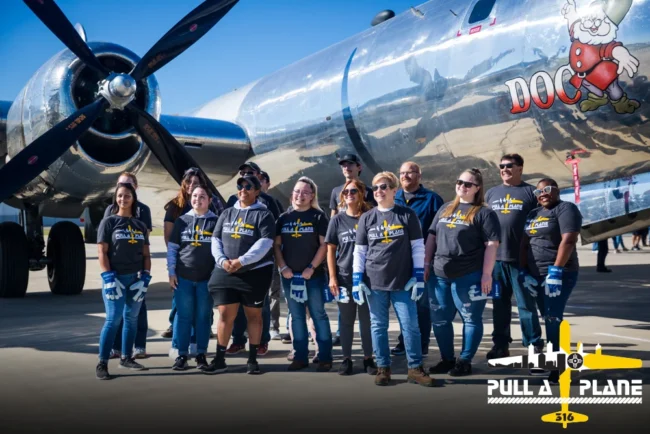
B-29 DOC and the WSU TECH Foundation will host the fourth Pull a Plane for Education, March 8, 2025, at the B-29 DOC Hangar, Education and Visitors Center.
The event raises funds for WSU TECH student support, creating career opportunities in aviation and beyond. Additionally, it supports the upkeep of B-29 DOC, ensuring it remains airworthy and serves as a living museum to honor the Greatest Generation and celebrate Wichita’s rich aviation heritage.
“Scholarships are the bridge to opportunity, empowering students to pursue meaningful careers that drive innovation and strengthen our community,” said Courtney Sendall, WSU TECH Foundation executive director. “Every dollar raised is a step toward breaking barriers and opening the door to dreams that soar beyond limits for aviation and other technical careers, while at the same time, helping to keep history alive and funding DOC’s mission as a flying museum.”
Each team of 25 people will raise a minimum of $2,500 to participate. Proceeds of the fundraiser will be shared between the WSU TECH Foundation (to finance student-focused initiatives) and DOC’s Friends (to help broaden DOC’s operations and hangar education program). The individual who raises the most donations for the event will be rewarded with a ride in B-29 DOC.
“We are excited to partner with WSU TECH Foundation once again to host this unique event that will help build a solid future for technical education students in Wichita while ensuring raising funds and awareness for DOC’s continued mission to honor, educate and connect,” said Josh Wells, B-29 DOC executive director. “The funds raised by Pull a Plane support student success in aviation and other technical careers, ensuring the next generation of aviation workers not only continue to hold Wichita’s claim to the Air Capital of the World, but also ensure warbirds like DOC have qualified mechanics to keep them flying for generations to come.”
Team and individual registration is open now via www.PullAPlane.com. Sponsorship opportunities are also available.