Starting Onions Indoors
From Aardvarks To Zebras
I don’t usually do obituaries but I’d like to make an exception in this case because the deceased is, and was, a childhood hero of mine.
If you know anything at all about horses you’ll recognize the name Dr. Robert Miller who died at 97 years of age on November 16, 2024. (The way deadlines fell this is the soonest I could get the news of his passing to you.) Dr. Miller didn’t die at the peak of his obituary value because he outlived his contemporaries but in my opinion he certainly deserved more mention in the animal press than he seems to have gotten.
I’ve known his name ever since high school because the world renowned large and exotic animal veterinarian founded the Conejo Valley Veterinary Clinic which was the first large animal practice in the region. His animal hospital received the American Veterinary Hospital Association’s Animal Hospital of the Year award in 1969 and was about 30 minutes from where I grew up on the northern edge of southern California.
I don’t know who was a more famous veterinarian, Dr. Miller or Baxter Black, but both left a lasting legacy in the print media, let alone all their other accomplishments. During his 50-year-plus career, Dr. Miller authored 23 books on equine health and behavior, a memoir called “Yes, We Treat Aardvarks” that should be in the library of everyone who loves animals and good clean humor. He contributed to numerous veterinary and equine publications like Western Horseman and also served on the editorial staff of Veterinary Medicine and was the magazine’s long-running “Mind Over Miller” columnist. Working well into his nineties Dr. Miller was a prolific veterinary and cowboy cartoonist and humorist who went by the moniker “RMM.”
With all this exposure you can imagine my shock when he called me up once to find out how I had become a syndicated columnist because he wanted to do the same. I was amazed that this famous writer, who was often referred to as America’s James Herriot, felt he hadn’t already done enough for one lifetime.
But it wasn’t just his writing that Dr. Miller will be remembered for. He was the “father of foal imprinting” and traveled the world revolutionizing the concept of imprint training and early learning as it pertains to newborn foals and for being an early adopter of relationship-based horsemanship, a movement that involves handling, training, and riding equines using humane, scientifically proven, noncoercive methods. As a practitioner and clinician, Dr. Miller visited six continents conducting horsemanship clinics and teaching imprint training, which has been implemented in stables, breeding programs, zoos, wildlife sanctuaries, and game preserves worldwide. He continued to travel, write, and lecture into his nineties.
Even that is not why and how I knew of Dr. Miller. Growing up I frequently read stories in our local newspaper about Dr. Miller saving the life of all kinds of animals from A to Z. From aardvarks to Zebras. Speaking of newspapers, he once did a rumenotomy on a bison to remove a swollen copy of the liberal LA Times. The massive Sunday edition had caused a near fatal impaction of the rumen and I’m sure the bison was very ill after trying to digest the slop printed by the Times.
Dr. Miller had notable clients including Circus Vargas, Jungleland, and Pacific Ocean Park and when Hollywood had a sick animal on their hands it was Dr. Miller they called. He was instrumental in helping advance the practice of veterinary medicine on all manner of domestic and exotic species. Reading about some of those episodes and encounters I think is one reason why I wanted to become a veterinarian as a youngster. When I saw the lions at Jungleland I was amazed that anyone would even consider being in the same cage with them.
Dr. Miller was a brilliant man with great compassion, wide-ranging interests, and insatiable curiosity, who loved and lived life to the fullest up until his passing. He died holding the reins of his favorite mule, Scooter, and is survived by his wife of 68 years, Debby. I’m sure all the animals he saved and the horses he made life better for threw Dr. Miller one great big celebration of his life once he passed through St. Peter’s gate.
Starting Garden Transplants from Seed
Lettuce Eat Local: Unusual Ubleck
Amanda Miller
Columnist
Lettuce Eat Local
A description of Scattergories came up in a parenting book I was reading the other day, and I recalled how much I love that game.
Above all when acquaintances allow my admittedly ample alliterative adjectives. If you’ve never played, play goes by rolling an alphabet-sided die, and then coming up with answers to categories that begin with that letter before the timer beeps. The more alliterative words, the more points — as long as everyone else agrees the utilization is appropriate and not overdone. I am gleefully guilty of often being ridiculous, simply because I can.
The gift of vocabulary verbosity can come in handy other times, too. My column’s theoretical alphabet die has rolled U this week, and the difficulty of culinary u-sage came as a surprise to me. I expected to be limited on my options for letters like J and Q; while the upcoming V and Z won’t have a big selection of options, at least we know there’s vanilla and zucchini.
But what is there for U? I didn’t go through all my cookbooks’ indices, but the armful of ones I did check had literally nothing listed for the absent 21st letter. The only thing I thought of was uni, which is the edible part (the reproductive organs) of sea urchins — I’ve never had this upscale luxury and never expect to, nor do I anticipate ever seeing it at my local Dillons.
Speaking of upscale, that’s when I started to wonder if I needed to employ my adjectival skills and get to U by just modifying other foods with words like upscale, unripe, underbaked. It would have worked, because no one but myself is making me alphabetize like this, but it seemed a little underhanded. Ugandan or Uruguayan food was on the proverbial table, as was ugali (thick white cornmeal we ate a lot in Kenya).
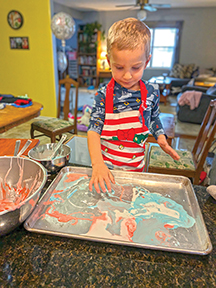
I was still pondering these things as I cleared off the counter in preparation for making slime with Benson. It was Saturday, a few days post-Christmas/Ohio vacation as well as blustery and pre-blizzardy, and the kid needed a low-key yet entertaining activity. I had found a big container of cornstarch when putting some stuff away downstairs, and Benson helped make it by carefully pouring the water into the mixing bowl. Even stirring it together begins the strange fun of this non-Newtonian fluid that seems to break the laws of science: its viscosity changes as pressure changes, its behavior particularly mysterious to a three-year-old. Hard touches make it almost solid; a gentle touch turns it into quicksand.
Also known as oobleck, this simple craft fascinates even me, although I don’t love the feeling of the cornstarch. Benson, however, was utterly absorbed in it (fortunately not physically, although that’s also probably technically debatable since his hands were fully covered). I’m not sure we’ve had a quieter hour in…the last year? And I mean 2024, not the few days of 2025. He played and played and played. We made a few different colors, and he lived in his own happy messy world with just some plastic animals, little cups, a strainer. It was unnerving and magical.
I’m sure it’ll never go that well again, but that recipe was certainly a winner.
Particularly since I remembered the value of umlauts and oobleck’s potential alternate spelling as übleck. U r welcome.
Unpalatable Übleck
This recipe is not unedible, since it’s cornstarch and water, but I would not recommend ingesting any quantity as far as flavor goes. My kids both tasted it of course, but their opinions are not always valid. It’s unconventional to share a recipe not intended for consumption, but not unpleasant in this case. I hope it affords your kids/grandkids (or yourself, I don’t judge) some fun this wintery week!
Prep tips: the mess can look a little terrifying, but it cleans up very easily with just a little water and soap. It’s not recommended to go down the drain in large quantities, but you can let it dry in a bowl/on a baking tray and toss it in the trash when it’s powdery — or add water and play with it again like Benson insisted we do.
2 cups cornstarch
1 cup water
a few drops of food coloring
Add cornstarch to a large bowl, and stir in water. Divide if desired, adding coloring. Play! Stick your hands in it, drizzle it on a tray to “paint,” submerge animal figures in it, etc.