Thursday, February 5, 2026
Home Blog Page 337

Drought, dry conditions pushing crops and hay

0

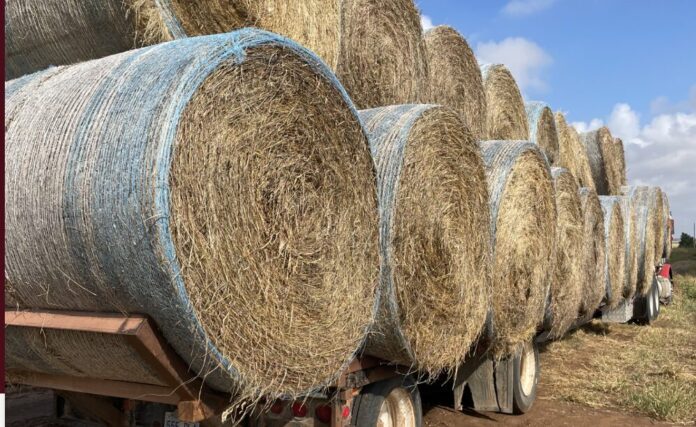
Drought and dry conditions in the western two-thirds of the state have dryland crops burning up, and alfalfa headed into dormancy, according to the Kansas Department of Agriculture-USDA Market Service, Aug. 6.

Although movement picked up a bit, demand remained very light as feed yards are still not buying. Even despite the setbacks to the hay crop, there is still large amounts of old crop hay available. Premium and supreme quality hay is more in demand but seems to be hard to find. Prices are based on averages and given on a per-ton basis, unless otherwise noted.

Southwest—Demand light. Trade activity is slow. Dairy alfalfa prices are steady. Grinding alfalfa price mostly steady and ground and delivered alfalfa price steady. Alfalfa: Dairy, $1.15-$1.25/point RFV. Good, stock or dry cow $120. Fair/good, grinding alfalfa, large rounds $100-$110, large square 3×4’s and 4×4’s $105-$115. Ground and delivered locally to feed lots and dairies $155-$160. Sudan large rounds and large squares $60-$70. Teff, small squares $9/bale, large rounds $130-$140. Wheat straw: large rounds and large squares $95-$110 delivered. For the week ending Aug. 3, 4,121 tons of grinding alfalfa and no dairy alfalfa was reported bought or sold.

South central—Demand light. Trade activity is slow. Dairy alfalfa prices are steady. Grinding alfalfa price mixed. Ground and delivered steady, and alfalfa pellet price steady to $5 lower. Alfalfa: Dairy $1.15-$1.25/point RFV. Good, Stock cow, none reported. Fair/good grinding alfalfa, large rounds $115–$125 delivered, 3×4 and 4×4’s $115-$125 delivered. Alfalfa ground and delivered $150-$160. Alfalfa pellets: Sun cured 15% protein $250-$260, 17% protein $265-$275, Dehydrated 17% protein: $370-380. Grass hay: Bluestem, large rounds and large squares $120-$130. Brome, rounds and squares $100-$120. For the week ending Aug. 3, 9,156.5 tons of grinding alfalfa and 950 tons of dairy alfalfa was reported bought or sold.

Southeast—Demand light. Trade activity is slow. Bluestem and brome hay price, largely unchanged. Alfalfa: horse or goat, none reported. Dairy, none reported. Good, stock cow, new crop $130. Fair/good grinding alfalfa, none reported. Bluestem grass hay, old crop small squares $180-$200, large round, $130-$140, large square, 3×4 and 4×4’s $130-$140. Brome, medium 3×3 squares $150-$175, large rounds $130-$140, large 3×4 and 4×4 squares $130-$140. For the week ending Aug. 3, 510 tons of grass hay was reported bought or sold.

Northwest—Demand light. Trade activity is slow. Grinding alfalfa prices are steady. Premium horse alfalfa, small squares, $310, good small squares $290. Alfalfa fair/good old crop, 3×3 squares, $120, Fair/good grinding alfalfa, $100 per ton. Sudan large rounds none was reported.

North central/northeast—Demand light. Trade activity is slow. Dairy alfalfa price is steady, grinding alfalfa steady, ground and delivered steady, and grass hay $5-$20 lower. Alfalfa: Dairy $1.15-$1.25/point RFV; Horse hay, premium small squares $12/bale; Stock Cow good, 3×4’s $145-$150; Fair/good, grinding alfalfa, large rounds $85-$95, large square 3×4’s none reported. Alfalfa ground and delivered $150-$160. Bluestem grass hay, small squares, $8-$9/bale, large rounds, $90-$100, large 3×4 and 4×4 squares, $130-$135. Brome, small squares, $10-$14/bale, large rounds, $110-$120, large squares, $125-$135. Wheat straw, large rounds, $60-$70. For the week ending Aug. 3, 782 tons of grinding alfalfa and 188 tons of dairy alfalfa was reported bought or sold.

Crush facility opens doors for canola growers

0

Canola is not a new commodity, but opportunities may help sway growers to consider it in their rotation as Scoular Grain has expanded its operation in northwest Kansas.

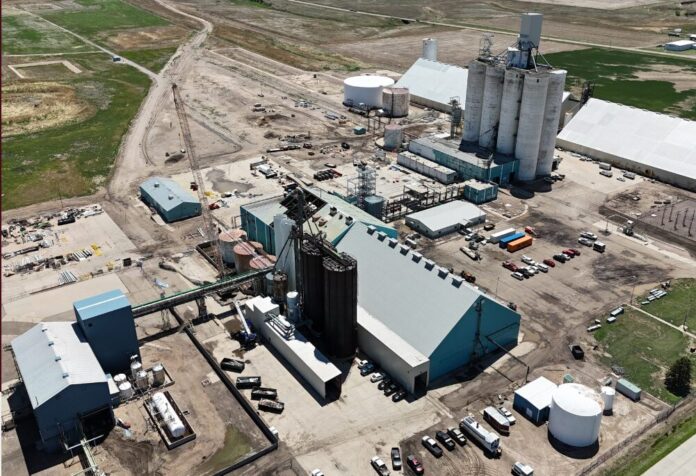
Scoular Grain’s canola and soybean crush facility (pictured above), located 5 miles west of Goodland at Caruso, is on track to launch full operations this October. Jeff Frazier, Scoular Grains market development manager, said one opportunity for growers to expand their marketing portfolio could include canola. Canola is planted in early September through October, depending on the region, he said. Canola planted this fall would be harvested in summer 2025.

Canola can be harvested two ways, he said. Farmers can cut it with a combine similar to wheat, or it can be swathed and about a week later picked up with a combine.

“One of our key initiatives is we want to eventually grow the program to 400,000 acres as we have a capacity for 11 million bushels a year,” Frazier said, adding that the company plans to be patient. “It is more important to us to get it right. Education is paramount, and that starts with letting producers know about potential benefits.”

Jeff Frazier is Scoular Grains market development manager. (Courtesy photo.)

Canola for the 2025 crop year currently offers a delivered crush bid of $11.20 a bushel, which is much higher than wheat. Dryland canola produced about 30 bushels per acre in 2024. Under ideal growing conditions, researchers say it has the potential to reach 60 bushels per acre.

Frazier said Scoular’s approach has been to work with growers and outline opportunities and answer questions.

That includes an arrangement so that if a producer cannot grow a crop due to circumstances beyond their control, typically called an “act of God,” Scoular will not force the farmer to buy off the open market to fulfill a contract. If the grower, as a starting point, wants to commit to delivering 5,000 bushels, that might be the right approach for him.

“We understand there is a lack of crop insurance to cover canola, so we want to provide our growers with ways to avoid risk and worry,” Frazier said.

The company will also have unloading sites at several towns in Kansas, including Cullison, Wellington, Coolidge and Horace. Growers can also develop their own on-the-farm storage or work with third-party elevators. The company has made a long-term investment in the processing plant because the venture is going to be “more of a marathon than a sprint,” Frazier said.

“We are in it for the relationship and we won’t be a fly-by-night operation,” he said.

Scoular retrofitted the facility so it can handle both soybeans and canola.

“We have a large footprint in soybeans, and crushing soybeans provides stabilities,” Frazier said.

Being located near Goodland made sense when Scoular purchased the facility from ADM several years ago. Frazier liked the idea that farmers in that region can have marketing options for their crops.

Renewable diesel and renewable markets have grown in importance, Frazier said.

“The renewable market is not going away any time soon,” he said. “With other commodity prices depressed, right now canola can be a viable option.”

He also believes that producers can benefit from canola to boost soil health, and he noted that a Kansas State University study that said wheat following canola has been known to push yield 10 to 20% when compared against continuous crop wheat.

For more information, he encouraged producers to visit the company’s website at www.scoular.com.

Lettuce Eat Local: A Toast To French’s Toast

0

Amanda Miller
Columnist
Lettuce Eat Local


I heard the bedroom door pop open with its all-too-familiar snap, and the tentative yet determined footsteps led straight to me in the living room. Benson crawled onto the couch next to me, looking up at me with those blue eyes. “I really miss Papa, Brecken, Callahan, and Mary Beth,” he said plaintively, “so I should probably watch Olympics.” 

While I’m not entirely sure of his logical sequence, it worked on me for the few minutes until Brian came in from pushing feed. Benson is fairly screen-naive, but we have only a limited two-week window of opportunity here. Also it’s the Olympics, so it’s good wholesome tv, right? 

Five minutes of my three-year-old watching judo told me that is absolutely not a correct assessment of the situation. We do not need any more encouragement for him to be crazy, and his new high kicks looked a little too inspired. You should have seen his face when we turned the tv on once in the middle of a wrestling match. “Mom!! They’re wrassling!” 

Now I know there were other parts and aspects of the Olympic Games that would not be considered wholesome. I’m thinking specifically of this year’s controversial opening ceremony scene, which fortunately I did not see. I won’t delve into any of that, but of course since the games were held in Paris, I’ve been thinking about French food. I like any excuse to focus on some global cuisine, although these last couple weeks have been busy enough that I have fallen regrettably short on bringing Paris to our table. 

That said, we did have some French food…French toast. You may or may not know that French toast isn’t necessarily as associated with France as the name would suggest, unlike one of our bonus kids for the weekend who quizzed me, “Do you know where French fries come from? From French!” 

There is a version of what we Americans call French toast in France, although naturally English would not be the language they would use; there it is deliciously poetic pain perdu, meaning “lost bread.” But this leftover bread soaked in milk and eggs, then fried and topped with a sweet drizzle, apparently is mentioned as far back as 4th century Rome. It’s been the perfect pantry dish for coming up on two millennia! 

The reason the United States calls this preparation French toast, however, is not even related to the European continent. I was intrigued to learn that the title comes from a New York hotel manager in the early 1700s, Joseph French. He put “French’s toast” on his menu, but somewhere along the way we lost the apostrophe and s — and voila, French toast! 

It’s one of the few/possibly only ways Brian appreciates repurposed “lost bread,” and he puts enough peanut butter on it to make it have at least some protein. I love making bread with wheat flour from our fields, and living on a dairy farm and raising chickens makes the milk and eggs bit a given. Serving it with fresh whipped cream and plain yogurt only requires more pantry staples, so it’s a great dish to make on the fly. Benson loves anything with honey or syrup of course, and has been super into cracking eggs (fortunately only at my request so far), so he gives it a thumbs up as well.

As long as he doesn’t start using his new judo skills to help.


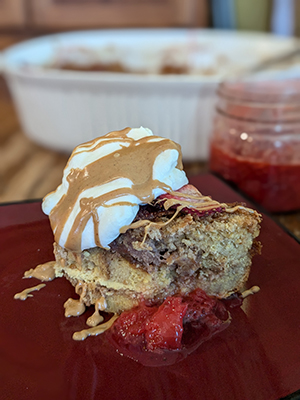
Peanut Butter & Jelly Baked French Toast

I had seen a recipe for pb & j cobbler, so I had peanut butter and jelly mash-ups on the brain when I also had a lot of leftover multigrain bread from a catering gig. I knew the time was right to work up a pb & j french toast, and this might even merit a place on the medal podium. It was so easy and handy, and fun to make with that homage to everyone’s childhood favorite sandwich. I loved the layers of peanut butter running through it all, especially complemented by the sweet, luscious strawberry jam. 

Prep tips: I prefer a good hearty bread to add both flavor and texture. Try this with different berries if you like. 

10 slices of bread of choice, about 1 pound

6 oz peanut butter of choice, plus more as desired

1 lb strawberries

½ cup white sugar

6 eggs

2 cups whole milk/cream

2 T syrup

dash salt

Toast bread; spread with peanut butter; layer into a 9×13” baking dish. Meanwhile, roughly chop remaining berries in a medium saucepan, add the sugar, and cook over medium heat for several minutes, until juicy and jammy. Reserve about a cup, and spoon the rest of the strawberries over the bread. In a mixing bowl, beat eggs; then whisk in milk, syrup, and salt. Slowly pour this over the bread, letting it soak in. Cover and refrigerate for several hours/overnight. When ready to bake, preheat oven to 375°. Bake uncovered for about 45 minutes, until just set in the center. Serve with reserved strawberry jam-sauce, more peanut butter, and whipped cream. 

Daughter Verena Shares Her Experiences

0

Lovina’s Amish Kitchen
Lovina Eitcher,
Old Order Amish
Cook, Wife &
Mother of Eight

Hello, this is Lovina’s daughter Verena writing. I was in one of those writing moods, and I heard Mom saying that she wished someone would write the column for her, so here I am.

Today, eight years ago, my sister Susan married Mose. They had two children together. I moved in with Susan for two years after Mose passed. It was very heartbreaking to watch Susan struggle with her loss. I remember staying up with her most nights just talking because she could not sleep. Susan married Ervin, who had three children and had lost his wife to cancer. Ervin and Susan could feel for each other and understand each other, and that brought a connection between them. I am thankful that God blessed us with Ervin and his three children that we consider family now. 

On July 19, my boyfriend Daniel and I decided to have a campout with my nieces and nephews and his younger siblings. There were five of his siblings: Andrew, 14, Anna, 12, Kenneth, 11, William, 7, and Alvin, 5. My sister Liz’s children Abigail, 7, T.J., 5, and Allison, 4. Also, sister Susan’s children Kaitlyn, 7, Jennifer, 6, Isaiah, 6, Ryan, 5, and Curtis, 4. My sister Liz and her husband Tim were kind enough to let us have it there. We put up two big tents and one small tent. Everyone brought snacks, hot dogs, and hot dog buns. I brought the drinks and everything that goes with the hot dogs. Two small pools were set up along with my inflatable slide pool. The night started out with a water balloon fight. We needed to dry off, so we played kickball. It was pretty funny watching the 4–6-year-olds learn to play. Ryan always ran like he was told but never to the correct base. By the end of the game, they had it figured out. 

We ended the night with stories around the campfire and s’mores. Tim and Liz ended up joining us with their daughter Andrea, who is two years old. They helped along with the stories, and it made the night a lot more interesting. 

I always enjoy sitting around the campfire and eating campfire food. Hobo suppers over the campfire are one of my favorite meals, and Daniel and I made them for my family one evening. On Saturday evening, Daniel and I brought supper over to Daniel’s parents’ place. We made hobos and put them on the campfire once we got there. This was the first time Daniel’s family had any. Thankfully, they all loved it. We had plenty leftover that we could put into a casserole dish and have for lunch the next day. Daniel has seven brothers and two sisters; none of them are married yet. 

I moved back home in January after three years of not living here. It feels so good to be back. I love that I have so much less responsibility than I did when I lived alone. Although, I sure enjoyed the experience.

My sister Loretta and her husband live across the road from Dad and Mom. Every morning that Dustin goes to work, I get up at 3:50 a.m. and head over there to stay with Loretta and her two boys, Denzel, 2, and Byron (turning 1 on August 7). 

Byron is awake most mornings when I get there. Loretta or I will change his diaper and then lay him back in his crib. The boys wake up at around 8 or 9 a.m. Loretta and I don’t get up until they do. Our excuse is that we don’t want to get up before the boys, or we might accidentally wake them. Haha. 

Loretta and I stay busy looking after the boys and getting their meals. One of us will wash the dishes while the other sweeps the floors. We like to mop the floors at least one day a week. Unless the boys decide to destroy the house and make us mop more than we like to. Haha. There’s also always laundry. Dustin most times will wash it, but he doesn’t offer to fold it. Ha. Loretta and I are both in a mobility scooter. We have Limb-girdle muscular dystrophy. I know that a lot of people doubt what we can accomplish, but when we work together, we get a lot done. Our disability does not define us. We are blessed. 

I will share the hobo supper recipe, and I hope you’ll all get a chance to try it. It is very tasty. This recipe is from my mom’s cookbook, The Essential Amish Cookbook. You all take care, and God bless. 

Hobo Suppers

10 red potatoes, unpeeled and cut into chunks

1/2 cup onion, diced

1/2 cup green bell pepper, diced

2 cups carrots, sliced

1 cup celery, chopped

1 (16-ounce) package smoky links, cut into pieces; or 1 pound smoked sausage, cut into pieces

Salt and pepper, as desired

Cheese, sliced

Preheat grill to medium-high heat. In a bowl, mix all the ingredients together except the cheese. Divide the mixture into the amount you want for each serving, placing individual servings on sheets of aluminum foil. Fold foil over, wrapping tight, and set on grill for 10 minutes on each side. 

Open up foil; if potatoes are soft, add a slice of cheese. (If potatoes need more time to cook, close pouches and return to grill before adding cheese.) Re-wrap and grill a few more minutes until cheese is melted. 

Alternatively, can be cooked in oven at 400 degrees for 10 minutes, then turned over and cooked for 10 additional minutes. Check doneness of potatoes before adding cheese. 

Lovina’s Amish Kitchen is written by Lovina Eicher, Old Order Amish writer, cook, wife, and mother of eight. Her three cookbooks, The Cherished Table, The Essential Amish Cookbook, and Amish Family Recipes, are available wherever books are sold. Readers can write to Eicher at Lovina’s Amish Kitchen, PO Box 234, Sturgis, MI 49091 (please include a self-addressed stamped envelope for a reply); or email [email protected] and your message will be passed on to her to read. She does not personally respond to emails.