Saturday, February 7, 2026
Home Blog Page 367

KU News: Attorney marketing tactics compared to ‘corporate ambulance chasing’ in new study

0

From the Office of Public Affairs | http://www.news.ku.edu

Headlines

Contact: Jon Niccum, 785-864-7633, [email protected]

Attorney marketing tactics compared to ‘corporate ambulance chasing’ in new study
LAWRENCE — The cliché of an unscrupulous lawyer pursuing clients who’ve just been injured after an accident is known as “ambulance chasing.” But does this same tactic also apply to big business?


“The most cynical view of corporate ambulance chasing is that any time a stock price drops or a negative press release is announced, you see lawyers chasing it,” said Eric Weisbrod, an associate professor of accounting at the University of Kansas School of Business. “We were curious to see if that played out in the data.”


His team’s research has resulted in a working paper titled “Corporate Ambulance Chasing? Plaintiff’s Attorney Marketing as a Signal of Corporate Litigation Risk.” It reveals that both traditional and social media announcements of plaintiff’s attorneys’ corporate investigations strongly predict future litigation.


And it finds that attorneys’ efforts to recruit additional plaintiffs after a lawsuit has been filed signal that the action is more likely to succeed and result in more severe damages.


Co-written with KU’s Adi Masli and Matt Peterson and Steven Kaplan of Arizona State University, the paper is predicated on a common litigation strategy. Upon learning of an “adverse” corporate event, plaintiff’s attorneys sometimes issue marketing releases announcing they are “investigating potential claims” against the corporation on behalf of shareholders and encouraging them to contact the law firm.


“Only 19.87% of the adverse events examined in our study lead to material lawsuits, but these lawsuits are costly for shareholders and managers when they do occur,” Weisbrod said.


“When something bad happens, people want to know, is the company going to get sued? We find that, instead of chasing every adverse event, attorneys use their judgment to selectively invest in marketing in situations where there’s more likely to be grounds for a lawsuit. So if you see attorneys marketing around such an event, that should raise the risk of a lawsuit or a negative outcome to the company.”


What is his definition of an adverse event?


“We examine announcements of things like financial restatements, missed earnings targets, auditor resignations and management turnover. We also look at mergers and acquisitions, which can increase litigation risk because shareholders of the target company sometimes sue to try to block the acquisition and get a higher acquisition price,” he said.


Weisbrod and his team conducted their main analyses at the company-month level, resulting in a sample of 298,411 company-month observations from 2013-2020. He searched for keywords on social media such as “investigation, behalf, shareholders” combined with terms such as “LLP” to let them know a law firm was involved.


“We started looking at tweets around restatements and saw a lot of them were from law firms starting investigations,” he said. “Once we saw that, we realized this could be a bigger phenomenon,” he recalled.


Litigation risk is invariably a concern for corporations and their shareholders. Weisbrod noted that maximum potential dollar losses from securities class action lawsuits reached an all-time high of $2.25 trillion in 2023.


“I always try to target my research to be relevant to investors,” he said. “But there are additional stakeholders who should be interested in this project. If an adverse event is announced, management is going to be very concerned if they’re going to get sued.


“Audit committees and boards of directors who have a vested interest and could potentially be named as defendants in a lawsuit might want to pay attention. Insurance companies also have an interest in estimating whether they will have to pay out claims resulting from the lawsuits. And it might have some interest to regulators, particularly the social media aspect of it.”


He also believes the study’s results imply that attorney marketing should not be considered indiscriminate ambulance chasing.


“Lawyers are really using their judgment to only market in cases where they think there’s a legitimate harm to shareholders,” he said.


Weisbrod previously served as an academic fellow in the Office of the Chief Accountant at the U.S. Securities and Exchange Commission in Washington, D.C. The Dallas native came to KU in 2020, where his research focuses on financial data providers and financial analysts.


“If you see an investigation announcement on Twitter or in The Wall Street Journal, then watch out, because it’s a very good signal there’s going to be a lawsuit coming up soon,” Weisbrod said. “This is like the sharks circling. If you see attorneys raising flags, then you really know to take seriously what’s happening.”


-30-


————————————————————————


KU News Service

1450 Jayhawk Blvd.

Lawrence KS 66045

Phone: 785-864-3256

Fax: 785-864-3339

[email protected]

http://www.news.ku.edu


Erinn Barcomb-Peterson, director of news and media relations, [email protected]


Today’s News is a free service from the Office of Public Affairs

 

KU News: Study finds US does not have housing shortage, but shortage of affordable housing

0

From the Office of Public Affairs | http://www.news.ku.edu

Headlines

Study finds US does not have housing shortage, but shortage of affordable housing
New research from the University of Kansas finds that most of the nation’s markets have ample housing in total, but nearly all lack enough units affordable to very low-income households. The researchers found only four of the nation’s 381 metropolitan areas experienced a housing shortage in the study time frame, as did only 19 of the country’s 526 “micropolitan” areas — those with 10,000-50,000 residents. The findings suggest that addressing housing prices and low incomes are more urgently needed to address housing affordability issues than simply building more homes, the authors wrote.


Annual summer solstice tour of KU medicinal garden set for June 21
The public is invited to the summer semiannual tour of the KU Native Medicinal Plant Research Garden at 7 p.m. June 21, one day after the summer solstice. The garden, situated just east of the Lawrence Municipal Airport, includes research plantings, a large native plant demonstration garden and the KU Community Garden.


Frederick Douglass’ relationship with audiences illustrates ‘outsized impact’ of public speaking in politics, scholar says
A new scholarly article examines Frederick Douglass’ relationship as an orator with his audiences — both present and imagined — and how this give-and-take was present during a notable shift in his thinking. “Thinking about audience and the way he was seeing audiences and they were seeing him led him down this road toward reinterpreting the Constitution,” said Laura Mielke. “Today it might be too easy for us to say politics are all about social media and the internet. I would suggest that public speaking still has an outsized impact on the American political scene.”


Full stories below.


————————————————————————


Contact: Mike Krings, 785-864-8860, [email protected]

Study finds US does not have housing shortage, but shortage of affordable housing
LAWRENCE — The United States is experiencing a housing shortage. At least, that is the case according to common belief — and is even the basis for national policy, as the Biden administration has stated plans to address the housing supply shortfall.


But new research from the University of Kansas finds that most of the nation’s markets have ample housing in total, but nearly all lack enough units affordable to very low-income households.


Kirk McClure, professor of public affairs & administration emeritus at KU, and Alex Schwartz of The New School co-wrote a study published in the journal Housing Policy Debate. They examined U.S. Census Bureau data from 2000 to 2020 to compare the number of households formed to the number of housing units added to determine if there were more households needing homes than units available.


The researchers found only four of the nation’s 381 metropolitan areas experienced a housing shortage in the study time frame, as did only 19 of the country’s 526 “micropolitan” areas — those with 10,000-50,000 residents.


The findings suggest that addressing housing prices and low incomes are more urgently needed to address housing affordability issues than simply building more homes, the authors wrote.


“There is a commonly held belief that the United States has a shortage of housing. This can be found in the popular and academic literature and from the housing industry,” McClure said. “But the data shows that the majority of American markets have adequate supplies of housing available. Unfortunately, not enough of it is affordable, especially for low-income and very low-income families and individuals.”


McClure and Schwartz also examined households in two categories: Very low income, defined as between 30% and 60% of area median family income, and extremely low income, with incomes below 30% of area median family income.


The numbers showed that from 2010 to 2020, household formation did exceed the number of homes available. However, there was a large surplus of housing produced in the previous decade. In fact, from 2000 to 2020, housing production exceeded the growth of households by 3.3 million units. The surplus from 2000 to 2010 more than offset the shortages from 2010 to 2020.


The numbers also showed that nearly all metropolitan areas have sufficient units for owner occupancy. But nearly all have shortages of rental units affordable to the very low-income renter households.


While the authors looked at housing markets across the nation, they also examined vacancy rates, or the difference between total and occupied units, to determine how many homes were available. National total vacancy rates were 9% in 2000 and 11.4% by 2010, which marked the end of the housing bubble and the Great Recession. By the end of 2020, the rate was 9.7%, with nearly 14 million vacant units.


“When looking at the number of housing units available, it becomes clear there is no overall shortage of housing units available. Of course, there are many factors that determine if a vacant is truly available; namely, if it is physically habitable and how much it costs to purchase or rent the unit,” McClure said. “There are also considerations over a family’s needs such as an adequate number of bedrooms or accessibility for individuals with disabilities, but the number of homes needed has not outpaced the number of homes available.”


Not all housing markets are alike, and while there could be shortages in some, others could contain a surplus of available housing units. The study considered markets in all core-based statistical areas as defined by the Census Bureau. Metropolitan areas saw a nationwide surplus of 2.7 million more units than households in the 20-year study period, while micropolitan areas had a more modest surplus of about 300,000 units.


Numbers of available housing units and people only tell part of the story. An individual family needs to be able to afford housing, whether they buy or rent. Shortages of any scale appear in the data only when considering renters, the authors wrote. McClure and Schwartz compared the number of available units in four submarkets of each core-based statistical area to the estimated number of units affordable to renters with incomes from 30% to 60% of the area median family income. Those rates are roughly equivalent to the federal poverty level and upper level of eligibility for various rental assistance programs. Only two metropolitan areas had shortages for very-low-income renters, and only two had surpluses available for extremely-low-income renters.


Helping people afford the housing stock that is available would be more cost effective than expanding new home construction in the hope that additional supply would bring prices down, the authors wrote. Several federal programs have proven successful in helping renters and moderate-income buyers afford housing that would otherwise be out of reach.


“Our nation’s affordability problems result more from low incomes confronting high housing prices rather than from housing shortages,” McClure said. “This condition suggests that we cannot build our way to housing affordability. We need to address price levels and income levels to help low-income households afford the housing that already exists, rather than increasing the supply in the hope that prices will subside.”

-30-

————————————————————————

The official university account for X (formerly Twitter) is @UnivOfKansas.

Follow @KUnews for KU News Service stories, discoveries and experts.

————————————————————————

Contact: Kirsten Bosnak, 785-864-6267, [email protected]

Annual summer solstice tour of KU medicinal garden set for June 21
LAWRENCE — The public is invited to the summer semiannual tour of the University of Kansas Native Medicinal Plant Research Garden at 7 p.m. June 21, one day after the summer solstice.


The garden, situated just east of the Lawrence Municipal Airport (directions and map), includes research plantings, a large native plant demonstration garden and the KU Community Garden. Garden pathways are ADA-compliant, and the site is open to the public dawn to dusk.


Kelly Kindscher, a senior scientist at the Kansas Biological Survey & Center for Ecological Research and a professor in the KU Environmental Studies Program, will give an overview of the research gardens and highlight important species. The group will explore the garden and see the work of the Douglas County Extension Master Gardeners, who partner with the research center to manage the garden.


The tour will end before dark, but visitors are welcome to stay to watch the sunset or to watch full Strawberry Moon rise at 9:10 p.m.


The garden site, established in 2010, serves as a gateway to the KU Field Station, as it is the first of several Field Station sites on East 1600 Road in Douglas County north of Highway 40. Land for the garden was made available by KU Endowment. See the KU Calendar event and the Facebook event page.


The KU Field Station, established in 1947, is managed by the Kansas Biological Survey & Center for Ecological Research, a KU designated research center. The core research and operations area of the Field Station, just north of Lawrence, consists of 1,650 acres, with five miles of public trails. The Field Station is a resource for KU students, faculty and staff in the sciences, arts, humanities and professional programs, as well as for visiting researchers and community members.


-30-

————————————————————————

Subscribe to KU Today, the campus newsletter,

for additional news about the University of Kansas.


http://www.news.ku.edu

————————————————————————


Contact: Erinn Barcomb-Peterson, 785-864-8858, [email protected]

Frederick Douglass’ relationship with audiences illustrates ‘outsized impact’ of public speaking in politics, scholar says

LAWRENCE — The late 18th to the mid-19th century was the golden age of public speaking. Part education, part entertainment, being a good orator was critical — particularly in certain social circles.


For writer and reformer Frederick Douglass, public speaking was among the vehicles he used to tell his story of enslavement, to call for abolition and to defend Black Americans’ rights.


A new scholarly article from Laura Mielke, “‘The Sea of Upturned Faces’: The Rhetorical Role of Audience in Frederick Douglass’s Constitutional Interpretation at Midcentury,” examines Douglass’ relationship as an orator with his audiences — both present and imagined — and how this give-and-take was present during a notable shift in his thinking.


Mielke is the Dean’s Professor of English at the University of Kansas, where she also serves as interim chair of the Department of History. The article appeared in the journal MELUS (Multi-Ethnic Literature of the United States).


Douglass was acutely aware of his audiences, both those in the room and the audience that would read written accounts of his oration in newspapers and other publications. In fact, Douglass advised fellow anti-slavery organizers to make sure the venues for lecturers had the audience illuminated.


“I imagine how Douglass wanted to see his audience so that he was constantly gauging their reaction, shifting his delivery and his tactics based on what he saw,” Mielke said. “He could shift from fire to comedy, from condemnation to satire.”


Mielke, whose scholarship has delved into the impact of theatre on the anti-slavery movement, said Douglass and his contemporaries understood how to leverage the art form’s popularity, even incorporating imitations of pro-slavery preachers and politicians.


“We can have a negative connotation with performance, but he was a talented performer,” Mielke said. “He knew it was important for him to perform — to capture imaginations — but also to counter the racist performances of popular theater,” Mielke said.


In her article, Mielke explores Douglass’ ideological transformation from seeing the U.S. Constitution as a pro-slavery document to seeing it as an anti-slavery document through the lens his relationships with his audiences. What has otherwise been described as Douglass’ personal and intellectual transformation, Mielke sees having taken place in the presence of his many live audiences, as well as other writers, thinkers, readers and activists.


“He had shifted from lectures that were primarily focused on his autobiography to lectures that are more about what he is reading, what others should read — the sense of it being a collective project,” Mielke said. “Thinking about audience and the way he was seeing audiences and they were seeing him led him down this road toward reinterpreting the Constitution.”


Particularly in a presidential election year, the term “political theatre” is a charged one. Yet the way candidates relate to and play off their audiences matters, even to those who aren’t present to witness it.


“Today it might be too easy for us to say politics are all about social media and the internet,” Mielke said. “I would suggest that public speaking still has an outsized impact on the American political scene.”


Case in point, the amount of coverage given to candidates’ audiences as well as the candidates themselves — not unlike newspaper coverage of Douglass in the 1800s.


“Live public speaking and its reception are very powerful, even when we are encountering them in a written record,” Mielke said.


The written record of Douglass’ life is a particular area of interest for Mielke, who has been involved in KU’s observance of Douglass Day, a nationwide event during which volunteers transcribe documents related to Black history to make the content digitally accessible.


“I love participating in Douglas Day because I love looking at old documents and learning about history,” Mielke said. “But I also have a sense that if I’m going to do scholarship in the field of 19th century African American literature I should do something to help sustain it. Anything we can do to help sustain community around the preservation of that history and the dissemination of those documents is important.”

-30-


————————————————————————


KU News Service

1450 Jayhawk Blvd.

Lawrence KS 66045

Phone: 785-864-3256

Fax: 785-864-3339

[email protected]

http://www.news.ku.edu


Erinn Barcomb-Peterson, director of news and media relations, [email protected]


Today’s News is a free service from the Office of Public Affairs

To save the bees, a Kansas scientist is building an app to identify thousands of species

0

Scientists want to know how well bees are coping with habitat loss. But first, they need to be able to tell nearly identical species apart.

Just a few decades ago, bee enthusiasts across much of North America could count on spotting one of the continent’s most common bumblebee species buzzing from flower to flower.

Today the American bumblebee is in trouble. Its numbers have dropped sharply, and it has vanished entirely from large swaths of its range.

Yet the fact that biologists even know of this pollinator’s plight marks a key step toward helping it, because population trends steer conservation efforts.

By contrast, scientists remain in the dark about how most of the other estimated 4,000 bee species in North America are handling habitat loss, pesticides, global warming and other challenges.

A new smartphone app called BeeMachine harnesses artificial intelligence to tackle a key hurdle to figuring this out: Right now, experts struggle to tell many species apart.

“It’s a huge problem,” said entomologist Brian Spiesman, the app’s creator and a professor at Kansas State University. “We bring back a few hundred specimens (from fieldwork) and we spend much longer identifying them in the lab than we do actually collecting them.”

Bee ecologists mail tricky specimens — many species are nearly identical and tiny as gnats — to specialized taxonomists.

But these taxonomists are in short supply, so Spiesman and his collaborators are training artificial intelligence to help. As an added bonus: The app lets the public participate in documenting bees, too, by snapping photos when they spot one.

“This type of citizen science has the potential to get more eyes out there sighting bees than any single study could ever hope for,” Spiesman said. “Better tools for crowdsourcing are really important.”

The public’s sightings can offer valuable intel on which bees live where.

In the Midwest, for example, a hiker wandering trails or a gardener scouting their flower beds could find a Southern Plains bumblebee or an American bumblebee, both of which are currently under review by the U.S. Fish and Wildlife Service for potential listing as threatened or endangered.

A separate project from Cornell University, E-Bird, has already proven the power of large-scale public participation by turning passionate birdwatchers into a wellspring of data for avian research and conservation efforts.

So far, BeeMachine can distinguish between more than 350 kinds of bees at the species or genus level.

The goal: teaching it to identify all of the estimated 20,000 bee species worldwide.

That will require international collaboration, though, because Spiesman and his colleagues need high-quality photos of accurately identified specimens to train BeeMachine.

Bees without borders

Spiesman and his colleagues corrall photographs from museums and other reliable sources around the world.

They’ve taken thousands of images themselves and have pulled others from international projects such as the Global Biodiversity Information Facility, a multigovernment-funded online repository of species data.

Natural history museums hold a treasure trove of specimen collections that have already undergone painstaking identification. Those specimens let BeeMachine correctly learn the minutiae of tricky species.

Yet getting images of these specimens remains a challenge. It can require a lot of specimen handling and imaging work.

“Museum staff often don’t have the time to pull specimens and definitely don’t have time to photograph them for us unless we have an existing collaboration that is already funded,” Spiesman said.

As BeeMachine grows and gets smarter, it has the potential to collect and accurately identify sightings on every continent and make the information available to researchers globally.

Already, the project partners with data collection efforts in Japan and Argentina, for example.

Ultimately, Spiesman hopes that BeeMachine will let scientists identify more bees in the field without needing to kill the creatures and scrutinize them under microscopes.

Researchers could, for example, aim a camera at a flower and leave it there to gather images of foraging pollinators for BeeMachine to analyze.

So far, data gathered by BeeMachine isn’t viewable online, but that will change soon — likely this month. Users will be able to view each other’s sightings on the project’s website.

Popular naturalist apps, such as Seek, do a good job of identifying the largest and most common bees, but Spiesman says ecologists need a more powerful tool to tell apart the many tiny, near identical species that exist.

“We are not replacing taxonomists at the rate that they’re retiring,” he said.

Taxonomy requires specialized expertise and rigor. Taxonomists say their field is widely underappreciated and misunderstood, exacerbating the shortage of professionals.

How many kinds of bees exist?

About 90% of plants can’t reproduce through wind pollination. They depend on animals to do the work, and bees rank among the most important of pollinators.

Yet bees remain as mysterious as they are important.

Scientists are still figuring out how many species of them exist. Estimates vary, but they commonly range around 20,000 worldwide and 4,000 in North America.

That staggering biodiversity is typical of invertebrates. For comparison, North America has fewer than 500 mammal species.

But what scientists know so far skews toward bigger species that are easier to observe and identify. Thousands of small bee species remain poorly understood.

Case in point: About 40% of the bee species assessed so far by the International Union for Conservation of Nature are bumblebees. This is despite the fact that bumblebees constitute a tiny sliver of the bee universe.

Based on the documented plight of some of the world’s best studied bees, though, scientists worry that their smaller counterparts could struggle, too.

Habitat loss and climate change have hit many insects hard. Insecticides inadvertently poison beneficial pollinators, and herbicides lead to fewer wildflowers on many farms.

Microscopic parasites spread to wild bee species from infected European honeybee hives that people ferry from region to region to pollinate crops.

Introduced honeybees compete for food in areas without enough of it to go around, and wild, native bees face undernourishment.

On some other continents, introduced bumblebees cause similar problems for native pollinators.

Kansas News Service ksnewsservice.org.

Wheat Scoop: Gone with the Wind

0

The lives of one Kansas farm family were forever changed after a large and violent long-track tornado tore across north central Kansas on May 25, 2015. Ranking as one of the most violent tornadoes of the season with an EF4 rating and estimated winds of 180 miles per hour, the funnel was on the ground for more than a staggering 90 minutes, bending railroad tracks and snapping trees three or four feet wide in half.

The worst damage was to a single farmstead one mile southwest of Chapman, where the home and all the outbuildings were completely blown away as the operation’s matriarch hid in the basement underneath pillows. But what could be only a story of devastation is also one of hope, community and resilience for Ken and Deb Wood, who shared their story with Aaron Harries, Kansas Wheat vice president of research and operations and host of the Wheat’s on Your Mind podcast.

Today, Ken is a retired wheat farmer, who has served on the boards of the Kansas Association of Wheat Growers and the National Association of Wheat Growers. He still serves as a board member for the National Wheat Foundation. Deb works as a family resource management agent for K-State Research and Extension in Salina.

The day the tornado struck wasn’t expected to be a very severe weather day. Ken was away in Hays for KAWG meetings and Deb went to and came home from work like normal. Their farmstead was picturesque, located in a river bottom with a traditional farmhouse, nine outbuildings and all the machinery you would expect on a working farm – minus the combines that were stored at a different location. Ken had all his corn and about half of his soybeans planted and he recalled he was three weeks to a month out from wheat harvest.

Deb came home like any other day, got a bite to eat and had the news on. There was a storm building east of Bennington, but it was Kansas and May, so thunderstorms and tornadoes are just part of the normal weather broadcast.

“There’s tornadoes around Kansas all the time, so I didn’t think too awful much of it until things started getting closer,” Deb said. “Looking back, if I knew then what I know now, I would have put as much stuff into my vehicle as I possibly could have and gotten the heck out of Dodge.”

Ken stayed in Hays for supper. He got an alert on his phone that there was some severe weather developing, but he just watched as it developed like a normal storm. He got on the road and headed for home, but the longer he drove, the more he realized the storm was developing into something dangerous.

In Kansas, tornadoes typically move from the southwest to the northeast or due north. This night’s tornado moved west to east, took a right turn, went south across I-70 and hit the Wood’s farmstead out of the northwest as a monster.

“When you live in Kansas, you spend a lot of time in the basement when there’s a warning,” Deb said. “Most of the time, I go downstairs and I just kind of sit there, listen to the radio and wait for it to be over with. I had done that and then I had gone back up as I was getting texts from people. And that’s when I started worrying.”

Deb quickly gathered what she could – some medicine, work clothes and, importantly, Ken’s work boots. Then she ducked under a desk in the basement, taking pillows off the bed in the room and stuffing them around her. Still, it didn’t occur to her that the storm would take everything else.

Then the storm hit. The glass broke. The subfloor was totally blown away. And the entire house was gone.

“There was nothing left at the farm and I mean nothing left,” Deb said. “There was just nothing. It just chewed everything up into little pieces.”

The glass all broke, it ripped off the subfloor totally. The house’s center beam broke into two and a wall landed on Deb. Then it started raining and then it started hailing. Still, Deb kept her cool.

“I called Ken to let him know we’d taken a direct hit, but I was fine, but I couldn’t get out,” Deb remembered.

A local fireman who had lost part of his own farming operation in a 2008 tornado that hit nearby Chapman was first on the scene. Deb could hear him calling for her, so she started hitting on top of the wall. He removed what he could but had to wait for help to get her out entirely.

Ken got the call when he was in nearby Abilene. He raced down the road but was stopped on his normal route on Old 40 Highway because there were poles across the road. When a deputy came flying around the corner and heading north towards I-70, Ken got behind him and followed him all the way – not stopping at a single stop sign, only slowing when they hit a heavy hailstorm.

By the time Ken got home, it was still light enough to see the damage. Deb had very deep bruises on her back, but no broken bones. Although they had no house, no clothes, no food, the community immediately rallied together. Ken and Deb stayed that night at Ken’s brother’s house, but neither slept a wink.

The next morning brought help that did not stop – from family, friends, neighbors, the community, former co-workers, the KARL program, the wheat family. Anyone and everyone who could offer help did. Two former teachers of Ken offered to rent them a two-story farmhouse west of Junction City that was fully furnished. The couple moved in with half a trash bag full of clothes and a pan of lasagna from a neighbor and lived there for 10 months. Although, the fridge was already so full of offerings that the lasagna barely fit.

In addition to the farmhouse and yard, the couple lost irrigation pivots, bins, other buildings and a couple of pieces of equipment. But one of the hardest chores was cleaning up all the acres where debris was scattered like crumbs.

“It literally just chewed stuff up and so there was a lot of stuff that was spread out over the fields,” Ken said. “Little pieces. You’d find a handle off a truck, and there was a lot of things that you couldn’t tell what they were.”

In addition to picking up individual pieces of debris, Ken and his helpers burned wheat stubble and then had to mine the debris hidden under the stubble. It couldn’t be done all at once, so it was done one smoky, dusty terrace at a time.

Within just a few weeks, it was time for wheat harvest. Luckily, Ken was no stranger to borrowing trucks or tractors from his brother or neighbors. And wheat harvest felt like a return to something normal.

“That was the first thing that felt like I was doing something that’s not picking stuff up and not tornado-related,” Ken said. “Although harvest was a real trip, cutting around stuff out in the wheat fields, that was what got me back into the right frame of mind to at least start a plan.”

The couple navigated insurance and deciding where and how to rebuild their farmstead. The home builders broke ground at the end of September and they moved into their brand-new home the first weekend of the next April.

Their story does not end there. When health issues popped up, Ken made the difficult decision to retire. One of the neighbors who stepped up after the tornado and brought out a loader to help out had a son coming home and wanted to expand his operation. So Ken and Deb made the calls – first to their landlords and then to others – it was time to turn over the operation to a new generation.

“One weekend, that’s about all I did was call people and let them know,” Ken said. “As it turned out, I’ve been way healthier than I was expecting to be from this whole deal, so I could have kept going. But once you make the decision, I’ve been at peace with it pretty much.”

While COVID-19 disrupted retirement travel plans, the Woods have found themselves as busy as ever. Deb now helps share her story about taking an inventory of both everything in the machine shed and in the house, but also putting together a grab-and-go box with all the policy and phone numbers needed if the worst happens. And Ken found he missed serving on wheat industry boards, so he quickly applied when a spot opened up for the board for the National Wheat Foundation.

“Now I’m probably busier than I want to be, but it’s self-inflicted,” Ken said. “So I’m good with that.”

Through it all – farming, tornadoes, rebuilding a home, retiring – Ken and Deb know one truth above all else – it’s the people around you that matter most.

“I feel like we’ve come out on the other side stronger and more resilient,” Deb said. “All of the people that helped us get through the recovery; we couldn’t have done it without them. Building those relationships and keeping in touch with people and having that community – it really helps you get through things like this.”

Listen to Ken and Deb’s full story on the podcast or find other episodes of “Wheat’s On Your Mind” at wheatsonyourmind.com.

A rancher’s journey: Caring for the land, cattle, and community

0

Rick Caquelin is using the knowledge he’s acquired from his three decades of working at the Natural Resource Conservation Service (NRCS), on his own ranch to improve his soil’s health.

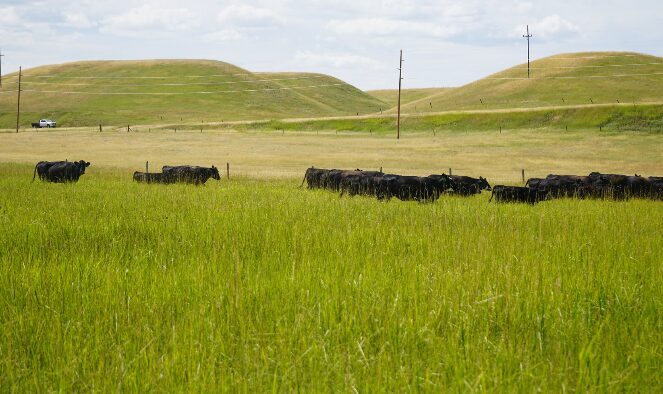
In the quiet town of Stanford, Montana, grassy plains spread out to the surrounding mountains where Rick Caquelin has embraced full-time ranching post-retirement. For over three decades, Caquelin worked for the USDA Natural Resources Conservation Service (NRCS), assisting ranchers and farmers across the state in improving land management.

“Without NRCS, I would have still ended up here, but I would have never gained the knowledge on how to do it or have been as successful,” says Caquelin.

Early Interest in Agriculture

Caquelin first learned about the NRCS when he was a child. The agency came out to his family’s farm in Illinois to conduct waterway projects on the land. This helped trigger his interest in conservation.

“I’ve always enjoyed being on the land and trying to make it the best it can be,” he explains.

Earning a Range Sciences degree from Montana State University reinforced his desire to work outdoors and cemented his decision to do something related to helping the land. After graduation, Caquelin accepted a job with the NRCS, which led him back to Montana.

“And now it’s 33 years later,” says Caquelin, who finished his career with the NRCS as a range specialist two years ago.

Rick and his wife, Doreen, have lived in their current home since 2011. With their children grown, the couple primarily devotes their attention to their ranch. On the side, Doreen is a talented baker and runs a candy operation. Not surprisingly, Rick is just as supportive of her growing venture as Doreen has been of his dream operating a ranch.

Same Passion, New Role

Ask anyone in the agricultural industry and they’ll tell you starting a ranch from scratch is no easy feat. Caquelin describes his journey as having evolved over the past 20 years in small doses. He acquired cattle in 2003 and little by little he was able to lease more land.

“Because of both of our careers, my wife and I we were able to slowly build into the cow business over a lot of years,” says Caquelin. “It’s difficult to do when you’re starting from scratch. You have to be patient and you have to work hard at finding the right opportunities so that you can succeed.”

Even after retiring from the NRCS, Caquelin still collaborates with and learns from his former coworkers, as well as the ranchers and farmers he assisted. This is what inspired him to venture into ranching himself and he has no intention of ending the relationship anytime soon.

Caquelin continues to share his valuable ranching experience to assist others both in and outside of the pasture. He actively serves on the Montana Grazing Land Conservation Initiative and the Ranchers Stewardship Alliance, continuing his dual role as rancher and conservation advocate.

One person who can speak at length about Caquelin’s journey is Pam Linker, an NRCS District Conservationist at the Stanford field office. She credits her friend and former coworker for helping her along her own journey in conservation. The two worked together for nearly 20 years, having first been introduced at a conference. Caquelin was not only her coworker, but as Linker describes him, “a mentor and teacher.”

“Rick’s operation is unique because he has used it as a training opportunity for so many people with NRCS,” says Linker. Caquelin has provided plant identification training, shared his knowledge about livestock, and offered guidance to new NRCS employees.

Leading by Example

Today, the Caquelins have a Conservation Stewardship Program (CSP) contract. With a goal of trying to provide maximum rest from grazing on their lands, it’s been a great vehicle to benefit the long-term use of the grassland.

Some of their practices include strategically rotating their cattle around using temporary fencing and water, planting species specifically for pollinators, and applying bale grazing to improve their land. Caquelin is also keeping a close eye on the health of the range—monitoring conditions right down to the soil beneath his feet, something he learned from his time at the NRCS.

One thing Caquelin is eager to talk about is soil health, especially for grazing lands. Healthy soil means healthier grass for the cattle and a better environment overall.

“We do range monitoring and even started doing soil biology monitoring to see if there was something to be gained by watching how microbiology works in the soil,” says Caquelin.

What’s incredible is that Caquelin is doing all of this on a smaller piece of land than many of the properties he visited over the years. His aim is to leverage this distinctive opportunity to demonstrate to other small landowners the significant impact they can have on conservation. “As far as land management goes, there are advantages and disadvantages for small operations,” he says. “Our economic scale is quite a bit smaller so there are tradeoffs.”

In addition to improving plant health, soil health, water infiltration, and forage production, the results of this work positioned the Caquelins’ pastures to better deal with recent drought conditions.

“Grazing management has been his passion throughout his career,” Linker states. “If there’s anything I take from that, it’s if you are on top of your grazing management, you remain more resilient and can make the changes without it being so pressed.”

Preparing for Tragedies

The past two years, marked by only 40-60% of usual precipitation, were particularly challenging for producers like the Caquelins in Judith Basin County.

While the ranch had seen benefits from existing grazing management plans, Caquelin says he still had to consider the option of destocking their animals. Currently, the ranch is down 30% from where it was at the end of 2020.

“The critical part was destocking quickly enough, so you didn’t have long-lasting severe negative impacts on the ground,” Caquelin says of his difficult choice.

Linker has watched ranchers who have spent decades culling the perfect herd, making destocking a difficult decision during tough times.

“They’re really proud of their bloodlines and it can be difficult to let them go,” she says. Unfortunately, waiting until the last minute only makes it more difficult as panic sets in.

Caquelin adds that while it’s common for people to notice when their cows don’t look well, they may overlook the condition of their grass and soil.

“Soil health tends to be underestimated,” notes Caquelin, mentioning the topic wasn’t widely discussed early in his career. “We always knew everything started there, but we never closely examined its state. A healthy and robust soil serves as the foundation for everything else to thrive.”

But Caquelin learned a lot during his time with NRCS, and he takes that knowledge with him now, on his own ranch. “What we’re discovering about grazing land is that the better we care for the surface, the better we care for the underground biology. This relationship is crucial.”

Legacy of Land Stewardship

Even after retirement, Caquelin remains passionate about the NRCS and continues to help other ranchers learn.

He lives by the belief that good management is key, no matter the size of your ranch. He wants people to understand conservation practices are simple to apply and can make a huge difference. And possibly most importantly, he’s learned that listening to others and being willing to learn is crucial, even if it means making mistakes along the way.

“I learned on the job for a long time from all the people that I worked with. Everything I think I know today is because of a thousand relationships over 30 years,” he says. “Whether they were relationships with NRCS; people that trained me and taught me about soil and water and grasses, or farmers and ranchers who taught me how to make use of all that institutional knowledge.”

Caquelin wants future landowners to know that taking care of the land is not just a job; it’s a way of life, filled with valuable lessons and a willingness to learn from others.

“We would’ve never ended up a small ranch as successful as we are without those relationships.