Tuesday, February 10, 2026
Home Blog Page 404

Water rights, law on agenda for June 13-14 Western Ag and Environmental Law Conference

0
“The Western agricultural industry is confronted with a unique body of legal and policy issues, with water issues often at the very top of the list.” — Harrison Pittman.

Instream water rights and the future of irrigated ag. The Klamath River Basin and the Endangered Species Act. The future of water quality in the West. Legal ethics and state water boards. Each of these issues and more will be on the agenda for the National Agricultural Law Center’s 2nd Annual Western Agricultural & Environmental Law Conference, set for June 13-14 in Reno, Nevada.

“The Western agricultural industry is confronted with a unique body of legal and policy issues, with water issues often at the very top of the list,” said Harrison Pittman, director of the National Agricultural Law Center. “We’re thrilled that some of the most respected water law experts in the West will be part of our terrific lineup of conference sessions.”

The conference, which will be held at the University of Nevada, Reno, will also be livestreamed. A complete conference agenda, as well as conference registration, is available online.

The Western Conference features 12 hours of continuing legal education credits, including two hours of ethics. It has been approved for CLE in Nevada and Idaho, and will be submitted for approval in Oregon, California, Arizona and Utah. It has also been approved for continuing education from the American Society of Farm Managers and Rural Appraisers. The NALC will coordinate with attendees to self-report in other states.

The water law sessions and speakers for the Western include:

  • Going With the Flow: Instream Water Rights & the Future of Irrigated Ag
  • The Klamath River Basin & the Endangered Species Act: Implications for Ag in Western States
  • WOTUS & Water Quality in the West in a Post-Sackett World
  • Water Law & Ethics: Sinking and Swimming With Litigation, Water Districts, and Agencies
    • Lauren D. Layne, Shareholder, Baker Manock & Jensen
    • Joe M. Marchini, Shareholder, Baker Manock & Jensen

Pittman said that Western attendees from a wide variety of backgrounds will benefit from the information shared at the conference.

“The Western Conference is designed for attorneys and non-attorneys alike,” he said. “It’s a great learning and networking opportunity for ag professionals, attorneys, students and more.”

For information about the National Agricultural Law Center, visit nationalaglawcenter.org or follow @Nataglaw on X. The National Agricultural Law Center is also on Facebook and LinkedIn.

Now’s the time to fertilize warm-season grasses in Kansas

0
Late spring, early summer applications are ideal, says K-State horticulture expert.

It’s crunch time for homeowners and others who manage warm-season grasses in Kansas.

“Turfgrasses should be fertilized when they are actively growing,” said K-State horticulture instructor Cynthia Domenghini, who manages the university’s Horticulture Response Center. “For warm-season grasses, that time is here.”

Domenghini said late spring and early summer fertilizer applications are ideal for bermudagrass, buffalograss and zoysiagrass. Fertilizing too early, she said, does not help warm-season grasses, but rather encourages cool season weeds to grow.

“Northern and northwest Kansas can wait until May 30 or after to fertilize warm-season grasses,” Domenghini said. “Those in other areas of the state can fertilize beginning now (mid-May). Fertilizing too late in the season can increase the turfgrass’ vulnerability to winter damage.”

Domenghini said homeowners should avoid fertilizing warm-season turf with nitrogen after Aug. 15.

Some recommendations for fertilizing the three most common warm-season varieties include:

  • Bermudagrass – Apply one pound of nitrogen per 1,000 square feet every four weeks.
  • Zoysiagrass – Apply three-fourths pound of nitrogen in two applications: one in June and one in mid-July.
  • Buffalograss – Nitrogen is not needed for its survival, but applying a nitrogen fertilizer will improve the color and density of the lawn. Apply one pound of nitrogen sometime between mid-May and early June. If a darker green is desired, follow the same fertilizer recommendations as zoysiagrass.

More information on fertilizing a warm-season lawn is available in the K-State Research and Extension publication, Fertilizing Kansas Lawns.

Domenghini and her colleagues in K-State’s Department of Horticulture and Natural Resources produce a weekly Horticulture Newsletter with tips for maintaining home landscapes and gardens. The newsletter is available to view online or can be delivered by email each week.

Interested persons can also send their garden and yard-related questions to Domenghini at [email protected], or contact your local K-State Research and Extension office.

Chigger season tips to beat the itch

0
AgriLife Extension entomologist talks all things chiggers, from why they make you itch to ways to avoid them.

If you’ve ever dealt with a bug bite, especially the annoying itchiness of chigger bites, you will want to be ready to avoid them the next time you are outdoors.

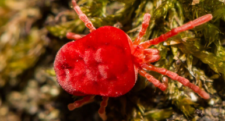
Chiggers are the larval stage of a group of mites containing many species found around the world. The six-legged larvae are generalist parasites and feed on lizards, birds and small mammals like mice and rabbits. However, as many of us know, they are not limited to those animals. The other stages of the chigger life cycle – nymphs and adults – are predators of other very small mites and insects.

There are a few things people should know about these tiny biting pests that might help them avoid a big itch, said Bryant McDowell, Texas A&M AgriLife Extension Service integrated pest management program specialist and entomologist in the Department of Entomology in the Texas A&M College of Agriculture and Life Sciences.

McDowell has already received several calls about chiggers from curious Texans. He expects the number of people suffering from chigger bites will increase as spring wraps up and we enter the summer season.

“Last year, it seemed like chigger outbreaks came earlier in the year, but late spring and early fall are really their prime seasons,” he said. “Anytime you mix temperatures above 80 degrees and moisture, that is the recipe for chigger infestations.”

What you need to know about chigger bites

Victims of their bite know the unrelenting itch that follows. But they may not know the details of how these pests spread their misery.

These near-microscopic mites hitch a ride, where they move along their host’s body to a feeding site and attach to the skin. Chiggers tend to settle in areas where clothing fits tightly to the body like socks and waistlines or in moist areas like armpits or behind the knees. They have a knack for concentrating in especially bothersome places.

They do not burrow into the skin, nor do they feed on blood. Instead, they inject saliva into the upper layers of the skin. The saliva contains enzymes that dissolve skin cells enabling the attached chigger to suck up the dissolved cells and lymph.

Over the chigger’s feeding period, the process of salivation and drinking or sucking of the dissolved skin cells is repeated many times creating a tiny tube through the skin layers.

Our bodies react to the enzymes and feeding process with an itching, allergic reaction producing inflammation typically with redness, swelling and sometimes welts.

Treating the itch

The itch and other reactions to the chigger bites typically occur several hours after the chiggers have fed and detached. Thus, we are left with treating the itch, inflammation and potential secondary infections with over-the-counter medications.

The bites are itchy for a few days and can take up to two weeks to disappear, McDowell said.

Chiggers typically exit the host soon after they’ve fed and do not burrow into the skin. Because of this, he said the home remedy of applying nail polish to suffocate them or bleach to kill them will only potentially add to the skin irritation.

“There are a number of ways you can try to relieve the itch, but once you’re bitten there is no stopping the reaction,” he said. “The deal is done. So, the best practice is avoidance and prevention.”

Don’t be a victim: avoid chigger bites

Avoiding habitats with high probabilities of supporting chiggers, using preventive measures with repellents, appropriate clothing and post-exposure cleansing can reduce the impacts of chiggers.

Chigger infestations can be random, “wrong place at the wrong time,” occurrences for hikers, trail walkers or anyone venturing off the beaten path, McDowell said. Often, they prefer undisturbed, unkept areas with taller grasses, vines and other low-growing plants. The vegetation provides cover for host animals of chiggers and protection from sunlight and heat.

McDowell said those overgrown areas, especially when combined with moisture, can create ideal conditions for infestations. So, he cautions about areas with tall grass around ponds, creeks and rivers as they could be problematic. Managing vegetation to prevent chigger harborage in areas with high human use such as parks or around homes can reduce exposure. But occasionally even manicured lawns can harbor chiggers under the right conditions, McDowell said.

Taking care when returning indoors

Given their randomness, he suggests removing clothes worn outdoors and showering as soon as you get home from any trek through taller grass or after activities in areas that might be hospitable to chiggers. Use a washcloth or something abrasive that will scrub them away.

Quick action can reduce the number and severity of bites.

“If you’ve been in an area that you think might have chiggers, the best thing to do is to take a shower as soon as possible,” he said. “Scrubbing with soapy water will take care of any chiggers on your body, but again, it may be too late to address bites that occurred.”

To reduce the chances of exposure to chiggers, McDowell recommends wearing long pants, tucking pant legs into socks, and using repellents or deterrents like DEET, sulfur powder or plant-based oils. Permethrin-based products can be used on clothing for a longer residual. These products should not be applied to the skin and only directly applied to clothing and allowed to dry before wearing.


Gardeners enter home stretch for onions, tomatoes

0
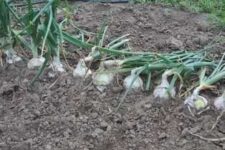
Photo courtesy: K-State Horticulture

K-State horticulture expert shares tips for successfully growing two garden staples

If gardeners are crying about their onions right now, it’s not because they’re slicing them in their kitchen. But they may soon.

“(Late May) is the time of year that onions grow and develop rapidly,” said Kansas State University horticulture expert Cynthia Domenghini. “Regular watering – if the soil is dry – and a light fertilization are helpful to maximize growth.”

In soils that tend to be alkaline, Domenghini suggests using ammonium sulfate (21-0-0) at the rate of ½ cup per 10 feet of row. The number combination refers to the rates of nitrogen, phosphorus and potassium contained in the fertilizer.

“You can use lawn fertilizer (such as 29-5-5, 27-3-3, or similar) but only use 1/3 cup per 10 feet of row,” she said. “Make sure the lawn fertilizer does not have a weed preventer or weed killer included. Sprinkle the fertilizer 2-3 inches alongside the row and water in. Do not fertilize after the onions start to bulb.”

Domenghini said that as onions develop, as much as 2/3 of the bulb remains out of the soil. She said that is normal and there is no need to cover the bulb with soil.

Tomatoes

Another garden favorite – tomatoes – could benefit from mulching as long as soils are warm enough and not saturated with water, according to Domenghini.

“Tomatoes prefer even levels of soil moisture, and mulches provide that by preventing excessive evaporation,” she said.

Mulch also helps to suppress weeds, moderate soil temperatures, and prevent the formation of hard crust on the soil. Crusted soils restrict air movement and slow the water infiltration rate.

Domenghini said hay and straw mulches are “very popular for tomatoes, but may contain weed or volunteer grain seeds.” Grass clippings can be used as mulch, but should be applied in a thin layer – “only 2-3 inches thick,” Domenghini said.

“Do not use clippings from lawns that have been treated with weed killer until some time has passed,” she said. “With most types of weed killers, clippings from the fourth mowing after treatment may be used.”

Domenghini and her colleagues in K-State’s Department of Horticulture and Natural Resources produce a weekly Horticulture Newsletter with tips for maintaining home landscapes and gardens. The newsletter is available to view online or can be delivered by email each week.

Interested persons can also send their garden and yard-related questions to Domenghini at [email protected], or contact your local K-State Research and Extension office.