Thursday, February 19, 2026
Home Blog Page 503

Lettuce Eat Local: My Chief takeaway from the Super Bowl

0

Amanda Miller
Columnist
Lettuce Eat Local

You may already be able to guess that my chief takeaway from the Super Bowl was not about the football. Don’t get me wrong, I’m glad the Chiefs won! I like when the people around me are happy. 

And while I’m not personally invested in their victory, I do even know a few things: Patrick Mahomes has sweet hair, this is Kansas City’s third win of the title in five years, and their jerseys are red and yellow (a similar color scheme to the 49ers, which was concerning to me). I wanted to do a bit of schputting, maybe say something about how they made three baskets in the second quarter thanks to their pitcher, but Chiefs football isn’t always a joking matter. And it’s just safer not to say anything about Taylor & Travis. 

I did watch the game — or at least, I was in the vicinity of a TV playing the game. Yet between the commercials, a smorgasbord of snacks, and my kids, there was barely time to direct much attention to football. We were with friends, so I had plenty of arms ready to hold Kiah, but I’m not sure whether Benson had had too much sugar at family lunch earlier or if he was trying to copy the players running up and down the field. Either way, he was under the influence of something, so when he wasn’t sneaking Brian’s soda or hiding in the giant blanket fort they built, he was running. Back and forth, back and forth, back and forth — right in front of the TV of course — careening into whichever parent was ready (or not). I don’t know how long or how late he kept that up, but it was impressive. 

Not quite as impressive, however, as the avocado stats I looked up, which is my real point. 

I know the Super Bowl is the biggest eating day of the year for avocados, but the data is still just always incredible. Although numbers vary, the major growing region in Mexico was projected to export close to 140,000 tons of avocados just for this year’s game, even with environmental factors resulting in a reduced harvest yield. Again, actual numbers are sketchy (or rather, the internet is?), but that equates to over 50 million avocados. Which is even way less than ten years ago, with the USDA estimating that 240 million avocados were consumed on Super Bowl Sunday: “enough to fill an entire football field from end zone to end zone over 46 feet high.”

Specifics aside, that’s a lot of guac. While avocados often get eaten straight out of the shell in our house (give Benson and me a little salt and pepper and we’ll make short order of one), guacamole is by far and away the most common way they show up at a Super Bowl snack bar. There are some variations, mainly in texture and spiciness, but guacamole follows a pretty standard flavor profile: avocado, lime, onion, garlic, maybe tomato and cilantro and jalapeño. 

Clearly, that’s delicious; otherwise, it wouldn’t be eaten in such astronomical quantities. But everyone can make that, so you’ll notice my recipe below is a bit different — however, as long as there’s avocado available in some form, I’m happy. 

To echo an online report’s sentiment, “Avocados are the real Super Bowl champion.” That’s a team we can all cheer for. 


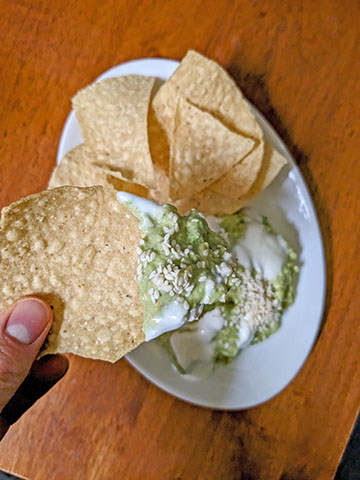
Sesame Guac

I know the Super Bowl is past, but we can still celebrate our win with a super bowl of guacamole. Especially since I forgot to actually bring my avocados to the game. This dip has some of the same aspects of regular guac, but it gets intercepted by the mild crunch and nuttiness of the sesame. Don’t relegate this simply to tortilla chips; try it with everything from dipped on pita to swiped on sandwiches to dolloped on salad.

Prep tips: if you don’t have toasted sesame oil, you can use extra virgin olive oil; it obviously won’t have the same effect, but still add a pleasant fruitiness.

2 avocados

1 teaspoon coriander

1 teaspoon toasted sesame oil

juice of half a lime

¼ cup plain yogurt or sour cream

2 tablespoons sesame seeds

salt

Mash avocados with a fork until smoothly chunky or chunkily smooth. Stir in the coriander, sesame oil, lime, and half the yogurt and sesame seeds. Season liberally with salt. Mound onto a serving dish (or your plate) and top with remaining yogurt and sesame seeds. Eat with whatever you would eat guac.

Invasive species in Kansas can cause thousands in vehicle damage

0

Be careful where you park your car this summer because it could cost you.

Last year state officials sought public input on a tree species that is causing harm to Kansas’ ecosystem. The trees are from the pear tree family and include Bradford, Cleveland Select, Chanticleer and other pear trees.

Callery pear trees, sometimes known as Bradford pears, are known for their strong, invasive roots that can damage sidewalks and plumbing. The trees can have branches snap off during severe weather which can cause property damage.

The sap that falls from the trees can cause paint jobs on vehicles to deteriorate. Tim Hicks of Tim’s Paint Works Collision Services of Topeka said he’s seen cars come into his shop with evidence of sap damage to paint.

It will penetrate the clear coat,” Hicks said. “You would have to strip and reprime and refinish the hood. It would penetrate the clear coat and the base coat. You’d have to sand it down primer it and then refinish it.”

When sap bonds to a vehicle surface, it shrinks over time . As the sap shrinks it creates stress on the car’s finish. Additionally, tree sap is acidic and can feed on surfaces like clear coats if neglected. The longer sap is left on a vehicle the harder it becomes to remove, according to autodetailingpro.ca .

Depending on how much sap has been left on your vehicle, the cost to repaint your vehicle could be as high as $5,000. Hicks said when the sap falls onto a car and is left unattended it will etch down into the clear coat.

“I say two to three months for it to do any damages,” Hicks said. “I’ve seen it on a quarter panel of a car from last year.”

Hicks said each car panel the sap falls on could cost $600 to $800 to repair.

“You’d notice it on the windshield before you noticed it on your car,” Hicks said. “If you hit your windshield wipers it would smear and you would have to wash it off.”

Kansas Department of Agriculture (KDA) spokeswoman Heather Lansdowne said the invasiveness has prompted the KDA to restrict their spread in Kansas. Public input was received in 2023 to quarantine the trees due to their invasive qualities. Quarantine of plants is allowed under the provisions of K.S. A. 2-2117.

USDA rules ‘color-coded’ corn plants can be sold and grown without restriction

0

A final ruling by the U.S. Department of Agriculture’s Animal and Plant Health Inspection Service allows farmers and growers to run field trials on corn plants with genetic traits developed by Insignum AgTech without restriction or the need for permits.

These plants use naturally occurring pigments to signal when specific plant stresses begin. The USDA found the genetically modified “color-coding” plants posed no risk to the environment or other plants.

Insignum CEO and founder Kyle Mohler called the announcement a “milestone for Insignum AgTech and its customers. It means our edited plants can be grown and tested across the U.S. without restrictive permits, opening the door for our customers to run trials. It strengthens our ability to help farmers treat specific problems affecting their crops exactly when, precisely where and only if needed to sustainably increase crop production.”

Additional traits

Mohler said the company will develop additional plant traits that utilize other natural pigments, like red or blue, to give an early indication of yield-limiting factors such as insect pests or fertility loss.
The techniques used by Insignum switch on existing plant genes without importing any foreign genetic material.

Mohler said all plants have the ability to make purple, red, and blue pigments, but normally that system is turned off. Insignum creates a new gene from pieces of DNA that are already present in the plant, not from foreign DNA or transgenes.
Insignum’s current corn product in testing causes the plant to turn purple at disease infection points as a leaf reacts to the first sign of infection at a molecular level. The purple color appears before any other symptom and about a week or more before diseases can be identified by other means.

In addition to the naked eye, the purple spots are visible by color cameras on satellites, drones, and other equipment. For example, a smart sprayer could use the same system to hunt for weeds and detect purple colors. In 2023, Mohler said, multiple drone companies were able to detect the purple spots from aerial imagery.

Cost cutting move

The color-coding can also help growers reluctant to use expensive pesticides to know where and when to use them. According to the Crop Protection Network, farmers lose about $5 billion worth of corn to diseases every year. This works out to $50 to $60 per acre. About 80% of U.S. corn farmers do not spray fungicides, according to USDA surveys.
After growing up on the family farm in Boone County, Indiana, Mohler earned his bachelor’s in biochemistry from Purdue University’s College of Agriculture and a doctorate in plant biochemistry from the University of Edinburgh in Scotland. He founded Insignum AgTech in 2019.

His company is working with corn but plans to work with the entire range of food plants once more funding is secured.

His own experience

The idea for his company occurred to Mohler when he saw family members applying fungicides before they knew whether or not they were needed.

“By the time a farmer sees disease, it’s too late to save the crop,” he said. “This is why many plan to spray preventively—and why that’s often profitable. However, if fungicides are applied too late, some damage is already done. If applied too early, efficacy fades and leaves crops vulnerable to late-season attack. When fungicides [are] applied at the right time, green, healthy crops remain green and healthy, leaving farmers wondering if the treatment did anything at all. Because of these challenges, most crop farmers ignore diseases altogether.”

“[With Insignum plants], farmers will gain the ability to sustainably and precisely treat when and where needed, ultimately increasing yields without arbitrarily increasing costly inputs,” Mohler said.
Right now, Insignum’s “go to market” strategy is to license its technology to seed companies. Three more years of field trials are in the offing, with a commercial product launch in the “late 2020s.”
In April 2023, Insignum AgTech and Beck’s signed an agreement to test Insignum’s corn traits in Beck’s elite varieties.

In January 2022, Insignum AgTech received a $100,000 investment from the Purdue Ag-Celerator, an agriculture innovation fund operated by the Purdue Foundry, with assistance from the Purdue College of Agriculture, the Purdue Research Foundation Office of Technology Commercialization and the agricultural industry.

As reported in the High Plains Journal

KU News: KU renames Institute for Sustainable Engineering after The Wonderful Company

0

From the Office of Public Affairs | http://www.news.ku.edu


Headlines


KU renames Institute for Sustainable Engineering after The Wonderful Company

LAWRENCE — The University of Kansas’ Institute for Sustainable Engineering has a new name — Wonderful Institute for Sustainable Engineering-KU (WISE-KU). The naming builds on the university’s relationship with The Wonderful Company, a global agricultural company. Along with the rebranding comes a $5 million commitment to promote sustainable engineering initiatives. In the last five years, The Wonderful Company has worked in collaboration with KU researchers to find ways to repurpose 50 million pounds of pistachio shells, which until now went to carbon-neutral fuel outlets or accumulated in piles on fallowed farmland.

KU Debate teams qualify for National Debate Tournament

LAWRENCE — Two University of Kansas debate teams composed of seniors Graham Revare, Shawnee, with William Soper, Bucyrus, and sophomores John Marshall, Lawrence, with Jiyoon Park, Topeka, were selected as automatic qualifiers for the 2024 National Debate Tournament. The tournament will take place April 4-8 in Atlanta. Only 16 teams from across the country can automatically qualify for the tournament, based on season-long performance.

KU Libraries host journals in open access space, making scholarship available worldwide

LAWRENCE — Journals from around the world have found new partnerships or homes with University of Kansas researchers and KU Libraries. More than 50 academic journals are now hosted through KU Libraries as part of its ongoing open access initiatives, with nearly a dozen moving away from a paywall model.


A box of Barnes: Group records all professor’s symphonies

LAWRENCE — A University of Kansas professor emeritus has a boxed set of all nine of his symphonies, which was performed and recorded last year and released this year by the Osaka Shion Wind Orchestra. The 70-piece group was rehearsed and performed for a month under the direction of the dean of the KU School of Music, Paul Popiel.


Full stories below.


————————————————————————


Contact: Michelle Keller, KU Endowment, 785-832-7336, [email protected]; @KUEndowment

KU renames Institute for Sustainable Engineering after The Wonderful Company


LAWRENCE — The University of Kansas’ Institute for Sustainable Engineering has a new name — Wonderful Institute for Sustainable Engineering-KU (WISE-KU). The naming builds on the university’s deep relationship with The Wonderful Company, a global agricultural company co-founded and led by Stewart and Lynda Resnick.

The Wonderful Company is one of the largest privately held companies in the U.S. whose iconic brands include Wonderful Pistachios, POM Wonderful, FIJI Water, JUSTIN Wines and others. Along with the rebranding comes a $5 million commitment to promote sustainable engineering initiatives.

“Complex problems require new and novel approaches in order to arrive at workable solutions,” said KU Chancellor Douglas A. Girod. “The Resnicks are prime examples of how creative use of philanthropy can drive university research and discoveries. We’re grateful they’ve chosen to work with our talented faculty and students to solve some of today’s thorniest issues. Their investment, combined with the opportunity to work on real-world challenges, will benefit generations to come.”

The Resnicks have a long history of supporting leading research universities in driving research solutions to solve the world’s most critical environmental challenges across energy, water, food and the climate. To date, the Resnicks, along with their foundations and The Wonderful Company, have invested nearly $2.6 billion in philanthropy and corporate social responsibility investments globally — in education, wellness, housing and the arts — with more than $850 million pledged to universities for research and technologies around sustainability.

“Environmental sustainability must be one of the priorities for our planet and is a primary focus of our company’s operations. Succeeding in our efforts to care for our world requires research and innovation – everything from renewable energy and responsible water usage to rethinking pistachio waste,” said Eric Johnson, senior vice president of Capital Projects at The Wonderful Company and KU alumnus. “The Institute of Sustainable Engineering at KU has taken a novel approach towards exploring new technologies and creating cutting-edge outputs that align with Wonderful’s mission to make our world a safer, healthier and better home for generations to come.”

In the last five years, The Wonderful Company, which is one of the world’s largest nut processors, has worked in collaboration with WISE-KU researchers to find ways to repurpose 50 million pounds of pistachio shells, which until now went to carbon-neutral fuel outlets or accumulated in piles on fallowed farmland. Researchers have found multiple ways to use them, including as an ingredient in animal feed.

“This substantial commitment by The Wonderful Company and Stewart and Lynda Resnick brings together researchers and students from multiple disciplines with industry partners to advance global sustainability through transformational engineering, science and entrepreneurship,” said Foundation Distinguished Professor Mark Shiflett, founder and director of the institute. “We are honored to name our institute after our partners at Wonderful for their major investment in our engineering students and university, as well as our ongoing collaboration to create solutions to today’s real-world issues promoting the societal, economic and environmental benefits of sustainable engineering.”

Ana Rita Morais, assistant professor of chemical & petroleum engineering and deputy director of the institute, said, “This convergent, inclusive approach fosters and supports innovation resulting in developing, inventing and patenting novel processes and products that sustainably utilize food, water and energy by recycling valuable resources while reducing our impact on the environment and protecting our planet.”

-30-

————————————————————————

The official university Twitter account has changed to @UnivOfKansas.

Refollow @KUNews for KU News Service stories, discoveries and experts.


————————————————————————


Contact: Scott Harris, KU Debate, 785-864-9878, [email protected], @KansasDebate

KU Debate teams qualify for National Debate Tournament


LAWRENCE — Two University of Kansas debate teams composed of seniors Graham Revare, Shawnee, with William Soper, Bucyrus, and sophomores John Marshall, Lawrence, with Jiyoon Park, Topeka, were selected as automatic qualifiers for the 2024 National Debate Tournament.

The tournament will take place April 4-8 in Atlanta.

The top 16 teams in the country — based on season-long performance — are selected by the NDT National Committee to receive automatic qualification to the national tournament. This is the 57th consecutive year that KU Debate has qualified teams for the National Debate Tournament.

In 1973 the National Debate Tournament began recognizing the top 16 teams in the country as automatic qualifiers for the 78-team field. KU has now had 47 teams receive top 16 automatic qualification to the tournament. It is the second consecutive year that KU has had two teams selected as automatic qualifiers and the eighth time KU has had two teams in the top 16.

Joining KU as automatic qualifiers are California State University at Long Beach, Dartmouth College, Emory University (two teams), Georgetown University, Harvard University (two teams), the University of Kentucky, the University of Michigan (two teams), Michigan State University, Northwestern University, the University of Texas and Wake Forest University. The rest of the field will be filled through regional qualifying tournaments and second-round at-large selections over the next few weeks.

KU has finished in the top four at the NDT in six of the past eight seasons including winning the national championship in 2018.

“We are very proud of the achievement of the debaters as they build on the legacy of past generations of KU debaters. We are grateful for the hard work of the coaches who contributed to their success,” said Brett Bricker, the team’s head coach, who won the NDT as a KU debater in 2009.

The coaching staff is led by Bricker along with assistant coaches Azja Butler, Allie Chase, Nathan Davis, Jyleesa Hampton, Derek Hilligoss, Ned Gidley, Nyx Moore, Max Reese, Michael Scott, Jesse Smith and Alaina Walberg. Scott Harris is the David B. Pittaway Director of the debate program.

-30-

————————————————————————

Subscribe to KU Today, the campus newsletter,

for additional news about the University of Kansas.


http://www.news.ku.edu

————————————————————————


Contact: Mike Krings, KU News Service, 785-864-8860, [email protected], @MikeKrings

KU Libraries host journals in open access space, making scholarship available worldwide


LAWRENCE – The world of academic journal publishing can be tenuous. Anything from an editor’s untimely death to a loss of funding to a professional society’s changing priorities can terminate even highly respected journals.

Journals from around the world have found new partnerships — sometimes an ocean away — with University of Kansas researchers and KU Libraries, allowing them to continue producing high-quality scholarship and preserve archives.

More than 50 academic journals are now hosted via KU Libraries and available online. In almost a dozen cases, those journals switched from a paywall model to an open access format.

A new home

Olga Pombo of the University of Lisbon is editor of Kairos: Journal of Philosophy & Science. The research center in which she created the online journal dedicated to the philosophy of science could no longer support it.

However, Pombo had worked with Irina Symons, multiterm lecturer of philosophy at KU. Symons offered to speak to Marianne Reed, digital publishing and repository manager in KU Libraries’ Digital Publishing Services program, and the journal became the most recent to be hosted and preserved via KU’s open access format.

For the past several years, KU Libraries have added 3-5 journals per year to its Journals@KU offerings. Last year, those journals had more than 1 million downloads. The result is access to knowledge created by scholars around the world and high-quality research that is available in a more open and equitable system that costs nothing to journals, authors or readers.

“You have these journals behind paywalls, and what that does is make the work less visible because only those readers or institutions that can afford to pay can see it,” Reed said. “Essentially, this program is one more way KU Libraries is making excellent research more available to the world.”

Journals become collaborators through a number of ways. If a faculty member or KU researcher is an editor, on an editorial board or connected to the journal in some way, KU Libraries is open to conversations about potentially hosting the journal, and if the journal has the rights to previously published material, hosting archives.

If those conversations result in a partnership, the parties sign a memorandum of agreement, and the journals have a new home.

“Each situation is different in terms of why journals want to do this,” Reed said. “Funding can play a big role. There is a dirty little secret in academia that, sometimes if you’re publishing commercially, the journal has to pay the company to publish. In those cases, the journal is publishing excellent research, but it just isn’t a model that all journals can afford. In a lot of fields, that content is foundational to the discipline and can be the basis for ongoing research, or is an important part of its history, so journals where funding is precarious are often motivated to try new models of publishing to survive. The Libraries’ model allows journals to transition to open access publishing without cost to the journals, authors or readers.”

Serving “citizen scholars”

When a journal partners with KU, it has access to Open Journal Systems (OJS), open-source software designed to support the workflow of academic journal publishing from submission through peer review to publication. OJS is designed to make journals more visible through Google and other search engines.

This enables people all over the world to discover the research, Reed said.

“People who find this information are not only academics. There are a lot of armchair herpetologists, for example, who are fascinated by snakes or turtles,” Reed said about readers who can find information in the journal Reptiles & Amphibians among the offerings. “I like to call them ‘citizen scholars.’”

The open access aspect was appealing to Pombo when considering how to continue the Kairos: Journal of Philosophy & Science.

“We live today in a world where science becomes more and more open each day. Openness inside and outside academia. Openness inside scientific communities who are increasingly international and globalized, openness between disciplines that increasingly need to establish interdisciplinary crossovers,” Pombo said.

“Now, open access of publishing, by approaching distant readers and removing financial barriers, is a fundamental way of promoting the scientific exchange between researchers from the same discipline, from different disciplines, from areas of diverse human activity, as well as an essential means for disseminating the scientific objectives, problems, methods and results among all interested people outside academia,” Pombo said.

Open access

Academic research is often funded by government grants or other forms of public money. A central argument of open access advocates has long been that findings of any research supported by public money should be available to everyone, not only those who can afford a journal subscription. Symons, who is also a vice editor of Kairos: Journal of Philosophy & Science, said that was an important factor in deciding to publish the journal via KU Libraries.

“I think that it is very important to have open access to quality research in all fields because the people who most need access to this kind of knowledge, more often than not, do not have resources to pay for it. I’m thinking primarily of students, be they in the U.S. or otherwise, and of academics who don’t live in wealthy countries,” Symons said. “I grew up under Communism and then went to college and joined academia in a country where libraries and universities could not afford to subscribe to prestigious journals or to purchase the latest academic books.

“To be a successful student, or scholar, nowadays is to meet global standards and be competitive in the global research and academic world,” Symons said. “To put the results of research behind a paywall amounts to setting up unequal opportunity to knowledge and securing an unfair path towards success for the affluent.”

While the Journals@KU program is now home to many existing journals, it can also host journals as they are created. Reed encourages any member of the KU community with interest in a journal to contact her if they feel it might be a potential fit.

For her part, Pombo said she is looking forward to the new arrangement and all that will come with it with its next issue, the first published under the agreement.

“We don’t hesitate to say that KU Libraries are offering the scientific communities a fantastic service. And the journal Kairos is going to benefit from the accurate and generous KU Libraries policy of scientific support. ‘Kairos’ is the ancient Greek word for timely time, right time, good time, appropriate opportunity. And I believe that KU Libraries constituted the ‘Kairos’ for our journal.”

-30-

————————————————————————

Don’t miss new episodes of “When Experts Attack!,”

a KU News Service podcast hosted by Kansas Public Radio.


https://kansaspublicradio.org/when-experts-attack

————————————————————————


Contact: Rick Hellman, KU News Service, 785-864-8852, [email protected], @RickHellman

A box of Barnes: Group records all professor’s symphonies


LAWRENCE — Like thespians who refer to “Macbeth” as “the Scottish play,” classical music composers have a superstition about the number of symphonies they may write. Beethoven and Mahler died shortly after completing their respective ninth symphonies.

So for 74-year-old James Barnes, professor emeritus of music at the University of Kansas, his Ninth Symphony will be his last, he said. He doesn’t want to tempt fate.

Now, though, Barnes has a boxed set of all nine of his symphonies, performed and recorded last year and released this year by the Osaka Shion Wind Orchestra. The 70-piece group was rehearsed and performed for a month under the baton of the dean of the KU School of Music, Paul Popiel.

Barnes, then still recovering from gallbladder surgery, couldn’t make the trip himself, but said Popiel “knows my music better than anyone else.” The two men have worked together for the past 14 years, since Popiel joined the music faculty.

Barnes has been a fixture at KU for more than 50 years, arriving as a tuba-playing junior high music camper from Oklahoma in 1963. Beginning in 1967, he attended undergraduate and graduate school here, receiving two degrees in music composition. He then began teaching and leading various bands at KU in 1975. He took emeritus status in 2015 but is still a familiar figure in Murphy Hall.

Popiel said there is an uncanny connection between Barnes and the Japanese classical music community.

“In Japan, he almost can’t walk down the street without being recognized,” Popiel said. “He’s very well known. His compositions really appeal to their classical music sense.

“There’s a pretty famous story of his Third Symphony, which is his best known,” Popiel said. “It was commissioned by the United States Air Force Band. Just before it was to be premiered in 1996, Newt Gingrich shut down the government. Therefore, the Air Force Band couldn’t travel to Roanoke, Virginia, for the premiere of this symphony at the Virginia Music Educators Convention … so the piece sat on a shelf for a year.

“Jim happened to be in Japan in the fall of 1996 and ran into the conductor of Osaka Shion, who asked, ‘Can we take a look at the piece?’ So it ended up getting premiered by what was then known as the Osaka Symphonic Band, later renamed Osaka Shion Wind Orchestra. So that piece has sort of an aura around it, particularly in Japan, because they know his most famous symphony has deep ties to Japanese bands.”

In 2018, Popiel led a consortium of more than two dozen academic and other music leaders who came together to commission Barnes’ Ninth Symphony, which was premiered by the KU Wind Ensemble at the Lied Center of Kansas before being performed nationwide by other college music groups.

Popiel said Barnes’ music could be called neo-romantic for its “beautiful, memorable, singable melodies.”

“That is not where a lot of classical music has been in the last 20 or 30 years,” Popiel said. “Some critics may say Jim’s music is dated because it has melody. But I’m not sure that’s a good criticism.

“I think Barnes’ music’s most shining attribute is how likable it is the first time you hear it … He is very contemporary,” Popiel said. “You can hear jazz harmonies, complex counterpoint. There is considerable dissonance. … It’s certainly 21st century modern music but in a way that’s very marketable and audience friendly.”

Popiel said when he came to KU in 2010, “I had the opportunity to do a lot more of Jim’s music. It’s the symphonies in particular that are really challenging pieces, and before I came to KU, I didn’t have a band that could play a lot of his music. So over the last 14 years, I have been one of the champions of his music.”

Popiel said he had to coax Barnes into giving Osaka Shion permission to record his First Symphony, written as Barnes’ master’s thesis, because in retrospect Barnes considered it an “early, immature work.” But the boxed set would not be complete without it, Popiel said, and so Barnes relented and, in fact, rescored and improved the First Symphony in the summer of 2022.

Popiel said the recording project was conceived as part of Osaka Shion’s centennial anniversary celebration.

“They got a grant and some crowdfunding to take on one of the most ambitious projects in our field — recording all nine of Jim’s symphonies,” Popiel said. “That’s never been done before, and it’s epic — huge forces, big orchestras and almost six hours of music. They performed a series of four concerts to record all nine symphonies live.”

In December 2023, Osaka Shion traveled to Chicago for the convention called the Midwest Clinic, the largest annual band and orchestra convention in the world. There were 18,000 attendees in 2023, and Barnes was invited to guest conduct Osaka Shion at its formal concert.

Popiel said it was a thrill for the KU delegation attending the clinic to see the esteem in which Barnes is held by peers worldwide.

A five-CD boxed set of the recordings was released in January by Osaka Shion in Japan. In addition, the set should be available soon through Keiser-Southern Music. A possible global release to streaming music services is still being negotiated.

-30-

————————————————————————


KU News Service

1450 Jayhawk Blvd.

Lawrence KS 66045

Phone: 785-864-3256

Fax: 785-864-3339

[email protected]

http://www.news.ku.edu


Erinn Barcomb-Peterson, director of news and media relations, [email protected]


Today’s News is a free service from the Office of Public Affairs

2024 Hort Newsletter No. 6

0
KSU horticulture

https://hnr.k-state.edu/extension/info-center/newsletters/index.html

Blog Post: http://www.ksuhortnewsletter.org

Video of the Week: Pruning Fruit Trees

ANNOUNCEMENTS

We asked. You answered. We are grateful you took the time to share your thoughts about the 2023 Horticulture Newsletter. We have been reviewing responses and making lists of changes for the 2024 Hort Newsletter. We are working on formatting updates of the email and pdf versions of the newsletter but this will take some time.

Several of you shared amazing stories of your garden. Since this survey is anonymous, we cannot follow up with you. Please contact Cynthia at [email protected] if you are willing to share your garden adventures. If you didn’t have a chance to complete the survey you can access it here: Horticulture Newsletter Needs Assessment.


Tech Complications

As you know, K-State has experienced campus-wide IT complications. We are pleased to tell you our online bookstore is available again. This means the links shared in earlier newsletters should now function properly.


Student Research Opportunity

We are inviting you to participate in the following survey: “The Perception and Environmental Impacts of Naturalistic and Manicured Lawns.” These anonymous survey results will only be used for research purposes and will help build the knowledge base for naturalistic landscapes. The survey is easy to complete with an estimated time of 10-20 minutes and will be open for 3 weeks. At the conclusion of the survey, participants will have the option to receive an incentive for the new K-State Extension publication of naturalistic landscaping scheduled for Fall 2024. Thank you for your time and we appreciate your consideration to participate!

https://kstate.qualtrics.com/jfe/form/SV_0kdlFqOKRybBiey


GARDEN CALENDAR

Start seeds indoors: Cabbage, Broccoli, Cauliflower, Lettuce
Prune fruit trees now through March

FLOWERS

Sharing the Love – Valentine’s Day Flowers

Americans celebrate Valentine’s Day with gifts of flowers, candy, cards and more. In 2023, customers spent an estimated $2.5 billion on flowers for Valentine’s Day. The rose is the most widely recognized and celebrated flower. Roses accounted for about 84 percent of the 2023 sales. Sixty-nine percent were red roses.

The rose is beautiful and versatile. Roses can be used in any type of design, from classic to contemporary. There are an abundance of commercially-grown varieties available in vibrant colors, sizes and shapes.

Bloom size, shape, speed of opening, color, petal count, petal texture, fragrance, and foliage are all points to consider as you select roses for your event.

The rose symbolizes love, romance and passion, so it’s no surprise that red roses are the most popular flower choice for Valentine’s Day. By following a few simple practices, you can ensure the longest-lasting roses.

Roses often come in a plastic sleeve which retains moisture. The sleeve should be removed after purchase.
Cut 1½ to 2 inches of each stem with a clean, sharp knife or flower snips. Uncut stems cannot efficiently absorb water needed by the flower to open fully. (Current research suggests that cutting stems under water is not necessary.)
Remove any leaves that will be underwater once stems are arranged in the vase.
Follow directions on flower food packet to mix the right amount of cold water to food ratio into the vase. Flowers need to be nourished. Professional flower food generally contains three ingredients:
Carbohydrate – (sugar) nutritional source
Acidifying agent – lowers the solution pH and improves water uptake
Microbiocide- reduces microbial growth
Arrange freshly cut stems into the vase.
Check the water level daily, repeat steps 2-5 every 2-3 days so flowers last as long as possible. Keep flowers away extreme cold, heat, direct sunlight and sources of ethylene gas (fruits and vegetables). (Irina Sheshukova)
FRUIT

Time for Fruit Trees

If you’re considering growing fruit planning is important. You will need plenty of space in full sun to accommodate fruit trees. Some varieties of trees will require multiple plants for pollination while others are self-fruitful. Know your soil and ensure it drains well. Be realistic about how many fruit trees you have time to manage.

Following thorough planning procedures is the best prevention against diseases and pests. This will save you time and money while also protecting beneficial insects from unnecessary pesticide use. Here is a guide from K-State Research and Extension for Planning your Fruit Garden.

Small- and Tree- Fruit Cultivars, is another great resource that provides information about types of fruits to consider including their harvest timing, size and pollination requirements.


Pruning Fruit Trees

For most of Kansas, it is time to start pruning fruit trees. This should be completed before active growth begins, which is typically in March. Folks in southern Kansas may need to finish pruning earlier.

Fruit trees have to be managed to promote the highest yield and healthiest plants. Pruning helps maintain the size of the trees for ease of harvest and to support the weight of the fruit. It is important to allow sunlight to reach the leaves so they can produce sugars to feed the plant. Methodically removing branches prevents parts of the tree from being shaded and negatively affecting fruit production.

Proper pruning also allows the root system to better support a smaller structure allowing the remaining branches to grow more vigorously.

Here are some of our publications with specifics for fruit tree pruning:

Pruning Apple and Pear Trees

Pruning Peaches, Plums, Cherries and Other Stone Fruits


Peach Leaf Curl

Last year, did leaves on your peach, nectarine or apricot trees appear swollen and/or curled? Were there reddish or purplish colors on the leaves? Did the trees have premature leaf and fruit drop?

These are symptoms of the fungus, Taphrina deformans, commonly referenced as: peach leaf curl. If your tree(s) had it last year, prepare for a resurgence unless trees are treated in early spring.

This fungus overwinters on the bark of the tree. Spring rains wash the spores to developing buds and leaf tissue spreading and infecting the new tissues. For this reason, it is important to treat the tree with fungicide prior to bud swell. Applying fungicide after symptoms appear as trees leaf out is ineffective. Fungicide must be applied during spring dormancy or during fall when most of the leaves have dropped. Always follow label instructions when using pesticides.

Prevention is the best recommendation for controlling diseases. Start your orchard with fruit tree cultivars with resistance or tolerance to peach leaf curl. Provide proper care to strengthen trees and prevent stress.

For more information about peach leaf curl and fungicide recommendations visit: K-State Research and Extension: Peach Leaf Curl and Plum Pocket


VEGETABLES

Square Foot Gardening

Limits on space for vegetable gardening combined with the desire for food security led to the square foot gardening method in the late 90’s. Through our Horticulture Newsletter Needs Assessment we learned some of our readers are looking for ways to garden in limited space. Square foot gardening solves that need but is also a practical strategy gardeners with unlimited space may want to consider.

The concept is simple: divide each raised bed into one-square-foot sections. Plant the garden according to the provided charts following the recommended number of plants that can grow in each square foot section. Achieve the maximum harvest with minimal space. The planting recommendations take into consideration the size of the plants at maturity as well as compatibility for growing in close proximity. The website: squarefootgardening.org is a valuable resource for this practice.


Here are some tips to get you started:

Build a raised bed that is 4’x4’. Though an in-ground bed can be used, starting with a square-shaped raised bed allows for precise measurements. This size allows you to grow a variety of vegetables and is easy to maintain. The raised bed can be made from wood, recycled plastic, concrete blocks and various other materials. The goal is to create a structure to outline the garden.
Fill the raised bed with a quality growing mix. A combination of peat moss, compost and vermiculite provides aeration, good water-holding capacity as well as nutrients for the plants.
Create a grid with one-foot square openings that lays over your garden space. The grid can be made from wooden lath boards or another material.
School Garden Tip: Educators, can’t you just imagine all the connections between square foot gardening and math??? This method is perfect for schools because of the educational value as well as making the most out of limited space, time and budget. If you’re looking for ways to incorporate math into the garden reach out to us for resources.

Square Foot Gardening Planting Chart


DISEASES/PESTS

Scale Insects

Varying in size and host, scale insects cause damage by sucking sap from plants. Their damage is not restricted to just trees and shrubs. They can devastate crops of herbaceous ornamentals as well. The time for investigating plants for scale is here and early detection is the best way to prevent crop damage.

Many scale varieties have white, tan or brown shell-like coverings that are round or oval in shape. They can blend into the bark so close inspection is necessary. If signs of scale are found, a dormant oil can be used as long as the plant is in dormancy and the temperature is above 40 degrees F. Dormant oils are beneficial because they can combat a wide range of life stages for scale insects. They are also less detrimental to beneficial insects because of the application timing and are less toxic than chemical controls. Read more about the use of dormant oils from K-State Extension Entomology.

Here are some resources to check out for more information about specific scale insect varieties and their hosts.

Euonymus Scale

Magnolia Scale

Pine Needle Scale

San Jose Scale


COMMUNITY GARDEN CORNER

Growing for the Community

Community gardens serve a number of purposes including fresh produce, social interaction and learning opportunities. I once helped establish a community garden in downtown Baltimore, MD where the goal was to turn abandoned lots into productive garden spaces. City beautification is among the many benefits community gardens can bring. With all these advantages come challenges too. Some are familiar to all gardeners but some are unique to community gardening.

Everyone has their own style of gardening. Some gardeners are meticulous about weeding while others are not. In a shared space, allowing weeds to set seed has an impact on the surrounding gardeners as well. Using community garden funds to keep a large mulch pile onsite for gardeners to use is one strategy to prevent this scenario. Planning regular “community workdays” where all gardeners are encouraged to work side-by-side is another option. Turn workdays into fun social events by playing music and having a potluck lunch when the work is done.

Clear, concise rules and regular communication go a long way for success in the community garden. February is a great time to bring the gardeners together for a planning meeting. Allow everyone to contribute and establish the rules for the year based on what worked well and what needs to improve from last year. During this meeting create a contact list with everyone’s email and phone number. Plan the calendar for the year including several celebrations. Focus on building community and get everyone working towards the same goals.

Funding is another challenge for community gardens. Charging a fee to individual gardeners who grow in each plot helps to offset these costs. This also results in the gardeners being more invested (literally) in caring for their space. Another source for funding is sponsorships. You may seek funding, even small amounts, from neighboring businesses who appreciate the beautification work your group is doing. Sponsors may be recognized with their company logo on community garden t-shirts, signage or by having their name(s) engraved on the tools they helped purchase.

If you are looking for resources to establish a new community garden or find an existing community garden in your area, contact your local extension office.


QUESTION OF THE WEEK

“Fall came and went and I never got my tulip and daffodil bulbs in the ground. Should I try to plant them now or wait until next fall?”

This is a common question this time of year. The problem with waiting to plant the bulbs until next fall is they are likely to rot due to unsuitable conditions.

Examine the bulbs. If they are still firm go ahead and plant them. They will probably not bloom in the spring. In fact, they may not bloom for a full year, but at least they weren’t wasted.

Alternatively, the bulbs can be forced to bloom indoors. Remember, many spring-flowering bulbs require a certain number of weeks of cold temperatures. You can plant the bulbs in containers and keep them chilled for the required time. Then move the containers to a bright room indoors to promote blooming.

Either way, planting the bulbs gives them a much better chance of survival than storing them any longer.


COMING UP NEXT WEEK

The Return of the Permaculture Feature

In the Permaculture feature next week the topic of “Growing Native Plants” will be highlighted. Why should we use native plants? What are some good options for urban landscapes? Can I grow native plants in my balcony garden? These questions and more will be considered. Stay tuned!


Contributors:

Cynthia Domenghini, Instructor and Horticulture Extension Specialist

Irina Sheshukova, Instructor and Floral Design Extension Specialist

Raymond Cloyd, Professor of Entomology (photos of scale)

Kansas Garden Guide


Department of Horticulture and Natural Resources

1712 Claflin, 2021 Throckmorton

Manhattan, KS 66506

(785) 532-6173


For questions or further information, contact: [email protected] OR [email protected]

This newsletter is also available on the World Wide Web at:

http://hnr.k-state.edu/extension/info-center/newsletters/index.html


The web version includes color images that illustrate subjects discussed. To subscribe to this newsletter electronically, send an e-mail message to [email protected] or [email protected] listing your e-mail address in the message.


Brand names appearing in this newsletter are for product identification purposes only. No endorsement is intended, nor is criticism implied of similar products not mentioned.


K-State Research and Extension is committed to making its services, activities and programs accessible to all participants. If you have special requirements due to a physical, vision or hearing disability, or a dietary restriction please contact Extension Horticulture at (785) 532-6173.

Kansas State University Agricultural Experiment Station and Cooperative Extension Service K-State Research and Extension is an equal opportunity employer. Issued in furtherance of Cooperative Extension Work, Acts of May 8 and June 30, 1914, as amended. Kansas State University, County Extension Councils, and United States Department of Agriculture Cooperating, Ernie Minton, Dean.