Saturday, February 21, 2026
Home Blog Page 534

KU News: Author makes case for data-driven language learning

0

From the Office of Public Affairs | http://www.news.ku.edu

Headlines

Contact: Rick Hellman, KU News Service, 785-864-8852, [email protected], @RickHellman

Author makes case for data-driven language learning

LAWRENCE – You could consider Nina Vyatkina an evangelist for data-driven learning and open educational resources as they apply to helping students learn a second language.

The case for the synergistic benefits of those two approaches and the results of a new study demonstrating their effectiveness form the content of Vyatkina’s new book, “Corpus Applications in Language Teaching and Research: The Case of Data-Driven Learning of German” (Routledge, 2024).

The University of Kansas professor of German and applied linguistics is a believer in students directly using collections of word usage – corpora – to help them understand and gain fluency in their target language.

“Simply put, a corpus is a curated assembly of naturally occurring texts chosen to represent a specific state or variant of a language,” Vyatkina said. “That’s still a mouthful, but the notion of corpora goes way, way back in literary scholarship.

“A great example of a corpus is the compilation of the Oxford English Dictionary. They wanted to have not only a list of words and their definitions, but usage examples. So in 1880, James Murray, the first editor-in-chief, put out the call to submit sentences with the words collected from books and over the years had collected millions of slips of paper, which he stored in something the size of a garden shed. And that was a prototype of our contemporary corpus.

“Of course, with modern electronics, this all became much, much easier,” Vyatkina said.

A popular corpus that Vyatkina cites as groundbreaking for its time (it debuted in 2008) and still useful today is COCA, the Corpus of Contemporary American English – which ranks and cross-references billions of words taken from newspapers, books, TV, webpages, etc., between 1990 and 2019. COCA has a user interface much like a Google search. For instance, learners of English can search to see which adjective — “big” or “large” — pairs most commonly – and thus best – with the noun “problem,” which will help them use English more idiomatically.

But not all corpora are so well-organized as COCA, Vyatkina said. Nor are there as many useful corpora for languages other than English (LOTE), even if one accounts for the smaller number of LOTE speakers. Nor were there many useful teaching guides to using these LOTE corpora, Vyatkina wrote.

So her book is an attempt to bridge all those divides.

“One part is a survey of what has been done in teaching German with this method and research on the effectiveness of teaching with this method,” the author said. “I have a new empirical study. I actually did use this method with KU students of German … and it turned out to be very effective, and students liked the method.

“Then the final part is the introduction of the open educational resource,” Vyatkina said.

In cooperation with the KU Open Language Resource Center, Vyatkina and co-author Schirin Kourehpaz, a multiterm lecturer in German language, published in 2020 a free online course titled Incorporating Corpora with links to active German corpora, making their use seamless to the teacher and student.

“You have exercises, lesson plans, explanations to teachers how to use it, and then you can click on links and you will be taken directly to the corpus, and that is what is needed for teachers and learners to use it,” Vyatkina said.

The proof this method’s success, she said, is in faster, better language acquisition.

“This is why we call it data-driven learning,” Vyatkina said, “because this teaching method is a little different from what we think of as traditional teaching, where the teacher presents a rule, and then the learners practice using the language. Here, it is the opposite procedure. They look at the examples first, and then, under the teacher’s guidance, they infer a rule or a pattern.”

Vyatkina also believes that the proven success of data-driven learning in acquiring German can be repeated with other languages and perhaps other fields.

“Absolutely,” Vyatkina said. “I review a lot of research that has been done on other languages, and I try to make this connection in every chapter of my book.”

-30-

————————————————————————

KU News Service

1450 Jayhawk Blvd.

Lawrence KS 66045

Phone: 785-864-3256

Fax: 785-864-3339

[email protected]

http://www.news.ku.edu


Erinn Barcomb-Peterson, director of news and media relations, [email protected]


Today’s News is a free service from the Office of Public Affairs

 

How do we control them, pesky indoor pests

0

You can have pests on your indoor plants even if you are taking the best of care for them. How do we control them. There are chemical methods and nonchemical methods to use.

Many insect problems on indoor plants can be managed using nonchemical methods, particularly if the infestation is minor.

Washing

Wipe leaves with a damp paper towel, changing towels often to prevent spread.
Spray small plants in a sink.
Spray large plants in a shower.
Physically remove pests

Handpick large pests such as earwigs, caterpillars, slugs and millipedes.
Small numbers of scale insects can be removed using a fingernail file or something similar.
Mealybugs can be removed using tweezers or a cotton swab dipped in alcohol.
Some pests can be removed using a forceful spray of water.
Repot with new potting soil to eliminate soil-borne pests. Use clean pots and wash soil off plant roots.
Pruning

Prune if a pest issue is isolated to a few leaves, stems or branches.
When infestations are more widespread, prune the most severely infested plant parts. This makes it easier to manage pests on the remaining plant.
In the case of severe infestations and depending on the type of plant, cutting it back may help eliminate pests.
Watch new growth for signs of infestation.
Throw away or compost plant

Necessary and economical if the plant is heavily infested and badly damaged.
Avoids exposing other plants to the same pest problem.

Seizures

0

A seizure can be one of the most frightening things for a family member, friend, or anyone to witness. However, for some people with epilepsy, seizures may be fairly common and not unexpected. Roughly 1 in 10 people may have a seizure at some point in their lifetime.

A seizure occurs when there is a burst of uncontrolled electrical activity in the brain. This may cause a sudden change in awareness or full loss of consciousness, unusual sensations or thoughts, or temporary problems in muscle tone or movements, such as stiffness, twitching, or limpness.

The two main types of seizures are focal and generalized. A focal onset seizure starts in one area of the brain and spreads, causing mild or severe symptoms. A generalized seizure occurs when both sides of the brain are affected. Generalized seizures may include:

· Absence – which causes a staring spell, the “petit mal” seizure

· Atonic – which causes someone to go limp suddenly

· Myoclonic – which causes sudden body jolts or increased tone briefly

· Tonic – which causes muscle stiffness

· Clonic – which causes muscles to spasm and jerk

· Tonic-clonic – a combination of jerking and muscle stiffness, the “grand mal” seizure

If you witness someone having a seizure, stay with them until the seizure ends and they are fully awake. Stay calm, it should end in a few minutes. Ease them to the floor and turn the person gently to one side which can help them breathe. Clear the area of anything hard or sharp to help keep them safe. Consider putting something soft and flat like a folded jacket under their head. Consider removing their glasses or sunglasses. Loosen ties or anything around the neck.

Not all people who have a seizure need to go to the hospital. Time the seizure and consider calling 911 if the seizure lasts longer than 5 minutes. Other reasons to call 911 include if they have never had a seizure before, if they have difficulty breathing or waking after the seizure, if they have another seizure soon after the first, if they get hurt from the seizure, if it happened in water, or if they have a known health condition like diabetes, heart disease, or are pregnant.

Do not hold the person down or try to stop their movements. Never put anything in their mouth or forcefully open a tightly clenched jaw, since that could harm them. It is a myth that someone having a seizure is in danger of swallowing their tongue.

After the seizure, the person is likely to be unconscious or sleepy for a few minutes more. This is the post-ictal phase, when the brain is still very active and trying to contain the electrical impulses. Once someone is alert, they are likely to be sore, confused, or frightened themselves. Tell them what happened in a calm and simple manner.

Seizures can be quite frightening to witness, but with some knowledge, you may be better prepared to help.

Andrew Ellsworth, M.D. is part of The Prairie Doc® team of physicians and currently practices family medicine in Brookings, South Dakota. Follow The Prairie Doc® at www.prairiedoc.org and on Facebook and instagram featuring On Call with the Prairie Doc® a medical Q&A show celebrating its 22nd season

of health information based on science, built on trust, streaming live on Facebook most Thursdays at 7 p.m. central.

KU News: Literary inquiry explores legacy of poet, journalist Frank Marshall Davis

0

From the Office of Public Affairs | http://www.news.ku.edu

Headlines

Contact: Rick Hellman, KU News Service, 785-864-8852, [email protected], @RickHellman

Literary inquiry explores legacy of poet, journalist Frank Marshall Davis

LAWRENCE – Frank Marshall Davis was virtually lost to the canon of African American poets when he left the 48 contiguous states for the Territory of Hawaii in 1948. Twenty-five years later, he would be discovered and brought back to the mainland to an appreciative audience of students at several historically Black colleges and universities. In new work, a University of Kansas professor emeritus of English maintains that the time is right for rediscovering Davis again.

At the invitation of the prestigious Poetry: A Magazine of Verse, John Edgar Tidwell assembled a portfolio on Davis. It consists of Tidwell’s essay “Weaving Jagged Words into Song,” an excerpt of a long interview he conducted with Davis, a sheaf of Davis’ poetry, photographs of Davis and a remembrance of Davis by his daughter Beth Charlton.


Although separated by generations, both Davis and Tidwell were both born and reared in southern Kansas: Davis in Arkansas City and Tidwell in Independence. Tidwell’s lengthy essay on Davis for The Dictionary of Literary Biography propelled him on the path to editing Davis’ memoirs, his collected poems and a selection of his news writing.


A consistent theme in Davis’ journalism – he wrote for the African American press in the mid-20th century — and a fair share of his poetry is the writer’s responsibility to engage social issues. But this doesn’t mean being strident, propagandistic or declamatory. Instead, as he described himself: “Since I am blues-oriented, I try to be as direct as good blues. This implies social commentary.”

His characterization often confounded and confused his critics. They seemed unable to separate his leftist politics from his vision of art, Tidwell said. Consequently, they branded him as “unpoetic” or “bitter.” But, as Tidwell wrote, “Davis found interesting ways of weaving jagged words into song.”

It was probably this quality that endeared him to the younger generation of students and insurgent writers who embraced the tenets of the 1970s Black Arts Movement, Tidwell said. They saw in Davis’ poetry precursors of their ideas about an aesthetic committed to transforming Black cultural norms and perceptions into a more dignified racial representation. “Black Man’s Verse,” Davis’ first collection of poems, was inspirational in that respect. Seeing him as a literary forefather, they discovered, offered a broader perspective of their project. Instead of inaugurating a decidedly new approach to art, they now understood they were part of a continuing historical narrative.

Davis was not always so highly regarded. A few writers attempted to distort his background into a negative representation. For example, as he was about to leave Hawaii for undergraduate study in California, young Barack Obama, then called “Barry,” sought advice from Davis about the politics of racial identity. Obama detractors would later draw upon Davis’ 1940s closet membership in the Communist Party to misrepresent this inquiry as an occasion for communist mentoring.

Others would offer the baseless claim that Davis was actually Obama’s father. While neither assertion was true, both gained currency and were widely discussed as if they were credible.

“Given the political environment in which we now live,” Tidwell said, “Davis’ art and imagination are as relevant today as they were in the 1940s and 1970s. Davis engaged public discourse and public politics in enlightening ways.

“Today, we see a resurgence of social practices that defined the era of Jim Crow. Voter suppression, the erosion of personal liberties, anti-immigration campaigns and much more have launched assaults on our very personhood. If the past has anything to teach us, we can learn from Frank Marshall Davis’ efforts to reclaim our humanity from those who would seek to deny us.”

-30-

————————————————————————


KU News Service

1450 Jayhawk Blvd.

Lawrence KS 66045

Phone: 785-864-3256

Fax: 785-864-3339

[email protected]

http://www.news.ku.edu


Erinn Barcomb-Peterson, director of news and media relations, [email protected]


Today’s News is a free service from the Office of Public Affairs

Lettuce Eat Local: Don’t be Dragon your feet into the New Year

0

Amanda Miller
Columnist
Lettuce Eat Local

Every year it’s a struggle, remembering to change the date to the next year. I haven’t had to write it many times yet, but my rate of success needs to improve soon or it’s going to be a long year of scribbling out mistakes. Awkwardly, I already started having an issue in December — my brain knew 2024 was close and sometimes it couldn’t immediately remember whether it was coming or already here. I’m guessing having a newborn may have also affected my processing speed. 

But whether we’re ready for it or not, 2024 is here in full swing. So far, however, full swing has been pretty mild in this household. We haven’t had a lot planned, at least not in contrast to the holidays, and the somewhat sedate pace is not unwelcome. 

Not much of that speaks “dragon,” but according to the Chinese zodiac, 2024 is the Year of the Dragon. That doesn’t actually begin until February 10 at the Lunar New Year, but since I put exactly zero stock in the zodiac, it doesn’t matter to me anyway. Personally, I think the dragon idea might be more tied to an earlier day, January 29 — when our son Benson turns three. 

He was pretty chill as a two-year-old, and I always called it the Terrific Twos instead of the Terrible Twos. He clearly had his moments, but overall, we just had fun together. People often warned me that the threes are actually the bad ones, and while I wasn’t sure I loved that kind of “encouragement,” the warning was not misplaced. I’m thinking our dragon this year will be blond-haired and blue-eyed — not to say I’m expecting our child to be terrible, but if there’s a developmental stage where children look innocent enough one moment, then turn around and breathe fire the next, this is it. 

Or rather, one of them. I’ve heard about teenagers, too. 

At any rate, we are in a bit of a more difficult phase with Benson. Not only is there a lot going on in him developmentally, but we did just kind of change his whole world with the addition of a baby sister. He’s actually had a baby sister show up before, along with a big sister, but he was much younger at that point and processed it very differently. We were a family of five then with our foster girls, but we’ve never been a family of four before, so this is still different. He adores Kiah, truly, but the transition — along with dropping his nap — has us living with a sweet yet volatile 2 ½ -foot-tall dragon some days. 

Benson himself doesn’t know much about dragons, but a fire-breathing dragon was his favorite Christmas lights display we drove by. So when I told him we needed to cut up a dragonfruit, of course he was thrilled. Talk about genius advertising: what’s not to love about a spiny yellow fruit of dragons? 

Besides the taste, apparently. Dragons might like the translucent whitish flesh scattered with crunchy black seeds, but my son does not. While legend has dragonfruit appearing as the last breath of a dragon dying in batter, it is actually the fruit of several cactus species; it’s also commonly referred to as pitaya, or moonflower, since the fruit blooms at night. The so-sweet flesh is white or a striking shade of red/pink, and the peel can be yellow, red, or pink, depending on the type. All those funny little seeds make dragonfruit extra nutritious.

I’m wondering if maybe we should make 2024 the Year of the Dragonfruit instead.


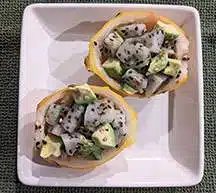
Dragon Fruit Salad

Most yellow dragonfruit recipes just toss cubes of it into a bowl with some other fruit — pink dragonfruit often gets picked for its vibrant magenta color, landing in smoothies, drinks, or ice creams. While the pink is fun, I think both types taste the same, and I like to eat it in an unblended format so I can enjoy the crunch of the seeds. Avocado is often eaten with/as a fruit in other countries, and its creaminess pairs so well here (and the green color pays homage to dragons). This simple mixture makes a great addition to breakfast, dessert, or snack. 

Prep tips: dragonfruit is not always easy to find, and if you can’t….I’m not sure what to say. Mango or papaya would also taste great here, just not dragon-y. 

1 large avocado

coarse salt

local honey

2 dragonfruits

a splash of fresh lime juice

red pepper flakes

Dice avocado into a small bowl, and gently toss with a sprinkle of salt and a drizzle of honey. Cut the dragonfruits in half, and using a spoon, scoop the flesh out of the peel. Dice and add to the avocado, along with lime juice and red pepper flakes to taste. Stir and serve, transferring back to the dragonfruit peel shells if you want to be extra.