Saturday, January 17, 2026
Home Blog Page 74

Estimating winter hay needs

0

Some basic rules of thumb to follow when determining the hay supplies you will need to sustain your cow herd over the winter and into next spring.

  1. Determine your average mature cow size. This can be done by weighing your 4- to 7-year-old cows and calculating the average weight. From mature cow size, we can approximate the amount of forage dry matter cows will need to consume per year or per day. For example: a 1,000-pound cow will consume about 26 pounds of forage dry matter per day. A 1,400-pound cow will consume about 36.4 pounds of forage dry matter per day.
  2. Determine your cow inventory.
  3. Estimate the amount of time you expect to be feeding cows.

From this information you can calculate the total amount of hay needed. For example: 100 cows weighing 1,400 pounds will consume about 3,640 pounds of hay per day. We should take into account that a certain amount of the hay fed will be wasted and there will be a certain amount of spoilage of each bale fed that won’t be consumed. With this in mind we will add another 10% to the daily total to bump it up to about 4000 pounds (2 tons) per day. Remember the amount of hay wasted or spoiled could be higher. If we are feeding hay carried over from last year, expect a higher percentage spoiled in each bale.

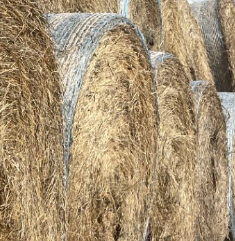
If we are expecting to feed hay from mid-October to mid-May, that is approximately 200 days of hay feeding. 4000 pounds of hay needed per day x 200 days equals a total of 800,000 pounds (400 ton) of forage dry matter that cows will consume over this time. If we are feeding or buying large rounds with an average weight of 1,250 pounds that equates to 640 (800,000 divided by 1,250) big bales needed to sustain the 100 cows.

If possible, purchase hay by the ton. It leads to less error in securing the amount of hay you will need to purchase or have on inventory. If buying hay by the bale is your only option, make sure to weigh enough of the bales to have an accurate representation of bale weight. Also, take into account the amount of spoilage of each bale. One of the upsides of hay baled this summer is less spoilage.

Other factors such as weather, stage of gestation or lactating versus dry cows will obviously impact nutritional requirements of cows from day to day. Many Oklahoma producers are fortunate to have more standing forage than normal as we evaluate pastures right now. This may reduce hay needs and move back the starting date of hay feeding this year.

Mark Z. Johnson is an Oklahoma State University Extension beef cattle breeding specialist

K-State beef cattle experts provide insight on evaluating anemia in cows

0

When cattle start showing signs of fatigue, unusual behavior or pale coloring, it can be more than a passing concern. K-State beef cattle experts say these subtle changes may point to anemia — a condition that, if left unchecked, can affect the health and productivity of the entire herd.

“The primary signs of anemia include weakness, and cattle may become aggressive when approached,” K-State veterinarian Todd Gunderson said. “Producers should also check for pale mucous membrane, which is a strong indicator.”

Anemia can occur for several reasons, so Gunderson emphasized the importance of identifying the cause.

“It depends on the source of the anemia and the cause,” Gunderson said. “A hemorrhage, where the cow has lost a lot of blood, is one possibility. Red blood cell destruction is also common and often involves parasites, which can develop over just a few days. In rare cases, the cow may stop producing red blood cells, but that process takes a long time.”

According to the experts, certain breeds may show physical signs more clearly than others.

“In white-faced cattle, they can naturally have a pink hue to their nose, which is normal,” K-State veterinarian Bob Larson said. “But if the tissue is almost completely white, especially around the nose and eyes, that can be a sign of anemia.”

Veterinarians recommend monitoring cattle closely and consulting with a herd health professional if symptoms appear. Early intervention can improve recovery and prevent further health complications.

To learn more about this topic and more, listen to the most recent episode from the K-State BCI Cattle Chat Podcast.

K-State Research and Extension news service

Mud swallowed half of this Kansas lake. Engineers think they can fight back

0
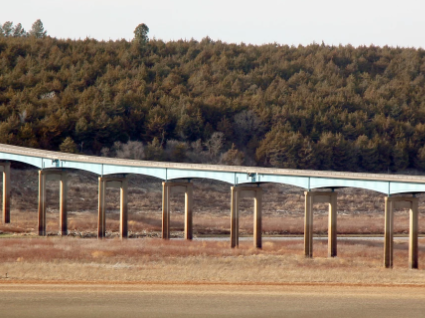
 In dry years, Tuttle Creek Lake and other reservoirs keep the Kansas River flowing strong enough to provide drinking water for hundreds of thousands of people. But these manmade lakes are disappearing.

Picture three-and-a-half football fields with earth piled onto them — piled as tall as the Empire State Building.

That’s how much sediment flows into Tuttle Creek Lake each year. After decades of this, mud has eaten up so much space that about half of the lake near Manhattan has disappeared.

Put another way, about half of its volume for storing water is gone.

That’s why the U.S. Army Corps of Engineers and the Kansas Water Office will start a first-of-its-kind pilot test this week to try to clear out some mud.

They’ll use an underwater dredging technique that they hope will loosen some of the sediment and allow it to flow out of the dam gates and continue moving downstream in the Big Blue and Kansas rivers.

Reservoirs are filling up with mud across the country

Dams interrupt the way rivers naturally transport sand, silt and other kinds of sediment. So over the decades, manmade lakes fill up with mud. Human activity – such as tilling farmland – can also speed up how fast this happens.

As a result, reservoirs don’t last forever.

Tuttle Creek Lake was completed in 1962. As mud accumulated, the marina had to move from its original location. Boat ramps became buried under mud.

In another 25 years, the Corps of Engineers estimates that just one-quarter of the lake’s original water storage capacity will remain. In 50 years, less than 10 percent will remain.

(Tuttle’s capacity to hold back floodwater in rainy years is another matter, and that capacity remains largely intact.)

Losing so much space to store water for dry years worries not just the U.S. Army Corps of Engineers but also the state of Kansas and cities in northeast Kansas.

This lake serves more than 40% of the state’s population. Households and businesses along the Kansas River — in cities such as Topeka, Lawrence and Olathe — depend on the river for water.

In dry years, the water stored in Tuttle and other manmade lakes can be drawn upon to ensure that the river flow stays strong enough.

Testing out a new approach to dredging

Engineers will run a pilot test of what is formally called water injection dredging during a 10-day period that starts on Wednesday and continues through Saturday, Sept. 27.

Because Tuttle is such a large lake, dealing with its sediment problem through traditional dredging – if even feasible – would take large amounts of fossil fuel to transport the sediment. It would also require finding somewhere to put all that mud.

That’s why engineers want to test the idea of releasing sediment through the dam gates and letting the natural energy of the river carry it downstream.

“We are excited” to run the first test, said Laura Totten, who is managing the project at the U.S. Army Corps of Engineers Kansas City District. “This project represents a significant step forward in exploring sustainable dredging techniques.”

How does it work?

Engineers will use a barge to lower water jets into the lake and aim them at the bottom.

The spray from the water jets should loosen the mud on the bottom and cause it to swirl up a bit from the lake bed. This will create muddy, swirly water that is denser than the rest of the lake water.

Engineers hope the density difference and the force of gravity will then move the muddy water downward along the sloped bed toward the dam and out its gates.

This kind of underwater dredging isn’t new, but normally it is used to remove sediment in places where naturally occurring water movement, such as ocean tides, can help with the process. It’s not clear whether the technique will work in a lake.

What will scientists watch for during the pilot test?

It’s also unclear what environmental effects the released sediment would have downstream.

The Corps of Engineers has enlisted help from scientists at Kansas State University and the U.S. Geological Survey to monitor not just the effects on the lake, but downstream in the Big Blue and Kansas rivers.

“Knowledge gained from the project will be invaluable for sediment management across the nation,” the Corps of Engineers said in a statement.

Engineers and other scientists will study whether any sediment exits through the dam and whether the water downstream shows any changes in oxygen levels, heavy metals or other content.

K-State scientists will also look for potential effects on fish and insect larvae downstream.

The Corps of Engineers plans to carry out two more 10-day test periods next spring and summer, with additional monitoring help from the Kansas Department of Health and Environment and the Kansas Water Office.

The total cost of the three test runs is $9.1 million. In addition to preparing and operating the barge, this amount also includes the cost of monitoring, analysis and reporting, plus preparations that took place in recent years to assess potential environmental effects.

Ultimately, the goal is to figure out whether this method has the potential to squeeze more years out of Tuttle Creek Lake at a reasonable cost — and without significant environmental impacts downstream.

Celia Llopis-Jepsen is the environment reporter for the Kansas News Service and host of the environmental podcast Up From Dust. You can follow her on Bluesky or email her at celia (at) kcur (dot) org.

The Kansas News Service is a collaboration of KCUR, Kansas Public Radio, KMUW and High Plains Public Radio focused on health, the social determinants of health and their connection to public policy.

Kansas News Service stories and photos may be republished by news media at no cost with proper attribution and a link to ksnewsservice.org.

Just a Little Light: School Days When My Daddy Was a Kid

0

Dawn Phelps
Columnist


School days, school days, dear old golden rule days,
Readin’ and ‘ritin’ and ‘rithmetic, Taught to the tune of a hick’ry stick,
You were my queen in calico, I was your bashful barefoot beau,
And you wrote on my slate, I love you Joe, when we were a couple of kids.


The song “School Days” was published in 1907, and the song writers were Gus Edwards and Will D. Cobb.  That was six years before my daddy, Burnis Humphrey, was born near Santa Fe, Tennessee in 1913.  


And, without a doubt, schools and education as we know them now are quite different from when my daddy was a kid.  Back then, over one hundred years ago, there were many small one-room schools where one teacher taught all the grades from first grade to grade eight.


But, looking back, it is interesting to think about what going to school looked like in the early 1900s.  And first, there were no big yellow buses stopping in front of the children’s doors to take them to school.  Parents did not drive their kids to school, and for sure, the students did not have their own cars to drive.


Some kids walked four or five miles to a small schoolhouse where the schoolteacher had arrived by 7:00 a.m. to start a fire in a woodstove.  Sometimes she taught a handful of students and sometimes up to forty students by herself! 


Some of the rural children only attended school for about five months because they had to stay home to help plant and harvest crops in the spring and fall.  My daddy completed the eleventh grade but dropped out to help my grandpa with crops the next year when he would have been a senior.

The children did not wear blue jeans.  The girls wore dresses, and the boys dressed up in knee-length trousers and sometimes three-piece outfits with shirts, pants, and vests.  Both boys and girls wore long socks and lace-up shoes.

There were no store-bought lunch boxes.  Instead, students brought their lunches in lunch pails, metal buckets, or baskets.  No hot-cooked meals. 

Children were taught to respect authority and knew they would be in very big trouble with parents at home if they got in trouble at school.  My daddy and mother passed that same rule down to my siblings and me when we were in school.  And we were expected to bring home grade cards with good grades!


Punishment at school might involve paddling or lashes on the palms of hands or knuckles with a ruler, and some children had to wear a dunce hat.  Disrespect was not tolerated.  


During the years my daddy was in school, some kids had individual slates, small little black boards they wrote on with chalk.  And by the time I was in school, the teachers wrote on blackboards.

In the early 1900s my daddy would have predominantly learned reading, writing, and arithmetic, just as the “School Days” song says.   


Not only were the kids expected to follow strict rules, but the teachers, who were paid about $75 a month, were also held to high standards.  I came across an old teacher’s contract from 1923, and here are a few of the rules a teacher was supposed to follow.


*To not to keep company with men, to not ride in a carriage or automobile with any man except her father or brother, and to not get married.  

*To be home between the hours of 8 p.m. and 6 a.m. unless at a school function.

*To not loiter in downtown ice-cream stores.

*To not smoke cigarettes or drink beer, wine, or whiskey.  

*To not wear bright colors and not dye her hair.

*To wear at least two petticoats with dresses not more than two inches above the ankle.

*To keep the schoolroom clean.  To sweep the floor at least once a day, and scrub it weekly with hot water and soap.  To clean the blackboard once a day.  

By now, most students are back in public schools in the U.S. or homeschools have begun.  But things are far different from the early 1900s, when the school year was shorter, the school buildings were smaller, and teachers were unmarried.  “School days, school days”—oh, how education has changed!  


[email protected]