Monday, January 12, 2026
Home Blog Page 4732

U.S. hogs and pigs inventory down 2 percent

0
Mike Gabelmann

WASHINGTON, September 26, 2014 – As of September 1, there were 65.4 million hogs and pigs on U.S. farms, down 2 percent from September 2013, but up 6 percent from June 1, according to the Quarterly Hogs and Pigs report published today by the U.S. Department of Agriculture’s National Agricultural Statistics Service (NASS).

Other key findings in the report were:

  • Of the 65.4 million hogs and pigs, 59.4 million were market hogs, while 5.92 million were kept for breeding.
  • Between June and August 2014, 29.5 million pigs were weaned on U.S. farms, down 1 percent from the same time period in 2013.
  • U.S. hog producers intend to have 2.89 million sows farrow between September and November 2014, and 2.87 million sows farrow between December 2014 and February 2015.
  • From June through August 2014, U.S. hog and pig producers weaned an average of 10.16 pigs per litter.
  • With 20.7 million head, Iowa hog producers had the largest inventory among the states. North Carolina and Minnesota had the second and third largest inventories with 8.4 million and 7.7 million head, respectively.
  • While the national hogs and pigs inventory is down from September 2013, growers in Texas and South Dakota have increased the number of hogs and pigs in their states.

To obtain an accurate measurement of the current state of the U.S. hogs and pigs industry, NASS surveyed over 7,800 operators across the nation during the first half of September. NASS interviewers collected the data by mail, telephone and through face-to-face personal interviews. NASS asked all participating producers to report their hogs and pigs inventories as of September 1, 2014.

The quarterly Hogs and Pigs report and all other NASS reports are available online at www.nass.usda.gov.

Contact: Dan Kerestes, (202) 720-3570;  Alex Minchenkov, (202) 690-8121

Game day eats

0

(Family Feature) It just isn’t game day without great food to help fill your belly and spirits as you cheer your favorite team to victory. While traditional tailgate fare has a rightful place in any pre-game celebration, adding interesting new tastes and textures to your typical spread only enhances the excitement.


Quick, flavor-rich appetizers are an easy way to amp up your tailgate experience. Add diversity to your menu with snacks that are as easy to prepare as they are likely to become new fan favorites.


You can save time while creating these delicious new dishes by relying on high-quality store-bought ingredients such as Sabra hummus and salsa. Flavorful hummus combines fresh chickpeas with the perfect blend of seasonings and ingredients to create a smooth and creamy spread every time, while each flavor in the Sabra salsa line features a unique blend of fresh veggies for a distinctive taste that is delicious on your favorite chips or in your favorite recipe.


Turn up the heat this tailgating season with this spicy Mexican-style hummus dip that layers fresh cilantro and avocados with sour cream, cheese, hummus and salsa, or go Mediterranean with a toasty crostini covered in feta cheese, hummus and olives.


For more game day appetizer recipes, visit www.sabra.com.


5-Layer Hummus Dip

Servings: 12


1          cup reduced fat sour cream

1          teaspoon fresh lime juice

2          tablespoons finely chopped cilantro

2          ripe avocados; pitted and peeled

10        ounce container Sabra Supremely Spicy Hummus

1          cup reduced-fat shredded cheddar cheese

1          14-ounce container Sabra Roasted Garlic Salsa


In small bowl, whisk together sour cream, lime juice and cilantro. Set aside.


Mash avocados in medium bowl, then whisk until smooth.


Spread hummus in even layer on bottom of small baking dish. Sprinkle cheese evenly over hummus. Dollop avocado, sour cream mixture and salsa over cheese in layers, spreading each layer with spatula before adding next ingredient.


Cover and chill for at least 30 minutes. Serve with crispy tortilla or pita chips.


Hummus Crostini Appetizer

Recipe provided by www.supergluemom.com

Servings: 6-8


1          French baguette

Extra virgin olive oil

Sea salt and black pepper

1-2       7-ounce tubs Sabra Classic Hummus

3/4       cup Feta cheese

1          cup chopped or sliced olives (Kalamata and/or green olives)


Preheat your oven to 350°F.


Slice baguette on slight diagonal angle. Brush tops with olive oil and place on large baking pan (cookie sheet). Sprinkle each slice with a little coarse sea salt and freshly ground pepper.


Bake for 12-15 minutes, carefully watching crostinis around 12 minutes, as oven temperatures vary. Remove from oven when golden brown and let cool.


Spread hummus on each crostini, garnish with feta and olives, and drizzle with olive oil.


Source: Sabra

Poll: Majority of rural Nebraskans not worried about crime in their communities

0
Ron Reiring

LINCOLN, Neb. — A majority of rural Nebraskans are not worried about crime in their communities, and concerns about certain specific crimes, though still significant in some cases, have dropped in the last decade, according to the Nebraska Rural Poll.


Fifty-one percent of respondents said they are not worried or not very worried about crime in their community, and 63 percent said they are not worried or not very worried about personally being a victim of crime. Sixteen percent of rural Nebraskans said they are worried or very worried about crime in their community, and 12 percent are very worried or worried about personally being a victim.


Sixty-five percent of poll respondents this year agreed that drugs are a problem in their community; however, that’s down from 76 percent in 2003. The portion of respondents who agreed that juvenile delinquency is a problem in their community dropped from 51 percent in 2003 to 40 percent this year.


Twenty-one percent of rural Nebraskans said they feel safer in their community now than they did five years ago; in 2003, that percentage was 17 percent. Thirty-eight percent said they feel less safe.


The 19th annual University of Nebraska-Lincoln poll was sent to 6,813 households in 86 Nebraska counties in April. Results are based on 1,943 responses.


Nationally, most crime rates are down in the last decade, poll organizers said. That may be reflected in the poll’s findings. There are some differences by region.


Only 9 percent of rural residents of North Central Nebraska are worried or very worried about crime, compared to about 20 percent of residents of both the Panhandle and Southeast regions.


Panhandle residents also are more likely to say that various crimes are a problem in their communities, including drugs, juvenile delinquency and violent crime. For example, about three-fourths of Panhandle residents agree drugs are a problem, compared to 57 percent of residents of the North Central region.


Residents of South Central and Northeast Nebraska are more likely than those in other regions to agree gang activity is a problem; about 17 percent of respondents in those regions agreed with that statement, compared to only 4 percent in North Central and Southeast Nebraska.


Rural Poll organizers said concerns about crime in rural Nebraska may be on the rise in parts of western Nebraska near Colorado, where the legalization of marijuana already is increasing workloads for law enforcement in this state.


This issue has received a lot of media attention in the region, which may be linked to area residents’ increased awareness and concerns, said Cheryl Burkhart-Kriesel, associate professor and UNL Extension community vitality specialist based at the Panhandle Research and Extension Center.


Brad Lubben, UNL Extension policy specialist, said these issues may lead to some policy discussions in Nebraska, including debate about whether state or federal aid should go to law enforcement in western Nebraska to combat the problem.


Other findings:


– Thirty-one percent of respondents said they have a gun for protection; 27 percent said they have a dog for protection. These numbers don’t necessarily reflect the numbers of guns or dogs in households – only of the respondents who report having them specifically for protection.


– Six percent reported avoiding contact with people of another race out of a concern about crime.


– People living in or near larger communities are more likely than those in or near smaller communities to be worried or very worried about crime. Twenty-two percent of those near towns with populations of 10,000 or more are worried. Only 10 percent of those near towns of fewer than 1,000 share this concern.


– Older people are more likely than younger to be worried or very worried about crime, as are those with household incomes under $60,000, people with lower education levels, people without children in the household and people who have lived in their community for more than five years.


The Rural Poll is the largest annual poll of rural Nebraskans’ perceptions on quality of life and policy issues. This year’s response rate was about 29 percent. The margin of error is plus or minus 2 percent. Complete results are available online at http://ruralpoll.unl.edu.


With its 19-year history, the poll has a collection of data about rural trends and perceptions that is unmatched in the country, said Becky Vogt, survey research manager who’s been working on the Rural Poll since its second year.


Although the Grand Island area (Hall, Hamilton, Howard and Merrick counties) was designated a metropolitan area by the U.S. Census Bureau in 2013, the Rural Poll continues to include those counties in its sample. Also, Dixon and Dakota counties were added to the poll this year, meaning the poll reaches all of Nebraska outside the Omaha and Lincoln metropolitan areas.


The university’s Department of Agricultural Economics conducts the poll in cooperation with the Nebraska Rural Futures Institute with funding from UNL Extension and the Agricultural Research Division in the Institute of Agriculture and Natural Resources.

Blue catfish showing promise at Cheney Reservoir

0
Chesapeake Bay Program

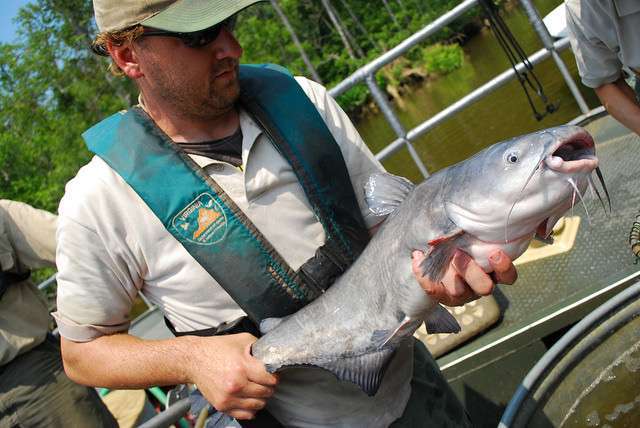
About 10,000 blue catfish have been stocked into Cheney Reservoir annually since 2006; however, the success of
these stockings has been relatively unknown. Periodic reports from anglers are received, and catches in standard gill
net samples usually amount to around10-20 fish each year. Generally, the best gear for collecting large numbers of
blue catfish is a specialized kind of electrofishing, which is far different
from the electrofishing technique used to capture other fishes like bass
and walleye. This method effectively stuns blue catfish in water up to 40
feet deep, and is most effective in late summer. In previous years, very
few blue catfish were sampled with this technique at Cheney Reservoir;
however, during sampling this summer, large schools of over a hundred
blue catfish were observed while electrofishing. These blue catfish varied
from five inches to 20 pounds. Some anglers have even patterned
blue catfish and have had success catching a few. Remember, as this
fishery develops, blue catfish are protected by a 35-inch minimum
length limit. Since blue and channel catfish look very similar, be sure of
your catfish identification. For identification tips, visit this link.

Source: Jeff Koch, District Fisheries Biologist

USDA invests $68 million in 540 renewable energy and energy efficiency projects nationwide

0
usda
Funding includes loan guarantees and grants for solar energy to create jobs, promote energy independence and advance the use of renewable fuels

BUNN, N.C., Sept. 18, 2014 – Agriculture Secretary Tom Vilsack today announced that USDA is investing in 540 renewable energy and energy efficiency projects nationwide.

“These loan guarantees and grants will have far-reaching impacts nationwide, particularly in the rural communities where these projects are located,” Vilsack said. “Investing in renewable energy and energy efficiency will continue the unprecedented increase in home-grown energy sources and American energy independence we’ve seen in recent years. This is creating jobs, providing new economic opportunities and leading the way to a more secure energy future.”

Secretary Vilsack made the announcement while in North Carolina to highlight USDA’s investments in rural renewable energy projects, as part of the Obama Administration’s ‘all-of-the-above’ energy strategy. It is the most recent of a series of USDA actions to strengthen the country’s energy sector. Two weeks ago, Vilsack announced a $105 million loan guarantee to a company that will produce jet fuel from municipal solid waste.

Today’s funding is being provided through USDA Rural Development’s Rural Energy for America Program (REAP). REAP was created by the 2008 Farm Bill and was reauthorized by the recently passed 2014 Farm Bill.

The announcement comes on a day when President Obama is announcing new executive actions to further advance the development of solar technologies across the country. These new investments in solar will reduce America’s energy consumption, cut carbon pollution by nearly 300 million metric tons – equivalent to taking more than 60 million cars off the road for a year – and save businesses nearly $45 billion on their energy bills. The renewed effort to invest in solar energy also includes commitments from a broad coalition of 50 public and private sector partners, including leading industry, community development organizations and housing providers in 28 states. To learn more about this new Obama Administration initiative to increase the use of solar power, visit the White House website.

“USDA is proud to play a key role in Obama Administration’s efforts to promote the use of solar technologies,” Vilsack said. “Of the REAP projects funded today, 240 projects are for solar investments of $5.2 million in grants and $55.3 million in loans.”

During Secretary Vilsack’s trip to North Carolina, he visited Progress Solar in Bunn, N.C., which received a $3.4 million REAP loan guarantee in 2012 for installation of a solar array. Progress Solar now produces enough solar energy to power 540 average-sized homes each year. The 4.5 megawatt array was developed by North Carolina-based O2 Energies, Inc. The Progress Solar site is a dual-use solar power plant and a working farm where a 10th generation farming family raises free range sheep and lambs. The project serves as a test site for herd management best practices on a solar farm, and the goal is to model future collaborative efforts that marry solar-energy production with agriculture production. This is the seventh solar farm venture that O2 Energies has developed in North Carolina.

In North Carolina alone, Vilsack announced $55.3 million in new REAP program loan guarantees and grants for 22 solar energy projects. For example, USDA is awarding a $3 million loan guarantee to Broadway Solar Center, LLC to help finance a 5 megawatt solar array in Columbus County, a $4.9 million loan guarantee for a similar project in Hertford County and a $2.1 million guarantee for a project in Warren County.

In total, Vilsack announced $68 million in REAP loan guarantees and grants today. Funding is contingent upon the recipients meeting the terms of the loan or grant agreement.

Eligible agricultural producers and rural small businesses may use REAP funds to make energy efficiency improvements or install renewable energy systems including solar, wind, renewable biomass (including anaerobic digesters), small hydroelectric, ocean energy, hydrogen, and geothermal.

Since the start of the Obama Administration, REAP has supported more than 8,800 renewable energy and energy efficiency projects nationwide. During this period, USDA has provided more than $276 million in grants and $268 million in loan guarantees to agricultural producers and rural small business owners.

President Obama’s historic investments in rural America have made our rural communities stronger. Under his leadership, these investments in housing, community facilities, businesses and infrastructure have empowered rural America to continue leading the way – strengthening America’s economy, small towns and rural communities.